
For generations, career success was built around expertise.
People gained value by developing specialized knowledge, mastering technical skills, and becoming efficient at specific tasks.
But artificial intelligence is changing the foundation of work.
This transformation is explored further in How AI Is Changing the Future of Work, which examines how artificial intelligence is reshaping productivity, jobs, and the relationship between humans and technology.
Artificial intelligence is increasingly capable of processing information, generating content, developing software, and automating repetitive work.
The rise of AI does not reduce the value of human capabilities.
It means the future will reward different kinds of abilities.
The AI economy will increasingly reward people who can combine technology with uniquely human abilities — creativity, judgment, communication, adaptability, and problem-solving.
This shift is closely connected to the changing job market explored in Top 10 Jobs AI Is Most Likely to Replace by 2035, which examines the occupations most vulnerable to automation and explains why developing future-ready skills is becoming increasingly important.
The future advantage may not come from competing against AI.
It may depend on combining human creativity with AI power.
AI is changing what makes workers valuable.
Traditional workplaces often rewarded employees for what they knew.
Knowledge, experience, and technical expertise were major sources of advantage.
However, when AI makes information easier to access, simply knowing information becomes less valuable.
The ability to apply knowledge becomes more important.
Future workers will need to:
- Think critically
- Solve complex problems
- Communicate ideas clearly
- Adapt to new technologies.
- Make decisions in uncertain environments.
The AI economy will not eliminate human value.
It will redefine it.
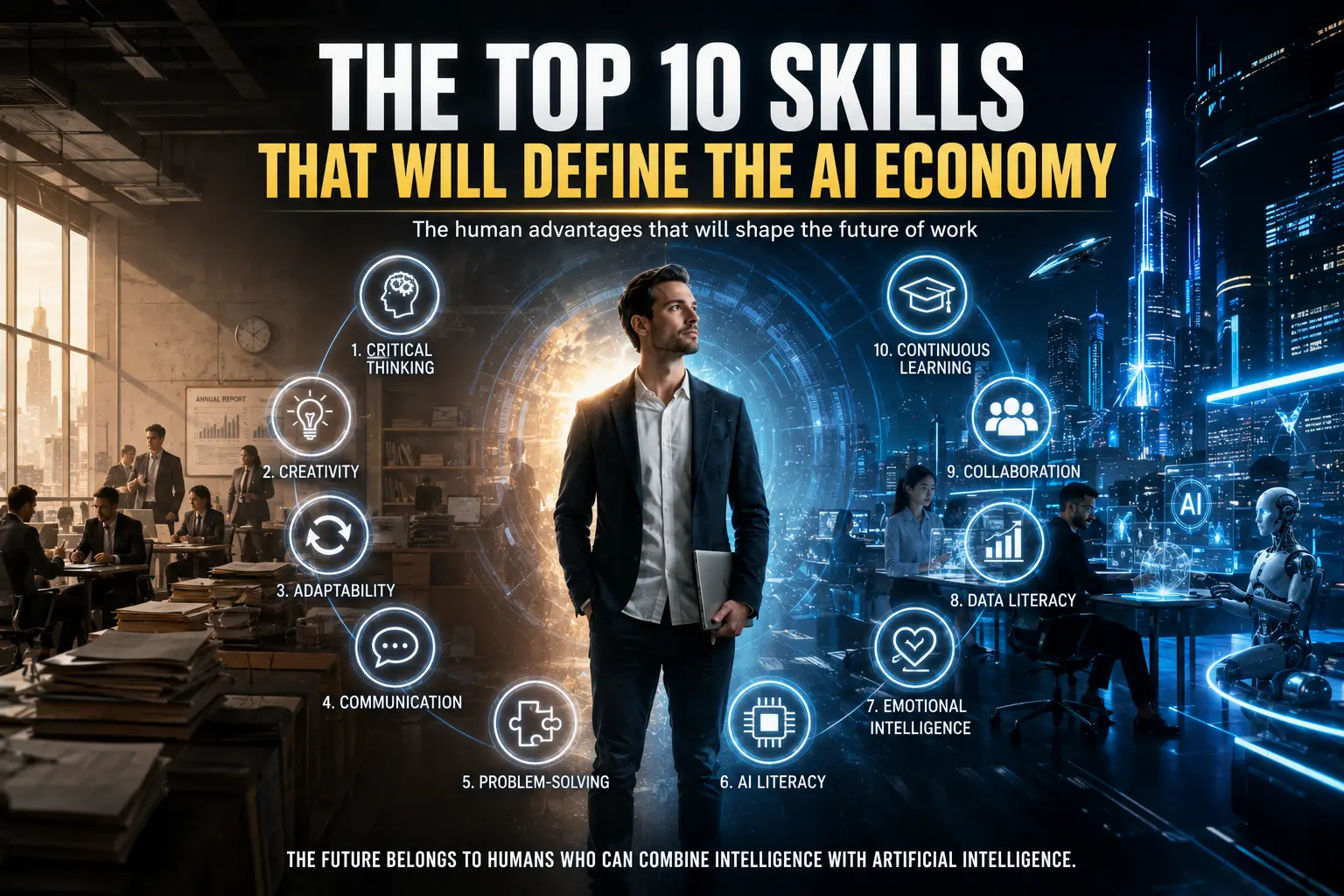
Top 10 skills that will matter most in the AI economy
| Skill | Why This Matters as AI Transforms the Economy |
|---|---|
| Critical thinking | Helps evaluate AI-generated information and make better decisions |
| Adaptability | Allows workers to adjust as technology and industries change |
| Creativity | Enables new ideas, innovation, and original solutions |
| Communication | Helps people explain ideas and collaborate effectively |
| Problem-solving | Supports complex decision-making beyond automation |
| AI literacy | Allows workers to use AI tools effectively |
| Emotional intelligence | Strengthens leadership, teamwork, and human relationships |
| Data literacy | Helps people understand and use information strategically |
| Collaboration | Enables humans and AI systems to work together |
| Continuous learning | Helps workers remain valuable in a changing economy |
1. Critical thinking may become a defining skill as AI continues to advance.
AI can generate answers quickly.
But speed does not always equal accuracy.
As AI produces more information, people will need stronger abilities to evaluate, question, and interpret results.
Critical thinking helps workers:
- Identify mistakes
- Understand context
- Compare different perspectives
- Make responsible decisions
In an AI-driven world, the ability to judge information may become more important than simply accessing it.
This growing importance of judgment and evaluation is explored further in Why Critical Thinking May Become the Most Valuable Skill in the Age of AI, which examines how human reasoning becomes increasingly valuable as AI produces more information.
2. Adaptability will define future career success
Technology changes faster than traditional career paths.
A skill that is valuable today may become less important tomorrow.
Workers who succeed in the AI economy will likely be those who can:
- Learn new tools quickly.
- Adjust to changing roles.
- Develop new abilities continuously.
- Embrace uncertainty
Adaptability may become a career advantage because change itself is becoming permanent.
3. Creativity will become more important, not less
AI can generate text, images, designs, and ideas.
However, creativity is not only about producing output.
Human creativity involves:
- Understanding human needs
- Finding opportunities
- Connecting different ideas
- Creating meaningful solutions
AI can generate possibilities.
Humans decide which possibilities matter.
The strongest innovators may be those who combine imagination with AI capability.
4. Communication will separate successful professionals
In the AI economy, having ideas is not enough.
People must communicate those ideas effectively.
Strong communication helps workers:
- Lead teams
- Explain complex concepts
- Build trust
- Influence decisions
- Collaborate across industries
As AI handles more technical tasks, human communication may become an even stronger competitive advantage.
5. Problem-solving will remain a human advantage
Many jobs are built around solving problems.
AI can assist with analysis, but real-world challenges often involve uncertainty, emotions, and competing priorities.
Strong problem-solvers can:
- Understand the bigger picture.
- Identify root causes
- Create practical solutions
- Balance different outcomes
The future workplace will reward people who can think beyond the obvious answer.
6. AI literacy will become a basic workplace skill
Understanding AI will likely become similar to understanding computers or the internet.
Workers will not necessarily need to become AI engineers.
But they will need to understand:
- How AI tools work
- How to use them effectively
- Their limitations
- How to integrate them into workflows
AI literacy may become a requirement across industries.
7. Emotional intelligence will become a major advantage
AI can process information.
But human relationships remain complex.
Emotional intelligence helps people:
- Build trust
- Understand others
- Manage conflict
- Lead teams
- Communicate with empathy
As automation increases, human connection may become more valuable.
The rise of human-centered skills is explored further in Why Emotional Intelligence Matters More Than Ever in the AI Age, which explains why empathy, communication, and relationship-building may become critical advantages in an AI-driven workplace.
This is why emotional intelligence is becoming one of the most important workplace skills in the AI age.
8. Data literacy will help workers make better decisions
Data is becoming central to modern business.
However, collecting data is not enough.
Workers need to understand:
- What does the information mean
- Which patterns matter
- How data influences decisions
People who can combine AI tools with data understanding may have a significant advantage.
9. Collaboration will become more important in human-AI teams
The future workplace may not be humans versus machines.
It may be humans working with machines.
Successful professionals may need to collaborate with:
- AI assistants
- Digital systems
- Global teams
- Cross-disciplinary experts
The ability to combine different strengths will become increasingly valuable.
10. Continuous learning will become a lifelong requirement
The traditional idea of education ending after school or university is changing.
Career success may increasingly depend on continuous learning and adaptation.
Continuous learners can:
- Adapt faster
- Learn new opportunities
- Stay competitive
- Develop future skills
The ability to learn may become the ultimate career skill.
Skills that complement AI will matter most.
| Human Skill | AI Capability | Combined Advantage |
|---|---|---|
| Creativity | Idea generation | Innovation |
| Judgment | Data analysis | Better decisions |
| Communication | Information processing | Clearer collaboration |
| Problem-solving | Automation | Higher productivity |
| Emotional intelligence | Pattern recognition | Better human interaction |
The biggest opportunities may come from combining human strengths with artificial intelligence.
Why education systems must prepare differently
Many education systems were designed for an earlier economic era.
Students were often trained to:
- Memorize information
- Follow instructions
- Complete standardized tasks
The AI economy requires broader preparation.
Future education may need a stronger focus on:
- Creativity
- Critical thinking
- Communication
- Collaboration
- Adaptability
Knowledge remains important.
But applying knowledge may become even more valuable.
The future workforce will reward those who combine human skills with AI capabilities.
AI will continue changing industries.
Some tasks will become automated.
New opportunities will emerge.
The most successful workers may not be those who avoid AI.
There may be those who understand how to use it effectively.
The future advantage will belong to people who combine:
- Human creativity + AI capability
- Human judgment + machine intelligence
- Human connection + technological power
Frequently Asked Questions (FAQs)
Critical thinking, adaptability, creativity, communication, AI literacy, emotional intelligence, and continuous learning are expected to become increasingly valuable.
No. AI skills will complement human abilities. Workers who combine technology knowledge with human strengths may have the greatest advantage.
Yes. Creativity involves more than producing content. It includes understanding problems, generating meaningful ideas, and creating solutions.
Because technology changes quickly, workers who can continuously learn and adjust are more likely to succeed.
AI is more likely to transform many jobs rather than replace all workers. The biggest shift may be how humans perform their work.
Human judgment, empathy, creativity, and the ability to understand complex situations remain major advantages.