
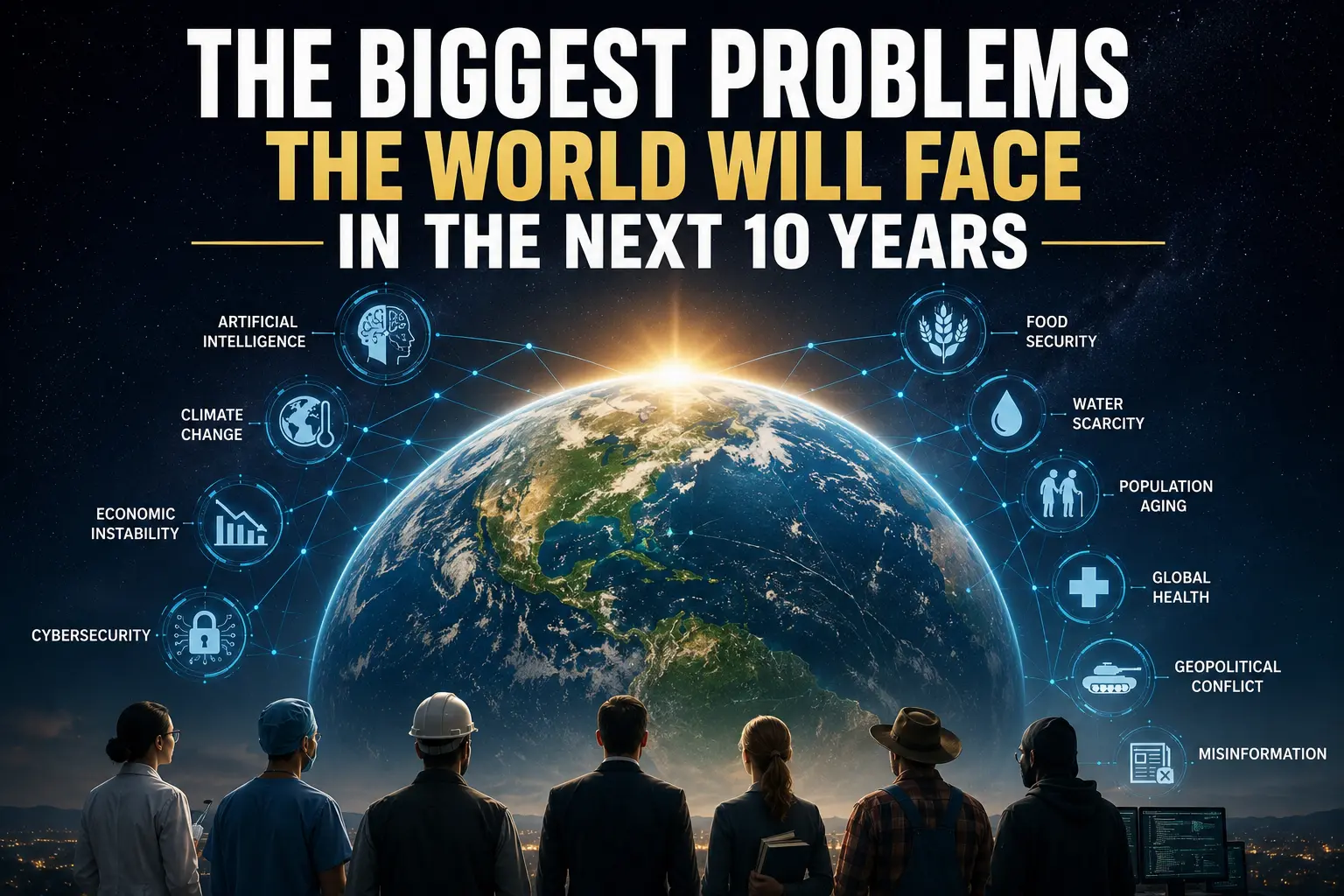
The next decade could become one of the most transformative periods in modern history.
Artificial intelligence is reshaping industries, climate change is accelerating, populations are aging, and geopolitical tensions continue to rise. At the same time, rapid technological advances offer tremendous opportunities to solve many of these problems—if governments, businesses, and individuals act wisely.
Unlike previous generations, today’s challenges are deeply interconnected. A cyberattack can disrupt global supply chains. Climate disasters can trigger migration and economic instability. AI can improve healthcare while also transforming labor markets.
Rather than viewing these issues in isolation, understanding how they influence one another provides a clearer picture of the future.
This article covers the biggest global challenges that will shape the next ten years and explains why they matter to every country, company, and person.
Why the Next 10 Years Will Be Critical
Human civilization has entered an era of rapid change.
Technologies that once took decades to develop now evolve within months. Scientific breakthroughs are accelerating, while global crises spread faster because economies, communication, and supply chains are more interconnected than ever.
Several powerful trends are unfolding simultaneously:
- Artificial intelligence is transforming nearly every profession.
- Climate-related disasters are becoming more frequent.
- Cyberattacks are increasing in sophistication.
- Many countries are dealing with older populations and falling birth rates.
- Competition between major world powers continues to reshape international politics.
- Healthcare systems must prepare for future pandemics and aging societies.
The choices governments, businesses, and individuals make during the next decade could influence global prosperity for generations.
The Biggest Global Challenges Ahead
| Global Challenge | Why It Matters |
|---|---|
| Artificial Intelligence | Reshapes jobs, education, and entire industries |
| Climate Change | Increases extreme weather and environmental risks |
| Global Economic Instability | Affects employment, inflation, and living standards |
| Population Aging | Creates labor shortages and healthcare pressures |
| Water Scarcity | Harms agriculture and public health systems |
| Cybersecurity | Protects critical infrastructure and digital economies |
| Food Security | Ensures stable global food supplies |
| Pandemics | Tests healthcare systems and international cooperation |
| Geopolitical Conflict | Disrupts trade, investment, and global stability |
| Misinformation | Weakens trust and informed decision-making |
1. Artificial Intelligence and Job Disruption
Artificial intelligence is no longer a futuristic concept.
It is already changing how businesses operate, how students learn, and how professionals perform everyday tasks.
Unlike previous waves of automation that primarily affected manufacturing, AI has the potential to automate many knowledge-based occupations, including customer service, accounting, software development, legal research, marketing, and administrative work.
However, AI is not simply replacing jobs.
It is also creating entirely new career opportunities across industries.
Professionals who learn to work alongside AI will likely enjoy greater productivity and expanded career options, while those who resist technological change may face increasing challenges.
This transformation is explored further in Top 10 Jobs AI Is Most Likely to Replace by 2035, which examines which occupations are most vulnerable to automation. Top 10 New Jobs AI Will Create by 2035 highlights the emerging careers expected to grow as AI adoption accelerates.
The greatest challenge may not be artificial intelligence itself, but society’s ability to help workers adapt quickly through education, reskilling, and lifelong learning.
2. Climate Change and Extreme Weather
Climate change continues to influence nearly every region of the world.
Many countries are experiencing more frequent heatwaves, stronger storms, prolonged droughts, severe flooding, and rising sea levels.
These environmental changes extend far beyond weather forecasts.
Agriculture faces declining crop yields in some regions, insurance costs continue to rise, infrastructure requires greater resilience, and vulnerable communities become increasingly exposed to natural disasters.
Businesses are also adapting by investing in renewable energy, sustainable manufacturing, and climate-resilient supply chains.
Governments face the difficult challenge of balancing economic growth with environmental protection while ensuring that communities remain prepared for future climate risks.
Over the next decade, climate adaptation may become just as important as climate mitigation.
3. Global Economic Instability
The global economy has become increasingly interconnected.
A financial crisis, geopolitical conflict, supply chain disruption, or major natural disaster in one region can quickly affect markets worldwide.
Inflation, rising government debt, housing affordability, energy prices, and slowing economic growth remain concerns for many countries.
Emerging technologies, demographic changes, and shifting international trade relationships are also transforming how economies compete.
While innovation creates new opportunities, economic uncertainty can make it more difficult for businesses to invest and for households to plan for the future.
Many experts believe that economic resilience will depend on stronger international cooperation, diversified supply chains, technological innovation, and investments in education and workforce development.
The future economy will likely reward countries that successfully adapt to rapid technological and demographic change rather than simply relying on traditional industries.
4. Population Aging and Declining Birth Rates
One of the most significant demographic shifts of the 21st century is the rapid aging of the global population.
Many developed countries—including Japan, South Korea, Germany, Italy, and China—are experiencing declining birth rates while people are living longer than ever before.
An aging population creates several long-term challenges:
- Labor shortages
- Higher healthcare costs
- Increased pension spending
- Slower economic growth
- Greater demand for caregivers
As the number of working-age adults declines, governments and businesses may struggle to fill critical positions in healthcare, education, manufacturing, and skilled trades.
Artificial intelligence and automation may help offset some labor shortages, but they cannot fully replace the human workforce in many professions.
Countries that successfully adapt through immigration, workforce participation, technological innovation, and family-friendly policies may be better positioned to maintain long-term economic stability.
5. Water Scarcity
Clean water is becoming more valuable than ever around the world.
Although Earth is covered by water, only a small percentage is suitable for human consumption.
Growing populations, climate change, pollution, and unsustainable water management are placing enormous pressure on freshwater supplies.
Many regions already experience:
- Severe droughts
- Falling groundwater levels
- Water pollution
- Agricultural shortages
- Competition over shared rivers
Water scarcity affects much more than drinking water.
Agriculture consumes nearly 70% of global freshwater supplies, making reliable access essential for food production.
Industries, power generation, manufacturing, and public health also depend on stable water resources.
Over the next decade, improving water conservation, desalination technology, wastewater recycling, and sustainable infrastructure may become increasingly important for national security and economic development.
6. Cybersecurity and Digital Warfare
As society becomes increasingly digital, cyber threats continue to grow in both scale and sophistication.
Governments, hospitals, banks, power grids, transportation systems, and businesses now rely heavily on connected technologies.
This dependence creates opportunities for cybercriminals and hostile governments to launch attacks that can disrupt essential services.
Common cyber threats include:
- Ransomware attacks
- Identity theft
- Financial fraud
- Data breaches
- Critical infrastructure attacks
- AI-powered cybercrime
Artificial intelligence is making cybersecurity both stronger and more challenging.
Defenders can use AI to detect threats faster, while attackers can also use AI to automate phishing campaigns, create convincing deepfakes, and identify software vulnerabilities more efficiently.
As digital technologies continue expanding, cybersecurity will likely become one of the most important investments for governments, organizations, and individuals.
7. Food Security
Feeding a growing global population remains one of humanity’s greatest long-term challenges.
Food production faces increasing pressure from multiple factors, including:
- Climate change
- Water shortages
- Soil degradation
- Rising fertilizer costs
- Supply chain disruptions
- Armed conflicts
Extreme weather events can damage crops, while geopolitical instability can interrupt international food trade.
These disruptions often lead to higher food prices, increased inflation, and greater food insecurity, particularly in lower-income regions.
Fortunately, innovation is creating new opportunities.
Precision agriculture, artificial intelligence, vertical farming, drought-resistant crops, and improved logistics are helping farmers produce more food using fewer resources.
However, ensuring global food security will require international cooperation, sustainable farming practices, investment in agricultural research, and stronger supply chain resilience.
Food security is no longer only about agriculture—it is tied to climate policy, economic stability, public health, and national security.
8. Pandemics and Global Health
The COVID-19 pandemic demonstrated how quickly a health crisis can disrupt the global economy, education, travel, and daily life.
While significant progress has been made in disease surveillance and vaccine development, experts warn that future pandemics remain a possibility due to factors such as globalization, urbanization, climate change, and increased human interaction with wildlife.
Beyond infectious diseases, healthcare systems must also address the growing burden of chronic illnesses, including heart disease, diabetes, obesity, and mental health disorders.
Preparing for future health challenges will require:
- Stronger public health systems
- Faster disease detection
- Global cooperation
- Medical research and innovation
- Improved healthcare accessibility
The next decade will test whether nations can apply the lessons learned from recent global health emergencies.
9. Geopolitical Conflict and International Tensions
Global stability depends heavily on cooperation between nations.
However, growing tensions between countries, land disputes, trade conflicts, and military competition continue to create uncertainty around the world.
Conflicts can disrupt:
- Global trade
- Energy supplies
- Food production
- Financial markets
- International investment
- Humanitarian assistance
Competition over advanced technologies—including artificial intelligence, semiconductors, cybersecurity, and space exploration—is becoming another major source of strategic rivalry.
Diplomacy, international institutions, and economic partnerships will play an increasingly important role in reducing tensions and preventing regional conflicts from escalating into broader global crises.
Maintaining peace remains one of humanity’s greatest priorities because nearly every other global challenge becomes more difficult to solve during periods of instability.
10. Misinformation and Social Polarization
Information travels faster today than at any other time in history.
While digital communication allows knowledge to spread rapidly, it also enables misinformation, manipulated content, and false narratives to reach millions of people within minutes.
Artificial intelligence has made it easier than ever to create convincing:
- Deepfake videos
- Synthetic voices
- AI-generated images
- Fabricated news articles
- Social media misinformation
These technologies can influence elections, financial markets, public health decisions, and social trust.
Addressing misinformation requires more than better technology.
It also depends on citizens being educated, understanding media, reporting news responsibly, developing AI transparently, and thinking critically.
As AI becomes more powerful, the ability to distinguish reliable information from manipulated content may become one of the world’s most valuable skills.
How These Global Challenges Are Connected
Although each challenge appears unique, they rarely occur in isolation.
Climate change can increase food and water shortages.
Economic instability can fuel political unrest.
Cyberattacks can disrupt healthcare systems.
Artificial intelligence can reshape labor markets while also helping solve scientific and medical problems.
This interconnected nature means governments, businesses, researchers, and communities must work together rather than treating each issue as an isolated problem.
Solutions developed for one challenge often contribute to solving several others.
Summary of the Biggest Problems the World Will Face
| Global Challenge | Potential Impact | Long-Term Priority |
|---|---|---|
| Artificial Intelligence | Employment, productivity, innovation | Workforce adaptation |
| Climate Change | Environment, infrastructure, disasters | Sustainability |
| Global Economic Instability | Inflation, trade, employment | Economic resilience |
| Population Aging | Labor shortages, healthcare | Demographic planning |
| Water Scarcity | Agriculture, public health | Resource management |
| Cybersecurity | Critical infrastructure, privacy | Digital security |
| Food Security | Nutrition, stability, agriculture | Sustainable food systems |
| Pandemics | Public health, global economy | Health preparedness |
| Geopolitical Conflict | Trade, peace, investment | International cooperation |
| Misinformation | Public trust, democracy | Media literacy & AI governance |
Frequently Asked Questions (FAQs)
There is no single answer, as many global challenges are interconnected. Artificial intelligence, climate change, geopolitical tensions, cybersecurity, and economic uncertainty are expected to have some of the widest-reaching impacts.
AI has enormous potential to improve healthcare, scientific research, education, agriculture, and disaster prediction. However, it also introduces challenges such as job displacement, misinformation, cybersecurity risks, and ethical concerns. Responsible development and governance will be essential.
Rising temperatures can alter rainfall patterns, increase droughts, reduce freshwater availability, and place greater pressure on agriculture and ecosystems. Managing water resources will become increasingly important as the climate continues to change.
As governments, businesses, and individuals rely more on digital technologies, protecting sensitive information and critical infrastructure becomes increasingly important. Cybersecurity helps defend against cybercrime, data breaches, ransomware, and attacks on essential services.
Yes. Individuals can help by staying informed, learning future-ready skills, using technology responsibly, supporting sustainable practices, getting involved in their communities, and sharing accurate information.
Conclusion
The next ten years will present extraordinary challenges, but they will also create unprecedented opportunities.
History shows that humanity has repeatedly overcome global crises through innovation, cooperation, and resilience.
Artificial intelligence may transform industries, climate change will demand sustainable solutions, and demographic shifts will reshape economies. At the same time, advances in medicine, renewable energy, education, and technology have the potential to improve billions of lives.
Preparing for the future begins with understanding these global trends today.
Rather than fearing change, individuals, businesses, and governments should focus on building adaptability, investing in knowledge, and working together to create practical solutions.
The future is not predetermined. The decisions made during the coming decade will help shape the world that future generations inherit.
Further Reading
- Top 10 Jobs AI Is Most Likely to Replace by 2035
- Top 10 New Jobs AI Will Create by 2035
- Top 10 Highest-Paying AI Careers in 2035