
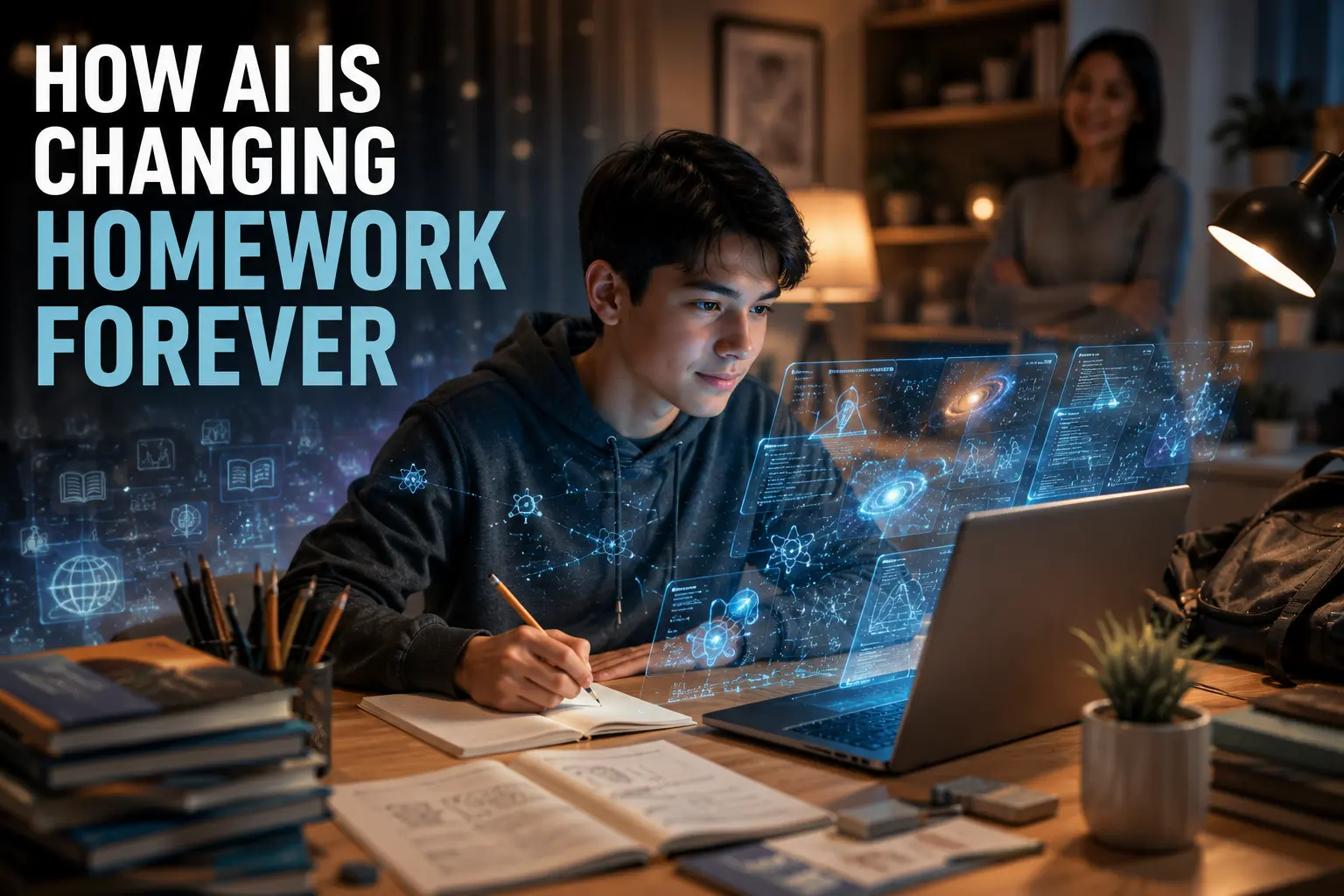
Homework Has Entered a New Era
For generations, Assignments followed a familiar pattern.
Students attended class during the day, took assignments home, completed them independently, and returned them to school for review.
If they struggled, they searched through textbooks, visited the library, or asked parents and teachers for help. Learning often depended on how much information students could find—and how long it took to find it.
That model remained largely unchanged for decades.
Today, however, something has fundamentally shifted.
Access to academic help has become almost immediate. Instead of searching through multiple websites or waiting until the next school day to ask a teacher, students can easily use an AI assistant and receive explanations within seconds.
They can ask follow-up questions.
Request examples.
Simplify difficult concepts.
Receive instant feedback.
Even practice until they fully understand a lesson.
Homework is no longer limited by access to books or private tutors.
Artificial intelligence has effectively placed a personal learning assistant into the hands of millions of students.
This change is happening faster than many schools can adapt.
Parents are noticing it at home.
Teachers are seeing it in classrooms.
Students are embracing it naturally because it feels as intuitive as using a search engine.
Whether people welcome or resist this change, one fact is becoming increasingly clear:
Homework is entering a new era.
Artificial Intelligence Is Becoming Every Student’s Personal Tutor
One of AI’s greatest educational strengths is not simply providing answers.
It explains.
Unlike traditional search engines, which return a list of websites, modern AI systems can guide students through problems step by step.
A child struggling with fractions can ask for a simpler explanation.
A student learning algebra can request another example.
Someone writing an essay can receive suggestions for improving clarity and structure.
Language learners can practice conversations.
Beginning programmers can debug code while learning why mistakes occurred.
In many ways, AI behaves less like a calculator and more like a patient tutor.
It can adapt explanations to different ages, learning styles, and levels of understanding.
Students are no longer limited to one explanation from a textbook.
If they don’t understand something, they can easily ask again.
Or ask differently.
This ability to personalize learning is one reason artificial intelligence is attracting significant attention in education.
For students who previously hesitated to ask questions in class, AI can provide a judgment-free environment that encourages curiosity and continuous learning.
Instead of feeling embarrassed about asking the same question multiple times, they can continue exploring until the concept makes sense.
For many students, that alone has fundamentally changed how Homework feels.
Why Millions of Students Are Already Using AI for Homework
The rapid adoption of AI among students should not be surprising.
It addresses many of the longstanding challenges that have traditionally made Homework difficult.
Instead of waiting hours—or even days—for help, students receive immediate assistance whenever they need it.
AI can help explain:
- Mathematics
- Science
- History
- Literature
- Foreign languages
- Computer programming
- Research methods
- Essay organization
- Grammar and writing
It can summarize complex topics.
Generate practice questions.
Create study guides.
Explain difficult vocabulary.
Provide multiple examples.
Even quiz students before an exam.
For many households, AI has quietly become another educational resource alongside textbooks, teachers, and parents.
Some students use it to check their work.
Others use it to understand lessons they missed.
Some rely on it for brainstorming ideas rather than completing assignments.
These uses demonstrate that AI is not simply replacing Homework.
It is changing how students interact with Homework.
Instead of spending most of their time searching for information, they can spend more time understanding it.
When used responsibly, artificial intelligence has the potential to reduce frustration while increasing confidence.
For students who have traditionally struggled to keep pace with their classmates, this can make learning more accessible than ever before.
The Benefits Go Beyond Simply Getting the Right Answer
Critics often assume students use AI only to finish Homework faster.
While that certainly happens, it overlooks the broader educational potential of these tools.
The greatest benefit of AI may not be speed.
It may be personalized learning.
Every student learns differently.
Some understand concepts after reading a definition.
Others need diagrams.
Some prefer analogies.
Others learn by practicing examples repeatedly.
Traditional classrooms often cannot personalize instruction for every student because teachers must balance the needs of dozens of learners simultaneously.
Artificial intelligence can.
Even as artificial intelligence becomes a powerful learning tool, it cannot fully replace the role of a skilled educator. A knowledgeable, prepared, and professional teacher remains essential to helping students think critically, stay motivated, and overcome learning challenges. This is why many parents are asking an important question: Should Teachers Be Graded Like Students? Why Incompetent Teachers Hurt Student Success, especially when poor teaching can limit student achievement regardless of the technology available.
It can explain the same concept five different ways without becoming impatient.
It can adjust explanations based on a student’s questions.
It can provide unlimited practice.
It allows students to learn from mistakes in real time rather than after Homework has been graded and returned.
This immediate feedback helps students identify misunderstandings before they become long-term learning gaps.
AI also makes learning available beyond school hours.
A student studying late at night no longer has to wait until tomorrow for clarification.
Help is available whenever curiosity appears.
For families who cannot easily afford private tutoring, this accessibility may become one of AI’s most significant educational contributions.
It has the potential to narrow learning gaps by making high-quality explanations available to anyone with an internet connection.
However, like every powerful educational tool before it, artificial intelligence also introduces new challenges.
The same technology that helps students understand concepts can also tempt them to bypass learning altogether.
That raises an important question:
If AI can complete Homework in seconds, what should Homework actually be teaching?
AI Homework: Helpful Learning Tool or Learning Shortcut?
| Using AI to Learn ✅ | Using AI to Avoid Learning ❌ |
|---|---|
| Explains difficult concepts | Copies answers without understanding |
| Provides step-by-step guidance | Completes the entire assignment |
| Helps brainstorm ideas | Writes essays word-for-word |
| Checks grammar and writing | Replaces independent thinking |
| Creates practice quizzes | Encourages overreliance |
| Gives personalized feedback | Prevents students from developing problem-solving skills |
| Helps review before exams | Makes learning passive instead of active |
The difference is not whether students use AI—it is how they use it. When AI encourages curiosity and understanding, it can become a powerful educational partner. When it replaces thinking altogether, it risks undermining the very purpose of Homework.
The Risks Parents and Teachers Should Understand
Artificial intelligence is one of the most powerful learning tools ever created.
But like every educational technology before it—from calculators to the internet—its value depends on how people use it.
AI can help students become better learners.
It can also make learning more superficial if it becomes a shortcut instead of a guide.
The biggest concern is not that students have access to AI.
It is that they may stop thinking for themselves.
Instead of working through a challenging math problem, students may quickly copy the answer generated by AI.
Instead of organizing their own ideas for an essay, they might ask AI to write it.
Instead of developing problem-solving skills, they might become dependent on instant solutions.
This creates an important distinction.
Using AI to learn is very different from using AI to avoid learning.
Parents and teachers are increasingly recognizing that the real challenge is no longer preventing students from using AI.
It is teaching them how to use it responsibly.
AI Should Be a Teacher, Not a Replacement for Thinking
Imagine two students using the same AI tool.
The first student asks:
“Can you explain why this answer is correct?”
The second asks:
“Do my homework for me.”
Both students are using artificial intelligence.
But only one is actually learning.
This distinction may become one of the defining educational challenges of the AI era.
Artificial intelligence works best when it encourages curiosity.
Students who ask questions, request explanations, compare ideas, and verify information often deepen their understanding.
Those who quickly copy answers may finish the assignment faster, but they risk missing the very purpose of the assignment.
Homework has never been only about producing correct answers.
It has also been about developing persistence, reasoning, and independent problem-solving.
If AI removes all of the thinking, it may also remove much of the learning.
The Purpose of Homework Is Beginning to Change
For decades, Homework had a relatively simple purpose.
It reinforced what students learned in school.
By solving problems independently, students strengthened their understanding through repetition and practice.
But AI challenges this traditional model.
The ability of AI to generate essays, solve complex equations, translate languages, and explain scientific concepts in seconds challenges assignments that assess students primarily by the answers they produce.
This does not necessarily mean Homework is becoming obsolete.
Instead, it suggests that Homework itself may need to evolve.
Rather than asking students only to produce answers, future assignments may increasingly ask them to explain their reasoning, defend their conclusions, evaluate different perspectives, and apply knowledge in original ways.
This evolution may transform Homework from measuring the answers students produce to revealing the thinking behind those answers.
This transformation reflects a broader conversation about education itself.
As explored in Sit, Memorize, Study, Exam, Forget, Repeat: Is School Preparing Students for what lies ahead?, many educators are questioning whether traditional learning models remain effective in a world where information is instantly accessible.
Why Critical Thinking Matters More Than Ever
One of AI’s greatest strengths is its ability to generate information quickly.
One of its greatest weaknesses is that it can sometimes generate information that is inaccurate, incomplete, or confidently incorrect.
Artificial intelligence does not always know when it is wrong.
That responsibility still belongs to people.
Students, therefore, need more than answers.
They need judgment.
They need to ask questions such as:
- Is this information accurate?
- Can I verify this source?
- Does this conclusion make sense?
- Is there evidence supporting this claim?
- Are there alternative viewpoints?
These are critical thinking skills.
Ironically, the widespread availability of AI may make critical thinking more valuable than ever before.
The challenge is no longer finding information.
The real challenge is determining whether that information can be trusted.
This is why many educators believe that the Future of education should emphasize analytical thinking alongside technological literacy.
This perspective is discussed in more detail in Why Critical Thinking May Become the Most Valuable Skill in the Age of AI, which explores how advances in AI are increasing the importance of human judgment.
Should Parents Allow Their Children to Use AI?
Many parents are asking the same question.
Should children use AI for assignments?
The answer may not be a simple yes or no.
A more useful question might be:
How should children use AI?
Used responsibly, AI can become an excellent educational partner.
For example, students can use AI to:
- Understand difficult concepts
- Practice math problems
- Improve grammar and writing
- Brainstorm ideas
- Review for exams
- Learn new vocabulary
- Receive personalized explanations
These uses encourage learning.
However, parents should discourage students from using AI to:
- Complete the entire assignment without participation
- Copy essays word for word
- Solve every problem without attempting it first
- Bypass critical thinking
- Misrepresent AI-generated work as their own
The goal is not to eliminate effort.
The goal is to make the effort more effective.
Children still need opportunities to struggle with problems, learn from mistakes, and develop confidence through independent thinking.
Artificial intelligence should support that process—not replace it.
Parents Are Becoming Learning Coaches
AI is also changing the role of parents.
In the past, parents often helped by checking Homework, explaining difficult questions, or reviewing answers.
Today, AI can perform many of those tasks almost instantly.
This does not make parents less important.
It makes their role different.
Instead of asking:
“Did you finish your homework?”
Parents may increasingly ask:
- What did AI help you understand?
- How would you describe this concept to someone unfamiliar with it?
- Do you agree with AI’s answer?
- Why do you think this solution works?
- In what ways has today’s lesson expanded your understanding of the topic?
These conversations encourage reflection rather than memorization.
They help children develop judgment, curiosity, and confidence—qualities that artificial intelligence cannot develop on their behalf.
Schools Are Already Rethinking Homework
Around the world, schools are beginning to recognize that Homework designed for the pre-AI era may no longer achieve its intended purpose.
If students can generate answers almost instantly, educators may need to design assignments that reward reasoning rather than repetition.
Increasingly, schools are experimenting with:
- Project-based learning
- Collaborative assignments
- Real-world problem solving
- Oral presentations
- Classroom discussions
- Reflective writing
- Research evaluation
- Creative projects
These activities are significantly more difficult to automate because they require students to demonstrate understanding rather than quickly produce information.
This broader transformation is already taking place in many education systems, as discussed in How Schools Around the World Are Preparing Students for the Future of Work, where schools are redesigning learning to emphasize creativity, adaptability, collaboration, and lifelong learning over memorization alone.
The Future of Homework May Be About Thinking, Not Answering
Homework has survived for centuries because it serves an important purpose.
It helps students reinforce what they learn in the classroom.
But the way that purpose is achieved is beginning to change.
For much of modern education, Homework focused on producing correct answers.
Students completed worksheets.
Solved equations.
Wrote essays.
Answered textbook questions.
The process assumed that finding the answer required time, effort, and independent research.
Artificial intelligence changes that assumption.
Today, answers are available almost instantly.
That does not mean Homework has lost its educational value.
Instead, its value may no longer lie solely in producing answers.
Homework in the years ahead may increasingly require students to:
- Explain their reasoning.
- Compare multiple viewpoints.
- Evaluate the reliability of information.
- Defend their conclusions with evidence.
- Solve real-world problems.
- Reflect on their learning process.
These kinds of assignments are more difficult for AI to complete independently because they require human judgment, creativity, and personal understanding.
Ironically, artificial intelligence may push education toward deeper learning rather than simpler learning.
What Homework Might Look Like in the Next Decade
The next generation of Homework could look very different from what previous generations experienced.
Instead of repeating information, students may spend more time applying it.
Future assignments could include:
- Designing solutions to real-world challenges
- Creating presentations supported by AI-assisted research.
- Collaborating with classmates on complex projects.
- Recording video explanations of their reasoning.
- Evaluating AI-generated responses for accuracy.
- Comparing multiple sources before reaching conclusions.
- Building portfolios that demonstrate long-term learning instead of one-time test performance.
Artificial intelligence may become a standard classroom tool, much like calculators and computers eventually did.
The difference is that AI assists with thinking rather than simple calculation.
Schools may gradually shift from asking:
“Can students find the answer?”
to asking:
“Can students explain why the answer is correct?”
That subtle change could transform education more than any technology has in decades.
Preparing Students for an AI-Powered Future
Artificial intelligence is not simply changing Homework.
It is changing the skills students will need throughout their lives.
Future employers are increasingly looking for people who can:
- Think critically.
- Solve unfamiliar problems.
- Communicate clearly.
- Learn continuously.
- Adapt to new technologies.
- Work alongside intelligent systems.
These abilities cannot be developed by memorizing information alone.
They require curiosity.
Practice.
Reflection.
And the willingness to ask better questions.
Homework, therefore, has an opportunity to become something far more meaningful than an evening assignment.
It can become a place where students learn how to think independently while using technology responsibly.
Rather than competing with artificial intelligence, future learners may succeed by understanding when to trust AI, when to question it, and when to rely on their own judgment.
The Conversation About Homework Is Just Beginning
Artificial intelligence has sparked one of the biggest educational debates in decades.
Some worry that students will become overly dependent on technology.
Others believe AI could democratize learning by making high-quality educational support available to anyone with an internet connection.
Both perspectives raise valid concerns.
The challenge is not choosing between traditional learning and artificial intelligence.
The challenge is combining the strengths of both.
Students still need opportunities to struggle with difficult problems.
To make mistakes.
To think independently.
To develop resilience.
AI should enhance those experiences—not eliminate them.
The schools that succeed in the coming years will likely be those that teach students how to use artificial intelligence wisely while continuing to cultivate the uniquely human abilities that machines cannot replace.
Final Thoughts
Homework is unlikely to disappear.
But it is almost certainly evolving.
For generations, Homework measured whether students could produce the correct answer independently.
In the age of artificial intelligence, that goal is becoming less meaningful because answers are increasingly available to everyone.
The real advantage now lies in understanding those answers.
Questioning them.
Applying them.
And knowing when they are wrong.
Artificial intelligence may become every student’s most accessible tutor.
But curiosity, judgment, creativity, ethics, and critical thinking will remain deeply human responsibilities.
Homework in the years ahead is not about replacing students with AI.
It is about helping students become better thinkers with AI.
Those who learn to use artificial intelligence as a learning partner—not as a shortcut—will likely be the ones best prepared for school, work, and life in an increasingly intelligent world.
Frequently Asked Questions (FAQs)
Not necessarily. Using AI to understand concepts, receive explanations, or practice problems can support learning. However, submitting AI-generated work as your own without understanding it may violate school policies and undermine learning.
Yes. AI can provide personalized explanations, instant feedback, additional practice, and step-by-step guidance. When used responsibly, AI can deepen understanding rather than merely provide answers.
Probably not. Homework is more likely to evolve than disappear. Future assignments may place greater emphasis on critical thinking, creativity, problem-solving, and the practical application of knowledge rather than memorization.
Many educators believe AI can be a valuable learning tool when children use it to explore ideas, understand difficult concepts, and review their work. Parents should encourage responsible use rather than complete dependence.
Potential risks include overreliance on AI, reduced independent thinking, inaccurate AI-generated information, plagiarism, and missing opportunities to develop problem-solving skills.
Many schools are redesigning assignments to emphasize discussion, projects, collaboration, presentations, and critical thinking over tasks that AI can easily complete.
The growing use of AI is reinforcing the importance of critical thinking, adaptability, creativity, communication, and lifelong learning—skills that many educators and employers believe complement rather than compete with artificial intelligence.