

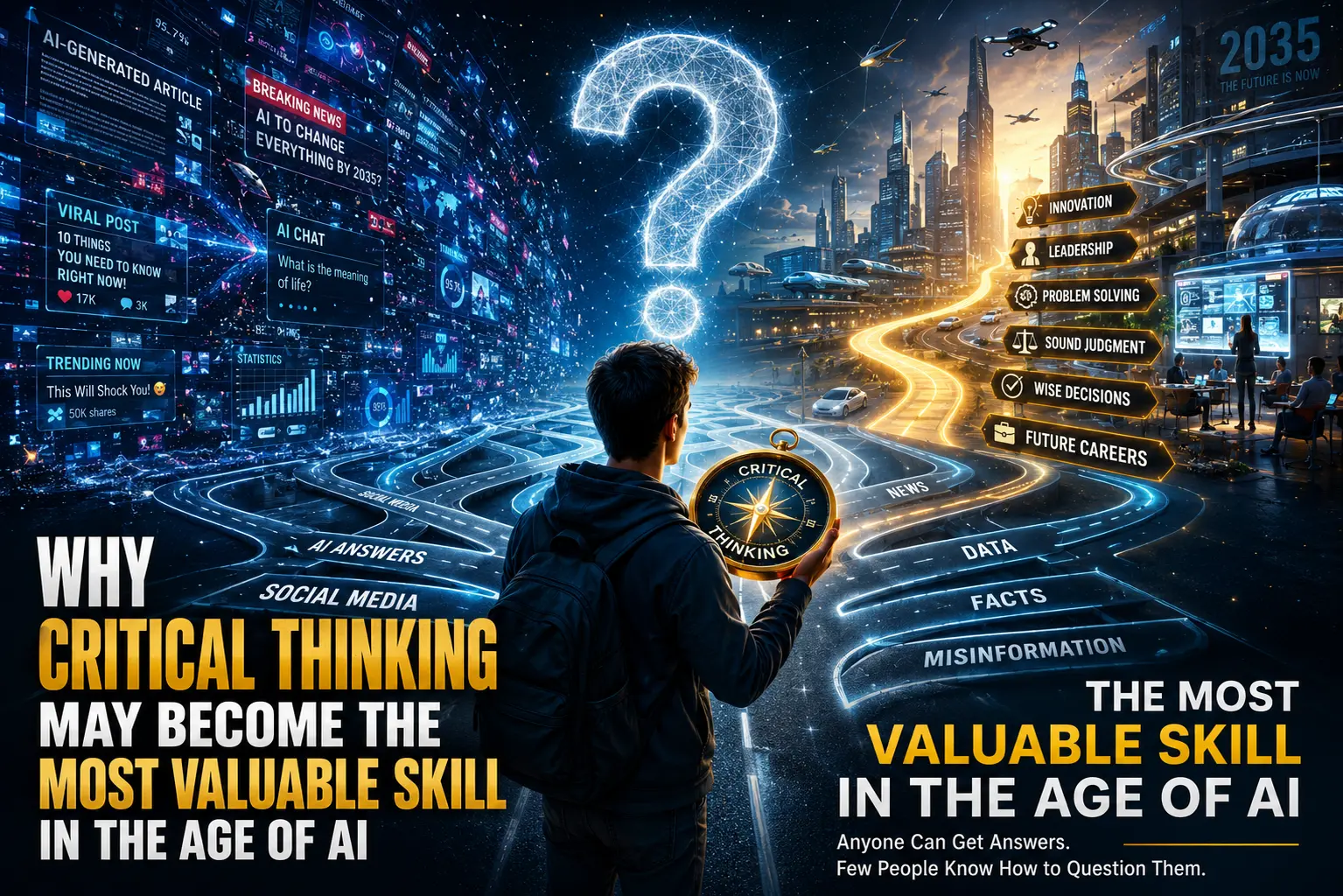
Modern education systems have historically placed strong emphasis on knowledge as the core objective.
Students had to memorize facts, study formulas, and recall what they learned during tests.
Knowledge was valuable because information was difficult to access.
This shift marks a significant departure from the past.
Artificial intelligence can answer questions in seconds.
It can summarize research papers, write essays, create business plans, build software code, and explain almost any topic.
As AI becomes more powerful, many people assume technical knowledge will become the most important skill.
However, a growing number of teachers, employers, and researchers believe something else could be more valuable:
Critical thinking.
In a world flooded with information, the ability to evaluate it may matter more than the ability to access it.
What Is Critical Thinking?
Critical thinking is the ability to:
- Analyze information objectively
- Evaluate evidence
- Identify assumptions
- Recognize bias
- Question conclusions
- Solve complex problems logically
Rather than accepting information at face value, critical thinkers examine how and why something may be true.
They ask better questions.
They look for weaknesses in arguments.
They look at different viewpoints.
Most importantly, they base their choices on reasoning, not on emotions or unproven beliefs.
How Artificial Intelligence Is Elevating the Importance of Critical Thinking
Artificial intelligence is remarkably powerful.
But it is not perfect.
AI systems are capable of:
- Produce inaccurate information
- Misinterpret context
- Present confident but incorrect answers
- Reflect biases found in training data
- Generate misleading conclusions
This creates a new challenge.
Getting information is no longer the hard part.
The problem is determining whether information is accurate.
As AI-generated content becomes increasingly common, critical thinking becomes the filter that separates reliable knowledge from misinformation.
The New Reality: Anyone Can Generate Information
A decade ago, creating large amounts of content demanded considerable effort.
Today, AI tools can generate:
- Articles
- Reports
- Presentations
- Images
- Videos
- Marketing campaigns
within minutes.
This creates unprecedented opportunities.
But it also creates unprecedented noise.
The internet now has lots of content that looks expert but might not be accurate.
People who can critically evaluate information gain a significant advantage.
Critical Thinking vs Artificial Intelligence
| Artificial Intelligence | Critical Thinking |
|---|---|
| Generates information | Evaluates information |
| Finds patterns | Questions assumptions |
| Processes data rapidly | Applies human judgment |
| Provides answers | Asks better questions |
| Automates tasks | Makes strategic decisions |
| Predicts outcomes | Evaluates consequences |
Why Schools Are Paying More Attention to Critical Thinking
Many education systems were originally designed for an industrial economy.
Students learned information.
Teachers delivered content.
Examinations measured recall.
This traditional structure shaped how education systems operated for generations. However, as the world moves from an industrial economy to an AI-driven one, many are questioning whether traditional educational models are still preparing students for the future. The history behind this debate is explored in “Were Schools Built for Factory Workers?“, which examines how education evolved and whether schools were designed around the needs of the industrial age.
But what future economies need is something different.
The ability to adapt is increasingly becoming more important than the ability to memorize.
This shift is one reason many countries are redesigning education systems to focus more heavily on problem-solving, inquiry-based learning, and analytical thinking.
Recent developments highlighted in “Why China Is Rebuilding Higher Education Around AI” show how universities are increasingly restructuring programs to meet future workforce needs rather than traditional educational models.
The Workplace Is Changing Faster Than Ever
Employers increasingly seek workers who can:
- Evaluate complex situations
- Solve unfamiliar problems
- Adapt to new technologies
- Make informed decisions
- Analyze competing information
These skills become increasingly critical as AI tools are integrated into everyday workflows.
The future may belong to workers who can effectively combine human judgment with artificial intelligence.
Why Critical Thinking Matters More Than Technical Skills Alone
Technical skills remain important.
However, technology evolves rapidly.
Specific software tools may become outdated.
Platforms could change over time.
Industries might evolve into something new.
Critical thinking stays important no matter how technology changes.
It helps individuals:
- Learn new skills faster
- Adapt to changing environments
- Make better decisions
- Navigate uncertainty
- Solve unfamiliar problems
These advantages often last longer than any specific technical skill.
Critical Thinking and Emotional Intelligence Work Together
Many people view critical thinking and emotional intelligence as separate skills.
In practice, they frequently support each other.
Critical thinking helps us decide what information to trust.
Emotional intelligence helps people understand others.
Together they improve:
- Leadership
- Communication
- Teamwork
- Decision-making
- Conflict resolution
This connection is explored further in Why Emotional Intelligence Matters More Than Ever in the AI Age, which examines why human-centered skills remain valuable as technology advances.
Why Students Need Critical Thinking More Than Ever
Students entering today’s workforce face unprecedented uncertainty.
Technology evolves rapidly.
Industries emerge and disappear.
Careers change over time.
Information spreads instantly.
Under these conditions, memorizing information is no longer enough.
Students increasingly need the ability to:
- Evaluate sources
- Verify claims
- Analyze evidence
- Think independently
- Make informed decisions
These skills help individuals remain effective even as technology changes.
The future of education may increasingly depend on it
Around the world, educators are rethinking what students need to succeed.
Knowledge remains valuable.
But having knowledge alone is not enough now.
Many experts believe education systems must place greater emphasis on:
- Critical thinking
- Creativity
- Emotional intelligence
- Adaptability
- Collaboration
This broader transformation is explored in How Schools Around the World Are Preparing Students for the Future of Work, which examines how countries are redesigning learning for an increasingly uncertain future.
The Human Advantage in an AI World
Artificial intelligence might grow more powerful over time.
It may write reports.
Generate ideas.
Analyze data.
Automate routine work.
But one thing remains true.
Someone still has to decide:
- Which information is trustworthy
- Which conclusions make sense
- Which risks matter
- Which actions should be taken?
That responsibility belongs to people.
The future may not favor people whose main skill is having the most information.
It may reward those who can think most effectively about the information available to them.
In an age where answers are everywhere, critical thinking may become the ultimate competitive advantage.
Frequently Asked Questions (FAQs)
Critical thinking is the ability to analyze information objectively, evaluate evidence, identify assumptions, and make reasoned judgments.
No. AI can assist with analysis, but human judgment remains essential for evaluating information, ethics, risks, and strategic decisions.
Critical thinkers solve problems more effectively, adapt to change, make better decisions, and navigate uncertainty.
Both matter. However, critical thinking often remains valuable even as technologies and industries change.
Students can strengthen critical thinking by questioning assumptions, evaluating evidence, comparing sources, and practicing problem-solving.
Nearly every job type sees advantages, from business and healthcare to education, engineering, law, technology, and leadership.
Emotional intelligence, communication, creativity, adaptability, and collaboration are often considered complementary future-ready skills.