

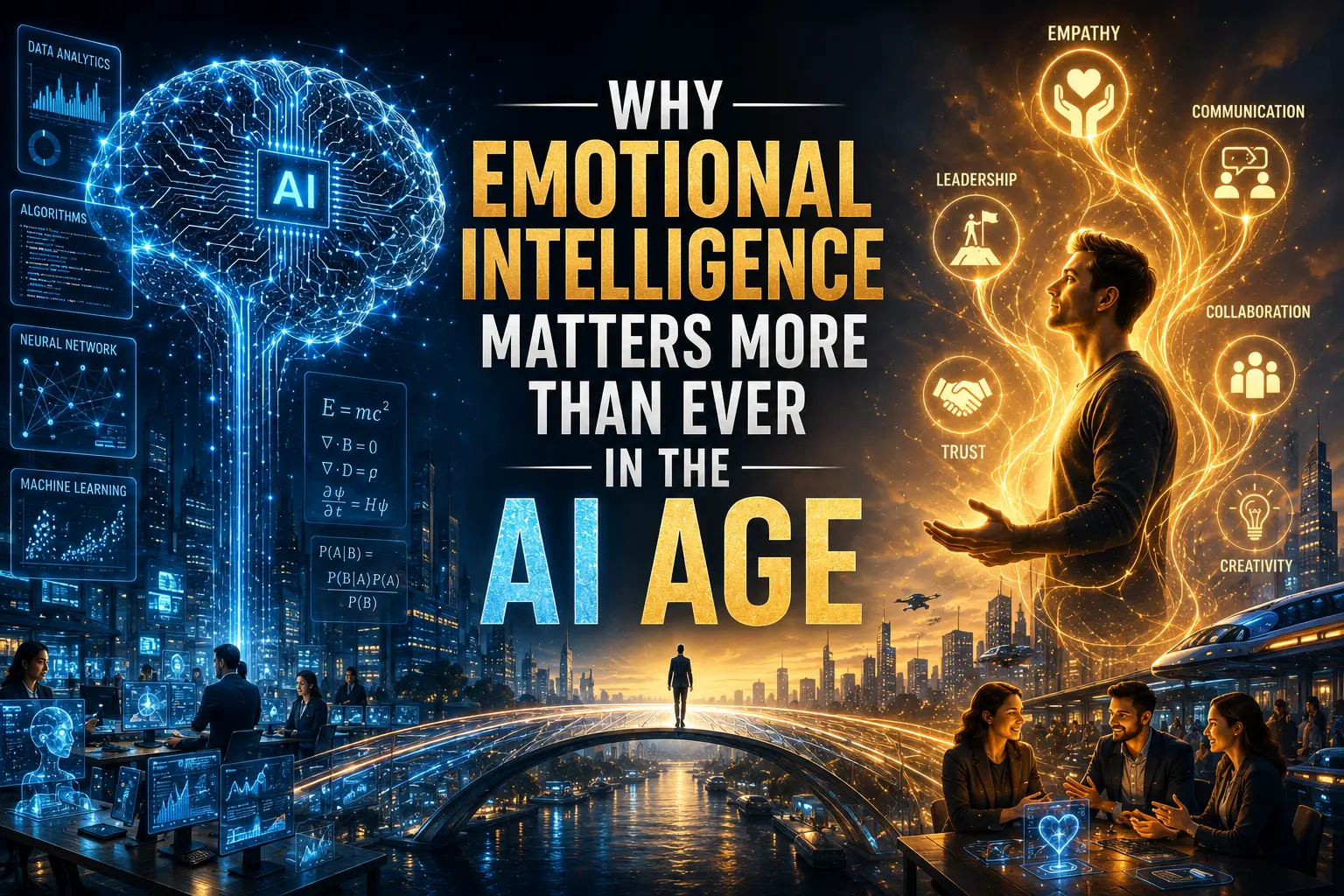
For decades, education systems rewarded students for memorizing information.
Knowledge was power.
Knowing more facts, solving more problems, and scoring higher on exams often meant an advantage.
But a fundamental shift is already happening.
AI can now answer questions, generate reports, analyze data, write code, and perform tasks that once required years of training.
As AI becomes more capable, many people are asking a new question:
If AI can do more intellectual work, what skills can only humans do?
One answer repeats across studies:
Emotional intelligence.
In a digital age, human understanding could matter as much as information.
What Is Emotional Intelligence?
Emotional intelligence (EQ) is the ability to recognize, understand, manage, and respond to emotions effectively.
It includes:
- Self-awareness
- Self-control
- Empathy
- Communication
- Relationship management
- Social awareness
While technical knowledge solves problems, emotional intelligence guides how people connect and communicate.
It influences leadership, teamwork, decision-making, and personal relationships.
Why AI Is Changing the Value of Human Skills
Artificial intelligence excels at processing information.
It can:
- Analyze large datasets
- Generate content
- Detect patterns
- Automate repetitive tasks
- Answer questions quickly
However, AI still struggles with many parts of human interaction.
For example:
- Building trust
- Understanding emotions
- Reading social cues
- Managing conflict
- Providing genuine empathy
These areas remain deeply human.
As routine tasks become automated, employers increasingly value skills that machines cannot easily replicate.
The Growing Importance of Human Connection
Technology connects people online.
Yet isolation affects more people than ever before.
Organizations increasingly recognize that strong relationships drive success:
- Team performance
- Customer satisfaction
- Leadership effectiveness
- Workplace culture
Employees who communicate effectively and build trust often outperform those with strong technical skills alone.
This is the main reason why emotional intelligence is now a major focus in leadership and workforce training.
Emotional Intelligence vs Artificial Intelligence
| Artificial Intelligence | Emotional Intelligence |
|---|---|
| Data analysis | Empathy |
| Pattern recognition | Relationship building |
| Automation | Conflict resolution |
| Speed and scale | Leadership |
| Information processing | Social awareness |
| Consistency | Human judgment |
Why Schools Often Overlook Emotional Intelligence
Traditional education systems primarily measure:
- Test scores
- Academic performance
- Subject mastery
Emotional intelligence is harder to measure.
As a result, many schools focus far more on academics than on emotional development.
This challenge is discussed in The Life Skills Schools Still Fail to Teach, which explores why practical life skills often receive less attention than traditional academic subjects.
Many educators now argue that emotional intelligence deserves a larger role in modern education.
Emotional Intelligence in the Workplace
Employers increasingly seek workers who can:
- Collaborate effectively
- Adapt to change
- Communicate clearly
- Manage stress
- Lead diverse teams
Technical skills can help someone land a job.
Emotional intelligence helps workers stay employed and grow their careers.
As jobs become automated, people skills may become the ultimate advantage.
Why Emotional Intelligence Matters for Students
Students entering today’s workforce face unprecedented uncertainty.
Technology evolves faster than ever.
Industries change rapidly.
Career paths change.
In today’s world, emotional intelligence can help students:
- Adapt to new situations
- Build professional networks
- Navigate workplace challenges
- Work effectively with others
- Lead with confidence
These abilities often influence long-term success far beyond academic achievement.
This idea is explored further in Why Good Grades No Longer Guarantee Success in Real Life, which examines why academic performance alone is no longer enough.
Will AI Ever Understand Human Emotions?
Artificial intelligence can simulate empathy.
It can generate supportive responses.
It can analyze emotional patterns.
But genuine human understanding remains difficult to replicate.
People often seek:
- Trust
- Authenticity
- Compassion
- Shared experiences
These qualities form the foundation of many meaningful human relationships.
While AI may become a powerful tool, many experts believe emotional intelligence will remain one of humanity’s most valuable strengths.
Why This Matters for the Future of Education
The future of learning could require a broader definition of success.
Students need knowledge.
But they also need:
- Emotional resilience
- Communication skills
- Adaptability
- Critical thinking
- Collaboration
Countries blending academic knowledge with people skills may have a stronger future.
This broader question is explored in Is School Still Relevant in 2030?, which examines how education may evolve in an AI-driven world.
The Human Advantage
As AI grows more advanced, many assume human value will decline.
Reality may tell a different story.
The more technology handles routine tasks, the more important uniquely human qualities may become.
Empathy.
Judgment.
Creativity.
Communication.
Leadership.
These abilities cannot easily be automated.
The future may belong not only to those who understand technology, but also to those who understand people.
Authority References
For readers interested in further research:
- World Economic Forum Future of Jobs Reports
- Harvard Graduate School of Education
- OECD Education Directorate
- UNESCO Education Programs
These organizations regularly publish research on future workforce skills, emotional intelligence, education reform, and human-centered leadership.
Frequently Asked Questions (FAQs)
Emotional intelligence is the ability to recognize, understand, manage, and respond effectively to emotions in yourself and others.
It helps improve communication, relationships, leadership, teamwork, and decision-making.
Yes. Emotional intelligence can be developed through practice, self-awareness, reflection, and experience.
No. AI can simulate certain emotional responses, but genuine empathy, trust, and human connection remain difficult to replicate.
Employees with strong emotional intelligence often collaborate better, handle stress more effectively, and build stronger professional relationships.
Both matter. However, many studies suggest emotional intelligence strongly influences leadership, teamwork, and long-term career success.
Traditional education systems have historically focused on academic performance, making emotional development a secondary priority.
Experts frequently cite emotional intelligence, adaptability, communication, creativity, critical thinking, and leadership as essential future skills.