
For most of modern history, work was built around human effort.
People exchanged time, physical labor, technical knowledge, and specialized skills for income and economic security.
Factories, offices, and professional industries were designed around a simple assumption:
Human workers were the primary source of productivity.
Artificial intelligence is challenging that assumption and reshaping what productivity means.
Unlike previous technologies that mainly improved physical capabilities, AI is beginning to influence activities once considered uniquely human — including writing, analysis, programming, design, decision-making, and communication.
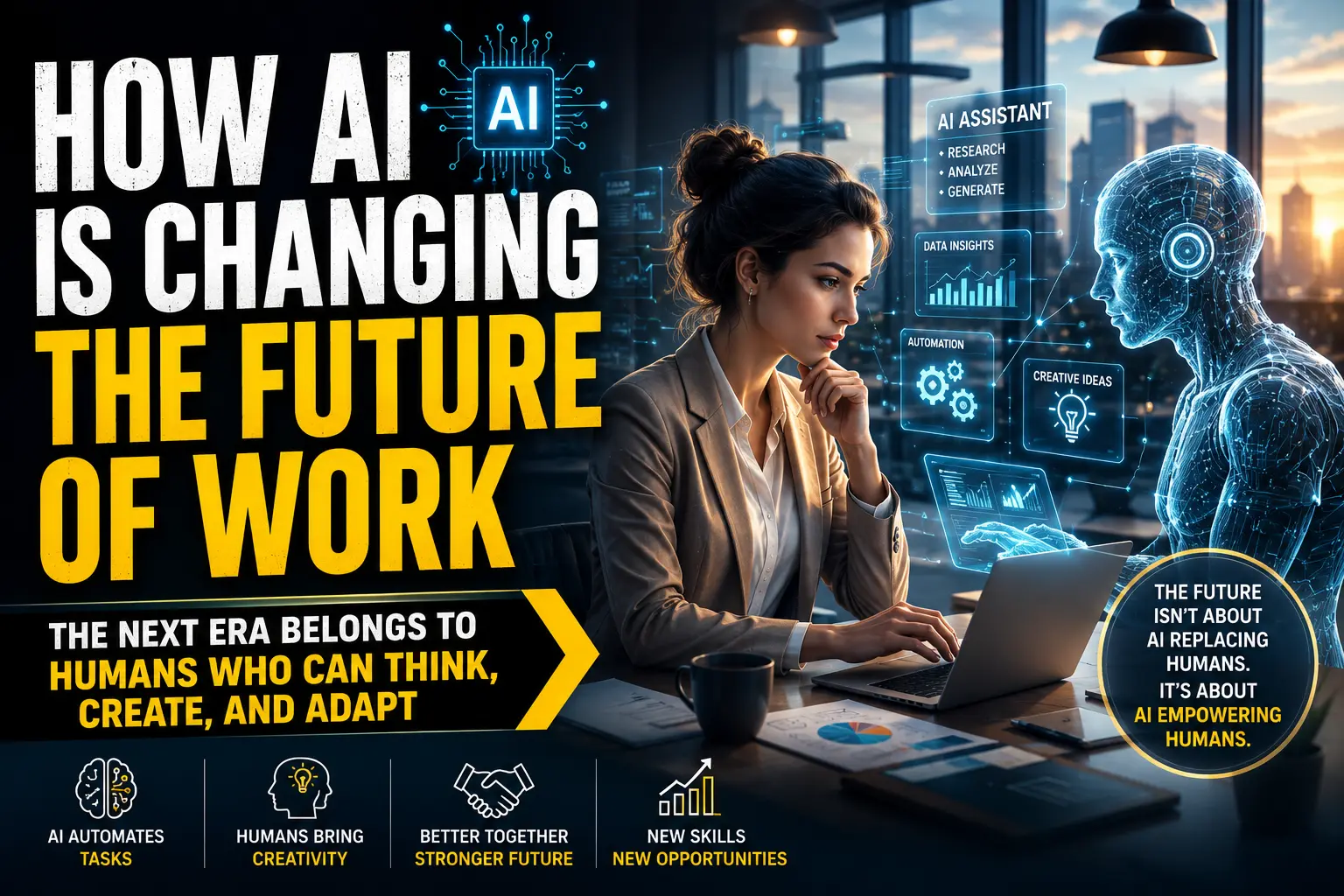
The future of work may not be defined by humans versus machines.
Instead, it may be defined by how effectively humans and AI systems work together.
AI is transforming the meaning of productivity.
For decades, productivity improvements often came from better machines, faster computers, and improved processes.
AI introduces something different:
The ability to increase productivity through intelligence itself.
AI systems can now analyze large amounts of information, identify patterns, generate content, automate repetitive tasks, and assist with complex decision-making.
This changes the workplace because many tasks that once required hours of human effort can now be completed faster.
The key transformation is not simply automation.
It is an augmentation.
AI allows workers to focus less on repetitive activities and more on creativity, strategy, judgment, and problem-solving.
As a result, the workplace is moving from task-based work to skill-based work.
Traditional employment often rewarded people for performing specific tasks.
Value was defined by expertise and performance as a worker:
- Knowledge they possessed
- Processes they followed
- The experience they accumulated
AI changes this dynamic.
When information becomes easier to access, the ability to apply knowledge becomes more important.
Future workers may be valued less for memorizing information and more for:
- Asking better questions
- Solving complex problems
- Communicating ideas clearly
- Making decisions under uncertainty
- Creating new solutions
The advantage may shift from knowing more information to using information more effectively.
Many jobs will change before they disappear.
One of the biggest misunderstandings about AI is that it will simply eliminate all human jobs.
The reality is more complex.
Many occupations are likely to experience transformation rather than complete replacement.
A lawyer may use AI to analyze documents faster.
A doctor may use AI to support diagnosis.
A teacher may use AI to personalize learning.
A designer may use AI to explore more creative possibilities.
A programmer may use AI tools to build software more efficiently.
The question may not be:
“Will AI replace this job?”
A better question may be:
“How will AI influence the future of this work?”
The rise of AI-assisted professionals
The future workplace may create a new category of workers:
AI-assisted professionals.
These are people who combine human expertise with artificial intelligence tools.
Their advantage comes from combining:
Human judgment + AI capability
Examples include:
| Profession | AI Assistance |
|---|---|
| Writer | Research, editing, and idea generation |
| Engineer | Simulation, analysis, optimization |
| Business leader | Data analysis and decision support |
| Teacher | Personalized learning materials |
| Developer | Faster coding and debugging |
| Researcher | Information discovery |
The most successful workers may not be those who compete against AI.
There may be those who know how to use AI better than others.
Creativity becomes more important, not less.
Some believe AI will reduce the importance of creativity because machines can generate images, text, music, and ideas.
However, creativity is not only about producing output.
Creativity involves:
- Understanding human needs
- Connecting unrelated ideas
- Identifying opportunities
- Creating meaningful solutions
AI can generate possibilities.
Humans decide which possibilities matter.
The future may belong to people who can combine imagination with technology.
Critical thinking becomes a valuable economic skill.
As AI generates more information, evaluating information becomes more important.
As AI generates more information, evaluating information becomes more important. This shift makes critical thinking one of the most valuable human abilities in the AI era, as explored in Why Critical Thinking May Become the Most Valuable Skill in the Age of AI.
Workers will need stronger abilities in:
- Reasoning
- Verification
- Analysis
- Decision-making
AI can produce answers quickly.
But speed does not always guarantee accuracy.
Human judgment remains essential because businesses, governments, and organizations still require people who can understand consequences and make responsible choices.
Education must prepare people differently.
Many education systems were designed for an earlier economic era.
Around the world, education systems are beginning to adapt to the demands of artificial intelligence, with some countries redesigning universities and training systems around AI capabilities. A major example is explored in Why China Is Rebuilding Higher Education Around AI.
Students were often trained to:
- Memorize information
- Follow instructions
- Complete standardized tasks
The AI era requires broader preparation.
Future education may need greater focus on:
- Creativity
- Communication
- Collaboration
- Adaptability
- Problem-solving
Knowledge remains important.
But the ability to apply knowledge may become even more valuable.
AI may increase inequality without adaptation.
While AI creates opportunities, it also creates challenges.
Workers who adapt quickly may experience major productivity advantages.
Those without access to AI tools, training, or digital skills may face greater pressure.
This creates an important economic question:
Will AI become a tool that expands opportunity, or will it widen existing gaps?
The answer may depend on education, accessibility, and how societies manage technological change.
Companies are entering a new era of competition.
Businesses are not only competing through products and prices.
Increasingly, they are competing through their ability to adopt technology.
Companies that successfully integrate AI may achieve:
- Faster innovation
- Lower operational costs
- Better customer experiences
- Improved decision-making
However, successful AI adoption is not only about purchasing technology.
Organizations must also redesign workflows and train people.
Technology alone does not create transformation.
People using technology effectively do.
The future of work will reward adaptability.
The most important workplace skill may not be a specific technical ability.
It may be adaptability.
Technology will continue changing.
New AI systems will emerge.
Industries will evolve.
The workers who succeed will likely be those who can continuously learn, adjust, and combine human strengths with new tools.
These changing workplace demands highlight a broader shift in the AI economy. The most valuable workers may be those who develop the right combination of human and technological abilities. This is explored further in Top 10 Skills That Will Matter Most in the AI Economy, which examines the key skills that will help people remain competitive as artificial intelligence transforms the future of work.
Future careers may depend less on one specialized skill and more on the ability to adapt as technology evolves. The changing demands of tomorrow’s workplace are explored in “Why the Future of Work Will Require Different Skills Than Today,” which examines why adaptability, creativity, problem-solving, and human-centered abilities may become essential in the AI era.
The future of work is unlikely to be fully human or fully automated.
It will be a partnership between human intelligence and artificial intelligence.
Frequently Asked Questions (FAQs)
AI is more likely to transform many jobs than eliminate all employment. Some tasks will become automated, while new roles and opportunities will emerge.
Critical thinking, creativity, communication, adaptability, and problem-solving are expected to become increasingly valuable.
No. AI changes the type of value humans provide. Human judgment, creativity, ethics, and decision-making remain important.
Yes. Understanding how to use AI tools effectively may become an important advantage across many industries.
The biggest change is that productivity is no longer limited only by human time. AI allows people to accomplish more by combining human expertise with machine intelligence.