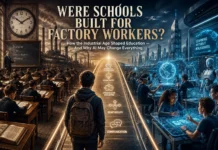

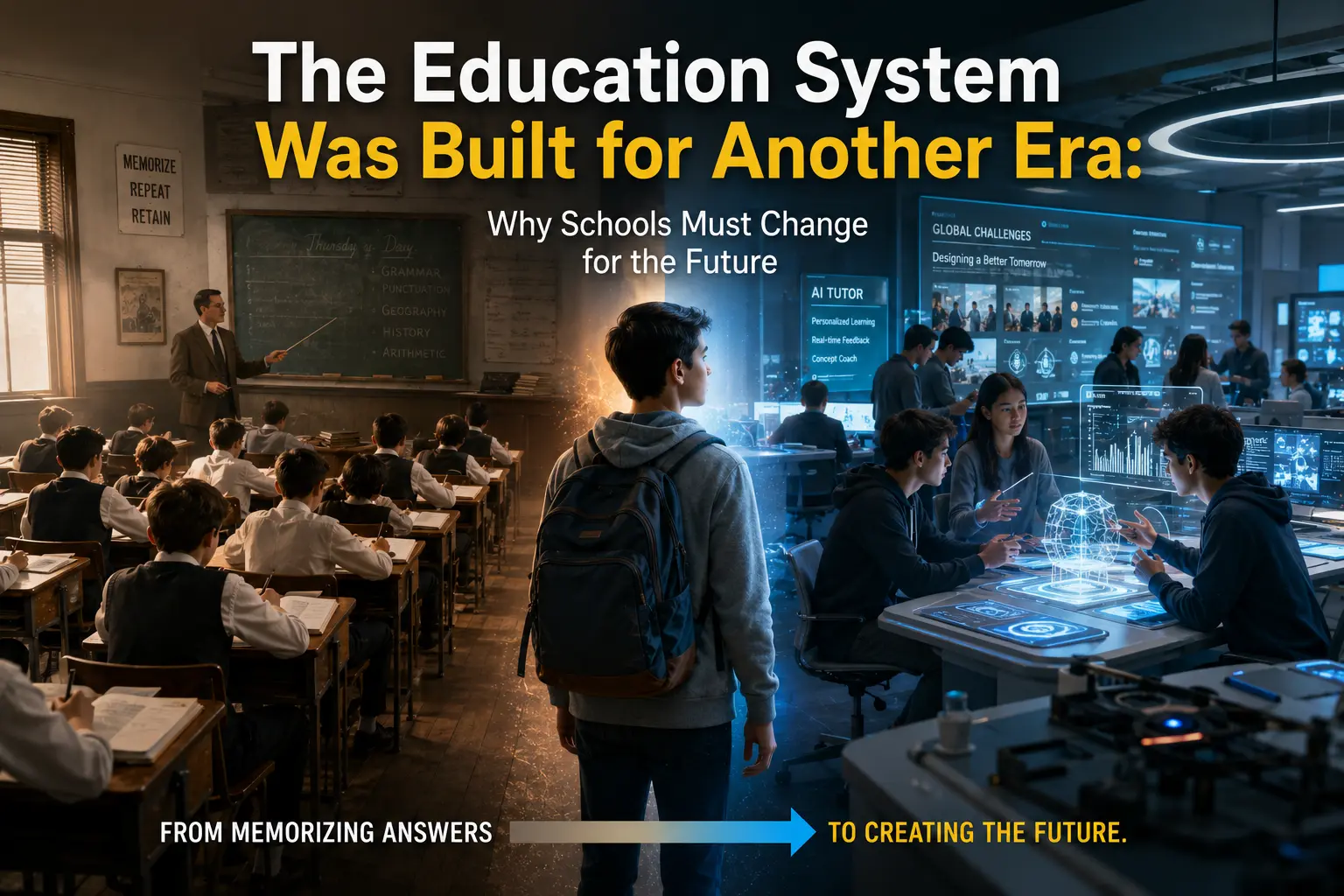
For generations, schools have followed a familiar pattern.
Students sit in classrooms.
Teachers deliver information.
Students memorize lessons.
Exams measure what they remember.
Then the cycle repeats.
This model has shaped education systems around the world for more than a century.
But as technology changes the way people work, a bigger question is emerging:
Are schools still preparing students for the world they are entering — or for a world that no longer exists?
The Traditional School Model Was Designed Around a Different Economy
Modern education developed during a period when economies were becoming increasingly industrialized.
Factories, offices, and large organizations needed workers who could follow processes, understand instructions, perform consistent tasks, and maintain productivity.
Schools began emphasizing skills that matched those environments:
- Memorizing information
- Following structured lessons
- Completing standardized assignments
- Performing well on examinations
- Reproducing correct answers
These methods helped prepare millions of people for the workforce of the industrial age.
However, the economy is changing.
The skills that created success in the past may not be enough for the future.
The Problem With “Memorize, Test, Forget”
One criticism of traditional education is that many students experience learning as a short-term process.
They study information.
They prepare for exams.
They achieve a score.
Then much of that information disappears.
This does not mean knowledge is useless.
Knowledge remains the foundation of learning.
The challenge is that modern society no longer struggles with access to information.
Today, anyone can find answers instantly.
Artificial intelligence can summarize documents, explain concepts, generate ideas, and provide information within seconds.
The new challenge is not simply knowing information.
It is knowing what information matters.
The AI Era Requires a Different Type of Student
Artificial intelligence is changing the value of human abilities.
When machines can perform many information-based tasks, students may need stronger abilities in areas AI cannot fully replace:
- Critical thinking
- Creativity
- Communication
- Problem-solving
- Adaptability
- Decision-making
A student who only memorizes information may struggle in a world where information is everywhere.
A student who can analyze, question, and create may have a stronger advantage.
Schools Were Built to Transfer Knowledge — But the Future Requires Application
For much of history, education focused on transferring knowledge from teachers to students.
The teacher was the source.
The textbook was the authority.
The exam measured understanding.
But the future may require a different relationship with learning.
Students may need to become active problem-solvers rather than passive receivers of information.
Instead of only asking:
“Why is this answer correct?”
Education may need to encourage questions like:
“Why is this answer correct?”
“What evidence supports this idea?”
“How can this knowledge be applied to real problems?”
The Future Workplace Rewards Skills, Not Just Credentials
For many years, completing education was viewed as a pathway to economic security.
A degree represented knowledge, discipline, and preparation.
However, workplaces are changing rapidly.
This transformation is explored further in Why the Future of Work Will Require Different Skills Than Today, which explains how AI, automation, and economic changes are reshaping the skills needed for future careers.
Employers increasingly value people who can:
- Learn new technologies
- Adapt to uncertainty
- Solve unfamiliar problems
- Collaborate effectively
- Think independently
The future worker may not be the person who remembers the most information.
It may be the person who can use information most effectively.
This shift is part of the broader transformation discussed in How AI Is Changing the Future of Work, where artificial intelligence is reshaping productivity, careers, and the relationship between humans and technology.
Education Must Move From Answers to Thinking
The purpose of education cannot only be to produce students who can pass tests.
It must also develop people who can understand complexity.
The modern world requires individuals who can:
- Evaluate sources
- Recognize misinformation
- Make decisions
- Generate new ideas
- Solve problems without clear instructions
These abilities become more valuable when technology becomes more powerful.
AI can provide answers.
Humans still need to determine whether those answers are meaningful.
The Role of Teachers May Become More Important
Changing education does not mean replacing teachers with technology.
Instead, the role of teachers may evolve.
Teachers may become:
- Learning guides
- Mentors
- Critical thinking coaches
- Problem-solving facilitators
Rather than only delivering information, educators may help students understand, question, and apply knowledge.
Technology can provide information.
Teachers help students develop wisdom.
Countries Are Already Rethinking Education
Around the world, education systems are experimenting with new approaches.
Many institutions are placing greater attention on:
- Creativity
- Technology skills
- Research ability
- Collaboration
- Real-world problem-solving
The goal is not to abandon traditional learning.
It is to update education for a different environment.
How Schools Around the World Are Preparing Students for the Future of Work examines how education is adapting to equip students for a more unpredictable world.
The Future of Education Is Not About Removing Knowledge
Knowledge will always matter.
A person cannot think critically without understanding basic concepts.
The future of education is not choosing between knowledge and skills.
It is combining both.
Students need knowledge.
But they must also know how to use it effectively.
They need facts.
But they also need judgment.
They need information.
But they also need wisdom.
Frequently Asked Questions (FAQs)
Many historians argue that mass education systems developed alongside industrial economies and adopted structures that reflected industrial needs, such as schedules, standardization, and large-scale organization. However, schools were created for many purposes, including literacy, citizenship, and social development.
Yes. Memorization provides foundational knowledge. However, many educators argue that memorization alone is insufficient because modern challenges require analysis, creativity, and problem-solving.
AI is unlikely to replace schools completely, but it may transform how students learn and how teachers teach.
Future-ready skills include critical thinking, adaptability, creativity, communication, collaboration, and the ability to work with technology.
Because the world in which students enter is changing faster than the systems designed to prepare them. Education must adapt to new technologies, new workplaces, and new economic realities.