
For decades, the highest-paying careers were concentrated in fields such as medicine, engineering, finance, and law.
Even though these jobs will stay important, artificial intelligence is transforming the global economy and creating new career opportunities. Organizations across nearly every industry are investing heavily in AI to improve productivity, automate routine work, develop new products, and make faster business decisions.
This rapid transformation is creating unprecedented demand for professionals who can build, manage, secure, and strategically apply artificial intelligence.
As explored in How AI Is Changing the Future of Work, AI is not simply replacing certain jobs—it is fundamentally changing how work is performed while creating entirely new professions that barely existed a few years ago.
The strongest career opportunities may not belong to people who compete against AI.
Instead, they may belong to those who know how to work alongside it.
Many of these emerging careers are expected to offer exceptional salaries because they combine advanced technical expertise with strategic thinking, leadership, creativity, and business knowledge.
While exact salaries will vary by country, experience, and industry, demand for AI talent is expected to remain strong well into the next decade.
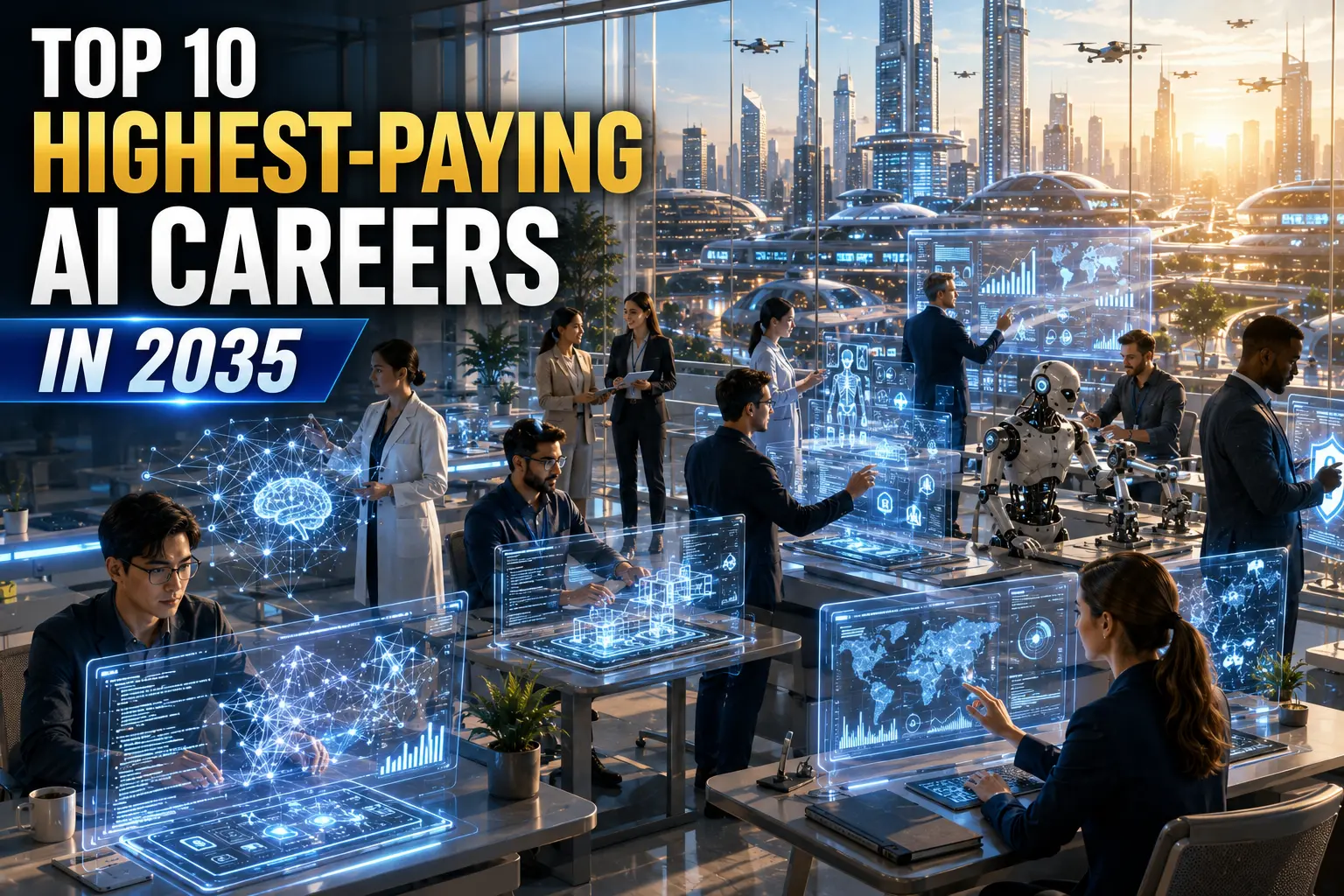
Here are ten AI careers that could become among the highest-paying professions by 2035.
Top 10 Highest-Paying AI Careers in 2035
| Career | Primary Role | Salary Potential | Future Demand |
|---|---|---|---|
| AI Research Scientist | Develop next-generation AI models | ★★★★★ | Very High |
| AI Solutions Architect | Design enterprise AI systems | ★★★★★ | Very High |
| Machine Learning Engineer | Build AI applications | ★★★★★ | Very High |
| AI Robotics Engineer | Build smart robotic systems | ★★★★★ | High |
| AI Cybersecurity Specialist | Protect AI-powered systems | ★★★★★ | Very High |
| AI Healthcare Specialist | Apply AI to medicine and diagnostics | ★★★★★ | High |
| AI Ethics & Governance Director | Ensure responsible AI use | ★★★★☆ | Very High |
| AI Product Manager | Lead AI product development | ★★★★★ | Very High |
| Human-AI Collaboration Consultant | Improve human-AI workflows | ★★★★☆ | High |
| AI Business Strategist | Drive AI transformation | ★★★★★ | Very High |
1. AI Research Scientist
Artificial intelligence begins with research.
AI Research Scientists develop the algorithms and models that make future AI systems more capable, efficient, and reliable. They work on advancing technologies such as large language models, computer vision, robotics, reinforcement learning, and reasoning systems.
Many work for major technology companies, research laboratories, universities, and government agencies.
Their work often influences the future of artificial intelligence itself.
Responsibilities may include:
- Designing new AI architectures
- Improving machine learning algorithms
- Publishing scientific research
- Training advanced AI models
- Collaborating with engineers and data scientists
Because relatively few professionals possess the mathematical, scientific, and research expertise required for this role, competition for experienced AI researchers remains extremely high.
As AI continues expanding into nearly every industry, these specialists are expected to remain among the highest-paid professionals in technology.
2. AI Solutions Architect
Building AI is only part of the challenge.
Organizations also need professionals who can design complete AI systems that integrate smoothly into existing business operations.
This is the role of an AI Solutions Architect.
These experts go beyond programming. They mix tech skills with business strategy to build AI tools that solve actual organizational challenges.
They often oversee projects involving cloud computing, machine learning, automation, cybersecurity, and enterprise software.
Typical responsibilities include:
- Designing AI infrastructure
- Selecting appropriate AI technologies
- Planning enterprise AI adoption
- Coordinating technical teams
- Ensuring systems remain scalable and secure
As more businesses adopt artificial intelligence, demand for experienced AI architects is expected to increase significantly.
Their ability to bridge technology and business makes them particularly valuable.
3. Machine Learning Engineer
Machine Learning Engineers transform AI research into practical applications.
While researchers develop new algorithms, engineers build the systems that millions of people actually use.
These professionals develop recommendation engines, voice assistants, fraud detection systems, autonomous vehicles, predictive analytics platforms, and countless other AI-powered products.
Their work combines software engineering, mathematics, statistics, and data science.
Common responsibilities include:
- Building machine learning models
- Training AI systems
- Optimizing model performance
- Deploying AI applications
- Monitoring system accuracy
As organizations increasingly adopt AI across finance, healthcare, manufacturing, retail, education, and logistics, Machine Learning Engineers are expected to remain among the world’s most sought-after technology professionals.
Developing the technical expertise for roles like this begins with mastering the capabilities that employers increasingly value. Top 10 Skills That Will Matter Most in the AI Economy explores the human and technical skills that will help professionals thrive in an AI-driven workplace.
4. AI Robotics Engineer
Artificial intelligence is allowing robots to become smarter, more adaptable, and increasingly capable of working alongside humans.
AI Robotics Engineers design intelligent machines that can perceive their surroundings, make decisions, and perform complex tasks with minimal human intervention.
These professionals may work in:
- Manufacturing
- Healthcare
- Agriculture
- Logistics
- Warehousing
- Construction
- Autonomous transportation
Instead of simply programming repetitive movements, modern robotics increasingly relies on AI to recognize objects, interpret environments, and continuously improve performance.
As automation expands globally, AI Robotics Engineers are expected to play a central role in building the next generation of intelligent machines.
5. AI Cybersecurity Specialist
Artificial intelligence creates tremendous opportunities.
It also creates new security risks.
Organizations increasingly rely on AI systems to manage sensitive information, financial transactions, healthcare records, and critical infrastructure.
Protecting these systems has become one of the fastest-growing areas within cybersecurity.
AI Cybersecurity Specialists combine traditional security expertise with artificial intelligence to detect threats, identify vulnerabilities, and defend organizations against increasingly sophisticated cyberattacks.
Their work often includes:
- AI-powered threat detection
- Automated security monitoring
- Protecting machine learning models
- Preventing AI data poisoning
- Securing enterprise AI infrastructure
As cyber threats become more advanced, organizations are expected to invest heavily in professionals who understand both artificial intelligence and cybersecurity.
This growing demand makes AI security one of the most promising and potentially highest-paying career paths of the next decade.
The rapid growth of careers like these reflects a broader trend explored in Top 10 New Jobs AI Will Create by 2035, which examines how artificial intelligence is creating entirely new professions across multiple industries.
6. AI Healthcare Specialist
Healthcare is becoming one of the biggest beneficiaries of artificial intelligence.
AI Healthcare Specialists combine medical knowledge with AI technologies to improve diagnosis, treatment planning, drug discovery, and patient care.
Rather than replacing doctors, AI helps healthcare professionals analyze medical images, identify diseases earlier, personalize treatments, and reduce administrative workloads.
These specialists may work with:
- Medical imaging AI
- Predictive healthcare analytics
- Personalized medicine
- AI-assisted surgery
- Clinical decision support systems
As populations age and healthcare systems face increasing pressure, AI is expected to become an essential tool for improving patient outcomes.
Professionals who understand both healthcare and artificial intelligence are likely to be in exceptionally high demand.
7. AI Ethics and Governance Director
As AI becomes more powerful, organizations must ensure it is used responsibly.
AI Ethics and Governance Directors create guidelines to ensure organizations use AI fairly, safely, and in line with the law.
Their responsibilities often include:
- Developing AI governance policies
- Monitoring AI bias
- Protecting user privacy
- Ensuring regulatory compliance
- Managing AI risk
- Advising executive leadership
Governments worldwide are introducing new AI regulations, making governance an increasingly important business function.
Organizations that fail to manage AI responsibly risk legal, financial, and reputational damage.
As a result, professionals who can balance innovation with responsible AI practices may become some of the most valuable leaders in the AI economy.
8. AI Product Manager
Creating successful AI products requires more than technical expertise.
Someone must understand customer needs, market demand, business goals, and technical possibilities.
That is the role of an AI Product Manager.
These professionals coordinate engineers, designers, researchers, marketers, and business leaders to develop AI-powered products that solve real-world problems.
Typical responsibilities include:
- Defining product strategy
- Managing AI development roadmaps
- Prioritizing new features
- Coordinating cross-functional teams
- Measuring product performance
- Understanding customer feedback
As more companies launch AI-powered software and services, experienced AI Product Managers are expected to command premium salaries.
Their ability to connect business strategy with emerging technology makes them highly valuable across industries.
9. Human-AI Collaboration Consultant
The future workplace is unlikely to become humans against AI.
Instead, it will increasingly involve humans working alongside intelligent systems.
Human-AI Collaboration Consultants help organizations redesign workflows, so employees and AI tools complement each other’s strengths.
Their work often focuses on:
- Improving productivity
- Redesigning business processes
- Training employees to use AI
- Integrating AI into existing teams
- Increasing workplace efficiency
Rather than replacing workers, these professionals help organizations determine which tasks should remain human-led and which can be enhanced through automation.
As AI adoption accelerates, demand for experts who understand both technology and human behavior is expected to grow rapidly.
10. AI Business Strategist
Every organization is asking the same question:
How can AI improve our business?
AI Business Strategists help answer it.
These professionals advise executives on how artificial intelligence can increase efficiency, improve customer experiences, reduce costs, and create new revenue opportunities.
Their work may involve:
- Developing AI adoption strategies
- Identifying automation opportunities
- Evaluating AI investments
- Managing digital transformation
- Measuring business impact
- Advising executive leadership
Unlike technical engineering jobs, AI Business Strategists combine business skills with a good understanding of what AI can do.
This combination makes them valuable across finance, healthcare, manufacturing, education, retail, and many other industries.
What these careers have in common
| Career | Technical Expertise | Human Skills Required | Salary Potential |
|---|---|---|---|
| AI Research Scientist | ★★★★★ | ★★★★☆ | ★★★★★ |
| AI Solutions Architect | ★★★★★ | ★★★★★ | ★★★★★ |
| Machine Learning Engineer | ★★★★★ | ★★★★☆ | ★★★★★ |
| Robotics and AI Engineer | ★★★★★ | ★★★★☆ | ★★★★★ |
| AI Cybersecurity Specialist | ★★★★★ | ★★★★☆ | ★★★★★ |
| AI Healthcare Specialist | ★★★★☆ | ★★★★★ | ★★★★★ |
| AI Ethics & Governance Director | ★★★☆☆ | ★★★★★ | ★★★★☆ |
| AI Product Manager | ★★★★☆ | ★★★★★ | ★★★★★ |
| Human-AI Collaboration Consultant | ★★★☆☆ | ★★★★★ | ★★★★☆ |
| AI Business Strategist | ★★★★☆ | ★★★★★ | ★★★★★ |
One clear pattern emerges from these careers.
The highest-paying AI jobs are not based solely on technical expertise.
They also require leadership, communication, strategic thinking, creativity, and sound judgment.
The future belongs to professionals who can combine advanced technology with uniquely human capabilities.
Why developing the right skills matters
Many people assume the highest-paying AI careers require advanced programming or computer science degrees.
While technical knowledge is valuable, employers increasingly seek professionals who can combine AI expertise with problem-solving, communication, adaptability, and leadership.
The rise of AI does not reduce the value of human capabilities.
Instead, it increases the importance of skills that technology cannot easily replicate.
This shift is explored further in Top 10 Skills That Will Matter Most in the AI Economy, which explains why critical thinking, creativity, emotional intelligence, and continuous learning may become some of the most valuable abilities in tomorrow’s workforce.
Whether you plan to become an engineer, researcher, consultant, or executive, investing in these skills can help you remain competitive as AI continues transforming the global economy.
Frequently Asked Questions (FAQs)
Not always.
While many technical AI careers require programming and engineering knowledge, roles such as AI Product Manager, AI Business Strategist, and AI Ethics Director often combine business, communication, leadership, or industry expertise with AI literacy.
AI Research Scientists, AI Solutions Architects, Machine Learning Engineers, and senior AI executives are widely expected to remain among the highest-paying AI careers due to their specialized expertise and strong market demand.
AI is expected to automate parts of software development rather than eliminate the profession.
Software engineers who learn to work effectively with AI tools are likely to become even more productive and valuable.
Many industries—including healthcare, finance, education, and technology—are expected to hire significantly more AI workers over the next decade.
Students can build a strong foundation by learning mathematics, programming, data literacy, critical thinking, communication, and AI tools while continuously developing problem-solving and leadership skills.
References
- World Economic Forum. The Future of Jobs Report.
- International Monetary Fund (IMF). Gen-AI: Artificial Intelligence and the Future of Work.
- Organisation for Economic Co-operation and Development (OECD). Artificial Intelligence, Employment and Skills.
- McKinsey & Company. The Economic Potential of Generative AI.
- Stanford University. AI Index Report.