
Artificial intelligence is transforming the way people work.
Tasks that once required human effort can now be completed in seconds by AI systems capable of writing, analyzing data, answering questions, generating images, and automating repetitive workflows.
This transformation is explored further in How AI Is Changing the Future of Work, which examines how artificial intelligence is reshaping productivity, employment, and the relationship between humans and technology.
As AI becomes more capable, an important question continues to emerge:
Which jobs are most likely to change—or even disappear—over the next decade?
The answer is more complex than many headlines suggest.
AI is unlikely to replace every occupation entirely. Instead, it is expected to automate specific tasks within many jobs, reducing demand for roles built around repetitive, predictable work while increasing demand for uniquely human skills.
The biggest workforce shift may not be humans versus machines.
It may be humans who know how to work alongside AI outperforming those who do not.
Why AI Is Changing Some Jobs Faster Than Others
AI is expected to transform some professions more rapidly than others.
AI performs best when work involves:
- Repetitive processes
- Pattern recognition
- Large amounts of digital information
- Predictable decision-making
- Standardized workflows
Jobs centered on these activities are generally more vulnerable than occupations requiring creativity, leadership, empathy, or complex human judgment.
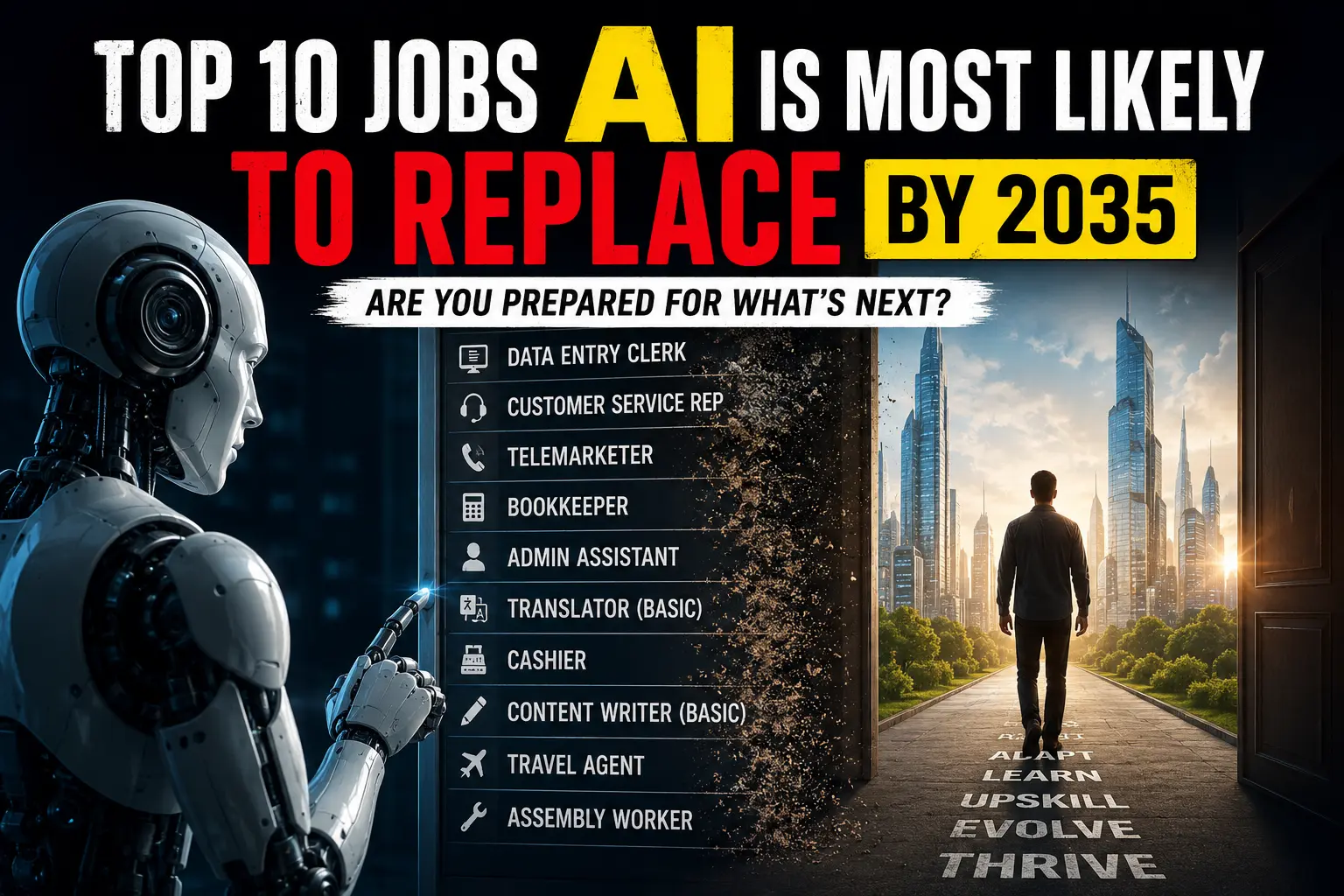
Top 10 Jobs AI Is Most Likely to Replace by 2035
| Job | Why AI Could Replace Many Tasks |
|---|---|
| Data Entry Clerk | AI automates repetitive data processing |
| Customer Service Representative | AI chatbots increasingly handle routine inquiries |
| Telemarketer | AI voice systems automate sales calls |
| Bookkeeper | AI accounting software performs routine financial tasks |
| Administrative Assistant | AI scheduling and document automation reduce manual work |
| Translator (Basic Content) | AI translation tools improve rapidly for common languages |
| Cashier | Self-checkout and AI-powered retail systems reduce staffing needs |
| Basic Content Writer | AI generates routine articles, product descriptions, and summaries |
| Travel Agent | AI planning tools automate booking and itinerary creation |
| Manufacturing Assembly Worker | Robotics and AI increase production automation |
1. Data Entry Clerks
Data entry has long relied on repetitive manual input.
Today, AI systems can automatically:
- Extract information from documents
- Organize databases
- Verify records
- Process invoices
- Reduce human errors
Because these tasks follow structured patterns, they are among the easiest to automate.
2. Customer Service Representatives
AI-powered chatbots have become dramatically more capable.
Many companies now use AI to answer:
- Frequently asked questions
- Product information
- Account inquiries
- Order tracking
- Technical troubleshooting
Human agents will still handle complex or emotionally sensitive situations, but routine support is increasingly automated.
3. Telemarketers
AI voice technology has improved rapidly.
Modern systems can:
- Make outbound calls
- Qualify leads
- Schedule appointments
- Answer customer questions
- Personalize conversations
Sales roles focused entirely on scripted conversations may continue shrinking.
4. Bookkeepers
Bookkeeping traditionally involves standardized financial processes.
AI accounting software can now:
- Categorize expenses
- Generate reports
- Reconcile transactions
- Detect anomalies
- Assist with tax preparation.
Financial professionals will remain important, but routine bookkeeping may require fewer people.
5. Administrative Assistants
Administrative work increasingly overlaps with AI capabilities.
AI can now help:
- Schedule meetings
- Draft emails
- Organize calendars
- Summarize meetings
- Prepare reports
Many administrative responsibilities may shift toward supervising AI systems instead of performing repetitive tasks manually.
6. Translators for Basic Content
Machine translation continues to improve every year.
Routine translation of:
- Product descriptions
- Business documents
- Emails
- Website content
can increasingly be handled by AI.
However, literary translation, legal interpretation, diplomacy, and culturally nuanced communication still require experienced human professionals.
7. Cashiers
Retail automation is expanding worldwide.
Technologies including:
- Self-checkout
- Smart stores
- AI-powered payment systems
- Computer vision
allow customers to complete purchases with minimal staff involvement.
Retail employees may increasingly shift toward customer experience and problem-solving roles.
8. Basic Content Writers
AI can now generate:
- Product descriptions
- News summaries
- Marketing copy
- Technical documentation
- Basic blog articles
However, originality, investigative journalism, strategic analysis, expert opinion, and editorial judgment remain areas where human writers provide significant value.
This distinction is explored further in Top 10 Skills That Will Matter Most in the AI Economy, which explains why creativity, critical thinking, communication, and human judgment are becoming increasingly valuable as AI takes over routine tasks.
9. Travel Agents
AI planning tools now help travelers:
- Compare prices
- Build itineraries
- Book hotels
- Reserve flights
- Recommend destinations
Human travel advisors will continue serving luxury travel, complex itineraries, and specialized experiences.
10. Manufacturing Assembly Workers
Industrial automation continues expanding.
Modern factories increasingly combine:
- Robotics
- Computer vision
- AI quality control
- Automated logistics
Workers may increasingly supervise intelligent machines rather than perform repetitive assembly tasks themselves.
Jobs Are Changing More Than They Are Disappearing
History suggests that technology rarely eliminates work.
Instead, it changes how work is performed.
The introduction of computers did not eliminate accounting.
The internet did not eliminate retail.
Likewise, AI is expected to reshape occupations rather than erase every profession.
Many jobs will evolve instead of disappear.
The Safest Jobs Share Common Characteristics
Jobs that remain resilient typically require qualities that AI struggles to replicate.
These include:
- Creativity
- Critical thinking
- Emotional intelligence
- Leadership
- Complex decision-making
- Relationship building
- Ethical judgment
These human-centered capabilities are explored further in Why Emotional Intelligence Matters More Than Ever in the AI Age and Why Critical Thinking May Become the Most Valuable Skill in the Age of AI.
AI Will Create New Careers Too
Every major technological revolution has created new industries.
The AI economy is already generating demand for:
- AI trainers
- Prompt engineers
- AI auditors
- Machine learning specialists
- AI ethics professionals
- Human-AI workflow designers
- Automation consultants
Many careers that will exist in 2035 have not yet been fully defined.
Preparing for the AI Economy
Instead of asking whether AI will replace your job, a better question may be:
How can you become someone AI makes more productive rather than someone AI replaces?
Workers who continuously learn, adapt, and develop uniquely human capabilities may enjoy significant advantages as technology evolves.
The future is likely to reward people who know how to combine artificial intelligence with creativity, communication, leadership, and sound judgment.
Frequently Asked Questions (FAQs)
No. Most experts expect AI to automate specific tasks rather than eliminate entire occupations.
Jobs emphasizing creativity, leadership, emotional intelligence, complex problem-solving, healthcare, skilled trades, education, and relationship-building are generally considered more resilient.
Yes. New roles involving AI development, oversight, ethics, integration, and human-AI collaboration are already emerging.
Rather than avoiding AI, students should focus on developing adaptable, human-centered skills while learning to use AI effectively.
AI is automating routine writing tasks, but human writers remain essential for investigative journalism, original research, strategic analysis, storytelling, and expert editorial content.
Authority References
For readers interested in further research:
- World Economic Forum — Future of Jobs Report
- OECD — Employment Outlook
- International Labour Organization (ILO)