
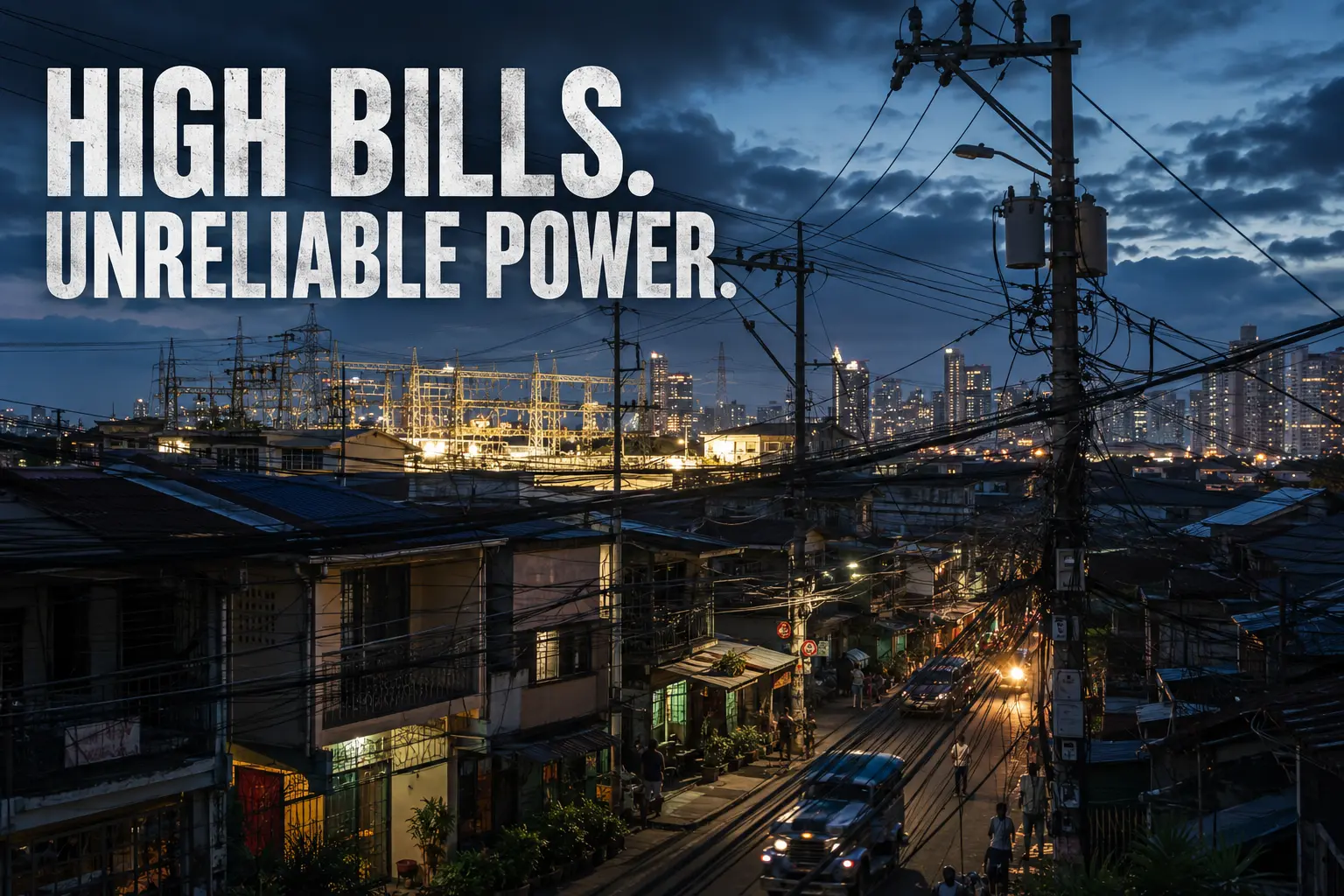
Electricity is one of the biggest recurring expenses for many Filipino households and businesses. Yet high electricity bills do not always come with the reliable service consumers expect.
Across the Philippines, customers continue to deal with brownouts, aging infrastructure, tangled spaghetti wires, voltage problems, and concerns about illegal connections and electricity theft. For businesses, unreliable electricity can also mean lost productivity, damaged equipment, spoiled inventory, and expensive backup power.
This creates a frustrating question: Why is electricity in the Philippines so expensive despite persistent problems with reliability and service?
The answer is more complicated than simply blaming an electricity company. The price consumers pay is influenced by generation, transmission, distribution, system losses, infrastructure, regulation, taxes, and market conditions. At the same time, electricity theft, illegal connections, inefficient infrastructure, and weak accountability can place additional pressure on the system.
The issue has become even more important in 2026, as the government moves to reconsider how system losses are treated on consumers’ electricity bills.
Understanding the problem requires looking beyond the monthly bill and examining how the Philippine power system works, where money is being lost, who is responsible, and what needs to change.
1. The Philippine Electricity Paradox
Electricity is one of the most important services in modern life. Filipino households rely on electricity for lighting, refrigeration, communication, education, cooling, appliances, and increasingly, work and business. Companies need reliable electricity to manufacture products, operate stores, run offices, preserve food, power machinery, and maintain digital systems.
Yet many Filipino consumers face a frustrating contradiction.
Electricity can be expensive while service remains unreliable.
A household may receive a large monthly bill and still experience brownouts, unexpected interruptions, voltage problems, aging infrastructure, and slow restoration after outages. Businesses can face even greater consequences because an interruption can mean lost production, spoiled inventory, disrupted transactions, or additional spending on generators and backup systems.
The concern is not simply that electricity costs money.
The deeper concern is whether consumers are receiving good value, reliable service, and adequate accountability for what they pay.
The Philippines is experiencing a renewed national debate over how electricity system losses should be measured, regulated, and allocated. In July 2026, the Department of Energy (DOE), Energy Regulatory Commission (ERC), and National Electrification Administration (NEA) began working on measures to remove system-loss charges from electricity bills, following a presidential directive. The government has said that legislative changes may be necessary because system-loss recovery is embedded in the Electric Power Industry Reform Act (EPIRA).
This matters because system loss is not a trivial component of the electricity system.
Under the existing framework, distribution utilities and electric cooperatives can recover certain system-loss costs from consumers within regulatory limits. Those losses can include unavoidable technical losses as well as non-technical losses associated with electricity theft, illegal connections, metering problems, and other issues.
The issue becomes even more significant when electricity prices are compared internationally.
In June 2026, the Philippines reportedly recorded an average residential electricity rate of ₱12.43 per kilowatt-hour, with the Department of Energy describing Philippine residential power rates as the highest in Southeast Asia for that month. According to ABS-CBN, the Philippines recorded a slightly higher residential electricity rate than Singapore in June 2026.
That does not mean every Filipino household pays exactly ₱12.43 per kWh. Electricity prices vary by utility, customer category, location, consumption, contracts, and monthly adjustments.
But it highlights why electricity affordability remains a serious national issue.
The bigger question is therefore:
Why can electricity in the Philippines be so expensive while consumers continue to complain about reliability, infrastructure, system losses, illegal connections, and service quality?
The answer requires looking at the entire electricity system rather than blaming one company.
Generation, transmission, distribution, regulation, infrastructure, electricity theft, market structure, and consumer behavior all play different roles.
Understanding those differences is essential if the country wants to lower electricity costs without sacrificing investment and reliability.
2. Why Is Electricity So Expensive in the Philippines?
A Philippine electricity bill is not simply the Cost of producing electricity.
The final amount paid by a consumer can include several components associated with generation, transmission, distribution, system losses, taxes, government charges, and other approved costs.
Generation represents the Cost of producing electricity. This component can be affected by fuel prices, power-plant operations, contracts, market conditions, and the energy mix in the Philippines.
Transmission involves moving electricity through the high-voltage grid.
Distribution is the final stage that delivers electricity through local networks to homes, businesses, factories, schools, and other customers.
This structure means a high electricity bill can have several underlying causes.
For example, expensive fuel can increase generation costs. Transmission constraints can affect the availability and delivery of power. Distribution infrastructure requires maintenance and investment. System losses create another layer of Cost.
The geography of the Philippines also creates structural challenges.
As an archipelagic country, the Philippines operates major electricity grids across Luzon, Visayas, and Mindanao. Efficient electricity delivery requires substantial generation, transmission, and distribution infrastructure, while geographically isolated and off-grid areas may face unique economic, technical, and logistical constraints.
However, geography alone does not explain everything.
The Philippines has also pursued electricity-sector reforms for decades. EPIRA, enacted in 2001, restructured the industry into generation, transmission, distribution, and supply components and established the ERC as an independent regulator. The law also helped create the Wholesale Electricity Spot Market and opened parts of the industry to greater private-sector participation.
For consumers who want a detailed explanation of the different charges appearing on electricity bills, our related article [Why Electricity Bills Are So High in the Philippines] provides a deeper breakdown.
The current article asks a different question.
Even after accounting for legitimate electricity costs, why does the Philippines continue to struggle with high prices and concerns about service reliability?
One important part of the answer is system loss.
3. System Losses: Where Does the Electricity Go?
System loss is one of the most controversial parts of the Philippine electricity bill.
Think of distribution system loss as an electricity gap: power enters the distribution network, but not all of it can be accounted for through legitimate consumption, metering, and billing.
But not all losses are the same.
Technical losses
Technical losses occur because electricity naturally loses energy as it travels through wires, transformers, and other electrical equipment.
Electrical resistance causes some energy to be dissipated as heat.
Transformers and other equipment also have operating losses.
These losses are a normal characteristic of electrical networks.
The goal is therefore not to eliminate technical losses.
The goal is to minimize them efficiently.
Better conductors, appropriately sized transformers, improved network design, modern equipment, better load management, and other investments can reduce technical losses.
Non-technical losses
Non-technical losses are different.
They can involve:
- Electricity theft;
- Illegal connections;
- Meter tampering;
- Inaccurate meters;
- Unregistered connections;
- Administrative errors;
- Billing problems;
- Other unaccounted electricity.
The distinction matters enormously.
A utility cannot reasonably be expected to eliminate the laws of physics.
But preventable electricity theft and operational inefficiency raise a different accountability question.
The current government debate recognizes this distinction.
The Philippine Information Agency reported in July 2026 that the DOE was seeking reforms to prevent utilities from passing certain pilferage and non-technical losses to consumers, while also pursuing longer-term legislative changes involving EPIRA.
What consumers need to know
| Type of loss | What it means | Main way to reduce it |
|---|---|---|
| Technical loss | Physical energy loss in electrical equipment | Modernization and network upgrades |
| Electricity theft | Electricity consumed without proper payment | Detection and enforcement |
| Illegal connection | Unauthorized connection to the network | Inspection and disconnection |
| Meter tampering | Manipulation of electricity measurement | Meter testing and replacement |
| Administrative loss | Billing or registration problems | Better systems and data management |
The controversy arises because the current legal framework permits certain system-loss costs to be passed on to consumers through their electricity bills.
In July 2026, the government said current caps allow private distribution utilities to recover up to 6.5% in system-loss charges, while electric cooperatives can have higher allowable limits depending on classification. Some cooperatives have reported significantly higher total losses.
That raises a reasonable consumer question:
Should customers pay for losses that a utility could reasonably have prevented?
The answer is not necessarily that consumers should pay nothing for system losses.
Some technical losses are unavoidable.
The stronger policy argument is that avoidable losses should create stronger incentives for utilities to improve their systems rather than automatically becoming a cost shared by paying customers.
4. Illegal Connections, Jumpers, and Electricity Theft
Electricity theft is one of the most visible and controversial problems in the distribution system.
In the Philippines, unauthorized connections are commonly referred to as jumpers.
A jumper or other illegal connection can bypass normal metering or connect a consumer directly to the electricity network.
The consequences go beyond unpaid electricity.
Illegal connections can create dangerous electrical conditions.
They can interfere with accurate measurement, overload equipment, damage electrical infrastructure, and increase the risk of fires and electrocution.
They can also distort the economics of the distribution system.
Imagine two households using approximately the same amount of electricity.
One household pays its bill.
The other consumes electricity through an unauthorized connection.
System losses do not eliminate the utility’s underlying costs. The distribution utility still has to maintain its infrastructure and pay for power purchases and other costs associated with delivering electricity through the network. But the utility does not receive the same revenue from the unauthorized consumption.
That creates a loss.
The question then becomes:
Who ultimately bears that loss?
Historically, the regulatory framework has allowed certain system-loss costs to be recovered from consumers.
This is precisely why electricity theft becomes a consumer-protection issue.
The government has recently emphasized the problem. DOE officials have said that non-technical losses are substantially associated with pilferage and unauthorized connections and have pointed to stronger enforcement and automated metering as potential solutions.
Technology could change the equation
Advanced metering infrastructure can potentially help utilities identify unusual consumption patterns more quickly.
The technology can make the system more proactive. Instead of waiting for periodic manual inspections, utilities can compare electricity entering a network with individual meter readings and quickly flag unusual discrepancies for investigation.
That can help detect:
- Abnormal consumption;
- Sudden drops in recorded demand;
- Suspicious meter behavior;
- Unusual neighborhood-level losses;
- Potential unauthorized connections.
But technology is not enough.
There must also be effective enforcement.
If illegal connections are repeatedly discovered but quickly return, the system has a governance problem rather than merely a technology problem.
Consumers therefore deserve answers about loss-reduction performance, not simply assurances that theft exists.
5. Why Are Consumers Still Experiencing Rotational Brownouts?
High electricity prices become considerably more frustrating when households experience brownouts.
But brownouts require careful analysis because not every outage has the same cause.
The Philippine electricity system can be broadly understood through three major operational stages:
Generation → Transmission → Distribution
A shortage at a power plant is different from a transmission failure.
A transmission constraint is different from a broken neighborhood transformer.
A distribution-line problem is different from an outage caused by a typhoon.
Yet consumers experience all of them as one thing:
No electricity.
The National Grid Corporation of the Philippines publishes power-system information covering generation availability, demand, operating conditions, transmission projects, and restoration activities.
This distinction is particularly important when discussing rotational brownouts.
Common causes of power interruptions
| Cause | Where the problem may originate |
|---|---|
| Generation shortage | Power plants / electricity supply |
| Transmission constraint | National transmission network |
| Distribution failure | Local distribution system |
| Transformer failure | Distribution infrastructure |
| Severe weather | Generation, transmission, or distribution |
| Planned maintenance | Utility or grid operator |
| Sudden demand increase | Generation and grid capacity |
| Equipment failure | Multiple parts of the system |
The question should therefore not simply be:
“Why is the electric company causing brownouts?”
It should be:
“Where did the outage originate, why did it occur, and what could have been done to prevent or shorten it?”
That is a much more useful accountability framework.
Reliability can be measured
Electricity reliability is not merely a matter of public perception.
The industry uses technical measures such as SAIFI and SAIDI.
SAIFI measures the average frequency of interruptions experienced by customers.
SAIDI measures the average duration of interruptions.
ERC reliability documents use these indicators when assessing distribution-system performance. An ERC 2026 document, for example, reported a 2024 SAIFI figure of 4.18 for the relevant system-level assessment.
These measures are important because they allow performance to be evaluated over time rather than through isolated anecdotes.
If interruptions are increasing, consumers should be able to see it.
If a utility is improving, consumers should also be able to see that.
6. Spaghetti Wires and Aging Electricity Infrastructure
The phrase “spaghetti wires” has become almost synonymous with urban infrastructure problems in the Philippines.
In many cities, poles can carry a dense web of electrical and telecommunications cables.
The appearance is more than an aesthetic problem.
Poorly organized overhead infrastructure can make maintenance more difficult and can complicate repairs, inspections, and emergency response.
However, responsibility must be assigned carefully.
Not every cable on a utility pole belongs to an electricity distributor.
Telecommunications companies and other network operators also use poles and overhead corridors.
Therefore, blaming the entire spaghetti-wire problem on an electric utility would oversimplify the issue.
The broader infrastructure challenge is more important.
Philippine electricity demand is changing
Households are consuming more electricity as living standards change.
Air conditioning is becoming more common.
Businesses increasingly depend on digital systems.
Data centers and technology-related industries require substantial power.
Electric vehicles and other electrified technologies may increase electricity demand over time.
Manufacturing and industrial expansion also require reliable power.
The grid therefore needs to evolve.
Old conductors, transformers, substations, protection equipment, and control systems cannot simply be maintained indefinitely without modernization.
Infrastructure investment should produce measurable results
A utility can spend money on infrastructure without necessarily producing the reliability consumers expect.
That is why investment should be evaluated through outcomes.
Consumers should be able to ask:
- Did system losses fall?
- Did outage frequency improve?
- Did restoration become faster?
- Did transformer failures decrease?
- Did network capacity increase?
- Did voltage quality improve?
- Did customer complaints decline?
Infrastructure spending is important.
But infrastructure performance is more important than spending alone.
7. Paying More Doesn’t Always Mean Better Service
The most frustrating aspect of electricity service is often the disconnect between cost and experience.
Consumers generally cannot choose between multiple companies operating the same local distribution network.
That is because electricity distribution has characteristics of a natural monopoly.
Building multiple competing sets of poles, transformers, substations, and local distribution lines for the same neighborhood would generally be inefficient.
Instead, distribution utilities operate within regulated franchise areas.
This is why the ERC plays such an important role.
A regulated utility does not face the same direct customer-switching pressure that companies in competitive markets typically experience.
If a customer dislikes a restaurant, they can go somewhere else.
If a customer has several internet providers available, they can potentially switch.
A household usually cannot simply select another company to maintain the distribution wires outside its home.
That means regulation has to provide a substitute for some of the competitive pressure.
What should consumers reasonably expect?
A regulated distribution utility should be expected to provide:
- Accurate metering;
- Transparent billing;
- Reliable electricity;
- Safe infrastructure;
- Timely outage communication;
- Reasonable restoration performance;
- Effective customer service;
- Appropriate maintenance;
- Compliance with regulatory standards;
- Effective loss reduction.
Perfect reliability is impossible.
Typhoons happen.
Equipment fails.
Generation plants require maintenance.
Transmission systems can experience unexpected problems.
But there is an important difference between an unavoidable event and persistent problems that could have been prevented through better planning, maintenance, investment, or enforcement.
That difference is where accountability begins.
8. Who Is Responsible for the Problems?
A serious discussion about Philippine electricity cannot simply blame one company.
The system is too complicated.
Different institutions and companies have different responsibilities.
Generation companies
Generators produce electricity.
Their fuel costs, operating efficiency, maintenance schedules, availability, and contracts can influence electricity prices and supply reliability.
Transmission
The national transmission system moves electricity from generating facilities toward distribution networks and large customers.
Transmission constraints can affect whether available electricity can reach where it is needed.
Distribution utilities
Distribution utilities operate the local networks that deliver electricity to consumers.
This includes lines, transformers, meters, substations, and related distribution infrastructure.
Regulators
The ERC establishes rules and regulates important aspects of the electricity sector.
Its distribution framework covers private distribution utilities, electric cooperatives, government-owned utilities, and other authorized entities.
Consumers
Consumers also have responsibilities.
Electricity theft, illegal connections, meter tampering, unsafe wiring, and other unauthorized activities can damage the system and increase risks.
Government
The government has a broader responsibility to establish rules that promote:
- Affordability;
- Reliability;
- Investment;
- Competition;
- Consumer protection;
- Energy security;
- Infrastructure modernization.
The accountability problem therefore has multiple layers.
Consumers should not steal electricity.
Utilities should aggressively reduce preventable losses.
Regulators should enforce performance standards.
Government should design rules that create the right incentives.
The objective should not be to find one villain.
The goal should be to identify which part of the system is failing and why existing incentives have not been strong enough to correct it.
9. Regulation and Accountability
The Philippines already has an electricity regulator.
The question is whether the regulatory framework produces the outcomes consumers need.
Good regulation has to balance competing interests.
Consumers want lower prices and reliable service.
Utilities need enough revenue to maintain infrastructure and attract investment.
The government wants economic growth and energy security.
Investors need predictable rules.
A regulator has to balance all of these objectives.
System-loss regulation is a good example
Under EPIRA, certain system-loss costs can be recovered through electricity rates within regulatory limits.
The current government debate is challenging that model.
The Philippine Information Agency reported in July 2026 that the DOE was pursuing legislation to repeal the provision allowing system-loss charges, while also considering immediate regulatory measures to tighten existing caps and prevent certain non-technical losses from being passed on to consumers.
The DOE has said the broader reform could potentially reduce electricity costs, although eliminating technical losses would require infrastructure upgrades and time.
The distinction is critical.
Consumers should not be charged for everything automatically
Where losses result from the unavoidable physical dissipation of electrical energy within the network, some recovery of legitimate and efficiently incurred costs may be justified.
But if losses are caused by preventable theft, poor metering, weak enforcement, or avoidable inefficiency, the regulatory incentives should be different.
Otherwise, a utility could theoretically have less financial pressure to eliminate preventable losses if those costs can be recovered from customers.
That is the central policy concern.
Accountability should be measurable
A strong regulatory system should publish comparable data on:
- System-loss rates;
- Technical losses;
- Non-technical losses;
- SAIDI;
- SAIFI;
- Restoration times;
- Complaints;
- Infrastructure investment;
- Compliance violations;
- Consumer refunds or adjustments.
Transparency allows consumers, journalists, policymakers, and investors to evaluate performance.
Without transparent metrics, accountability becomes mostly political rhetoric.
10. Does Limited Competition Keep Electricity Expensive?
When Filipinos debate electricity prices, competition, and utility power, one word frequently enters the conversation: “monopoly.”
But the industry is more complicated than a single monopoly.
EPIRA divided the electricity industry into generation, transmission, distribution, and supply.
Generation and retail supply have competitive mechanisms.
Distribution, however, has natural-monopoly characteristics because building duplicate distribution networks for competing companies in the same neighborhood would generally make little economic sense.
That is why distribution requires regulation.
However, a natural monopoly does not mean unlimited monopoly power.
A regulated monopoly should face strong performance requirements.
If consumers cannot switch distribution providers, regulators have to ensure that the utility has meaningful incentives to control costs and improve reliability.
Competition is expanding in other parts of the market
The ERC has continued to expand retail electricity competition.
In June 2026, the ERC lowered the contestability threshold under Retail Competition and Open Access and its Retail Aggregation Program from 500 kW to 100 kW, allowing more medium-sized commercial and institutional consumers to choose electricity suppliers.
This is significant because it gives more consumers a degree of choice.
The ERC has also maintained market-share limits intended to prevent excessive concentration in electricity generation and supply.
The better policy question is therefore not:
“How do we eliminate every monopoly?”
It is:
“Where can competition work, and where competition cannot work, how do we make regulation strong enough to protect consumers?”
That is a much more realistic approach.
11. The Economic Cost of Expensive and Unreliable Electricity
The cost of electricity extends far beyond the monthly household bill.
Electricity is an input into almost every productive activity.
A bakery needs electricity for ovens and refrigeration.
A restaurant needs it for cooking, lighting, cooling, refrigeration, and payment systems.
A factory needs it to operate machinery.
A hospital needs it for medical equipment.
A hotel needs it for air conditioning, elevators, refrigeration, water systems, and communications.
A call center needs electricity for computers, telecommunications, cooling, and backup systems.
When electricity prices rise, operating costs rise.
When electricity becomes unreliable, businesses face another layer of expense.
Businesses may need backup power
Companies may invest in:
- Generators;
- Fuel storage;
- Batteries;
- UPS systems;
- Solar installations;
- Energy storage;
- Redundant equipment.
These are additional costs that businesses would prefer to spend elsewhere.
A large company may be able to absorb them.
A small business may not.
For a small store, repeated outages can mean lost customers.
For a restaurant, an extended interruption can spoil food.
For a factory, an unexpected shutdown can interrupt production.
For a digital business, an outage can interrupt online services.
The economic impact therefore extends beyond the electricity bill.
Electricity affects national competitiveness
Investors do not look only at electricity prices.
They also ask:
How reliable is the power supply?
How frequently do outages occur?
How quickly are problems restored?
Will the business need expensive backup systems?
Can the electricity network support expansion?
These questions influence investment decisions.
The Philippines therefore faces a strategic problem.
Expensive energy does not stop at the monthly electricity bill. Across Europe, high energy costs are increasingly affecting household budgets, business competitiveness, and industrial policy — a broader trend explored in [Why Energy Prices Are Reshaping the Economy in Europe].
If electricity remains relatively expensive while reliability and infrastructure remain concerns, the country can become less competitive in electricity-intensive industries.
That matters for manufacturing, technology, data centers, tourism, food processing, logistics, and other sectors.
Affordable and reliable electricity is not merely a household issue.
It is economic infrastructure.
12. What Should Change?
The Philippines does not need a single miracle solution.
It needs a better combination of investment, accountability, regulation, enforcement, competition, and transparency.
1. Make system-loss data easier for consumers to understand
Consumers should be able to see how much electricity is lost in their distribution system and how that performance compares with historical levels.
A system-loss number without context is difficult for ordinary consumers to evaluate.
Utilities and regulators should make the information understandable.
2. Separate technical losses from preventable losses
Technical losses are a physical reality.
The goal should be to reduce them to economically efficient levels.
Electricity theft, illegal connections, meter tampering, and avoidable administrative losses are different.
They should not be treated as inevitable.
3. Strengthen enforcement against illegal connections
Illegal connections should be detected and removed efficiently.
Where criminal activity is involved, appropriate legal enforcement should follow.
The objective is not to punish poor communities simply because they are poor.
It is to ensure that electricity theft does not become normalized or transferred to legitimate customers.
4. Modernize metering
Advanced and automated metering can make electricity consumption easier to monitor.
It can help identify unusual patterns and potentially reduce non-technical losses.
The DOE has identified advanced automated metering as one potential tool for reducing non-technical losses.
5. Reward utilities that improve performance
A utility that reduces losses, improves reliability, and provides better service should have incentives to continue doing so.
A utility that persistently performs poorly should face meaningful regulatory consequences.
The system should reward improvement rather than compensate for costs.
6. Modernize distribution infrastructure
Investment should focus on:
- Transformers;
- Substations;
- Conductors;
- Automated switches;
- Protection systems;
- Smart meters;
- Monitoring technology;
- Underground infrastructure where economically justified;
- Network automation.
But investment should also be linked to measurable outcomes.
7. Improve outage transparency
Consumers should know:
- What caused an outage;
- whether it was planned;
- Which part of the system failed;
- How long is the restoration expected to take;
- What corrective action is being taken?
Better information builds trust.
8. Publish reliability performance
SAIDI and SAIFI should be made easier for ordinary consumers to understand.
A customer should be able to determine whether the electricity service in their area is improving or deteriorating.
9. Strengthen consumer protection
Consumers need accessible mechanisms for:
- billing disputes;
- outage complaints;
- service-quality complaints;
- meter disputes;
- connection problems;
- Refund claims.
A regulated utility should be judged not only by its financial viability but also by the quality and reliability of the service it provides.
10. Expand competition where practical
Retail competition can give some consumers more choices.
The ERC’s 2026 decision to reduce the contestability threshold to 100 kW expands that opportunity.
Competition should continue where it can realistically improve prices and service.
Where physical distribution remains a natural monopoly, strong regulation must provide the necessary discipline.
11. Review who bears the cost of avoidable losses
This may be the most important question for meaningful reform.
If a loss is unavoidable, there may be a legitimate argument for cost recovery.
If a loss is preventable, the system should create incentives for the responsible party to reduce it.
Consumers should not automatically become the final payer for every inefficiency in the electricity system.
12. Measure electricity policy by outcomes
Ultimately, the Philippines should judge electricity reform through measurable results.
Are bills becoming more affordable?
Are system losses falling?
Are illegal connections being reduced?
Are outages becoming less frequent?
Is restoration becoming faster?
Is infrastructure improving?
Are businesses becoming more competitive?
Are consumers receiving better service?
Those are the questions that matter.
High electricity costs are only one part of a much broader set of structural challenges facing the country, as discussed in 10 Reasons Why the Philippines Remains a Poor Country.
What Consumers Are Paying For
| Electricity Cost Component | Basic Explanation |
|---|---|
| Generation | Cost of producing electricity |
| Transmission | Cost of moving electricity through the high-voltage grid |
| Distribution | Cost of delivering electricity to customers |
| System Loss | Technical and non-technical electricity losses |
| Taxes and Charges | Government and regulatory charges |
| Other Approved Costs | Other costs permitted under the electricity regulatory framework |
Frequently Asked Questions
Philippine electricity prices reflect several components, including generation, transmission, distribution, system losses, taxes, and other approved charges. The cost of fuel, electricity supply contracts, infrastructure, and market conditions can also influence the final price.
Yes, recent data supports the view that residential electricity prices in the Philippines are among the highest in the region.
The numbers are striking. The Department of Energy reported an average Philippine residential electricity rate of ₱12.43/kWh in June 2026, the highest among ASEAN markets for that month. Still, regional comparisons are not always straightforward, as methodology, customer categories, exchange rates, and the period examined can influence the ranking.
System loss is the difference between electricity entering a distribution system and electricity properly accounted for as output or billed consumption.
It includes technical losses caused by the physical operation of electrical equipment and non-technical losses such as electricity theft, illegal connections, metering problems, and other unaccounted consumption.
No.
Electricity theft is one potential source of non-technical loss.
Technical losses occur naturally as electricity moves through wires, transformers, and other equipment.
The distinction is important because technical losses cannot be eliminated, while some non-technical losses may be preventable.
In Philippine electricity terminology, a jumper refers to an unauthorized connection that bypasses the electricity meter or improperly taps into the distribution network.
Illegal connections can create safety hazards and contribute to electricity losses.
This is one of the central policy questions now being debated in the Philippines.
Some system losses are unavoidable technical losses.
Other losses may result from electricity theft, illegal connections, metering problems, or operational inefficiency.
In July 2026, the government announced efforts to remove system-loss charges from consumer bills and pursue legislative changes involving EPIRA.
The Energy Regulatory Commission (ERC) regulates important parts of the electricity industry, including distribution.
The sector includes private distribution utilities, electric cooperatives, government-owned utilities, and other authorized entities.
No.
Meralco is a major distribution utility, but the Philippines has many other distribution utilities and electric cooperatives.
Furthermore, electricity problems can originate from generation, transmission, distribution, weather, equipment failures, and other parts of the system.
Meralco’s own data tells a more specific story: its actual system loss was 5.85% in 2025. That is why investors, policymakers, and consumers should examine utility-specific figures rather than assume that every provider experiences the same level of losses.
Distribution networks have natural-monopoly characteristics.
It would generally be inefficient to build several competing sets of poles, transformers, substations, and local electricity lines serving the same homes.
That is why distribution utilities generally operate within defined areas under regulatory oversight.
Brownouts can result from generation shortages, transmission constraints, distribution failures, equipment problems, maintenance, severe weather, unexpected demand, and other causes.
The cause of a particular outage should be identified before responsibility is assigned.
SAIDI measures the average duration of electricity interruptions experienced by customers.
SAIFI measures the average frequency of interruptions.
They are important reliability indicators because they allow electricity service to be evaluated using measurable performance rather than anecdotes alone.
“Spaghetti wires” refers to dense and tangled overhead cables commonly seen in some Philippine urban areas.
These cables can include electrical and telecommunications infrastructure, so responsibility cannot automatically be assigned to an electricity distributor.
Yes.
High electricity prices increase operating costs for households and businesses.
Unreliable electricity can create additional costs for generators, batteries, backup systems, spoiled inventory, lost production, and downtime.
This can reduce the competitiveness of Philippine businesses.
Not entirely.
EPIRA separated the electricity industry into generation, transmission, distribution, and supply, with competitive mechanisms in some parts of the sector.
Distribution has natural-monopoly characteristics and is therefore regulated.
Retail competition is also expanding. In 2026, the ERC lowered the contestability threshold to 100 kW, allowing more customers to participate in competitive electricity supply arrangements.
Not realistically.
Technical losses occur naturally whenever electricity travels through electrical infrastructure.
The practical objective is to reduce losses to economically and technically efficient levels while aggressively addressing preventable losses such as theft, illegal connections, inaccurate metering, and operational inefficiencies.
The regulatory system should provide meaningful incentives and consequences based on measurable performance.
Utilities should be evaluated on areas such as system losses, outage frequency, outage duration, restoration times, customer complaints, infrastructure investment, and compliance.
A combination of reforms is needed:
- Lower avoidable system losses;
- Stronger enforcement against electricity theft;
- Modern metering;
- Infrastructure upgrades;
- Improved grid reliability;
- Transparent electricity pricing;
- Stronger consumer protection;
- Better outage reporting;
- Appropriate competition;
- Effective regulation.
The goal should not simply be cheaper electricity.
It should be affordable, reliable, safe, and accountable electricity.
What This Means for Consumers
The Philippine electricity debate should not be reduced to a single question about whether a particular company charges too much.
The more important question is whether the entire electricity system creates the right incentives.
Consumers need electricity providers that invest in infrastructure, reduce preventable losses, enforce against theft, respond quickly to outages, communicate clearly, and provide reliable service.
Utilities also need a regulatory environment that allows them to recover legitimate costs and earn enough to continue investing.
The challenge is finding the balance.
But one principle should remain clear:
Filipino consumers should not be expected to carry avoidable inefficiencies indefinitely.
If electricity is lost because of unavoidable physical limitations, the system needs to manage those costs efficiently.
If electricity is lost through theft, illegal connections, poor metering, or preventable operational inefficiencies, there should be strong incentives to address the underlying problems.
If consumers are paying among the highest electricity rates in the region, they are justified in expecting reliable service, greater transparency, and meaningful improvements in return.
They have the right to demand reliable power, safe infrastructure, transparent pricing, responsive service, and meaningful accountability.