
For generations, career success followed a predictable path.
Study hard.
Earn good grades.
Graduate.
Find a stable job.
Develop experience over time.
This traditional model shaped how millions of people approached education and employment.
However, the modern workforce is entering a period of rapid transformation.
Artificial intelligence, automation, globalization, and technological change are reshaping industries faster than ever before.
Many jobs are not disappearing completely.
Instead, the tasks inside those jobs are changing.
The most valuable workers of the future may not simply be those who know the most information.
They may be those who can think critically, adapt quickly, communicate effectively, and continuously learn.
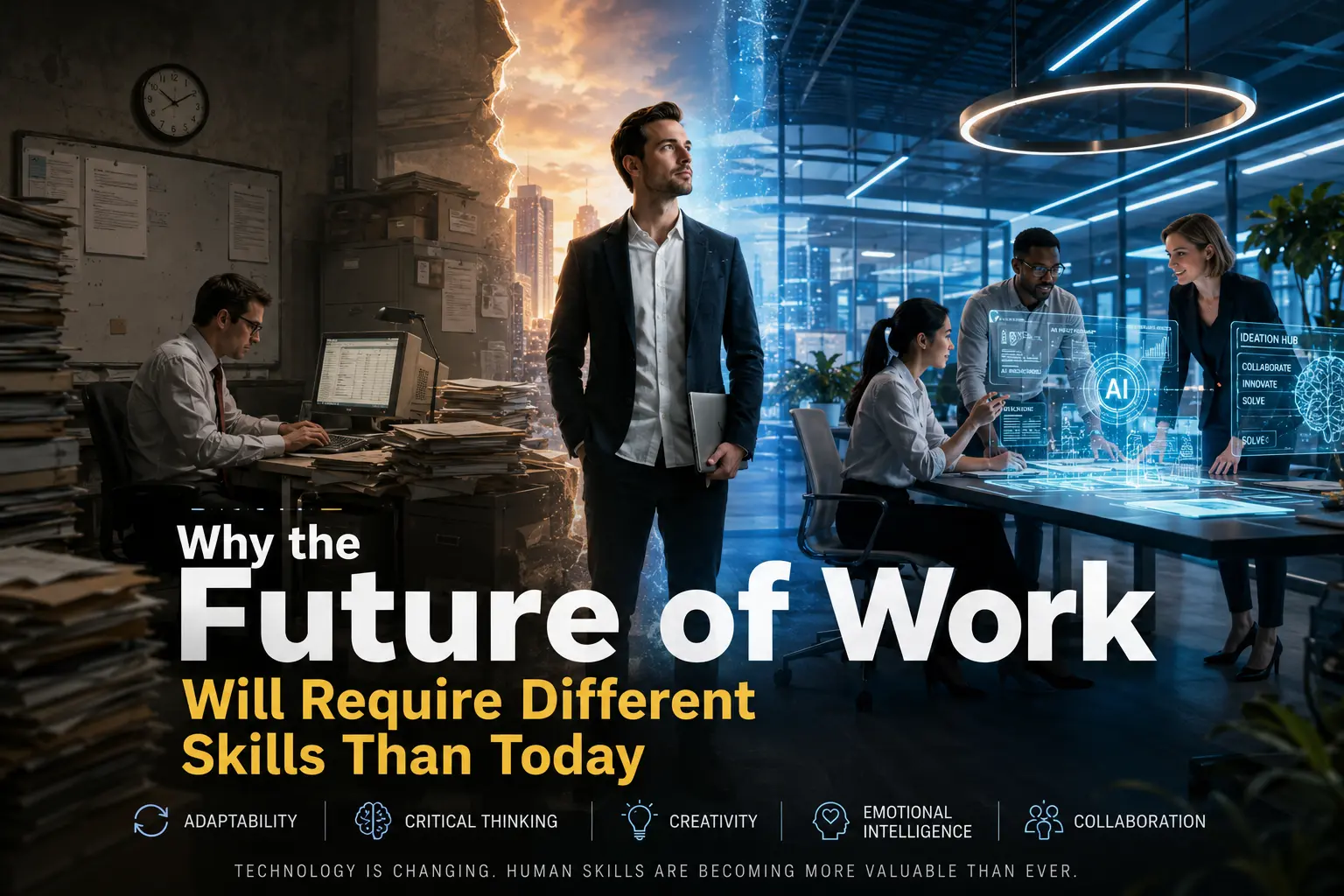
The future of work will require a different combination of human skills and technological abilities.
The Old Definition of Career Success Is Changing
For much of modern history, workers were valued mainly for specialized knowledge and technical skills.
A person trained for a specific profession could often expect that their skills would remain useful for decades.
A degree represented expertise.
Experience represented stability.
But technology has changed the relationship between knowledge and work.
Today, information is easier to access than ever before.
Artificial intelligence can:
- Analyze data
- Generate reports
- Write content
- Assist programming
- Translate languages
- Support research
- Automate repetitive tasks
This does not mean human workers become irrelevant.
Instead, it changes what makes people valuable.
The question is no longer only:
“What do you know?”
It is becoming:
“How well can you use what you know?”
Why Knowledge Alone Is No Longer Enough
Traditional education systems were built around knowledge acquisition.
Students memorized information, completed exams, and demonstrated academic performance.
This approach worked well in a world where information was limited and difficult to access.
But the digital age created a different environment.
Today, anyone can search for information instantly.
The challenge is not finding answers.
The challenge is understanding whether those answers are accurate, useful, and appropriate.
This is why skills like critical thinking are becoming increasingly important.
The changing role of education is explored further in Why Critical Thinking May Become the Most Valuable Skill in the Age of AI, which examines why evaluating information may become more valuable than simply collecting it.
The Rise of Human Skills in an AI Economy
As artificial intelligence becomes more powerful, uniquely human abilities may become more important.
These include:
1. Critical Thinking
AI can generate information.
Humans must decide whether that information makes sense.
Critical thinking allows people to:
- Evaluate evidence
- Identify mistakes
- Question assumptions
- Make better decisions
In a world filled with AI-generated content, judgment becomes a competitive advantage.
2. Communication
The ability to explain ideas clearly remains essential.
Strong communication helps people:
- Work with teams
- Lead others
- Negotiate solutions
- Build relationships
Even the best ideas have limited impact if they cannot be communicated effectively.
3. Emotional Intelligence
Technology can process information.
It cannot fully replace human connection.
Emotional intelligence helps people:
- Understand others
- Manage conflict
- Build trust
- Collaborate effectively
As workplaces become more technology-driven, human relationships may become even more valuable.
This connection between technology and human ability is explored in Why Emotional Intelligence Matters More Than Ever in the AI Age.
4. Adaptability
The future workplace will likely reward people who can change.
Industries evolve.
Tools improve.
New roles appear.
Old skills become outdated.
Workers who can continuously learn may have a major advantage.
Adaptability is becoming one of the most important career skills as uncertainty becomes the norm.
AI Will Not Replace Every Worker — But It Will Change Every Worker
A common discussion about artificial intelligence focuses on replacement.
However, the larger transformation may be different.
AI may not replace people directly.
People who use AI effectively may replace those who do not.
The future workplace may involve collaboration between humans and intelligent systems.
For example:
A writer using AI may produce better research.
A programmer using AI may build faster.
A teacher using AI may personalize learning.
A business leader using AI may make better decisions.
The advantage will belong to those who understand how to combine human judgment with technology.
Why Education Must Prepare Students Differently
Many education systems were designed for previous economic conditions.
The Education System Was Built for Another Era: Why Schools Must Change for the Future explores how education can evolve beyond past models to better prepare students for the demands of the future.
Students were prepared for structured careers where knowledge and repetition were highly valued.
But the modern economy rewards:
- Creativity
- Problem-solving
- Collaboration
- Innovation
- Lifelong learning
This is why education systems around the world are beginning to change.
Why China Is Rebuilding Higher Education Around AI examines how educational institutions are changing to prepare students for an AI-driven future.
The Future Worker: A Combination of Human and Digital Skills
The strongest workers of tomorrow may not be purely technical or purely creative.
They may combine both.
| Skill Category | Why It Matters in the Future Workplace |
|---|---|
| AI Literacy | Helps workers use new technologies effectively |
| Critical Thinking | Helps evaluate information and make decisions |
| Communication | Improves collaboration and leadership |
| Creativity | Helps develop new ideas and solutions |
| Emotional Intelligence | Strengthens teamwork and relationships |
| Adaptability | Allows workers to adjust to change |
| Problem-Solving | Helps handle complex challenges |
The future belongs to people who can learn, adapt, and apply knowledge effectively.
The Shift From Jobs to Skills
One of the biggest changes in the future of work is the move from job-based thinking to skill-based thinking.
In the past, people often asked:
“What job do you have?”
Increasingly, the more important question may become:
“What skills can you provide?”
A single career may involve multiple roles over a lifetime.
Workers may need to continually upgrade their skills rather than rely solely on a single degree or profession.
This shift also explains why many graduates feel unprepared after completing traditional education programs.
Academic achievement remains valuable, but real-world success requires broader abilities.
The Skills That Will Define Future Success
The future worker will likely need a combination of:
Technical Skills
- Digital literacy
- AI understanding
- Data awareness
- Technology adaptation
Human Skills
- Communication
- Leadership
- Creativity
- Critical thinking
- Emotional intelligence
Learning Skills
- Curiosity
- Self-improvement
- Adaptability
- Problem-solving
The ability to continue learning may become the most important skill of all.
The Future of Work Is Already Beginning
The transformation of work is not a distant prediction.
It is already happening.
Companies are changing how they operate.
Schools are reconsidering what students need.
Workers are learning new ways to remain competitive.
The biggest advantage in the future may not belong to those with the most traditional qualifications.
It may belong to those who can combine knowledge, technology, and human abilities.
The future of work will not only require people to know more.
It will require people to think better, adapt faster, and create more.
Frequently Asked Questions (FAQs)
AI is expected to change many jobs by automating certain tasks. However, many experts believe the future will involve humans working alongside AI rather than the complete replacement of all workers.
Critical thinking, adaptability, communication, emotional intelligence, creativity, and AI literacy are expected to become increasingly valuable.
Degrees can still provide valuable knowledge and opportunities. However, employers may increasingly focus on practical skills and the ability to apply knowledge.
Technology and industries change quickly. Adaptable workers can learn new skills and remain effective despite changing conditions.
No. Technical skills remain valuable. However, combining technical abilities with human skills may create the strongest advantage.
Students can prepare by developing problem-solving abilities, communication skills, digital literacy, and the ability to learn continuously.
Future jobs may focus less on repeating information and more on solving problems, creating ideas, and working with advanced technologies.
References
- World Economic Forum — Insights from the Future of Jobs Report
- OECD — Research on future skills, education, and workforce transformation
- UNESCO — Global education transformation and digital learning research
- International Labour Organization (ILO) — Future of work research