
For generations, universities followed a familiar formula.
Students selected a degree.
Spent years mastering a subject.
Graduated.
Then, they entered a workforce that largely rewarded specialized knowledge.
But artificial intelligence is changing that equation.
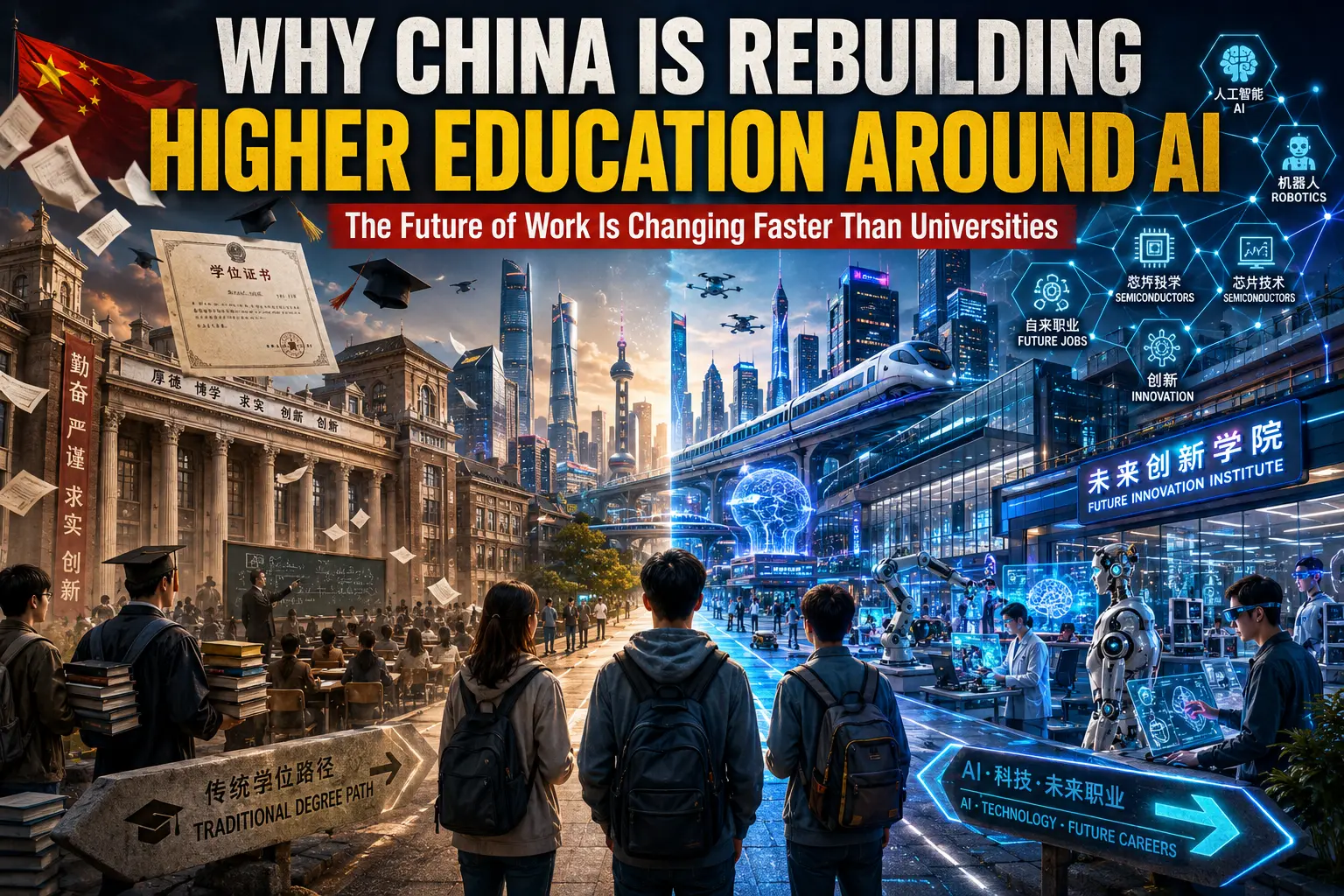
Chinese universities are executing a major education reform—restructuring thousands of degree programs and rapidly scaling AI, robotics, semiconductor, and intelligent engineering courses.
The changes are not happening in isolation.
They reflect a growing belief that the future economy demands a different skill set than traditional ones.
For students, parents, educators, and policymakers globally, China’s transformation raises an important question:
What happens when technology changes faster than education?
A Major Shift in Chinese Higher Education
Ministry of Education data and South China Morning Post reporting confirm that thousands of undergraduate programs at Chinese universities have been revoked, suspended, merged, or restructured.
Many changes targeted programs with weak job demand. New programs now focus on AI, advanced manufacturing, robotics, semiconductors, data science, and intelligent systems.
This restructuring signals a wider initiative to bring education into closer alignment with national economic goals and the evolving demands of the workforce.
For many observers, it represents one of the clearest examples yet of how artificial intelligence is influencing education policy.
Why China Is Making These Changes
The answer is simple:
The economy is changing.
Artificial intelligence is increasingly capable of performing tasks that once required human labor.
Automation is transforming industries.
Digital technologies are reshaping business models.
Entire sectors are evolving faster than traditional educational systems can adapt.
As a result, governments and universities face intensifying pressure to prepare students for roles that may not have existed ten years prior.
China’s response has been direct:
Invest more heavily in programs connected to future industries.
Reduce emphasis on programs with weaker employment outcomes.
Strengthen national competitiveness in emerging technologies.
The Future Workforce Is Already Taking Shape
The debate is not simply about technology.
It is about employability.
Many of today’s students may eventually work in careers that do not yet exist.
Others may see their professions transformed by AI tools.
China is merely one node in a much broader global pattern.
Around the world, education systems are rethinking how they prepare students for the future.
How Schools Around the World Are Preparing Students for the Future of Work explores how countries are redesigning education to emphasize adaptability, critical thinking, digital literacy, and real-world skills.
The common theme is clear:
Preparing students for the future increasingly means teaching them to adapt to change.
Degrees Under Pressure
The restructuring has sparked debate about whether certain degrees are becoming less valuable.
Some observers point to fields such as:
- Translation
- Administrative support
- Routine office work
- Basic content production
- Repetitive analytical tasks
Technology has not eliminated these professions.
However, it is changing how they operate.
AI-powered tools can now translate text, summarize information, generate content, and automate routine workflows in seconds.
As technology evolves, workers in these fields must continuously upskill to stay competitive.
The challenge facing universities is determining which skills students will need most in the coming decades.
Growing Skills vs Declining Advantages
| Growing Skills | Why Demand Is Increasing |
|---|---|
| AI Literacy | AI tools are becoming part of everyday work |
| Critical Thinking | Human judgment remains essential |
| Problem Solving | Complex challenges require human reasoning |
| Adaptability | Industries change rapidly |
| Creativity | Innovation remains difficult to automate |
| Emotional Intelligence | Human relationships still matter |
Are Traditional Degrees Becoming Obsolete?
Not necessarily.
The issue is more nuanced.
History, literature, languages, arts, and social sciences continue to provide valuable knowledge and perspectives.
Yet universities are increasingly expected to prove graduates can thrive in rapidly evolving labor markets.
Many institutions are now blending traditional disciplines with technology-focused skills.
Examples include:
- Digital humanities
- AI-assisted design
- Computational linguistics
- Data-driven social science
- Technology-enabled creative industries
Rather than facing extinction, many academic disciplines are adapting and redefining their scope.
How Other Countries Are Responding
China is not the only country rethinking education.
Worldwide, governments are reassessing how schools and universities can better adapt students to technological change.
Finland has gained international attention for emphasizing student well-being, teacher quality, and meaningful learning experiences over excessive testing and academic pressure.
Why Finland’s Students Spend Less Time in School Yet Still Succeed explores why many educators view Finland as a model for modern education reform.
Other countries are investing in:
- Digital literacy
- Coding education
- STEM programs
- AI awareness
- Project-based learning
- Career readiness initiatives
The approaches differ, but the goal remains similar:
Prepare students for a future that is becoming increasingly difficult to predict.
What This Means for Students
The lesson is not that students must bypass specific degree programs.
Lifelong learning is becoming essential.
Students entering university today may need to:
- Learn continuously
- Adapt to new technologies.
- Build transferable skills
- Develop interdisciplinary knowledge
- Embrace career flexibility
A degree may still matter.
But the ability to evolve may matter even more.
What This Means for Parents
Parents often encourage children to pursue stable careers.
We face a paradox wherein stability itself has become unstable.
Jobs once considered secure can be transformed by technology.
New opportunities can emerge unexpectedly.
Parents may increasingly need to focus less on specific professions and more on helping children develop adaptable skills that remain valuable regardless of industry changes.
The Human Skills AI Cannot Easily Replace
One of the most surprising outcomes of the AI revolution is that human skills may become more valuable, not less.
Artificial intelligence excels at processing information.
Humans excel at understanding people.
Empathy.
Communication.
Leadership.
Collaboration.
Trust.
These qualities remain difficult to automate.
This is explored further in Why Emotional Intelligence Matters More Than Ever in the AI Age, which examines why emotional intelligence may become one of the most valuable skills of the future.
Is Traditional Education Still Relevant in the AI Age?
As artificial intelligence becomes more powerful, many people are questioning traditional educational models.
If information is instantly accessible, what should schools teach?
If AI can generate answers, what knowledge matters most?
These questions are becoming increasingly important.
Is School Still Relevant in 2030? explores how education may evolve as technology reshapes the way people learn, work, and develop skills.
The fix may not involve scaling back education.
It may be a different education.
Why This Matters More Than Ever
China’s university reforms are about more than degree programs.
These developments signal a broader transformation in societal attitudes toward knowledge, skills, and economic competitiveness.
For decades, education prepared students for a relatively predictable world.
That world is changing.
Artificial intelligence is accelerating technological transformation.
Universities are adapting.
Governments are responding.
Employers are redefining workforce needs.
There is no longer any question about whether education will change.
The question is how quickly institutions can adapt to the future already taking shape.
Authority References
The ideas discussed in this article are supported by research and reporting from:
- UNESCO Education Programs
- OECD Education Directorate
- South China Morning Post reporting on China’s university restructuring and AI-related education reforms
These organizations regularly publish research on future workforce skills, educational transformation, technological disruption, and labor-market trends.
Frequently Asked Questions (FAQs)
China is aligning higher education with future workforce needs, technological development, and national economic priorities, particularly in areas such as AI, robotics, semiconductors, and advanced manufacturing.
Recent reporting indicates that thousands of undergraduate programs have been revoked, suspended, merged, or restructured as universities adapt to changing demands.
AI is changing how many professions operate, but most experts argue that degrees are evolving rather than becoming completely obsolete.
AI, robotics, semiconductors, data science, intelligent engineering, and advanced technology programs are among the fastest-growing areas.
For many careers, university remains valuable. However, lifelong learning, adaptability, and practical skills are becoming increasingly important alongside formal education.
Critical thinking, emotional intelligence, adaptability, creativity, communication, and problem-solving are consistently identified as high-value skills.
Yes. Many countries are expanding technology education, digital literacy, career readiness programs, and AI-related learning initiatives.
It highlights a growing global challenge: preparing students for an economy increasingly influenced by artificial intelligence, automation, and rapid technological change.