
Pakistan is a country of incredible potential.
Rich history. Strategic location. Young population.
Yet the nation faces deep, structural challenges that affect millions.
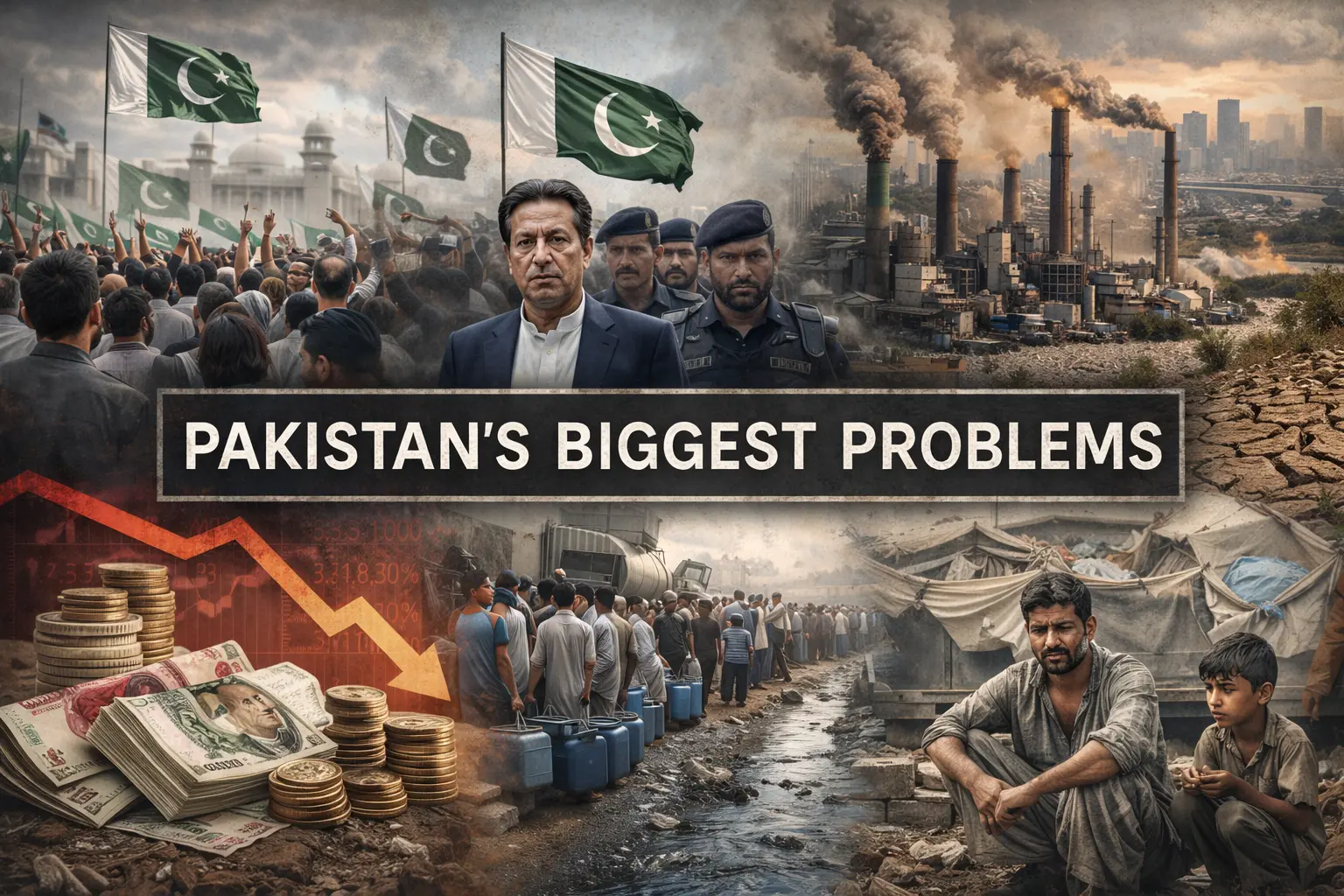
From political instability to energy crises, from social inequality to environmental disasters, these issues shape daily life in Pakistan.
Understanding them is key — for policymakers, investors, and citizens alike.
Here, we examine the 10 biggest problems in Pakistan, using data and evidence to highlight each challenge.
Here are The 10 Biggest Problems in Pakistan
Political Instability
Frequent changes in government and weak institutions limit effective governance.
Policy instability often leaves citizens and businesses facing uncertainty.
Pakistan ranked 140th out of 180 countries in the 2025 Corruption Perceptions Index, according to Transparency International.Economic Crisis
High inflation, low growth, and mounting debt make everyday life difficult for ordinary Pakistanis.
GDP growth in Pakistan slowed to 2.4 percent in 2025, according to the World Bank (2025).
Unemployment and underemployment remain persistent challenges.Energy Shortages
Load-shedding and power shortages disrupt households and industries.
Dependence on imported energy increases fiscal pressure.
Energy shortages cost industries billions annually (Asian Development Bank, 2024).Poverty and Inequality
Many people in the country continue to live in poverty.
24% of the population lives below poverty levels (UNDP, 2024), with rural areas disproportionately affected.
Regional and urban-rural inequalities exacerbate social tensions.Corruption and Governance Weakness
Weak institutions hinder service delivery and accountability.
Corruption reduces transparency and limits economic development (Transparency International, 2025).Education System Challenges
Low literacy rates, inadequate infrastructure, and gender gaps limit human capital development.
Only 60% of adults in rural areas are literate (Pakistan Bureau of Statistics, 2025).
School dropout rates remain high, particularly among girls.Healthcare System Weaknesses
Millions are affected by limited access to quality healthcare, a shortage of doctors, and high medical costs.
Health systems face major pressure whenever public health emergencies occur (Pakistan Health Ministry, 2025Security and Terrorism
Internal conflicts, extremist activities, and border tensions impact safety and economic growth.
Terrorist attacks have declined but remain a persistent threat (SIPRI, 2025).Environmental Issues
Air pollution, water scarcity, deforestation, and climate-related disasters threaten livelihoods.
Pakistan faces severe water scarcity, affecting nearly 40% of the population (Pakistan Environmental Protection Agency, 2025).Population Pressure and Urbanization
Rapid population growth strains infrastructure, housing, transportation, and public services.
Mega-cities like Karachi and Lahore face congestion, pollution, and slum expansion (UN-Habitat, 2024).
Data Snapshot
| Problem | Impact | Current Trend |
|---|---|---|
| Political Instability | Weak governance, policy disruption | Frequent government changes, low institutional trust (Transparency International, 2025) |
| Economic Crisis | High inflation, unemployment, and rising debt | GDP growth slowed to 2.4% (World Bank, 2025) |
| Energy Shortages | Household and industrial disruptions | Load-shedding remains frequent (ADB, 2024) |
| Poverty & Inequality | Low living standards, social unrest | 24% population is below the poverty line (UNDP, 2024) |
| Corruption & Governance Weakness | Inefficient services, low transparency | Persistent corruption (Transparency International, 2025) |
| Education Challenges | Low literacy, high dropout rates | Rural and female enrollment lagging (Pakistan Bureau of Statistics, 2025) |
| Healthcare Weaknesses | Limited access, high disease burden | Facilities are under-resourced (Pakistan Health Ministry, 2025) |
| Security & Terrorism | Safety risks, economic slowdown | Extremist attacks reduced but persist (SIPRI, 2025) |
| Environmental Issues | Health hazards, resource scarcity | Pollution and water scarcity are increasing (Pakistan EPA, 2025) |
| Rising Population and Rapid Urbanization | Infrastructure strain, slum expansion | Rapid urban growth (UN-Habitat, 2024) |
Frequently Asked Questions (FAQs)
What are the main problems in Pakistan today?
Pakistan faces political instability, economic crises, energy shortages, social inequality, environmental challenges, and security concerns.
Why is Pakistan experiencing economic challenges?
Factors include high inflation, fiscal deficits, energy shortages, unemployment, and heavy debt burdens.
In what ways does corruption affect development in Pakistan?
Corruption weakens institutions, reduces transparency, hinders public service delivery, and limits economic growth.
What are the most urgent environmental issues in Pakistan?
Air and water pollution, deforestation, water scarcity, and climate-related disasters such as floods and heatwaves.
How does the education system in Pakistan influence economic and social development?
Low literacy rates, gender gaps, high dropout rates, and regional disparities limit human capital development.
What security challenges does Pakistan face?
Internal conflicts, terrorism, extremist activity, and regional tensions threaten stability and economic progress.
How can Pakistan address these problems?
Strengthening institutions, implementing economic reforms, investing in education and healthcare, and improving governance and accountability.
- The 10 Biggest Problems in Israel
- The 10 Biggest Problems in France
- The 10 Biggest Problems in Italy
References
- Pakistan Bureau of Statistics – National demographic, employment, and education statistics
- Pakistan Environmental Protection Agency – Environmental reports, climate data