
Europe has long been associated with economic stability, strong social protections, and a high quality of life.
For years, workers followed a predictable pattern. Education led to jobs. Jobs brought financial security. That security made it possible to own a home, support loved ones, save for retirement, and build lasting stability.
But the usual way to achieve financial security is now less predictable, laying the groundwork for new difficulties.
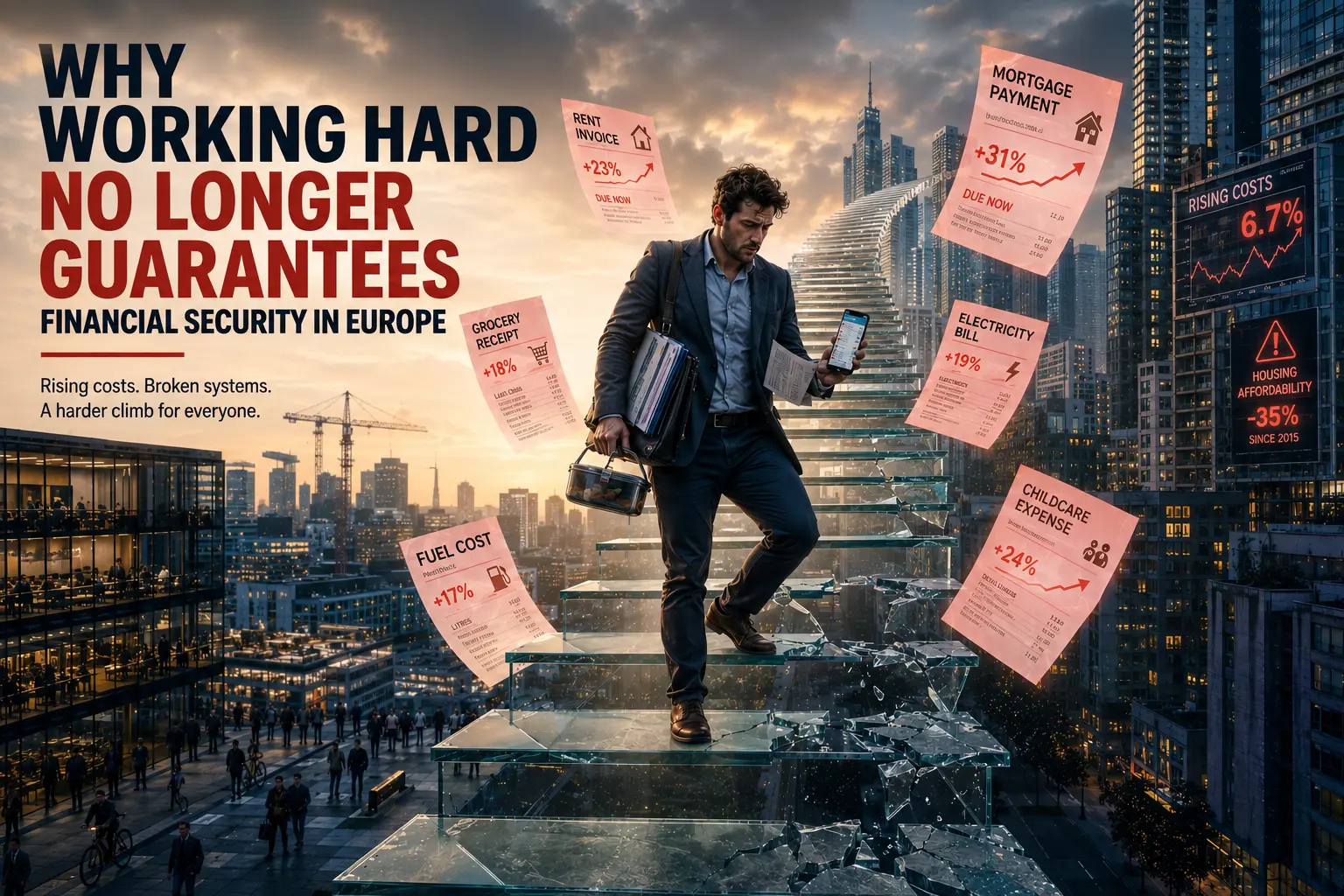
Throughout Europe, many households still have jobs and work hard, but financial pressure continues. Housing costs have jumped, inflation has lowered buying power, energy bills remain unpredictable, and saving money has become harder.
This has created a common belief that working hard alone no longer ensures financial security.
This issue ties into discussions in Why Europe Is Becoming Harder to Afford for Ordinary People, The Cost of Living Crisis in Europe Is Getting Worse, and Why Europe Is Entering a New Era of Economic Uncertainty, where structural pressures increasingly affect ordinary households.
Europe’s Money Security: A Quick Look
| Factor | Historical Expectation | Current Reality |
|---|---|---|
| Employment | Stable income leads to security | Employment does not always protect purchasing power |
| Housing | Home ownership is possible for workers. | Housing costs are rising faster than incomes |
| Savings | Regular savings possible | Household budgets are getting tighter. |
| Energy | Predictable utility costs | Greater price volatility |
| Family Formation | Financial stability supports families | Rising costs delay major life decisions |
| Retirement | Long-term planning achievable | Saving for retirement is getting harder. |
Factors That Influence Financial Security Across Europe
| Indicator | Current Trend | Source |
|---|---|---|
| Housing Affordability | Declining in many major cities | OECD |
| Consumer Prices | Elevated compared to pre-pandemic levels | Eurostat |
| Energy Costs | Remain volatile | International Energy Agency |
| Real Wage Growth | Uneven across Europe | European Commission |
| Household Purchasing Power | Under pressure in several economies | World Bank |
1. Rising Costs Are Outpacing Income Growth
Many European workers continue to receive wage increases.
But pay increases usually fall short of rising costs.
Households increasingly face higher costs for:
- Housing
- Food
- Transportation
- Utilities
- Childcare
- Insurance
Even when incomes rise, purchasing power can remain stagnant or decline.
This creates a widening gap between what people earn and their actual standard of living.
2. Housing Has Become a Major Financial Obstacle
Housing represents one of the largest expenses for most households.
In many European cities:
- Home prices have increased sharply
- Rents continue rising
- Mortgage costs remain elevated
- Housing supply remains constrained.
This means many workers now spend a larger part of their pay on housing than their parents or grandparents did.
This challenge is examined in “Why Housing Is Becoming Unaffordable Across Europe,” which shows that affordability pressures increasingly affect renters and buyers alike.
3. Employment No Longer Guarantees Wealth Building
Historically, steady employment often allowed workers to accumulate assets over time.
Today, many households report difficulty building wealth despite full-time employment.
Several reasons play a role:
- Higher living costs
- Reduced saving capacity
- More expensive housing
- Increased financial uncertainty
For some workers, keeping their current lifestyle has become the main goal.
4. Inflation Has Reduced Purchasing Power
Inflation affects financial security even when employment remains stable.
When costs rise more quickly than wages, families experience:
- Reduced purchasing power
- Smaller savings contributions
- Lower discretionary spending
- Greater financial stress
Although inflation rates have moderated in some countries, the cumulative effect of recent price increases continues to influence household finances.
5. Energy Costs Affect More Than Utility Bills
Energy prices influence much more than household electricity costs.
They affect:
- Transportation expenses
- Manufacturing costs
- Food production
- Business operating expenses
- Consumer prices
Because energy impacts nearly every sector of the economy, price volatility can spread financial pressure throughout society.
Why Energy Prices Are Reshaping the Economy in Europe explores how these effects extend far beyond household budgets.
6. Saving Money Has Become More Difficult
Financial security depends heavily on savings.
Savings protect against:
- Emergencies
- Job disruptions
- Unexpected expenses
- Economic downturns
Yet families in numerous locations say basic costs are growing as a part of their monthly income.
When less money can go toward savings, long-term financial stability suffers.
7. Younger Generations Face Additional Challenges
Younger Europeans often face several barriers at the same time.
These include:
- Higher housing costs
- Rising rents
- Slower asset accumulation
- Greater competition in labor markets
- Delayed financial independence
This means many young people hit important financial markers later than past generations did.
8. Financial Pressure Influences Family Decisions
Economic conditions increasingly affect personal decisions.
Researchers and policymakers have linked affordability pressures to:
- Delayed marriage
- Later homeownership
- Lower birth rates
- Smaller households
Financial security is becoming a key factor in long-term family planning.
9. Regional Differences Are Growing
Europe is not experiencing these challenges uniformly.
Some regions offer:
- Higher wages
- Stronger labor markets
- Better public services
However, these areas often also experience:
- Higher housing costs
- Greater competition
- Increased living expenses
This creates a growing divide between available opportunities and what people can afford.
10. Financial Security Is Becoming a Structural Challenge
Many economists increasingly view these trends as structural rather than temporary.
Several forces are reshaping Europe’s economic landscape:
- Demographic aging
- Housing shortages
- Energy market pressures
- Slower productivity growth
- Global economic uncertainty
Together, these factors create a situation where achieving financial security takes more work than in past decades.
How Money Safety Is Being Transformed
| Area | Current Pressure | Potential Long-Term Impact |
|---|---|---|
| Housing | Rising costs | Lower homeownership |
| Savings | Reduced capacity | Less financial resilience |
| Family Formation | Higher expenses | Demographic decline |
| Retirement | Lower contributions | Future income insecurity |
| Purchasing Power | Inflation pressure | Reduced living standards |
| Workforce | Cost pressures | Greater economic uncertainty |
Frequently Asked Questions (FAQs)
Many households struggle more due to expensive homes, inflation, rising energy costs, and wages that grow too slowly.
Many countries saw pay increases, but families still struggled as costs outpaced income growth.
Housing is often the largest household expense, making affordability a critical determinant of financial security.
Energy influences transportation, manufacturing, food production, and household expenses, affecting overall living costs.
Many younger adults face higher housing costs, slower wealth accumulation, and delayed financial independence compared with previous generations.