
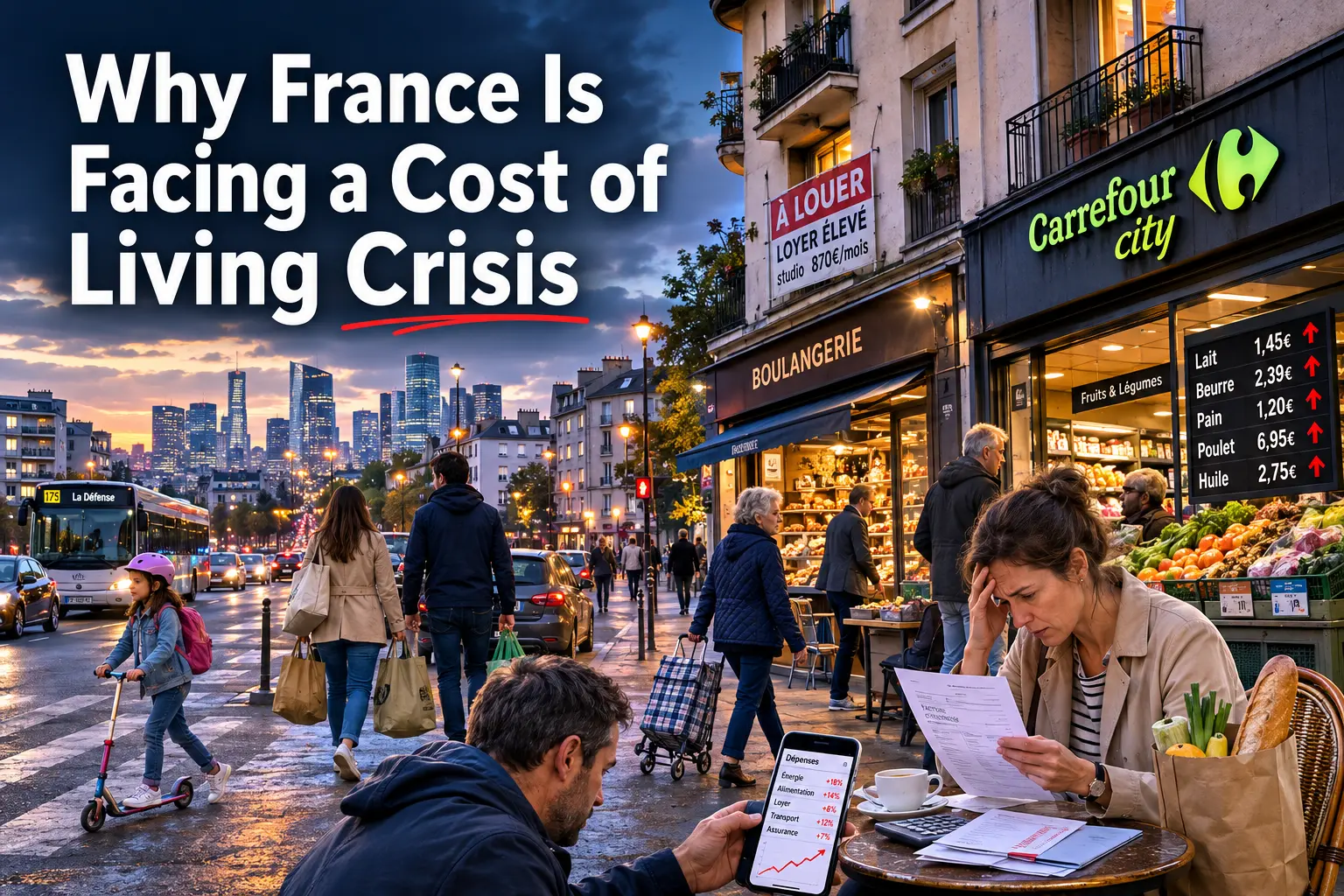
Even as inflation slows, millions of French households continue to feel financially squeezed. Let’s dive into why everyday life is becoming more expensive across France.
France remains one of Europe’s largest and wealthiest economies, with extensive public services, a strong social safety net, and relatively high household incomes. Yet for many households, everyday life has become noticeably more expensive.
The important point is that France does not need extremely high inflation today for people to continue feeling a cost-of-living squeeze.
Prices can rise more slowly while remaining at a much higher level than they were several years ago. That distinction helps explain why official inflation figures can improve while households continue to feel financially pressured.
The result is a growing gap between what people earn and what everyday life actually costs.
France Under Pressure: What Is Driving the Cost-of-Living Crisis?
A cost-of-living crisis occurs when essential expenses consume an increasingly large share of household income, leaving people with less money for savings, leisure, investment, and discretionary spending.
For French households, the pressure comes from several areas simultaneously:
Why Is the Cost of Living Rising in France?
| Cost Category | What Is Driving Costs Higher? | Why It Matters to Households |
|---|---|---|
| Housing | High rents, limited housing supply, and expensive property markets in major cities | Housing is difficult to reduce because households need a place to live, making it one of the largest fixed expenses |
| Food | Higher accumulated food prices, production costs, transportation, and retail costs | Grocery expenses occur frequently, so even moderate price increases can significantly affect monthly budgets |
| Electricity & Heating | Volatile energy markets, fuel costs, supply conditions, and policy changes | Higher utility costs can place a heavier financial burden on lower-income households. |
| Transportation & Fuel | Fuel, public transport, vehicle ownership, and vehicle maintenance costs | Commuters who rely on cars often face high recurring costs. |
| Insurance | Higher claims costs, repairs, healthcare-related expenses, and operating costs | Rising premiums increase household expenses even when people do not increase their consumption |
| Childcare & Education | Regional differences, childcare availability, fees, and related household expenses | Families with children have less disposable income available for other needs |
| Taxes & Social Contributions | France’s extensive tax and social-protection system | These finance major public services but also affect how much income households have available to spend |
| Everyday Services | Higher wages, rents, energy costs, and other business expenses | Service prices can remain elevated because businesses gradually pass higher operating costs on to consumers |
Not every category is increasing at the same rate. In fact, inflation has slowed considerably compared with the peaks seen in recent years.
But slower inflation does not mean prices have returned to their previous levels.
Inflation vs. the Cost of Living
Imagine a basket of essential household goods that once cost €100.
If prices rise to €120, and inflation later slows, that basket may increase to €122 instead of €125.
Inflation has improved.
But households are still paying 22% more than before.
That accumulated increase remains embedded in monthly budgets long after inflation begins cooling.
This is why both of these statements can be true at the same time:
Inflation is falling.
Everything still feels expensive.
Purchasing Power Is the Real Problem
The most important concept in understanding France’s cost-of-living pressures is purchasing power.
Purchasing power measures what households can actually buy with their income after accounting for changes in prices.
If wages rise by 2% while household expenses rise by 3%, purchasing power falls.
If wages rise faster than prices, purchasing power improves.
This is why the cost of living is fundamentally different from inflation alone.
Many French workers have received wage increases over the past few years, but rising housing costs, food prices, utilities, insurance, and transportation have often absorbed much of that additional income.
Why It Matters
A household earning €3,000 per month may technically earn more than before, yet still feel financially worse off because:
- Rent has increased
- Groceries cost more
- Heating and electricity remain expensive
- Insurance premiums continue rising
- Transportation consumes a larger share of income
The result is a growing feeling that incomes are rising on paper, while financial flexibility is shrinking in reality.
Housing Is Becoming the Biggest Financial Burden
Housing is arguably the most significant cost-of-living pressure because it is an essential expense.
People can postpone holidays or reduce restaurant visits.
They cannot simply stop paying rent or their mortgage.
Major French cities—including Paris, Lyon, Marseille, and Toulouse—continue to face significant affordability pressures as housing demand outpaces supply.
High rents force many households to make difficult trade-offs between:
- Living close to work
- Having enough living space
- Accessing quality schools
- Reducing commuting costs
- Staying within budget
For lower-income households, housing can consume such a large share of income that other essentials become increasingly difficult to afford.
Housing is no longer just a real estate issue—it has become one of France’s defining economic challenges.
Related reading: Why Housing Is Becoming Increasingly Unaffordable in France
Food Prices Still Hurt Household Budgets
Although food inflation has eased, grocery prices remain well above their pre-surge levels.
Food is particularly important because it is one of the few expenses households experience every week.
Even small increases become highly visible over time.
For many families, rising supermarket costs have changed purchasing habits by encouraging:
More private-label products
Reduced restaurant spending
Bulk purchasing
Greater price comparison between retailers
Lower-income households are especially vulnerable because food represents a larger share of their disposable income.
The same inflation rate can create very different financial pressures depending on a household’s financial situation.
Energy Costs Continue to Shape Everyday Life
Energy remains one of the most unpredictable household expenses in France.
Electricity, heating, gas, and fuel prices can fluctuate rapidly because they are influenced by:
International oil markets
Natural gas prices
Geopolitical tensions
Supply disruptions
Electricity market conditions
Government energy policies
Higher energy costs create a double burden.
Households pay more directly through utility bills and fuel.
Businesses also face higher operating costs, which can eventually lead to more expensive goods and services for consumers.
Energy therefore affects almost every part of the economy—not just household electricity bills.
Why Services Are Becoming More Expensive
The cost-of-living story is no longer just about food and energy.
Services are becoming an increasingly important source of inflation, including:
Insurance
Public transportation
Communications
Hospitality
Personal services
Professional services
Unlike energy prices, which can fall relatively quickly, service prices tend to adjust more gradually because they are closely tied to wages, rents, and operating costs.
This means households may continue experiencing rising everyday expenses even after headline inflation improves.
Why the Crisis Feels Worse Than the Inflation Rate
Many people wonder why the official inflation rate appears relatively modest while everyday life still feels expensive.
There are several reasons.
People remember previous price increases
Households compare today’s prices with what they paid several years ago—not just with last year.Essential expenses matter more
Rent, groceries, electricity, insurance, and transportation dominate household budgets far more than luxury goods.Housing costs vary dramatically
A renter in Paris experiences inflation very differently from a homeowner in a smaller city.Income growth is uneven
Higher-income professionals often have greater financial flexibility, while lower- and middle-income households have fewer ways to absorb rising costs.Savings only provide temporary relief
Many families initially responded to higher prices by using savings, but that strategy becomes difficult to sustain over time.
Rising Living Costs Are Putting Pressure on France
The crisis extends far beyond household budgets.
Consumer spending accounts for a significant share of economic activity in France. When households become more cautious, they often postpone:
Home renovations
Car purchases
Travel
Dining out
Furniture and electronics
Entertainment spending
Reduced consumption affects businesses, employment, and overall economic growth.
The cycle becomes self-reinforcing:
Higher living costs → Lower purchasing power → Reduced consumer spending → Slower economic growth.
This is why the cost-of-living crisis in France extends beyond a social issue and has become a major economic challenge.
What Matters Most
The Cost-of-Living Crisis in France Goes Beyond Inflation. The deeper challenge is the accumulated impact of higher housing costs, energy volatility, rising service prices, and uneven wage growth on household purchasing power.
Even as inflation cools, many French families continue asking the same question:
The answer lies not in a single price increase, but in the combined pressure of multiple essential expenses rising faster than many households can comfortably absorb.
Wages Are Not Always Keeping Up With the Cost of Living
The gap between income growth and rising essential costs remains a key factor behind the cost-of-living crisis.
A household does not experience inflation as an abstract percentage.
It experiences it through the amount of money left in the bank account after paying rent, groceries, energy, transportation, insurance, and other necessities.
France’s household purchasing power actually declined in 2025. INSEE data show that purchasing power declined by 0.4% for households and by 0.7% per person.
That does not mean every French household became poorer.
Some households experienced faster wage growth, while others received higher pensions, social transfers, or other forms of income support.
But at the national level, the figures demonstrate why the cost-of-living issue remains important even after inflation has slowed.
The problem is not simply whether salaries are increasing.
The more important question is:
Are incomes increasing fast enough to preserve purchasing power?
The Difference Between Income and Disposable Income
A salary is not the same thing as disposable income.
French households pay income taxes, social contributions, and other charges before they can use their remaining income for everyday consumption and saving.
At the same time, households can receive social benefits and other transfers that affect their final disposable income.
This means a household’s financial position depends on more than its gross salary.
A pay increase may provide little financial relief when housing, transportation, insurance, food, and other essential costs are rising simultaneously.
This is particularly important for middle-income households.
They may earn above the threshold for certain benefits while still having limited disposable income after covering essential costs.
The Middle Class Is Under Increasing Financial Pressure
France has a substantial social safety net, but that does not mean every household is financially comfortable.
The cost-of-living squeeze can be particularly difficult for middle-income families because many of their expenses are unavoidable.
A family may have to pay for:
- Housing
- Food
- Electricity and heating
- Transportation
- Car expenses
- Insurance
- Child-related costs
- Taxes and social contributions
- Communications
- Household repairs
When several essential costs rise together, households have less room to absorb the additional financial pressure.
They may cut restaurant visits.
They may postpone vacations.
They may purchase cheaper groceries.
They may delay replacing a vehicle or appliance.
Eventually, they may begin reducing savings.
This is one reason a cost-of-living crisis can exist even when unemployment remains relatively moderate and average incomes continue to rise.
The issue is the amount of disposable income left after essential spending.
Taxes and Social Contributions Add Another Layer
France is known for having relatively high levels of taxation and social contributions compared with many other advanced economies.
These payments help finance the country’s extensive public services and social protection system.
This provides important benefits to households.
Healthcare, pensions, family benefits, unemployment protection, education, and other public services reduce expenses that households might otherwise have to pay privately.
Therefore, taxes cannot simply be described as an additional burden without considering what households receive in return.
However, from the perspective of household budgets, taxes and social contributions still matter.
A household ultimately cares about its disposable resources.
If gross wages increase but taxes, contributions, and essential expenses absorb much of the increase, the household may see little improvement in its financial situation.
This creates a complicated political and economic balancing act.
France needs sufficient revenue to maintain its public services and welfare system.
Households also need enough disposable income to cover everyday spending, build savings, invest, and absorb unexpected expenses.
The cost-of-living debate, therefore, cannot be completely separated from France’s broader debate over taxation and public spending.
Housing Makes the Cost-of-Living Problem Worse
Housing deserves particular attention because it affects almost every other part of household finances.
A household can cut back on entertainment expenses.
It can buy cheaper food.
It can drive less.
But housing costs are much harder to avoid.
Rent or mortgage payments are generally fixed obligations that must be paid every month.
And when housing becomes more expensive, the impact extends beyond the housing payment itself.
People living farther away from employment centers may face higher transportation costs.
Families may spend more time commuting.
Parents may face difficult choices about schools and childcare.
Workers may turn down employment opportunities because moving closer to work is too expensive.
This creates a chain reaction:
Higher housing costs → Longer commutes → Higher transportation costs → Less disposable income.
France’s housing pressures are particularly significant in major urban areas.
Paris remains the most obvious example, but affordability pressures also affect other large cities and growing metropolitan areas.
Recent INSEE data shows that rents in metropolitan France continued to rise into early 2026, with rents for principal residences increasing by 0.5% between October 2025 and January 2026.
The increase may appear modest in isolation.
Households with high housing costs have little room to absorb even modest increases in monthly expenses.
Why Housing Costs Affect Young Adults So Much
Young adults often face a particularly difficult combination of financial pressures.
Many are entering the labor market with lower salaries than more established workers.
At the same time, they may need to pay rent, transportation costs, deposits, insurance, and other expenses associated with living independently.
This can delay major life decisions.
Some young adults may postpone:
- Moving out of their parents’ home
- Buying a home
- Starting a family
- Having children
- Relocating for employment
- Building significant savings
Housing therefore has consequences far beyond the property market.
It can influence demographics, employment mobility, household formation, and long-term wealth accumulation.
This connection makes housing affordability in France a central part of the wider cost-of-living crisis.
Transportation Is Another Major Household Expense
Transportation can become a hidden extension of housing costs.
A cheaper home located far from employment may not actually be cheaper once commuting expenses are included.
French households may face costs associated with:
- Fuel
- Public transportation
- Vehicle insurance
- Vehicle maintenance
- Repairs
- Parking
- Tolls
- Vehicle financing
For workers who depend on cars, fuel prices can have a particularly noticeable effect.
Even when fuel prices fall, households may still face high transportation costs because insurance, maintenance, vehicle prices, and financing expenses remain significant.
For people living in major cities, public transportation can reduce dependence on cars.
But transportation costs still affect household budgets.
This creates another important relationship:
The location of a home can determine transportation costs, which ultimately add to the true cost of living.
Energy Prices Continue to Create Uncertainty
Energy is another reason French households can feel financially vulnerable even when headline inflation is relatively low.
Electricity and heating are essential expenses.
A household cannot simply stop heating its home during winter or stop using electricity altogether.
Several factors beyond household control can influence energy prices, including global energy markets, geopolitical developments, supply conditions, weather, and government policy.
The good news is that energy prices have not continued rising at the extreme pace seen during the earlier inflation shock.
INSEE reported that household energy prices fell by 3.0% in 2025, while fuel prices fell by 4.4%.
But this illustrates an important distinction.
A decline in energy prices does not automatically erase the financial impact of earlier price increases.
Households remember the level of their bills.
Businesses also remember their higher operating costs.
And the broader price level remains higher than it was before the inflation shock.
Food Remains a Weekly Reminder of Higher Prices
Food has a unique psychological impact on the cost-of-living crisis.
Households buy food repeatedly.
Unlike an annual insurance payment or an occasional major purchase, groceries provide a constant reminder of changing prices.
Even when food inflation slows, consumers may still notice that familiar products cost substantially more than they did several years ago.
INSEE reported that food prices increased by 1.1% in 2025, following a 1.3% increase in 2024.
The rate of price growth has slowed significantly from the peak of the inflation shock.
But the accumulated increase remains.
This explains why consumers can simultaneously acknowledge that food inflation has improved while still feeling that grocery shopping is expensive.
The Cost of Living Is Not the Same for Everyone
One of the biggest weaknesses of a single national inflation figure is that it can hide enormous differences between households.
A retired homeowner in a smaller French town does not have the same cost structure as a young renter in Paris.
A family with two cars does not face the same expenses as a household with access to reliable public transportation.
A household with a mortgage fixed at a favorable rate may be in a very different position from someone entering the rental market.
A high-income household can also absorb a €100 increase in monthly expenses more easily than a low-income household.
This means the cost-of-living crisis is highly uneven.
Location matters
The same salary can provide very different lifestyles depending on where someone lives.
A worker earning €3,000 per month in a smaller city may have considerably more housing flexibility than someone earning the same amount in central Paris.
But moving to a cheaper area is not always a realistic solution.
Employment opportunities, schools, family networks, transportation, and access to healthcare all influence where people can live.
This makes the cost-of-living problem partly a geographical problem.
Household Savings Are Providing a Cushion—but Not Forever
French households have historically maintained relatively high savings rates.
That can provide an important financial cushion during periods of rising prices.
Families can use savings to absorb higher grocery bills, energy costs, unexpected repairs, or other expenses.
But savings cannot solve a structural affordability problem indefinitely.
If household income consistently fails to keep pace with essential expenses, families eventually have to make choices.
They can reduce consumption.
They can reduce savings.
They can borrow.
Or they can draw down existing assets.
Each option has consequences.
INSEE reported that France’s household saving rate remained high at 17.9% in 2025, even as household consumption slowed.
That combination is revealing.
Households were still saving substantial amounts, but consumption growth was weak.
It suggests that financial caution remains an important part of household behavior.
Why Consumers Are Becoming More Cautious
When people become uncertain about their financial future, they often change their spending behavior before their income actually falls.
They may postpone large purchases.
They may save more.
They may avoid taking on new debt.
They may compare prices more aggressively.
They may delay home improvements or vehicle purchases.
INSEE data indicated that household sentiment deteriorated further in May 2026, particularly regarding personal finances and major purchases.
This matters because consumer confidence influences the broader economy.
Widespread household caution can translate into weaker demand for businesses.
That can reduce investment and make economic growth more difficult.
The Cost-of-Living Crisis Can Become a Self-Reinforcing Cycle
The problem can eventually develop into a broader economic cycle.
The process looks like this:
Higher essential costs → Lower purchasing power → More cautious consumers → Weaker demand → Slower business growth.
Businesses can then face pressure from both sides.
Their customers become more price-sensitive while their own operating costs remain elevated.
This can make it harder for companies to increase wages, invest in expansion, or hire additional workers.
The result is that a household problem can gradually become a broader economic problem.
Addressing the cost of living in France requires looking beyond consumer prices to the wider forces shaping productivity, wages, housing, energy costs, taxation, competitiveness, and growth.
The Cost-of-Living Crisis Is Becoming a Structural Problem
The biggest mistake would be to assume that the problem disappears simply because inflation has returned closer to normal levels.
Inflation measures the rate at which prices are changing.
The cost-of-living problem concerns the level of those prices relative to household incomes.
Those are different concepts.
When prices rise rapidly and inflation later slows, the higher price level generally remains.
That is why the French cost-of-living debate is likely to continue even if inflation remains relatively moderate.
The challenge is no longer to stop prices from rising rapidly.
The aim should be to ensure that incomes, housing, essential services, and economic opportunities remain affordable as the cost of living rises.
That is a much more difficult problem.
Key Takeaway
France’s cost-of-living crisis is increasingly about purchasing power rather than inflation alone.
Housing, food, energy, transportation, taxes, and services all compete for the same household income.
Even when individual price increases slow, the accumulated increase in essential expenses can continue to constrain household budgets.
This creates a financial squeeze for renters, young adults, families, and middle-income households that have limited room to cut essential spending.
And that pressure does not stop at the household level.
When millions of consumers become more cautious, the entire French economy feels the effect.
What Happens Next? The Cost-of-Living Crisis in France and the Road Ahead
The cost-of-living crisis in France is unlikely to disappear simply because inflation eventually returns to a more normal range.
The bigger challenge is that households are now operating from a higher price level.
Housing, food, energy, transportation, insurance, and services have all become more important pressures on household budgets. At the same time, wages do not always adjust immediately when prices rise.
The Banque de France currently expects household purchasing power to decline by 0.4% in 2026, before recovering modestly in 2027 and 2028. It also expects household consumption growth to remain weak in 2026.
This suggests the cost-of-living problem in France is increasingly about purchasing power rather than inflation alone.
The Wage-Price Gap Could Remain a Problem
One of the biggest challenges is the time lag between prices and wages.
Rapid increases in energy, food, rent, and other costs can outpace wage growth.
Even when salaries eventually rise, households may already have experienced several years of higher expenses.
This creates a difficult cycle.
Higher prices → delayed wage adjustments → weaker purchasing power → reduced spending.
The Banque de France expects nominal wages to increase in 2026, but not quickly enough to completely offset the rise in prices during the year.
For households, the distinction between nominal income and real income is critical.
A salary increase may look positive on a payslip.
But if housing, food, electricity, transportation, and insurance rise faster, the household may still have less financial flexibility.
Housing Could Remain the Biggest Structural Problem
Housing deserves special attention because it is different from many other household expenses.
A family can reduce restaurant spending.
It can postpone a holiday.
It can buy cheaper groceries.
But moving to a significantly cheaper home is often much more difficult.
Housing decisions are connected to employment, schools, transportation, family networks, and access to essential services.
This makes housing costs particularly powerful in determining household purchasing power.
High housing costs can also create a geographical divide.
Someone living in an expensive metropolitan area may experience a completely different financial reality from someone living in a smaller city or rural region.
The result is that France does not have one single cost-of-living experience.
It has many different cost-of-living realities depending on where people live and how much they earn.
Energy Prices Could Keep Creating New Shocks
Energy is another major source of uncertainty.
France benefits from a relatively low-carbon electricity system with substantial nuclear generation, but household energy costs are still affected by broader European and international energy markets.
Oil and gas prices can influence transportation, heating, manufacturing, logistics, and food production.
That means an energy shock does not remain confined to the utility bill.
It can spread through the economy.
For example:
Higher oil prices → higher transportation costs → higher business costs → higher consumer prices
This is particularly important in 2026.
The Banque de France raised its 2026 inflation forecast to 2.5%, citing higher energy prices and the effects of the Middle East conflict.
This demonstrates why inflation can remain unpredictable even after a previous inflationary surge has faded.
The Cost-of-Living Crisis Could Slow Consumer Spending
When households feel financially pressured, they often become more cautious.
They may save more.
They may delay major purchases.
They may reduce restaurant visits.
They may postpone home improvements.
They may purchase cheaper products.
Individually, these decisions make sense.
Collectively, however, they can weaken consumer demand.
This is significant because household consumption is a major driver of economic activity in France.
Household consumption growth is expected to slow to 0.2% in 2026, from 0.5% in 2025, according to the Banque de France.
This creates an important economic feedback loop:
Higher living costs → weaker purchasing power → cautious households → weaker consumption → slower economic growth.
If this continues for a prolonged period, the problem can move from households into businesses and employment.
Businesses Face the Same Cost Pressures
French households are not the only ones under pressure.
Businesses also face higher operating costs.
Companies must pay for:
- Energy
- Rent
- Wages
- Insurance
- Transportation
- Raw materials
- Financing
- Professional services
When these costs rise, businesses have several choices.
They can absorb the additional costs.
They can reduce investment.
They can cut expenses.
They can reduce hiring.
Or they can increase prices.
None of these options is particularly attractive in an economy where consumers are already becoming more cautious.
This is one reason why a cost-of-living crisis can become an economic growth problem.
Lower-Income Households Remain the Most Vulnerable
The impact of higher prices is not evenly distributed.
A household with substantial savings can absorb a temporary increase in food or energy costs.
A household living close to the edge of its monthly budget has far less flexibility.
This creates an important distinction between average inflation and personal inflation.
Official inflation measures the change in prices across a representative basket of goods and services.
But households consume different baskets.
A renter spending a large share of income on housing will experience rising rents very differently from a mortgage-free homeowner.
Higher fuel prices can have a greater impact on car-dependent commuters.
Households with children often face greater costs for food, childcare, transportation, and education.
This is why the same national inflation rate can produce very different experiences.
France’s Social Safety Net Can Reduce the Impact — But It Has Limits
France has an extensive welfare system designed to protect households from economic shocks.
Social transfers, housing assistance, healthcare coverage, unemployment protections, pensions, and other public programs provide important support.
These institutions can prevent a temporary price shock from becoming an immediate household catastrophe.
But they also create a difficult fiscal question.
Government support costs money.
France is already dealing with significant fiscal pressure, including high public debt and a large budget deficit. Current political debates increasingly revolve around how to control public spending while protecting households.
But they also create a difficult fiscal question. Government support costs money.
France is already dealing with significant fiscal pressure, including high public debt and a large budget deficit. Current political debates increasingly revolve around how to control public spending while protecting households. This fiscal pressure is closely connected to why France has one of Europe’s highest public debt levels.
This creates a difficult policy balancing act:
Protect purchasing power → increase public spending.
but
Reduce public spending → potentially weaken household support.
The government therefore faces a problem that cannot be solved simply by increasing subsidies indefinitely.
Taxes and Social Contributions Make the Issue More Complicated
Another reason France’s cost-of-living debate is politically sensitive is the country’s relatively high level of taxation and social contributions.
These finance extensive public services and social protection.
But from the household perspective, what matters is disposable income.
A worker does not spend their gross salary.
The worker spends the income remaining after taxes and mandatory contributions.
This creates an important economic equation:
Gross income − taxes and contributions = disposable income
If prices rise while disposable income grows slowly, households feel poorer even if their gross salary increases.
This is why debates over taxation, wages, social contributions, benefits, and public services are all connected to the cost of living.
Why France May Not Return to the Old Normal
There is an important psychological dimension to inflation.
People adapt to higher prices, but they rarely forget them.
If a product once cost €2 and now costs €2.50, a return to low inflation does not automatically bring the price back to €2.
The price may stop rising as quickly.
This means that a temporary inflation shock can permanently change household budgets.
The same logic applies to housing, energy, food, and essential services.
The crisis can therefore evolve from an inflation problem into a price-level problem.
That distinction is crucial for policymakers.
Reducing inflation is not necessarily the same thing as restoring purchasing power.
What Could Actually Improve the Cost of Living in France?
No single policy can solve the problem.
A sustainable improvement would likely require several developments to occur together.
Wages must grow faster than essential costs
The most direct way to improve purchasing power is for real household incomes to increase.
That means wage growth needs to exceed inflation over time.Housing supply needs to improve
Building more homes where people want and need to live could help make housing more affordable.
This is particularly important in major employment centers.Energy costs need greater stability
France needs an energy system that combines affordability, reliability, and long-term investment.
Reducing exposure to international energy shocks can help households and businesses plan their finances more effectively.Productivity needs to improve
Higher productivity allows businesses to produce more value per worker.
Over the long term, productivity growth is one of the foundations for sustainable wage growth.Public finances need to remain credible
Government support can protect households during shocks.
Excessive subsidies and transfers can become increasingly difficult to finance when public debt and interest payments are already high.Competition needs to remain strong
Competitive markets can put pressure on businesses to control prices and improve efficiency.
This matters particularly in sectors where consumers have limited alternatives.Economic growth must return
Ultimately, France needs an economy capable of generating stronger employment, investment, productivity, and wage growth.
A permanently weak-growth economy makes it much harder to improve living standards.
The Bigger Question Is Purchasing Power
A decline in inflation alone is unlikely to resolve the cost-of-living crisis in France.
The more important question is:
Can French households afford more tomorrow than they can today?
That depends on the relationship between:
- Wages;
- Housing;
- Food;
- Energy;
- Transportation;
- Taxes;
- Social contributions;
- Employment;
- Productivity;
- Public services.
The Banque de France 2026 outlook highlights the economic challenges facing France: purchasing power is expected to decline temporarily before recovering, while household consumption remains weak.
That means the pressure facing households is not necessarily permanent.
But neither is it likely to disappear overnight.
Frequently Asked Questions
Households in France are facing rising costs across housing, food, energy, transportation, insurance, services, and other essentials. Even though inflation has slowed from its earlier peak, many prices remain significantly higher than they were several years ago.
Yes, many French households continue to experience cost-of-living pressure, particularly those with lower or middle incomes. The issue is increasingly related to accumulated price increases and purchasing power rather than exceptionally high inflation alone.
Falling inflation means prices are increasing more slowly; it does not mean prices are returning to their previous levels. For example, an item can rise from €100 to €120 and stay near that higher price even when inflation slows, leaving consumers with a permanently higher cost.
Housing is one of the biggest household financial pressures because rent or mortgage payments are difficult to reduce. Affordability problems are particularly acute in major cities such as Paris, Lyon, Marseille, and Toulouse, where housing demand puts substantial pressure on prices and rents.
Wage growth has helped protect household purchasing power in some cases, but it has not affected all households equally. When essential expenses such as housing, food, energy, transportation, and insurance rise faster than disposable income, households can still feel financially squeezed even when nominal wages increase.
Food prices remain high because many grocery prices have risen substantially during previous inflationary periods. Production, transportation, energy, labor, and other operating costs can also influence the prices consumers ultimately pay.
Energy affects households directly through electricity, heating, gas, and fuel bills. It also affects businesses because higher energy costs increase production, transportation, and operating expenses, which can eventually contribute to higher prices for goods and services.
Taxes and social contributions reduce the amount of income households have available for spending and saving. However, they also help finance public services and the social protection system in France. This makes the cost-of-living debate partly a trade-off between household disposable income and public benefits.
Yes. When households face higher essential expenses, they may reduce discretionary spending or postpone major purchases. Weaker consumer spending can affect businesses, employment, investment, and overall economic growth.
There is no clear timeline for when cost-of-living pressures in France will ease. A lasting improvement will require stronger purchasing power, faster wage growth, more affordable housing, stable energy prices, and stronger productivity and economic growth.