
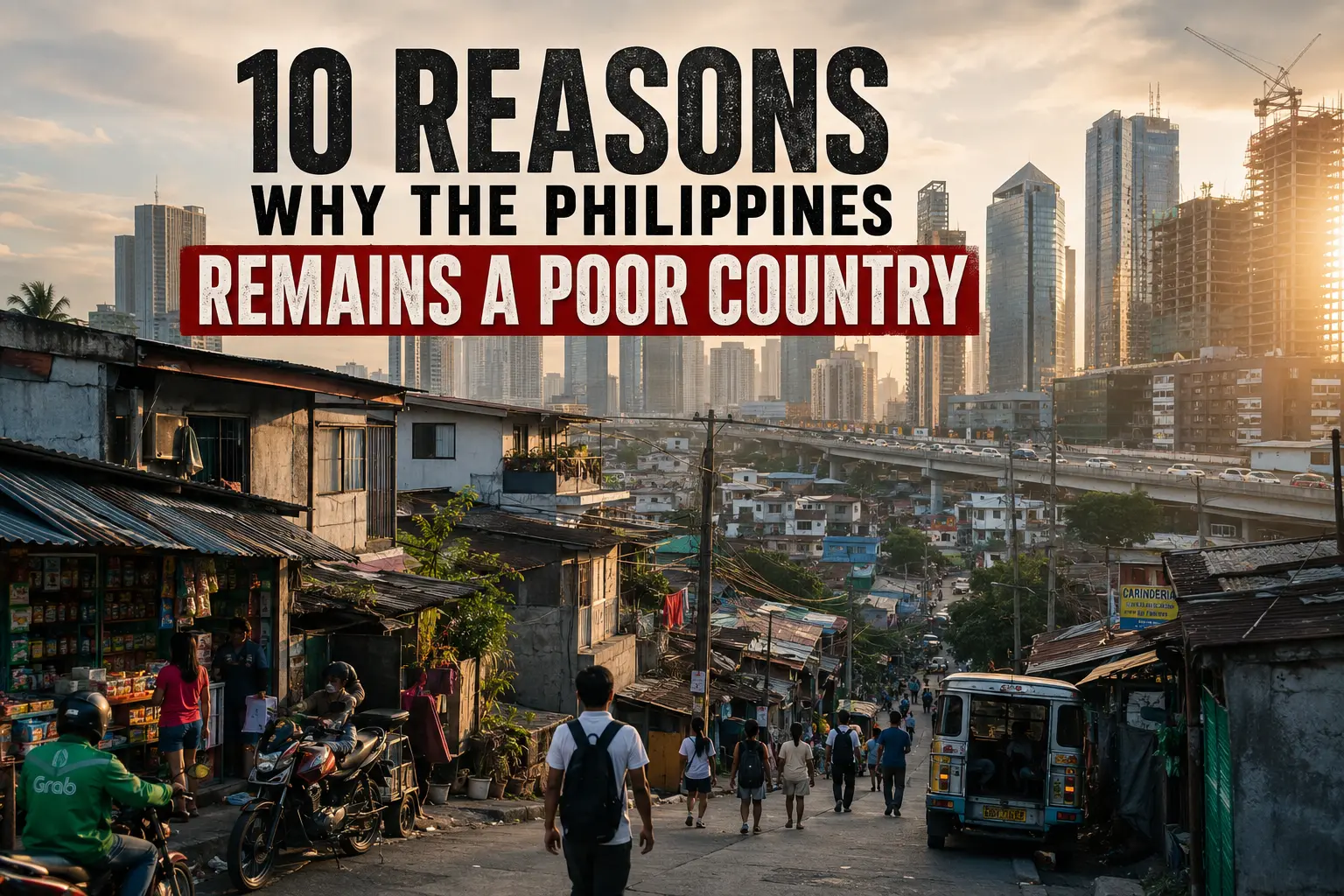
The Philippines has experienced decades of economic growth, expanding cities, rising investment, a growing services sector, and a rapidly developing digital economy.
Despite economic growth, millions of Filipinos continue to face low incomes, high living expenses, insecure employment, and limited opportunities to improve their lives.
This creates an important question:
Why does the Philippines remain a relatively poor country despite economic growth?
The answer is not simply that the Philippines is not growing.
The more in-depth problem is that economic growth has not yet translated into enough high-productivity jobs, strong wage growth, affordable essential services, reliable infrastructure, and broadly distributed economic opportunities.
The country has made substantial progress.
But progress in GDP does not automatically mean that ordinary households become significantly wealthier.
A country can grow economically while many families continue to struggle with food, electricity, transportation, housing, education, healthcare, and other necessities.
This is one of the central contradictions of the Philippine economy.
The Philippines is no longer the low-income economy it was several decades ago.
The country has struggled to transition to an economy in which higher productivity translates into better jobs and greater purchasing power.
What Does It Mean to Say the Philippines Is Poor?
The Philippines is not among the world’s poorest countries.
It is a developing middle-income economy with a large population, a substantial domestic market, major cities, a growing services industry, and increasingly important connections to the global economy.
The problem is that average incomes remain relatively low compared with those in wealthier economies.
This means many Filipino households have considerably less purchasing power than households in developed countries.
The distinction matters because GDP growth and household prosperity are not the same thing.
GDP measures the value of economic activity produced within a country.
It does not tell us how much income each household receives, how expensive essential goods are, or how much money families have left after paying their bills.
A growing economy can therefore still contain millions of financially vulnerable households.
The 10 Reasons the Philippines Remains Poor
Persistent poverty reflects a combination of economic and structural challenges.
Instead, several structural weaknesses reinforce one another.
The most important include:
- Low productivity and low wages
- Too many low-quality and informal jobs
- Education and skills gaps
- High electricity and energy costs
- Weak infrastructure and connectivity
- Agricultural productivity problems
- Corruption and Weak Government Accountability
- High Taxes and Fees Reduce Household Purchasing Power
- High Electricity Costs Raise the Cost of Living and Doing Business
- Intergenerational poverty and unequal opportunities
These problems are interconnected.
Solving one without addressing the others would make progress, but it would not completely transform the Philippine economy.
1. Low Productivity Keeps Wages Low
One of the deepest reasons the Philippines remains relatively poor is low productivity.
Productivity shows how efficiently available labor, capital, technology, infrastructure, and other resources are converted into economic output.
Higher productivity generally gives businesses greater capacity to pay higher wages.
This creates an important relationship:
Higher productivity → Higher economic output per worker → Greater capacity for higher wages
Countries with highly productive industries can generally support higher wages and stronger living standards.
The Philippines, however, still has numerous workers engaged in relatively low-productivity activities.
The problem is particularly evident in agriculture, informal work, small businesses, and industries with limited access to modern technology and capital.
A worker can work extremely hard and still earn relatively little if the economic value generated by that work is low.
This is why poverty cannot be solved simply by telling people to work harder.
The economy must create conditions that allow workers to become more productive.
That requires investment in:
- Technology
- Machinery
- Infrastructure
- Education
- Training
- Management
- Research and development
- Efficient supply chains
- Competitive industries
When productivity rises, businesses can potentially produce more output without increasing costs at the same rate.
That creates greater room for wage growth and investment.
Without stronger productivity growth, however, wages can remain trapped at relatively low levels.
2. Too Many Workers Remain in Low-Quality or Informal Jobs
Employment is essential for reducing poverty.
But having a job does not necessarily mean having economic security.
Many Filipinos work in informal or lower-quality jobs with unstable incomes and limited benefits.
Many workers rely on small businesses, casual work, independent services, or other forms of irregular income.
These workers provide valuable economic services.
But informal employment can leave households vulnerable.
Workers may have limited access to:
- Stable wages
- Paid leave
- Employer benefits
- Retirement protection
- Formal credit
- Job security
- Insurance
When income suddenly falls, families may have very little financial protection.
This creates an important distinction:
Employment is not the same as financial security.
A person can work every day and remain poor if their income is too low or unpredictable.
The Philippine economy therefore needs not only more jobs but also more productive, formal, stable, and better-paying jobs.
3. Education and Skills Gaps Limit Economic Mobility
Education is one of the most powerful tools for escaping poverty.
A strong education system can help workers acquire the skills needed for higher-productivity employment.
But access to education alone is not enough.
Students also need to acquire skills that are relevant to the economy.
The Philippines continues to face challenges involving:
- Learning quality
- Teacher capacity
- School resources
- Digital access
- Regional inequality
- Technical skills
- Workplace readiness
- Skills mismatches
This can create a frustrating situation.
Businesses may struggle to find workers with the skills they need, while graduates struggle to find well-paying jobs.
The problem becomes even more important as the global economy becomes increasingly dependent on technology, engineering, healthcare, advanced manufacturing, digital services, and other knowledge-intensive industries.
Limited skills can keep workers concentrated in lower-paying occupations.
This limits both individual income and national productivity.
For a deeper examination of the country’s education challenges, see The State of Philippine Education: Challenges, Reforms, and What Every Parent Should Know.
Education therefore matters not only because it improves individual lives.
It also determines whether the Philippine economy can move into higher-value industries.
4. High Electricity and Energy Costs Reduce Competitiveness
Electricity is essential to almost every part of a modern economy.
Factories need electricity to operate machinery.
Businesses need it for computers, refrigeration, lighting, and equipment.
Hospitals need reliable power.
Households need electricity for basic daily activities.
When electricity is expensive, businesses face higher operating expenses.
Those costs can eventually affect consumer prices, investment decisions, and the wages businesses can afford to pay.
This creates a difficult cycle:
High electricity costs → Higher business costs → Higher consumer prices → Lower purchasing power
The problem becomes even more serious when electricity service is unreliable.
Businesses may need backup generators, batteries, or other systems to maintain operations during interruptions.
Households can also suffer when power interruptions disrupt work, education, communication, and small businesses.
The Philippines therefore faces an important development challenge involving both energy affordability and reliability.
Reliable and affordable electricity is not simply a household convenience.
It is an essential foundation for industrialization and higher productivity.
5. Weak Infrastructure Raises the Cost of Doing Company
Infrastructure has a direct effect on economic productivity.
Roads, bridges, ports, airports, public transportation, water systems, telecommunications, and digital infrastructure all influence how efficiently people and businesses operate.
The Philippines faces unique infrastructure challenges because it is an archipelago consisting of thousands of islands.
Connecting workers, businesses, producers, and consumers across such a large geographic area is expensive and complicated.
Poor or insufficient infrastructure can result in:
- Longer travel times
- Higher transportation costs
- Higher logistics costs
- Congestion
- Delivery delays
- Limited market access
- Reduced worker productivity
These problems affect both businesses and households.
A worker who spends several hours commuting has less time available for family, education, rest, or additional work.
High logistics costs can make it harder for businesses to compete with firms in countries with more efficient transport networks.
Infrastructure therefore influences the competitiveness of the entire economy.
Better infrastructure can reduce costs, connect workers with jobs, and allow businesses outside major cities to reach larger markets.
6. Agricultural Productivity Remains Too Low
Agriculture remains important to the Philippine economy and provides livelihoods for millions of Filipinos.
Yet many farmers continue to face low productivity and difficult economic conditions.
Some challenges include:
- Small farm sizes
- Limited irrigation
- Expensive agricultural inputs
- Limited access to modern machinery
- Weak storage infrastructure
- Post-harvest losses
- Transportation problems
- Weather disruptions
- Limited access to financing
- Market inefficiencies
These problems can keep farm incomes low.
They can also contribute to higher food prices.
This creates a difficult situation where farmers may struggle to earn enough while consumers struggle to afford food.
Agricultural modernization could therefore have a significant effect on poverty.
Higher productivity could increase farmers’ incomes while improving the reliability and affordability of food supplies.
The issue is not simply producing more food.
It is about creating a more efficient agricultural system that allows farmers to capture more value from their production.
7. Corruption and Weak Government Accountability
Corruption is another major obstacle to long-term economic development in the Philippines.
It can affect the economy in several ways.
When public funds are misused, diverted, or spent inefficiently, governments may receive less value from the money collected from taxpayers.
The consequences can extend far beyond the money involved.
Corruption can contribute to:
- Higher infrastructure costs
- Poorer-quality public projects
- Delays in government programs
- Unfair business competition
- Reduced investor confidence
- Weak public services
- Less effective regulation
The economic damage becomes particularly serious when corruption affects essential infrastructure and public services.
A road that costs more than necessary because of inefficient procurement represents funds that could have been used for another project.
A delayed infrastructure project can increase transportation costs and reduce economic productivity.
Poor enforcement can undermine fair competition by favoring politically connected businesses over more efficient firms.
This can discourage legitimate investment and entrepreneurship.
Corruption can also weaken public trust.
When citizens believe that government resources are not being used effectively, confidence in public institutions can decline.
That can make it more difficult to build support for taxation, infrastructure programs, economic reforms, and other long-term policies.
However, corruption should not be viewed as the only explanation for Philippine poverty.
Lower living standards are linked to a broader set of structural challenges, including weak productivity, inadequate infrastructure, education gaps, regional inequality, high electricity costs, weak institutions, and limited high-quality employment.
The more profound problem is that corruption can make many of these existing weaknesses more difficult and expensive to solve.
For the Philippines to achieve stronger and more inclusive economic growth, public institutions need to become more transparent, accountable, and effective.
Reducing corruption is therefore not simply a political objective.
It is an economic necessity.
8. High Taxes and Fees Reduce Household Purchasing Power
Filipino households face taxes and mandatory charges at several stages of economic life.
Income is taxed. Consumption is subject to VAT and other taxes. Fuel, vehicles, alcohol, tobacco, telecommunications, and other products can carry additional taxes and charges.
Businesses also pay taxes, licenses, fees, and regulatory costs. These expenses can ultimately be passed on to consumers through higher prices.
The issue is not simply that the Philippines has taxes.
Taxes finance public services, infrastructure, education, healthcare, social protection, and government operations.
The deeper issue is whether households receive enough economic value from the taxes and charges they pay.
When taxes and other mandatory costs consume a significant portion of household income, less money remains available for:
- Housing
- Food
- Education
- Healthcare
- Savings
- Investment
- Starting a business
- Building wealth
For lower-income households, even relatively small increases in the cost of essential goods can have a significant impact.
This creates another poverty cycle:
Higher taxes and costs → Lower disposable income → Less saving and investment → Slower wealth accumulation
The problem becomes more serious when high taxation is combined with weak infrastructure, expensive utilities, inefficient public services, or limited economic opportunities.
In that situation, households can feel that they are paying more without receiving a proportional improvement in their standard of living.
Important: I would avoid calling the Philippines simply a country with “overpriced taxes.” That’s subjective and difficult to establish objectively.
“High taxes and multiple layers of taxation” is much stronger editorially and easier to defend.
9. High Electricity Costs Raise the Cost of Living and Doing Business
Electricity is another major obstacle to higher living standards in the Philippines.
Filipino households can face substantial electricity costs while also experiencing concerns about reliability, brownouts, infrastructure, and service quality.
The problem extends beyond the household electricity bill.
Electricity is a fundamental input across the economy.
Businesses need power to operate factories, stores, restaurants, offices, warehouses, farms, and digital services.
When electricity is expensive, businesses face higher operating costs.
Those costs can eventually be reflected in:
- Higher prices
- Lower business investment
- Reduced competitiveness
- Higher operating expenses
- Slower expansion
- Fewer employment opportunities
High electricity costs leave households with less disposable income.
A family that spends more on electricity has less money available for food, education, transportation, savings, or other necessities.
The situation becomes even more complicated because electricity bills can contain multiple regulated components and pass-through charges.
The Energy Regulatory Commission continues to regulate mechanisms involving generation, transmission, system losses, subsidies, taxes, and other electricity charges. In 2026, the ERC also revised rules governing the recovery and true-up of pass-through costs and introduced measures intended to make electricity charges more transparent.
This means the problem is not simply that one company decides to charge consumers whatever it wants.
The electricity system itself contains multiple layers of costs.
For a closer look at the high cost of electricity and ongoing service problems in the Philippines, see Why Is Electricity So Expensive in the Philippines Despite Poor Service?
10. Poverty Can Become an Intergenerational Cycle
Perhaps the most difficult problem is that economic hardship can reproduce itself across generations.
A child born into a low-income household may begin life with fewer opportunities.
The family may have limited resources for:
- Nutrition
- Healthcare
- Education
- Technology
- Transportation
- Private tutoring
- Higher education
- Professional networks
These disadvantages can affect future employment opportunities.
Lower educational outcomes can lead to lower-paying jobs.
Lower income limits savings.
Low household savings can limit investment in the next generation.
The cycle can continue.
Low household income → Limited opportunities → Lower educational and employment outcomes → Low adult income → Poverty continues
This does not mean that people cannot overcome economic hardship.
Millions of Filipinos have improved their economic circumstances through education, entrepreneurship, migration, and employment.
But structural disadvantages can make upward mobility much more difficult.
That is why tackling economic hardship requires more than short-term assistance.
The country must also expand access to opportunities that allow people to improve their economic position over time.
How These 10 Problems Reinforce One Another
The biggest mistake would be to treat these as ten completely separate problems.
They are interconnected.
Low-quality education can limit workers’ skills.
Limited skills can reduce productivity.
Low productivity can limit wages.
Low wages reduce savings.
Limited savings make households vulnerable to emergencies.
Poor infrastructure increases business costs.
High electricity costs further increase operating expenses.
Low agricultural productivity raises food costs and limits rural incomes.
Regional inequality limits access to better jobs.
Weak institutions can make it harder to solve all of these problems efficiently.
The result is a cycle that can be difficult to break.
Low productivity → Low wages → Limited savings → Lower investment → Continued low productivity
But the cycle can work in the opposite direction as well.
Better education → Higher skills → Higher productivity → Better jobs → Higher wages → Greater savings and investment → Stronger economic growth
This is why long-term poverty reduction requires structural economic improvements rather than a single policy solution.
Economic Growth Is Still Important
None of this means that Philippine economic growth has been meaningless.
Growth has helped reduce hardship, expand employment, improve infrastructure, increase access to services, and create new opportunities.
Millions of Filipinos today have living standards that would have been difficult to imagine several decades ago.
The country has also developed a much larger middle class and a more diversified economy.
The problem is that progress has not been fast or evenly distributed enough.
The Philippines is competing in a global economy where other countries are also improving their productivity, infrastructure, education, and industries.
The question is therefore not whether the Philippines has progressed.
It has.
What matters is whether the country can sustain faster progress that delivers meaningful improvements in living standards for most people.
Why Has Growth Not Been Enough?
The Philippines does not suffer from a complete lack of economic activity.
It suffers from a productivity and distribution problem.
The country produces economic value, but too much employment remains concentrated in relatively low-productivity activities.
Economic opportunities are also concentrated geographically.
And many households face high costs for essential goods and services.
This means a portion of the gains from economic growth can be absorbed by the cost of simply living and working.
A worker may earn more than before but still struggle to save.
A business may generate higher revenue but face high electricity, transportation, labor, and financing costs.
A family may have access to education but still lack the resources needed to reach higher education or specialized training.
These are the kinds of structural issues that determine whether economic growth becomes widespread prosperity.
A Country Can Be Growing and Still Feel Poor
This may be the most important point in understanding the Philippine economy.
A country can experience:
- GDP growth
- Rising investment
- Growing cities
- New businesses
- Expanding industries
- Higher employment
- At the same time, households can still experience:
- Low purchasing power
- High living costs
- Limited savings
- Insecure employment
- Expensive electricity
- Long commutes
- Unaffordable housing
- Weak access to quality services
There is no contradiction.
Economic growth measures the expansion of economic activity.
Poverty is ultimately about whether people have enough resources and opportunities to achieve a decent standard of living.
The Philippines has made economic progress.
But the country still has a long way to go before that progress translates into broadly shared prosperity.
Bottom Line
The Philippines remains relatively poor because economic growth has not yet produced enough high-productivity jobs, strong wage growth, affordable essential services, and equal access to economic opportunities.
The ten major reasons are interconnected:
- Low productivity and low wages
- Too many low-quality and informal jobs
- Education and skills gaps
- High electricity and energy costs
- Weak infrastructure
- Low agricultural productivity
- Regional inequality
- Governance and institutional problems
- Limited high-value industries and investment
- Intergenerational poverty
The Philippines has the resources, workforce, geographic position, and economic potential to become substantially wealthier.
But reaching that potential requires more than simply growing GDP.
It requires transforming economic growth into higher productivity, better jobs, stronger household incomes, affordable essential services, and greater economic mobility.
And that raises the most important question:
What would it actually take for the Philippines to break the cycle of persistent poverty?
That is where the country’s next stage of economic development becomes critical.
What Would It Take for the Philippines to Escape Persistent Poverty?
The Philippines does not need to reinvent its economy from the ground up.
It already has many of the foundations needed for faster development.
The country has a large working-age population, a strategic location in Southeast Asia, a growing services sector, a strong overseas workforce, a large domestic consumer market, and an increasingly connected digital economy.
The challenge is turning these advantages into sustained improvements in productivity and household income.
Sustainable growth requires greater inclusion, stronger productivity, and higher-quality employment.
That requires changes across several areas of the economy.
Higher Productivity Must Become a National Priority
Higher minimum wages alone cannot solve the problem of low wages.
Wages can rise sustainably when workers become more productive and businesses generate more economic value.
This requires greater investment in:
- Modern technology
- Machinery
- Infrastructure
- Worker training
- Research and development
- Digitalization
- Business management
- Efficient supply chains
- Productive industries
A small business using outdated equipment may struggle to increase wages even if its owner wants to pay employees more.
A modern, productive business can potentially generate much greater output per worker.
This is why productivity is at the heart of long-term poverty reduction.
The Philippines needs to make it easier for businesses to invest, modernize, expand, and compete internationally.
Better Jobs Matter More Than More Jobs
Creating employment is important.
But the quality of those jobs matters just as much.
A country cannot become significantly wealthier if most new employment remains concentrated in low-productivity, low-wage activities.
The Philippines needs more jobs that provide:
- Higher wages
- Stable employment
- Skills development
- Career progression
- Social protection
- Opportunities for specialization
These jobs are more likely to emerge from industries that generate significant economic value.
Technology, advanced manufacturing, engineering, healthcare, financial services, professional services, logistics, and other knowledge-intensive industries can play an important role.
The goal should not simply be to reduce unemployment.
Economic progress should create opportunities for workers to move into more productive and higher-paying jobs.
Education Must Become More Closely Connected to Economic Opportunity
Education is one of the most important long-term investments the Philippines can make.
But improving enrollment alone is not enough.
Students need strong foundational skills and practical capabilities that translate into employment.
The country needs to strengthen:
- Reading and mathematics
- Science education
- Technical and vocational training
- Digital skills
- English proficiency
- Critical thinking
- Engineering and technology
- Healthcare training
- Industry-specific skills
The connection between education and employment also needs to become stronger.
Education and training institutions should work more closely with employers to identify the skills businesses need.
This can reduce the mismatch between graduates seeking jobs and employers seeking qualified workers.
Education should ultimately give people more than a certificate.
It should increase their economic opportunities.
Affordable and Reliable Electricity Is Essential
Electricity deserves particular attention because it affects nearly every part of economic activity.
A factory cannot operate efficiently without reliable power.
A restaurant cannot function without refrigeration and equipment.
A small online business depends on electricity and internet connectivity.
Electricity is increasingly essential for students using computers, devices, and online learning.
When electricity is expensive or unreliable, the entire economy pays a price.
Businesses may have to spend more to keep operating.
Consumers may face higher prices.
Investors may favor countries with lower operating costs.
Small businesses can find it harder to compete.
This is why improving the Philippine electricity system is not merely an energy-policy issue.
It is an economic-development issue.
Infrastructure Can Unlock Economic Growth Outside Major Cities
Infrastructure investment can have a powerful effect on poverty.
Better roads can connect farmers to markets.
Better ports can reduce shipping costs.
Better public transportation can connect workers to employment.
Better telecommunications allow businesses outside major cities to reach global customers.
Better water systems can improve health and productivity.
The Philippines therefore needs infrastructure that does more than improve major metropolitan areas.
Development needs to reach regions where economic opportunities remain limited.
This could help reduce regional inequality by allowing businesses to operate more efficiently outside Metro Manila and other major urban centers.
Infrastructure can effectively reduce the economic distance between people and opportunities.
Agriculture Needs to Become More Productive
Reducing rural poverty requires stronger agricultural productivity.
Farmers need better access to:
- Irrigation
- Machinery
- Quality seeds
- Fertilizer
- Financing
- Storage
- Technology
- Transportation
- Markets
- Modern agricultural techniques
Higher productivity could allow farmers to produce more while reducing the cost per unit of output.
It could also increase rural incomes.
At the same time, better agricultural supply chains could help stabilize food prices for consumers.
Agricultural reform should therefore be viewed as both a poverty-reduction strategy and a food-security strategy.
The Philippines Needs More Investment
Investment is essential for increasing productivity.
Businesses need capital to build factories, purchase equipment, develop technology, train workers, and expand operations.
Foreign direct investment can also bring technology, management expertise, global supply-chain connections, and access to international markets.
But investors compare countries.
They consider factors such as:
- Electricity costs
- Infrastructure
- Taxes
- Regulation
- Political stability
- Labor skills
- Market access
- Logistics
- Corruption risks
- Contract enforcement
If the Philippines is significantly pricier or more difficult to operate than competing economies, investment may go elsewhere.
Improving the investment environment is therefore directly connected to job creation and wage growth.
Stronger Institutions Can Reduce the Cost of Doing Business
Economic development becomes easier when institutions are predictable and efficient.
Businesses should not have to spend excessive amounts of time navigating unnecessary bureaucracy.
Government services should be accessible and transparent.
Regulations should be clear.
Permits should be processed efficiently.
Contracts should be enforceable.
Public funds should be used effectively.
These improvements may sound administrative rather than economic.
But they can have a major effect on productivity.
Every unnecessary delay or additional cost makes businesses less competitive.
Conversely, more efficient institutions can make it easier for entrepreneurs to start companies, expand operations, and hire workers.
Reducing Regional Inequality Requires More Than Building Roads
Infrastructure alone cannot solve regional inequality.
Economic activity also needs to develop locally.
That means encouraging investment and business growth in secondary cities and underserved regions.
Local economies need:
- Good schools
- Reliable electricity
- Internet connectivity
- Healthcare
- Transportation
- Business services
- Financial institutions
- Industrial facilities
- Tourism infrastructure where appropriate
When these foundations exist, businesses have more reasons to invest outside the country’s largest metropolitan areas.
This can create employment closer to where people live.
It can also reduce the pressure on major cities.
Breaking Intergenerational Poverty Requires Early Intervention
Persistent poverty can make it harder for families to improve their economic position.
Children from poor households may face disadvantages long before they enter the workforce.
Poor nutrition can affect development.
Limited educational resources can affect learning.
Lack of internet access can limit opportunities.
Financial pressure can push young people into employment before completing their education.
These disadvantages can accumulate.
That is why poverty reduction must begin early.
Programs that improve nutrition, healthcare, education, childcare, and access to technology can have effects that extend for decades.
The objective should not simply be to help families survive poverty.
It should be to give the next generation a realistic opportunity to escape it.
Why Philippine Education Is So Important to the Poverty Problem
Education deserves greater attention because it plays a central role in addressing many economic challenges.
A stronger education system can produce a more productive workforce.
A more productive workforce can attract more investment.
More investment can create better jobs.
Better jobs can increase household incomes.
Higher incomes can increase savings and investment in education.
This creates a positive cycle.
Better education → Better skills → Higher productivity → Better jobs → Higher incomes → Greater economic mobility
The reverse can also happen.
Weak educational outcomes → Limited skills → Low productivity → Low wages → Persistent poverty
Education reform should therefore be treated as an economic development strategy rather than simply a social policy.
For parents and families trying to understand these challenges, The State of Philippine Education: Challenges, Reforms, and What Every Parent Should Know provides a broader examination of the country’s education system.
The Role of Overseas Filipino Workers
Overseas Filipino Workers have played an enormous role in the Philippine economy.
Remittances provide income to millions of Filipino households.
They can help families pay for:
- Education
- Housing
- Healthcare
- Food
- Transportation
- Small businesses
- Savings
Remittances also provide an important source of foreign currency for the country.
However, dependence on overseas employment has a limitation.
If highly skilled Filipinos must leave the country to earn substantially higher wages, that can also reveal weaknesses in the domestic economy.
The long-term goal should be an economy that provides enough quality jobs for workers to build financially secure lives at home.
Overseas employment can remain an important economic advantage.
But it should not become the country’s primary pathway to upward mobility.
The Middle Class Is Critical to Long-Term Development
A strong middle class is one of the clearest signs of broad-based economic development.
Middle-income households tend to:
- Consume more
- Save more
- Invest more
- Pay taxes
- Purchase homes
- Start businesses
- Educate their children
- Support local businesses
When the middle class expands, domestic demand can become a powerful engine of growth.
But if households remain financially vulnerable, they may spend most of their income simply covering necessities.
That limits savings and investment.
It also makes families vulnerable to unexpected shocks.
Higher household incomes therefore matter not only because they reduce poverty.
They can also contribute to stronger domestic growth.
Why High Living Costs Can Keep People Poor
Economic development is not only about increasing income.
It is also about keeping essential costs manageable.
A worker receiving a higher salary may still struggle if:
- Rent rises
- Electricity becomes expensive.
- Food prices increase
- Transportation costs rise
- Healthcare becomes expensive.
- Education costs increase
When essential expenses consume most of household income, there is little left for savings or investment.
This is why the cost of living is closely connected to poverty.
The Philippines needs both higher incomes and greater affordability.
Improving only one side of the equation may not be enough.
The Philippines Needs to Move Up the Economic Value Chain
One of the biggest long-term challenges is moving from relatively low-value economic activities toward higher-value industries.
This does not mean abandoning traditional sectors.
Agriculture, retail, construction, and other industries will remain important.
But the economy also needs more activities involving:
- Advanced manufacturing
- Technology
- Engineering
- Research
- Financial services
- Healthcare
- Software
- Artificial intelligence
- Semiconductors
- High-value business services
These sectors can generate greater economic value per worker.
They can also create demand for highly skilled employees.
That can increase wages and encourage further investment in education.
The goal is a gradual transformation of the economy toward activities that generate higher productivity.
Economic Growth Must Become More Inclusive
Economic growth is necessary.
But growth alone is not sufficient.
The country needs growth that reaches:
Low-income households
Rural communities
Young workers
Small businesses
Farmers
Informal workers
The emerging middle class
This means policies should focus not only on headline GDP growth but also on:
Real wages
Productivity
Employment quality
Household purchasing power
Poverty reduction
Regional development
Access to education
Access to healthcare
Infrastructure quality
Affordable energy
These indicators provide a much clearer picture of whether economic growth is improving ordinary lives.
Can the Philippines Become a Much Wealthier Country?
Yes.
There is nothing inevitable about the Philippines remaining relatively poor.
Several countries that were once considerably poorer have achieved dramatic improvements in living standards through sustained investment, industrialization, education, infrastructure development, and productivity growth.
The Philippines has several advantages.
It has a large population.
It has a young and increasingly skilled workforce.
It has a strategic location in Southeast Asia.
It has a large English-speaking population.
It has a growing services sector.
It has substantial natural resources.
It has strong connections to the global economy.
It has a large domestic consumer market.
These advantages provide a strong foundation.
But potential is not the same as outcome.
The country needs institutions, infrastructure, education, investment, and economic policies capable of converting those advantages into sustained productivity growth.
What Would Success Look Like?
Success should not simply mean a higher GDP figure.
A more successful Philippine economy would mean:
Workers earning substantially higher real wages.
More formal employment
Lower poverty
Better schools
More productive farms
Reliable and affordable electricity
Better transportation
More competitive businesses
More investment
Stronger regional economies
Greater household savings
More affordable essential services
A larger and more financially secure middle class
These changes would make economic growth visible in everyday life.
People would not simply hear that the economy is growing.
They would experience that growth through better jobs, higher incomes, greater financial security, and improved living standards.
The Philippines Cannot Solve Poverty With One Policy.
There is no single reform capable of transforming the Philippine economy.
Reducing poverty requires several improvements to happen together.
Education must improve.
Infrastructure must expand.
Electricity must become more reliable and affordable.
Agricultural productivity must increase.
Investment must grow.
Institutions must become more efficient.
Businesses must move toward higher-value activities.
Workers must gain stronger skills.
Regional economies must develop.
And household purchasing power must improve.
The challenge is therefore not finding one perfect solution.
It is creating an economic environment where these improvements reinforce one another.
Poverty Is a Structural Problem
The Philippines remains relatively poor not because Filipinos are unwilling to work.
Filipinos are among the most economically active and globally mobile workers in the world.
The deeper issue is that too much economic activity still generates relatively low income per worker.
This is a structural problem.
When productivity is low, wages tend to remain low.
When wages are low, households struggle to save.
When savings are low, investment becomes more difficult.
When investment is insufficient, productivity improves slowly.
And when productivity improves slowly, wages remain under pressure.
Breaking this cycle requires building a more productive economy.
This requires equipping workers with better tools, infrastructure, education, technology, and opportunities.
How Poverty Connects to Other Problems in the Philippines
Poverty does not exist separately from other challenges in the Philippines.
It is connected to education.
It is connected to electricity.
It is connected to infrastructure.
It is connected to healthcare.
It is connected to transportation.
It is connected to housing.
It is connected to agriculture.
It is connected to governance.
These problems can reinforce one another.
This is why Philippine poverty cannot be understood without considering the broader economic picture.
The broader structural challenges facing the country are explored in The 10 Biggest Problems in the Philippines.
The relationship between these problems is important.
A country can improve one area while remaining held back by weaknesses in another.
For example, better education can produce skilled workers, but those workers may still struggle if there are not enough high-paying jobs.
Better infrastructure can attract investment, but businesses may remain hesitant if electricity costs and regulatory barriers are too high.
Economic development therefore requires a coordinated approach.
The Road Ahead for the Philippines
The Philippines has already demonstrated that it can grow.
The more difficult task is ensuring that growth becomes powerful enough to transform household living standards.
The country needs to move from an economy focused on survival to one where more workers can build wealth.
That requires:
- Higher productivity
- Higher real wages
- Better jobs
- More investment
- Better education
- Affordable energy
- Reliable infrastructure
- Stronger institutions
- More competitive industries
- Greater economic mobility
The Philippines does not need to become rich overnight.
It needs to maintain a consistent direction of development for many years.
Economic transformation is usually measured in decades, not months.
Bottom Line
The Philippines remains relatively poor despite economic growth because growth has not yet translated into sufficiently high productivity, wages, investment, and economic opportunity for a large share of the population.
The country has enormous potential.
But potential alone does not eliminate poverty.
The Philippines needs to move more workers into higher-productivity industries while improving education, lowering infrastructure and energy costs, increasing investment, strengthening institutions, and expanding opportunities beyond major urban centers.
The ultimate goal is not simply economic growth.
It is economic growth that ordinary Filipinos can actually feel in their daily lives.
And the next question is perhaps the most important one:
Can the Philippines finally break the cycle of low productivity, low wages, and persistent poverty?
Can the Philippines Break the Cycle of Persistent Poverty?
The Philippines has many of the ingredients needed for long-term economic success.
It has a large workforce, a strategic location in Asia, a growing services industry, a large domestic market, significant natural resources, and strong connections to the global economy.
Yet these advantages have not been enough to eliminate widespread poverty.
The central challenge is no longer simply generating economic growth.
It is making that growth more productive, more inclusive, and more visible in household incomes and living standards.
For millions of Filipinos, the question is not whether the Philippine economy is growing.
The question is whether that growth is creating a better life.
Why Economic Growth Alone Cannot Eliminate Poverty
Economic growth increases the total amount of economic activity in a country.
But the benefits of that growth depend on how the economy generates income and employment.
If growth is concentrated in industries that employ relatively few workers, its impact on household incomes may be limited.
If most new employment is concentrated in low-paying sectors, poverty can remain widespread.
Rapidly rising living costs can offset wage increases and limit gains in purchasing power.
This creates a crucial distinction:
Economic growth is necessary for poverty reduction, but growth alone does not guarantee broad prosperity.
The Philippines therefore needs growth that generates more productive employment and allows workers to participate more fully in the benefits of economic expansion.
The Country Needs a Stronger Productivity Engine
The most important long-term objective should be increasing productivity.
Higher productivity enables businesses to generate greater value from their labor and capital.
That creates the economic foundation for higher wages.
A productive economy can gradually support:
- Higher salaries
- Better working conditions
- More investment
- Greater business profits
- Higher tax revenues
- Stronger household savings
- Better public services
This creates a positive cycle.
Higher productivity → Higher wages → Greater household spending and savings → More investment → Higher productivity
The Philippines needs to expand this cycle on a much larger scale.
Wages Need to Rise Through Productivity
Raising wages is an important part of improving living standards.
But wage increases must be sustainable.
Wage increases without productivity gains can lead businesses to raise prices, limit hiring, cut investment, or relocate.
The stronger solution is to make workers and businesses more productive.
That means giving workers:
- Better education
- Better training
- Better technology
- Better infrastructure
- Better access to capital
- Better management
- Better employment opportunities
When workers can generate more economic value, businesses have greater capacity to pay higher wages.
This is one reason productivity is ultimately more important than simply comparing nominal salaries.
The Philippines Must Become More Competitive
The global economy gives businesses and investors many choices.
Companies can decide where to establish factories, offices, technology operations, logistics centers, and regional headquarters.
The Philippines therefore competes with other countries for investment.
Investors look at:
- Labor costs
- Worker skills
- Electricity prices
- Infrastructure
- Taxes
- Regulation
- Political stability
- Transportation
- Internet connectivity
- Market access
- Institutional quality
If the cost of doing business becomes too high, investment can move elsewhere.
Improving competitiveness is therefore not simply about attracting foreign companies.
It is also about helping Filipino businesses become more productive and competitive.
Small Businesses Need Greater Opportunities to Grow
Small businesses are an important part of the Philippine economy.
They provide employment and income across cities, towns, and rural communities.
But many small businesses struggle to expand.
Common barriers can include:
- Limited access to financing
- High operating costs
- Complex regulations
- Weak infrastructure
- Expensive electricity
- Limited technology
- Small domestic markets
- Difficulty accessing larger supply chains
A business that remains permanently small cannot generate the same productivity gains as a company that can invest, expand, automate, and reach larger markets.
Helping viable small businesses grow can therefore contribute directly to poverty reduction.
The objective should not be to keep people trapped in subsistence entrepreneurship.
It should help successful businesses become more productive employers.
Technology Could Help the Philippines Leap Forward
Technology gives the Philippines a chance to accelerate development by bypassing some traditional barriers.
Digital services can allow Filipino workers and businesses to participate in global markets without physically relocating abroad.
Online platforms can connect small businesses with customers.
Digital banking can improve financial access.
Automation can increase productivity.
Artificial intelligence can help businesses perform tasks more efficiently.
Modern telecommunications can connect rural communities with education, healthcare, and economic opportunities.
However, technology alone will not solve poverty.
People need the skills and infrastructure to use it effectively.
A digital economy without reliable electricity, affordable internet, strong education, and appropriate skills will not reach its full potential.
The Philippines Needs to Develop More Outside Metro Manila
Economic opportunities remain highly concentrated in the largest urban centers.
This creates enormous pressure on major cities.
People move toward areas where jobs are available.
That increases demand for housing and transportation.
Congestion increases.
Housing becomes expensive.
Commute times become longer.
Infrastructure becomes strained.
Meanwhile, rural and smaller urban areas may continue to lose skilled workers.
A more geographically balanced economy could help address both problems.
Developing stronger regional centers could create employment closer to where people live.
Growing economic centers such as Cebu, Davao, Iloilo, and Clark can help drive broader regional development.
The objective is not to reduce the importance of Metro Manila.
The goal is to create more economic centers capable of generating high-quality employment.
Affordable Housing Is Part of Poverty Reduction
Income alone does not determine living standards.
Housing costs matter enormously.
A higher household income can still leave little financial flexibility when housing costs take up much of the budget.
Expensive housing also creates secondary costs.
People may move farther from employment.
Longer commutes increase transportation expenses.
Parents may spend more time traveling.
Workers may have fewer opportunities to change jobs.
This means housing policy should be viewed as part of economic policy.
Building sufficient housing near employment centers can help reduce the combined burden of housing and transportation.
Healthcare and Education Protect Household Wealth
A poor household can be pushed deeper into poverty by a major unexpected expense.
Healthcare is one example.
When families have to pay substantial amounts for medical treatment, they may be forced to borrow money, sell assets, or reduce spending on education and other necessities.
Education can also create significant financial pressure.
Families may struggle to afford tuition, transportation, school supplies, technology, and other educational expenses.
Strong public services can therefore serve as an economic protection mechanism.
They reduce the amount households need to pay privately.
This is one reason economic development should not focus exclusively on wages.
The effective living standard of a household also depends on the quality and affordability of essential public services.
Social Protection Can Reduce Poverty—but It Cannot Replace Economic Growth.
Government assistance can protect vulnerable households.
Cash transfers, social insurance, healthcare programs, pensions, housing assistance, and other forms of support can reduce the immediate effects of poverty.
These programs are important.
But social protection cannot permanently replace productive employment.
Sustainable poverty reduction ultimately requires more people to earn sufficient income through productive economic activity.
The ideal system therefore combines:
Strong social protection + productive employment + rising wages + economic mobility
This allows government assistance to protect people during difficult periods while the broader economy creates opportunities for households to become financially independent.
The Philippines Needs Stronger Domestic Investment
Foreign investment receives considerable attention, but domestic investment is equally important.
Filipino entrepreneurs and companies need opportunities to expand.
Domestic businesses can create jobs, develop supply chains, introduce new products, and invest in local communities.
A healthy investment environment should make it easier for entrepreneurs to:
- Start businesses
- Access financing
- Hire workers
- Expand operations
- Adopt technology
- Export products
- Enter new markets
- Compete internationally
When domestic businesses grow, the benefits can spread throughout the economy.
Suppliers receive more orders.
Workers receive wages.
Governments collect taxes.
Consumers gain more choices.
Other businesses emerge to serve the expanding market.
Why Public Spending Must Be More Effective
Government spending can support development through infrastructure, education, healthcare, social protection, and public services.
But spending more does not automatically produce better outcomes.
The quality of spending matters.
Public resources need to generate measurable improvements.
That means focusing on:
- Efficient infrastructure projects
- Better schools
- Reliable public transportation
- Healthcare access
- Digital infrastructure
- Agricultural modernization
- Public safety
- Effective social protection
Wasteful or poorly implemented spending can limit the impact of scarce public resources.
For a developing country, every peso matters.
The objective should therefore be better outcomes, not simply larger budgets.
The Philippines Must Address Its Education Crisis
Economic development cannot move much faster than the skills of its workforce.
Students who leave school without strong foundations may face disadvantages for decades.
Weak educational outcomes can affect:
- Employment
- Productivity
- Wages
- Innovation
- Business investment
- Social mobility
The problem therefore extends far beyond classrooms.
It affects the entire economy.
The Philippines needs an education system capable of preparing students for both current and future employment.
That means improving foundational learning while expanding access to technical, digital, scientific, and professional skills.
This is particularly important as automation and artificial intelligence reshape the global labor market.
Energy Reform Could Have an Economy-Wide Impact
Electricity deserves to be treated as a strategic economic issue.
Affordable and reliable electricity can help:
- Reduce business costs
- Support manufacturing
- Improve digital services
- Increase household purchasing power.
- Attract investment
- Support small businesses
- Improve education
- Increase productivity
- The opposite is also true.
Expensive or unreliable electricity can become a structural disadvantage.
This is why electricity problems in the Philippines are directly connected to poverty.
The Philippines cannot easily become a high-productivity economy while businesses and households face excessive energy costs.
What Happens If These Problems Are Not Addressed?
The country could continue experiencing economic growth without achieving the transformation necessary to become significantly wealthier.
GDP may continue increasing.
Cities may continue expanding.
New businesses may continue appearing.
But millions of households could remain financially vulnerable.
This creates the possibility of a middle-income trap.
A country can move beyond extreme poverty but struggle to transition into a high-income economy.
Wages rise somewhat.
Living standards improve.
But productivity does not increase quickly enough to support another major leap in income.
Breaking this pattern requires moving into higher-productivity activities.
Could the Philippines Escape the Middle-Income Trap?
Yes, but it will require sustained structural reform.
The country must increasingly compete on:
- Productivity
- Skills
- Technology
- Innovation
- Infrastructure
- Business efficiency
Rather than relying primarily on low labor costs.
Low wages can attract certain types of investment.
But low wages are not a sustainable development strategy.
As workers become more productive, the economy should move toward industries where higher wages are supported by higher economic value.
That is how countries can gradually move from low-cost production toward higher-value economic activity.
What the Philippines Can Learn From More Successful Asian Economies
Several Asian economies have demonstrated that rapid improvements in living standards are possible.
Their experiences differ, but many successful development stories involved combinations of:
- Strong education
- Industrialization
- Infrastructure investment
- Export growth
- Technology adoption
- High savings and investment
- Productivity improvements
- Effective institutions
- Economic openness
- Long-term policy consistency
The Philippines can adapt successful ideas from other countries without replicating their models exactly.
Its economy, geography, political system, and population are different.
But the underlying principle is relevant:
Countries become substantially wealthier when productivity rises for a sustained period.
The Philippines Has the Potential to Become Much Wealthier
The country can change its economic trajectory through sustained development and reform.
There are significant opportunities.
The Philippines can benefit from:
- It’s a large domestic market
- It’s an English-speaking workforce
- It’s a young population
- It’s strategic location
- It’s expanding the digital economy
- It’s the business-process outsourcing industry
- It’s tourism potential
- It’s manufacturing opportunities
- It’s a growing technology sector
- It’s the Overseas Filipino network
The challenge is converting these advantages into higher domestic productivity.
If the country can create more productive industries and better jobs, the benefits can spread across households and communities.
What Would a Richer Philippines Look Like?
A genuinely wealthier Philippines would not simply have a higher GDP.
It would have households with greater financial security.
Workers would be able to earn enough to:
- Pay for housing
- Buy nutritious food
- Afford reliable electricity
- Access healthcare
- Educate their children
- Save regularly
- Handle emergencies
- Take vacations occasionally
- Invest for retirement
- Build assets
A stronger economy would also mean businesses capable of competing globally while paying better wages domestically.
It would mean fewer people needing to leave the country to find a decent-paying job.
It would mean more opportunities outside the largest cities.
It would give children from lower-income households a better chance of achieving financial security as adults.
The Real Measure of Progress
The ultimate test of economic development is not whether politicians can announce a higher GDP growth rate.
It is whether ordinary households experience meaningful improvements.
Can workers afford more?
Can families save more?
Can young people find better jobs?
Can parents provide better opportunities for their children?
Can businesses grow without high costs?
Can farmers earn more from their land?
Can people access reliable electricity?
Can families afford decent housing?
Can people build wealth without leaving the country?
These questions provide a more human measure of development.
Why Does the Philippines Remain a Poor Country?
The Philippines remains relatively poor because its economic growth has not yet been accompanied by sufficiently strong productivity growth, high-quality employment, wage growth, infrastructure, education outcomes, affordable essential services, and equal access to opportunity.
The country is not poor because it lacks potential.
It is not poor because Filipinos lack ambition.
And it is not poor because economic growth has failed.
The deeper problem is that too much of the economy still operates below the productivity level required to generate high incomes for the majority of workers.
The Philippines has made real progress.
But the country still needs a much stronger transformation from:
Low productivity → Low wages → Limited savings → Limited investment
toward:
Higher productivity → Better jobs → Higher wages → Greater savings → More investment → Stronger growth
That transformation will take time.
But it is achievable.
Bottom Line
The Philippines does not need merely more economic growth.
It needs better economic growth.
Growth that creates productive jobs.
Growth that raises real wages.
Growth that attracts investment.
Growth that improves infrastructure.
Growth that strengthens education.
Growth that makes electricity more affordable and reliable.
Growth that creates opportunities outside major cities.
And growth that allows ordinary families to build savings and assets.
The country has already demonstrated that it can grow.
The next challenge is ensuring economic growth delivers lasting improvements in incomes and living standards for millions of Filipinos.
The Philippines does not have to remain poor. But escaping persistent poverty will require turning economic potential into sustained productivity, better jobs, and broadly shared prosperity.
Frequently Asked Questions (FAQs)
The Philippines has experienced sustained economic growth, but productivity, wages, infrastructure, education outcomes, and economic opportunities have not improved quickly or evenly enough to eliminate widespread poverty. Many workers remain in relatively low-productivity or informal employment.
The Philippines has moved beyond low-income status and is now a developing middle-income economy. However, average incomes and household purchasing power remain substantially lower than in wealthier developed economies, while poverty and economic insecurity continue to affect millions of Filipinos.
Low productivity is one of the most fundamental reasons. When workers and businesses generate relatively little economic value per worker, there is less capacity for high wages, investment, and sustained improvements in living standards.
Yes. Education affects worker skills, productivity, employment opportunities, and wages. Weak educational outcomes or skills mismatches can prevent workers from moving into higher-paying and higher-productivity industries.
Wages are influenced by productivity, labor demand, industry structure, skills, investment, and regional economic conditions. The large number of workers in low-productivity and informal employment contributes to relatively low average wages.
Electricity affects households, businesses, manufacturing, digital services, agriculture, and investment. Expensive or unreliable electricity can increase operating costs, reduce competitiveness, and limit productivity growth.
Yes. The Philippines has significant economic potential, but reaching high-income status would require sustained improvements in productivity, education, infrastructure, investment, institutions, technology, and high-value industries.
Long-term poverty reduction requires better-paying jobs, stronger education, higher productivity, affordable and reliable electricity, improved infrastructure, agricultural modernization, greater investment, stronger institutions, and wider access to economic opportunities.
Overseas employment provides access to higher wages and employment opportunities that may not be available domestically. Remittances are an important source of household income and foreign exchange, but stronger domestic job opportunities could reduce the need for workers to leave primarily for economic reasons.
The most difficult challenge is transforming economic growth into sustained productivity growth and broadly shared increases in household income. The country needs to move more workers and businesses into higher-value economic activities while improving education, infrastructure, energy, and institutions.