
France has welcomed immigrants from across Europe, North Africa, Sub-Saharan Africa, Asia, and the Middle East for over 100 years. These workers have helped build the country’s economy, culture, and society.
Immigration has contributed to France’s labor force, entrepreneurship, and demographic growth. But bringing together millions of people from different backgrounds has become increasingly difficult.
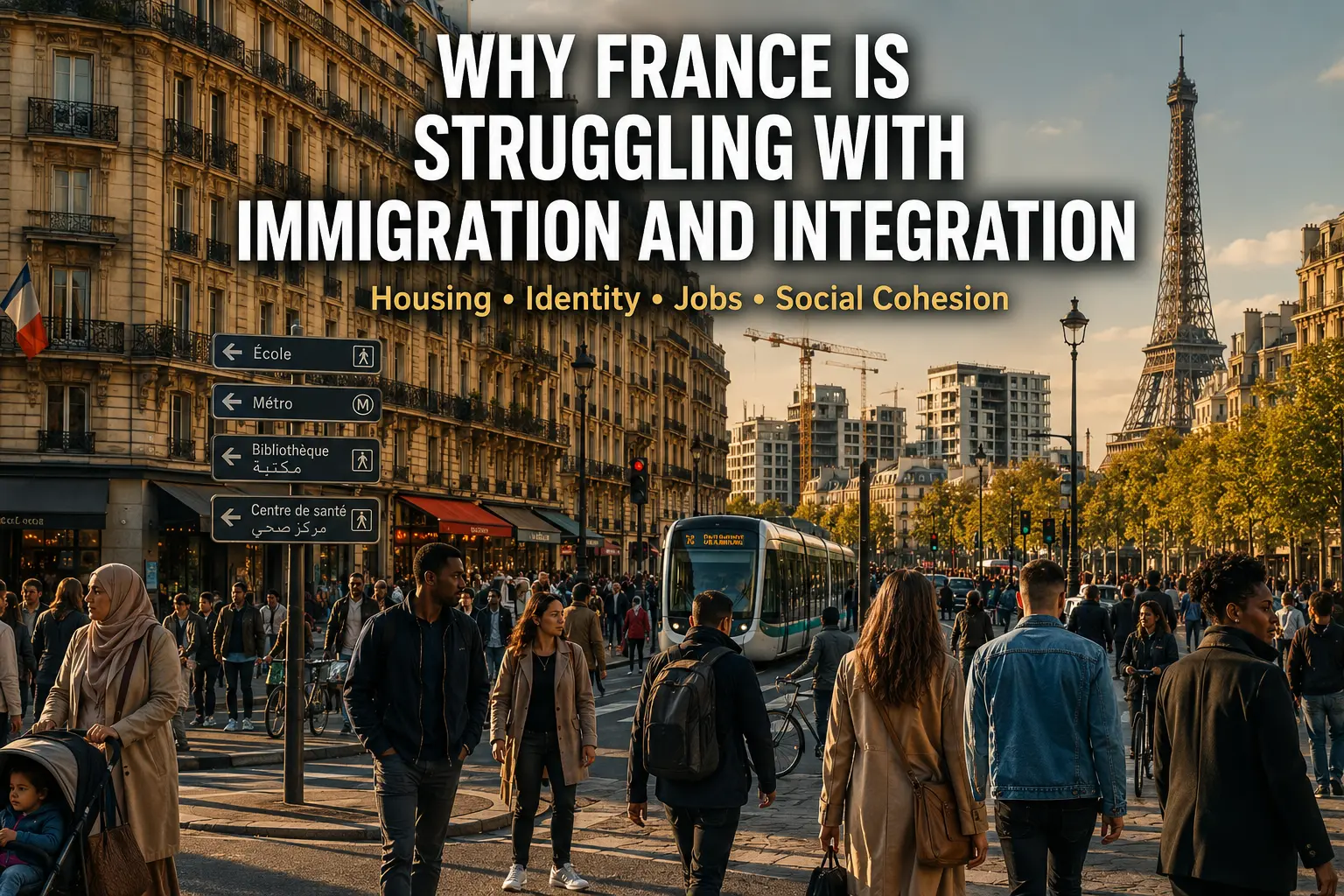
Today, debates about immigration are no longer focused solely on border control. They increasingly center on housing, employment, education, social cohesion, public services, and national identity.
Immigration is only one part of a broader set of structural challenges discussed in The 10 Biggest Problems in France, where housing affordability, rising living costs, public debt, and demographic pressures are also reshaping the country’s future.
Rather than asking whether immigration is good or bad, policymakers are increasingly asking a different question: How can France successfully integrate newcomers while maintaining social cohesion and economic opportunity for everyone?
1. France Has a Long History of Immigration
Immigration is not a recent phenomenon in France.
Following World War II, the country faced severe labor shortages as it rebuilt its economy. Millions of workers arrived from Italy, Spain, Portugal, and later from former French colonies such as Algeria, Morocco, and Tunisia.
During the following decades, immigration continued through:
- Family reunification
- European Union free movement
- International students
- Skilled professionals
- Refugees seeking protection
Today, France remains one of Europe’s largest destinations for immigrants because of its strong economy, extensive public services, and global influence.
The country’s diversity is now deeply woven into everyday French life, from business and education to sports, science, and the arts.
2. Why Integration Has Become More Difficult
Immigration and integration are not the same.
While immigration involves people entering a country, integration is the long-term process of helping newcomers participate fully in society.
Successful integration often depends on:
- Learning the French language
- Finding stable employment
- Accessing quality education
- Affordable housing
- Equal economic opportunities
- Civic participation
When several of these factors become difficult simultaneously, integration becomes much more challenging.
Rapid population growth in some urban areas has increased pressure on schools, housing markets, transportation systems, and local government services.
3. Housing Pressures Are Making Integration Harder
Housing has become one of France’s biggest structural challenges.
Major cities such as Paris, Lyon, Marseille, and Toulouse face persistent shortages of affordable housing.
As prices continue rising, many lower-income households—including both immigrants and native-born French citizens—are pushed toward suburban neighborhoods where employment opportunities and public services may be more limited.
Some communities experience:
- Higher unemployment
- Greater poverty
- Limited investment
- Overcrowded housing
- Reduced social mobility
These conditions can slow integration and reinforce long-term inequality.
4. Employment Challenges Remain Significant
Finding stable employment is one of the most important factors in successful integration.
Although many immigrants fill essential roles in healthcare, transportation, hospitality, construction, and agriculture, others face obstacles entering the labor market.
Common challenges include:
- Language barriers
- Recognition of foreign qualifications
- Limited professional networks
- Skills mismatches
- Higher unemployment rates among some communities
Employment provides far more than income—it also creates opportunities to build social connections, improve language skills, and participate more fully in society.
5. Education Plays a Critical Role
Schools often represent the first point of integration for many immigrant families.
French schools help students learn the language, understand civic values, and prepare for future employment. However, educational outcomes can vary depending on:
- Family income
- Neighborhood conditions
- Language proficiency
- Access to educational resources
Supporting equal educational opportunities remains one of the country’s most important long-term investments.
Well-integrated students are more likely to participate successfully in the workforce and contribute to economic growth.
6. Security Concerns and Public Perception
Immigration is often closely linked to debates about public safety.
High-profile terrorist attacks and isolated incidents of crime have influenced public opinion and shaped political discussions across France.
However, experts generally caution against equating immigration with crime.
Most immigrants obey the law and contribute positively to society. Crime happens because of many factors, such as poverty, education, jobs, and feeling excluded.
Media coverage can sometimes amplify isolated events, affecting public perceptions beyond the available evidence.
As a result, immigration remains one of France’s most politically sensitive issues.
7. Immigration Has Become a Major Political Issue
Immigration consistently ranks among the most debated topics during French elections.
Political parties differ significantly on questions such as:
- Border security
- Asylum policies
- Family reunification
- Citizenship requirements
- Integration programs
- Labor migration
Some advocate stricter immigration controls, while others emphasize improving integration and addressing labor shortages.
Despite differing approaches, most agree that managing immigration effectively will remain an important challenge in the coming decades.
8. Immigration Also Brings Important Economic Benefits
While much public debate focuses on challenges, immigration also provides significant economic advantages.
Many sectors of the French economy depend on immigrant workers, including:
- Healthcare
- Agriculture
- Hospitality
- Construction
- Transportation
- Information technology
Immigrants also start businesses, create jobs, and contribute to tax revenues.
While immigration can expand the workforce and increase tax revenues over time, France’s fiscal challenges are driven by many broader factors, including decades of public spending, pension obligations, healthcare costs, and slower economic growth. To understand why government borrowing continues to rise despite having one of Europe’s largest economies, see Why France Has One of Europe’s Highest Public Debt Levels.
As France’s population continues to age, immigration may help offset workforce shortages and support economic growth.
France remains one of the world’s largest economies, helping explain why it continues to attract workers, entrepreneurs, and students from around the globe. You can see how it compares internationally in The 10 Most Powerful Economies in the World.
9. What Could Improve Integration?
Most experts agree that successful integration requires long-term investment rather than short-term solutions.
Potential improvements include:
- Expanding French language education
- Improving access to affordable housing
- Faster recognition of foreign qualifications
- Better employment support
- Increased vocational training
- Stronger community engagement
- Equal educational opportunities
Successful integration benefits not only immigrants but society as a whole by strengthening economic participation and social cohesion.
10. Looking Ahead
France faces several long-term demographic and economic challenges, including an aging population, labor shortages, and slower economic growth.
Immigration alone cannot solve these issues.
However, effective integration can help maximize the benefits that immigration brings while reducing social tensions and improving opportunities for everyone.
The coming decades will likely depend less on the number of people arriving and more on how successfully France helps newcomers become fully integrated members of society.
| Challenge | Why It Matters | Long-Term Impact |
|---|---|---|
| Housing affordability | Limits where newcomers can live | Slower integration |
| Employment barriers | Makes economic participation harder | Higher inequality |
| Education gaps | Affects future opportunities | Reduced social mobility |
| Language barriers | Limits communication and job prospects | Weaker community integration |
| Public perception | Influences political debate | Greater social polarization |
| Population aging | Increases labor demand | Immigration becomes more economically important |
Conclusion
Immigration has played a major role in shaping modern France and will likely continue to influence its future.
The country’s challenge is not simply managing migration flows but creating the conditions that allow people from diverse backgrounds to succeed together.
France can strengthen its economy and society by investing in education, housing, jobs, language learning, and bringing people together.
Ultimately, the debate is not only about immigration—it is about building a society where opportunity, cohesion, and prosperity can be shared more widely.
France’s influence also extends beyond economics and politics into global culture and digital media. For another perspective on modern France, explore Top 10 Most Popular YouTubers in France.
Frequently Asked Questions (FAQs)
Yes. Immigration can help fill labor gaps in sectors such as healthcare, construction, farming, and hospitality, but successful integration is still necessary.
Immigration affects housing, employment, public services, national identity, and security, making it one of the country’s most debated policy topics.
Language barriers, employment opportunities, housing affordability, education, and social inclusion are among the most significant challenges.
Immigrants contribute to the workforce, start businesses, pay taxes, and help address labor shortages, although the overall economic impact depends on effective integration policies.
Most experts believe immigration will continue to play a role in addressing demographic changes and labor market needs, alongside broader economic and social reforms.