
Europe has long been viewed as one of the world’s most stable and prosperous regions.
A model of strong institutions, advanced economies, and social protections defined Europe. Decades of growth, rising living standards, and mobility reinforced confidence in its future.
Today, however, analysts, policymakers, and citizens increasingly question whether the assumptions underpinning that stability remain reliable.
These challenges include unaffordable housing, rising living costs, energy price pressures, accelerating population aging, and youth outmigration.
Individually, none of these challenges necessarily signals decline.
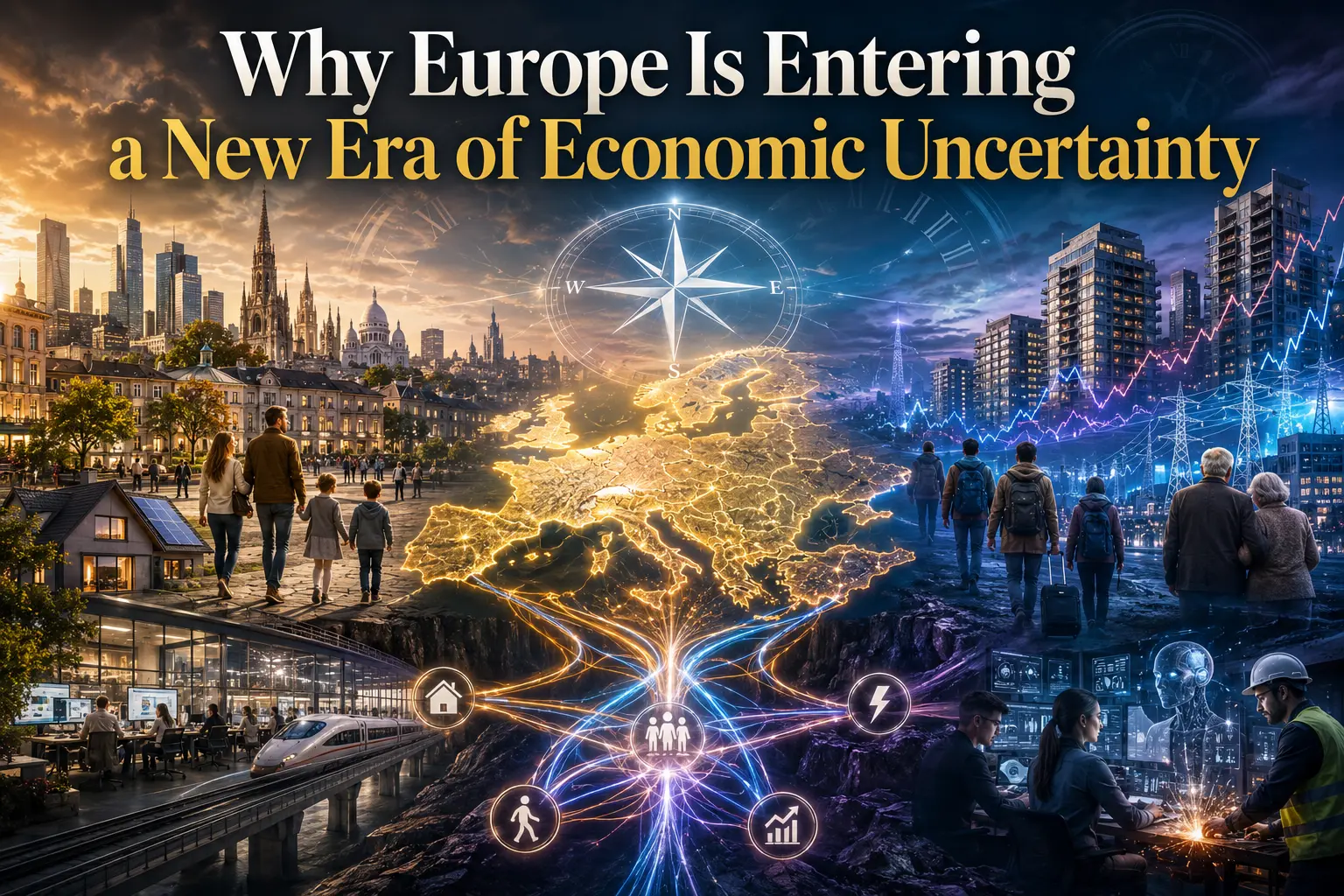
Together, however, they suggest that Europe may be entering a new era defined not by crisis, but by growing economic uncertainty and structural change.
Key Economic Indicators
| Indicator | Current Trend | Primary Source |
|---|---|---|
| Housing affordability | Deteriorating in many major cities | Eurostat |
| Population aging | Accelerating across much of Europe | Eurostat |
| Labor shortages | Increasing in multiple sectors | OECD |
| Energy costs | More volatile than historical norms | IEA |
| Real wage growth | Uneven across countries | European Commission |
| Economic outlook | Moderate growth with ongoing uncertainty | IMF |
Why Economic Uncertainty Matters
Economic uncertainty does not necessarily mean recession or collapse.
Instead, it describes a period in which households, businesses, and governments face increasing difficulty predicting future conditions.
When uncertainty rises:
- Consumers spend more cautiously.
- Businesses delay investment.
- Families postpone major life decisions.
- Governments face more difficult policy trade-offs.
Across Europe, many of these dynamics are becoming increasingly visible.
1. Housing Is Becoming a Structural Challenge
Housing has emerged as one of the defining economic issues of the decade.
Across many European cities, property prices have risen substantially faster than incomes. Rent costs have also increased, reducing disposable income and limiting financial flexibility for many households.
For younger generations, homeownership is increasingly difficult to achieve despite higher levels of education and workforce participation.
Why Housing Is Becoming Unaffordable Across Europe details rising prices, limited supply, and affordability pressures.
Why It Matters
- Delayed homeownership
- Reduced wealth accumulation
- Lower financial security
- Greater economic inequality
2. The Cost of Everyday Life Continues to Rise
Housing is only one part of a broader affordability challenge.
Many households face higher costs for:
- Food
- Transportation
- Utilities
- Healthcare
- Consumer goods
Even when inflation slows, prices often remain elevated relative to previous years, placing ongoing pressure on household budgets.
The Cost of Living Crisis in Europe Is Getting Worse explores how persistent affordability pressures are affecting European families.
3. Energy Prices Are Reshaping Europe’s Economy
Energy has become one of the most important economic variables influencing Europe’s future.
Higher and more volatile energy costs affect:
- Manufacturing competitiveness
- Household spending
- Business investment
- Inflation levels
Energy-intensive industries are particularly exposed, while consumers often face rising utility bills that reduce purchasing power.
Why Energy Prices Are Reshaping the Economy in Europe details the economic consequences of shifting energy markets across Europe.
4. Europe Is Becoming Harder to Afford for Ordinary People
For many households, the issue is no longer a single expense category.
Instead, multiple costs are rising simultaneously.
Housing, food, energy, transportation, and essential services increasingly consume larger shares of income.
As a result, many Europeans report feeling financially stretched despite stable employment.
Why Europe Is Becoming Harder to Afford for Ordinary People details how rising costs are transforming daily life across Europe.
5. Young People Are Responding to Economic Pressures
Economic conditions influence behavior.
Across parts of Europe, younger generations are increasingly:
- Delaying homeownership
- Delaying family formation
- Seeking opportunities abroad
- Reassessing long-term career plans
While migration has always been part of European life, affordability and economic opportunity are becoming increasingly important factors.
6. Population Aging Is Accelerating
Europe is aging faster than many other regions.
Lower birth rates combined with longer life expectancy are creating significant demographic shifts.
This affects:
- Labor markets
- Pension systems
- Healthcare spending
- Economic growth potential
An aging population does not automatically create economic decline, but it does require adaptation and policy responses.
The Fastest-Aging Countries in Europe examines the demographic dimension in detail.
7. Labor Markets Face Growing Pressure
Many European countries simultaneously face:
- Worker shortages
- Aging workforces
- Skills mismatches
- Regional labor imbalances
In some sectors, employers struggle to find qualified workers despite slowing economic growth.
These challenges can limit productivity and make long-term growth more difficult to sustain.
8. Regional Inequality Continues to Expand
Economic outcomes vary significantly across Europe.
Some metropolitan areas continue attracting:
- Investment
- Skilled workers
- New businesses
- International talent
Meanwhile, other regions experience:
- Population decline
- Slower growth
- Limited investment
- Reduced economic dynamism
This divergence creates additional economic and political challenges.
9. Europe’s Economic Pressures Are Interconnected
One reason uncertainty has become more significant is that many challenges reinforce one another.
Housing affects affordability.
Affordability influences migration.
Migration affects demographics.
Demographics affect labor markets.
Labor markets influence growth.
Growth affects living standards.
Rather than existing independently, many of Europe’s economic pressures now operate as part of a larger interconnected system.
Europe’s economic challenges are also part of broader global trends. To see how issues such as demographic change, climate risks, technological disruption, food security, cybersecurity, and geopolitical tensions are shaping the future worldwide, read our guide to The Biggest Problems Facing the World in the Next 10 Years.
Structural Pressures and Their Long-Term Effects
| Structural Pressure | Immediate Impact | Long-Term Risk |
|---|---|---|
| Housing affordability | Higher costs | Reduced homeownership |
| Energy volatility | Business pressure | Lower competitiveness |
| Population aging | Labor shortages | Slower growth |
| Migration trends | Talent movement | Workforce imbalance |
| Cost of living | Lower purchasing power | Reduced savings |
| Regional inequality | Uneven development | Social fragmentation |
10. Uncertainty Does Not Necessarily Mean Decline
Despite these challenges, Europe remains one of the world’s largest and most advanced economic regions.
The continent continues to benefit from:
- Strong institutions
- Highly educated populations
- Advanced infrastructure
- Global economic influence
- Innovation capacity
The central question is not whether Europe is collapsing.
The more important question is how successfully Europe adapts to the structural pressures now emerging across its economies and societies.
Frequently Asked Questions (FAQs)
Multiple structural challenges—housing affordability, demographic aging, energy costs, and slower growth—are creating a more complex economic environment.
Not necessarily. Many analysts describe the situation as a period of structural adjustment rather than a traditional economic crisis.
Housing affects wealth creation, financial stability, family formation, labor mobility, and overall affordability.
Energy costs affect households, businesses, inflation, industrial competitiveness, and long-term investment decisions.
Many seek better economic opportunities, higher wages, and improved affordability elsewhere.
Yes. Aging populations can place pressure on labor markets, healthcare systems, and public finances if not addressed effectively.