

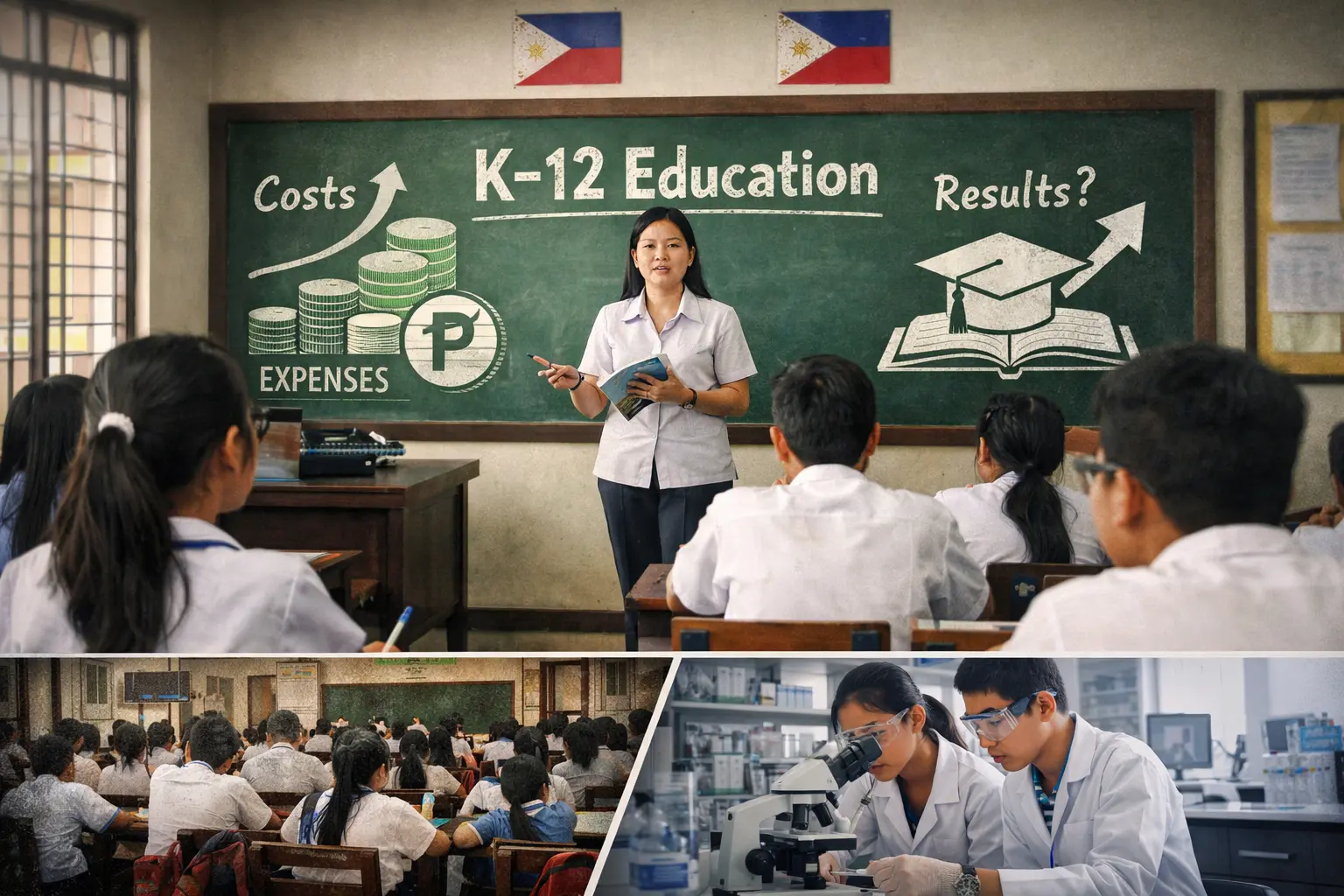
The K–12 reform was one of the most ambitious education overhauls in Philippine history.
When the Department of Education rolled it out, the promise was bold.
Add two years of Senior High School.
Align with global standards.
Improve employability.
Raise academic performance.
On paper, it sounded transformative.
The effectiveness of education reform extends beyond structural design.
We determine its effectiveness through student learning outcomes and performance metrics.
A decade later, the questions are sharper.
Are students learning more?
Are graduates more employable?
Are families better off?
Has the reform extended schooling but intensified the financial strain on families and public funds?
These are not emotional questions.
They are policy questions.
And policy must be judged by outcomes, not intentions.
This article examines the data closely.
Student performance.
Employment absorption.
Public spending.
Equity impact.
Because if K–12 is delivering results, the evidence should show it.
And if it is not, the costs demand accountability.
Are Students Benefiting—or Just Paying the Price?
The Promise of Reform
The K–12 reform, implemented by the Department of Education, was framed as a structural transformation. The two additional years of Senior High School aim to:
• Align with international education standards.
• Improve employability
• Reduce skills mismatch
• Strengthen college preparedness
The central claim was clear: more years would mean better outcomes.
A decade later, the core question remains: Has the promise translated into measurable results?Student Performance: Are Learning Outcomes Improving?
International Benchmarks
The Philippines participated in global assessments such as:
• Programme for International Student Assessment (PISA)
• Trends in International Mathematics and Science Study (TIMSS)
Results placed Filipino students near the bottom in reading, mathematics, and science.
Despite K–12 expansion, learning gaps remain severe.
Structural extension does not necessarily equate to instructional quality.Employment Outcomes: Did Senior High School Improve Job Readiness?
K–12 introduced tracks:
• Academic
• Technical-Vocational-Livelihood (TVL)
• Arts and Design
• Sports
The reform aimed to make graduates employable without requiring a college degree.
However:
• Many employers still prefer college credentials.
• TVL graduates report limited industry absorption.
• Job matching remains inconsistent.
The question becomes structural:
Did the labor market respond to K–12, or did students extend their schooling without guaranteed outcomes?The Cost Dimension: Who Is Paying?
K–12 required:
• Massive infrastructure expansion
• Teacher hiring and retraining
• Curriculum redesign
• Learning material production
Costs were borne by:
• Government (public funding)
• Families (transportation, materials, lost earning time)
• Students (two additional years before workforce entry)
For low-income households, the opportunity cost is high.
Reform without proportional outcome gains raises a policy concern:
Is the return on investment measurable?Systemic Weaknesses: Accountability Gaps
Even with structural expansion, recurring issues persist:
• Overcrowded classrooms
• Inconsistent grading standards
• Resource inequality across regions
• Monitoring gaps
If evaluation mechanisms remain weak, reform becomes procedural rather than transformational.
It connects directly to a deeper structural question:
Can K–12 succeed without strong institutional accountability?Equity Impact: Did K–12 Reduce or Reinforce Inequality?
One of the reform’s goals was social mobility.
Yet disparities persist between:
• Urban and rural schools
• Public and private institutions
• High-resource and low-resource divisions
When reform implementation varies widely, outcomes follow suit.What the Data Suggests So Far
Emerging patterns indicate:
• Structural alignment improved on paper.
• Learning outcomes remain weak.
• Employment absorption is uneven.
• Financial burden increased
• Institutional oversight remains inconsistent.
The reform’s measurable impact appears mixed rather than transformational.
Key Data Snapshot
| Dimension | Intended Outcome | Observed Trend |
|---|---|---|
| Academic Performance | Higher test scores | Persistently low global rankings in PISA and TIMSS |
| Employment | Job-ready graduates | Mixed absorption rates; many employers still prefer college degrees |
| Equity | Reduced inequality | Regional disparities persist between urban and rural schools |
| Costs | Long-term economic gain | Immediate financial burden increased for government and families |
Frequently Asked Questions (FAQs)
Did K–12 improve Philippine education rankings?
International assessments suggest limited improvement in global standing.
Is Senior High School truly preparing students for the workforce?
Results vary by track and region, with uneven labor market absorption.
Why is K–12 controversial?
Concerns center on cost, learning outcomes, and consistency in implementation.
Is the problem structural or instructional?
Evidence suggests that simply adding years without improving quality may limit impact.
- Are Public School Grades Reliable in the Philippines — or Systemically Flawed?
- How Teacher Inexperience Can Affect Student Learning and Grades
- 10 Warning Signs the Polish Education System Is Quietly Breaking