

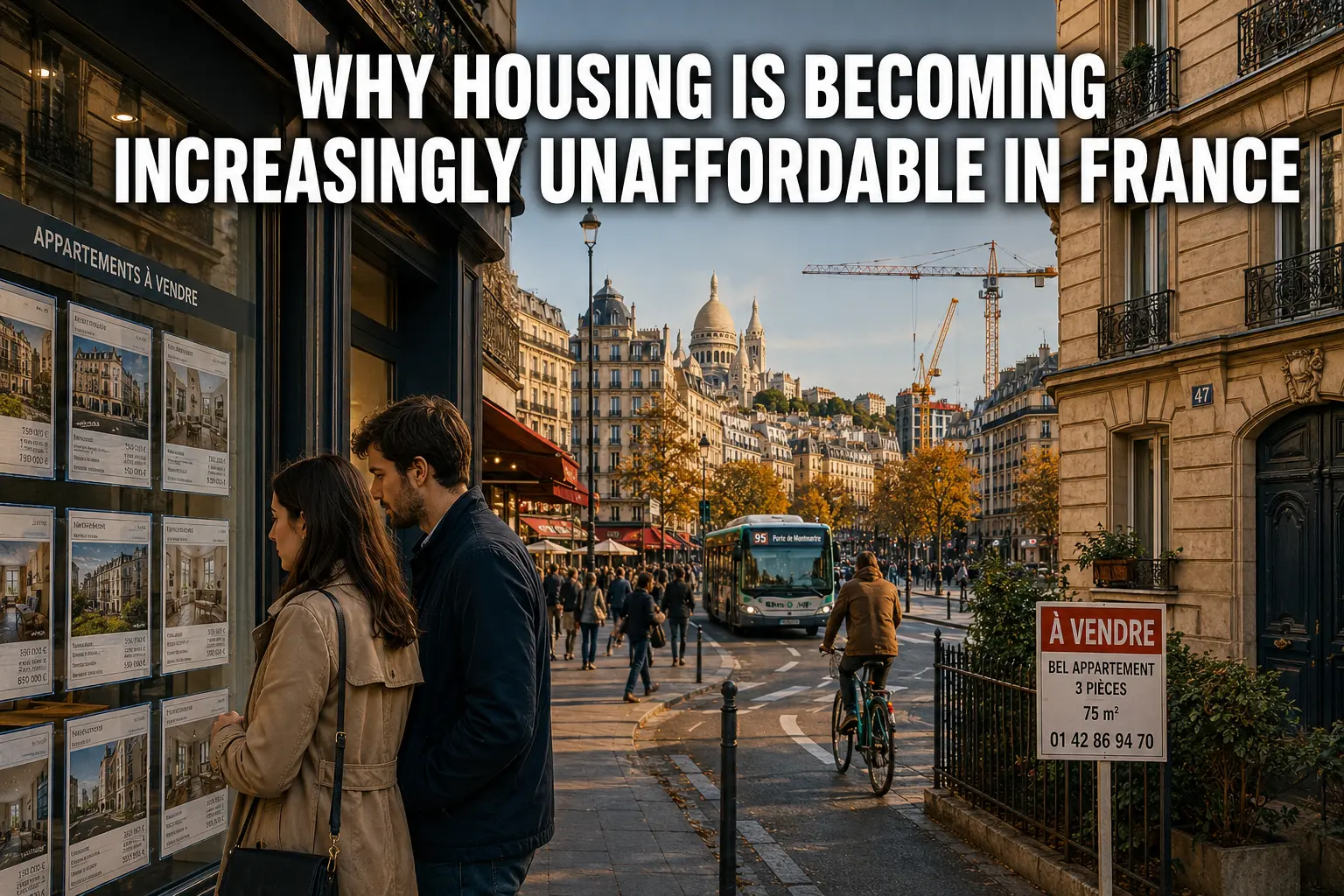
France has long been associated with a high standard of living, generous social protections, and vibrant cities. Yet for millions of households, one of life’s necessities—affordable housing—is becoming increasingly difficult to secure.
Whether in Paris, Lyon, Marseille, Bordeaux, or many smaller cities, rising property prices and rents are forcing families, young professionals, students, and even middle-income workers to spend a growing share of their income on housing.
The problem extends beyond expensive real estate. Housing affordability now influences labor mobility, economic growth, family formation, immigration, social inequality, and France’s long-term competitiveness. As demand continues to outpace supply in many regions, policymakers face mounting pressure to expand housing while balancing environmental, financial, and urban planning goals.
Measuring Housing Affordability in France
| Indicator | Current Trend | Why It Matters |
|---|---|---|
| Home prices | Rising in many metropolitan areas | Reduces affordability for first-time buyers |
| Rental costs | Increasing faster than incomes in many cities | Places pressure on household budgets |
| Housing supply | Insufficient in high-demand regions | Drives prices higher |
| Mortgage affordability | Weakened by higher interest rates | Makes homeownership more difficult |
| Social housing demand | Growing | Longer waiting lists for affordable homes |
| Young homeownership | Declining | Delays wealth building and family formation |
1. Housing Prices Have Outpaced Income Growth
One of the biggest reasons housing has become less affordable is that property values have increased much faster than wages over the past two decades.
Although price growth varies by region, many major French cities have experienced sustained increases driven by strong demand and limited supply.
For many households, salaries have not kept pace with rising housing costs.
As a result:
- Saving for a down payment takes longer.
- Rising mortgage costs are placing greater pressure on household incomes.
- More people remain in the rental market.
- Younger generations delay buying their first home.
This affordability gap has become especially pronounced in economically dynamic regions where employment opportunities continue to attract new residents.
2. Paris Remains One of Europe’s Most Expensive Housing Markets
Paris remains the country’s most expensive housing market.
The capital attracts:
- International investors
- Highly paid professionals
- Students
- Tourists
- Global businesses
- Government institutions
Demand consistently exceeds available housing.
Housing pressures in France are closely tied to population growth and migration, topics explored in Why France Is Struggling With Immigration and Integration.
Even relatively small apartments can command exceptionally high prices compared with average incomes.
Many workers who cannot afford to live in Paris move to surrounding suburbs, often facing longer commutes while placing additional pressure on neighboring municipalities.
This trend affects not only low-income households but also teachers, healthcare workers, civil servants, and young professionals who increasingly struggle to find affordable accommodation near their workplaces.
3. Housing Supply Has Not Kept Up With Demand
One of the most important drivers of rising prices is a persistent imbalance between supply and demand.
Several factors contribute to limited housing construction:
- Lengthy planning approval processes
- Strict zoning regulations
- Rising construction costs
- Labor shortages in the building industry
- Limited availability of land in major cities
- Environmental regulations affecting new developments
France continues to add new housing each year, but construction has not always kept pace with population growth or the changing housing needs of high-demand areas.
As available properties become scarcer, competition intensifies, placing upward pressure on both purchase prices and rental costs.
4. Rising Interest Rates Have Made Buying Even More Difficult
Higher mortgage interest rates have added another layer of difficulty for prospective homebuyers.
During periods of historically low interest rates, many households could borrow larger amounts while keeping monthly repayments manageable.
As borrowing costs increased, however:
- Monthly mortgage payments rose.
- Banks tightened lending standards.
- Buyers qualified for smaller loans.
- Purchasing power declined.
Ironically, housing prices have not always fallen enough to offset these higher financing costs.
This combination has left many first-time buyers caught between expensive homes and more costly mortgages, forcing some to postpone homeownership altogether.
5. Renting Is Becoming Increasingly Expensive
For households unable to purchase property, renting has become the primary alternative.
Unfortunately, rent has also become less affordable.
In many French cities, tenants now spend a substantial share of their monthly income on rent, leaving less money for:
- Food
- Transportation
- Utilities
- Healthcare
- Education
- Savings
Students and young workers are particularly affected because they often enter the labor market with relatively modest salaries while competing for limited rental housing.
The growing rental burden also reduces financial mobility, making it more difficult for tenants to accumulate savings needed for future homeownership.
6. Housing Affordability Is Closely Linked to the Cost of Living
Housing rarely exists as an isolated economic issue.
For most households, rent or mortgage payments represent the single largest monthly expense.
When combined with rising prices for food, electricity, transportation, and other essentials, housing becomes part of a much broader affordability challenge.
This explains why housing is increasingly viewed as one of the key drivers behind France’s wider cost-of-living pressures. In our next article, Why France Is Facing a Cost of Living Crisis, we’ll explore how inflation and rising household expenses are reshaping everyday life across the country.
7. Social Housing Demand Continues to Grow
France has one of Europe’s largest social housing systems, providing affordable accommodation for millions of residents.
However, demand has grown much faster than the number of available units.
Across many regions, waiting lists for social housing continue to expand as more households struggle to afford market rents or purchase homes.
Applicants often include:
- Low-income families
- Young workers
- Single parents
- Retirees
- Students
- Essential public-sector employees
While social housing helps reduce housing inequality, limited availability means many eligible households must wait months—or even years—for a suitable home.
Expanding affordable housing remains one of the country’s biggest policy challenges.
8. Young Adults Are Delaying Major Life Decisions
Housing affordability affects far more than where people live.
It also influences major life milestones.
As housing becomes increasingly expensive, many younger French adults are delaying:
- Buying their first home
- Moving out of their parents’ house
- Marriage
- Having children
- Long-term financial planning
Without affordable housing, building wealth becomes significantly more difficult.
Instead of accumulating equity through homeownership, many households spend a growing share of their income on rent, leaving fewer opportunities to save or invest.
This trend also contributes to broader demographic challenges that France is expected to face over the coming decades.
9. Businesses Are Also Feeling the Effects
Housing affordability is no longer just a household issue—it has become an economic issue.
Employers increasingly report difficulties recruiting workers in expensive cities because many potential employees cannot afford to live nearby.
Industries experiencing particular pressure include:
- Healthcare
- Education
- Hospitality
- Construction
- Retail
- Public transportation
Long commutes and high housing costs reduce quality of life while increasing employee turnover.
Some companies have begun offering housing assistance or relocation support to attract workers, but these measures are often expensive and only partially address the underlying shortage of affordable homes.
Over time, persistent housing pressures can reduce labor mobility and weaken economic productivity.
10. Government Policies Aim to Improve Housing Affordability
Successive French governments have introduced a range of measures designed to improve housing affordability.
These include:
- Expanding social housing construction
- Financial assistance for first-time buyers
- Rent regulation in selected cities
- Urban renewal projects
- Incentives for residential construction
- Programs encouraging energy-efficient housing renovations
Despite these efforts, results have been mixed.
High construction costs, complex regulations, and strong demand in major cities have made it harder to deliver new housing quickly.
Many economists argue that lasting improvements will require a combination of increased housing supply, faster planning approvals, infrastructure investment, and policies that encourage balanced regional development.
Why Housing Affordability Matters for France’s Economy
Housing influences nearly every part of the economy.
Affordable homes help workers move to where jobs are available, encourage family formation, support consumer spending, and improve long-term financial security.
When housing becomes too expensive, the consequences extend well beyond the property market.
Higher housing costs can lead to:
- Lower household savings
- Reduced consumer spending
- Greater wealth inequality
- Slower labor mobility
- Increased pressure on public housing
- Wider regional disparities
Housing affordability has therefore become one of the structural issues shaping France’s future economic performance.
It is also closely connected to other national challenges. Rising housing costs, public spending, and slower economic growth all place additional pressure on government finances, as explored in Why France Has One of Europe’s Highest Public Debt Levels.
Quick Facts: Why Housing Has Become Less Affordable
| Challenge | Main Cause | Long-Term Impact |
|---|---|---|
| Rising home prices | Strong demand and limited supply | Lower homeownership |
| Expensive rents | Housing shortages | Reduced household savings |
| Limited construction | Planning rules and higher costs | Persistent affordability problems |
| Higher mortgage rates | Increased borrowing costs | Fewer first-time buyers |
| Growing social housing demand | More households need affordable homes | Longer waiting lists |
| Regional imbalances | Jobs concentrated in major cities | Greater pressure on urban housing markets |
The Future of Housing Affordability in France
France’s housing market is unlikely to become significantly more affordable overnight.
Most economists agree that housing affordability will remain one of the country’s biggest long-term economic challenges throughout the coming decade.
Several trends will continue shaping the market:
- Population growth in major metropolitan areas
- Smaller average household sizes
- Rising construction costs
- Higher environmental standards for buildings
- Interest rate movements
- Changing patterns of remote work
If housing supply fails to keep pace with demand, affordability pressures could remain elevated for years.
However, there are also reasons for cautious optimism.
Continued investment in residential construction, transport infrastructure, and regional development could gradually reduce pressure on the country’s most expensive cities while creating new opportunities elsewhere.
The challenge will be ensuring that economic growth translates into greater housing accessibility for ordinary households rather than continued price inflation.
Can France Solve Its Housing Affordability Problem?
There is no single solution.
Most housing experts argue that meaningful improvements will require several complementary policies working together.
Potential long-term solutions include:
- Building more homes in high-demand areas
- Simplifying planning and permitting procedures
- Expanding affordable and social housing
- Encouraging development beyond major cities
- Improving public transportation to connect suburban communities with employment centers
- Supporting first-time buyers responsibly
- Investing in modern infrastructure that enables balanced regional growth
Housing markets typically evolve slowly.
As a result, reforms introduced today may take years before producing noticeable improvements in affordability.
Frequently Asked Questions (FAQs)
Housing prices have increased because demand has grown faster than supply in many cities. Rising construction costs, limited land, planning restrictions, and higher mortgage rates have also contributed to declining affordability.
Yes. Paris generally has the country’s highest residential property prices and rental costs, making it one of Europe’s least affordable cities relative to average incomes.
Several factors slow new housing construction, including lengthy planning approvals, environmental regulations, construction costs, labor shortages, and limited land availability in densely populated urban areas.
Yes. Rising rents have increased financial pressure on many households, particularly students, young professionals, and lower-income families who spend a larger proportion of their income on housing.
Social housing provides below-market rental accommodation for eligible households. It helps improve affordability, but demand has grown faster than supply, leading to long waiting lists in many regions.
High housing costs reduce consumer spending, slow labor mobility, delay homeownership, increase inequality, and make it more difficult for employers to recruit workers in expensive metropolitan areas.
Generally, yes. Younger adults often face lower starting salaries while trying to save for increasingly expensive homes, leading many to delay purchasing property or remain in rental housing for longer.
Lower interest rates can reduce mortgage repayments and improve borrowing capacity. However, if housing supply remains constrained, lower rates may also increase demand, potentially pushing prices higher again.
The government has introduced policies such as expanding social housing, supporting first-time buyers, regulating rents in some cities, encouraging residential construction, and investing in urban renewal projects. However, affordability remains a significant long-term challenge.
Most analysts believe so. Housing affordability is closely linked to employment, demographic change, economic growth, regional development, and the overall cost of living, making it one of France’s most important structural issues for the coming decade.