

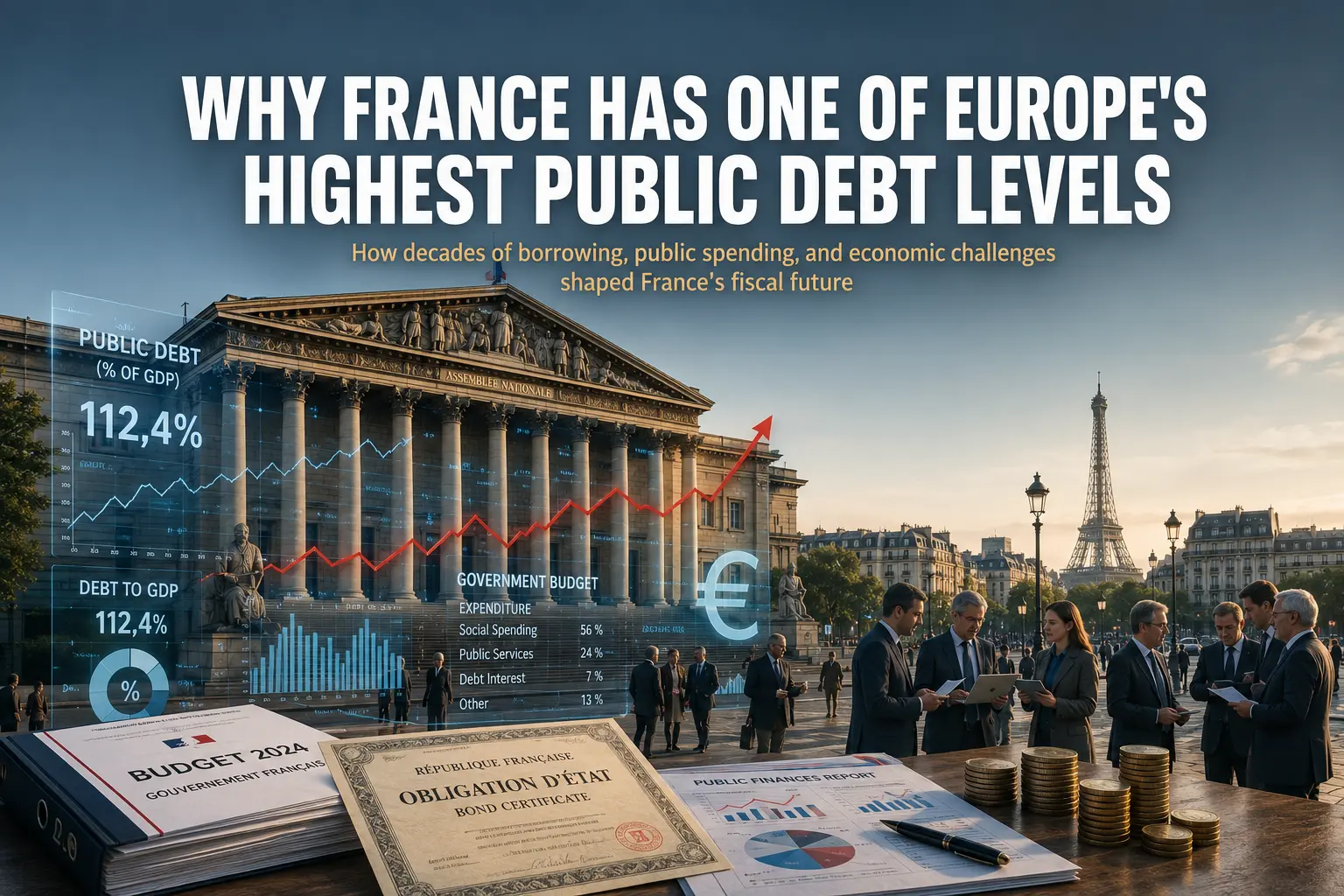
France is home to one of the world’s largest economies and remains a leading political and economic power within the European Union. The country has excellent infrastructure, a well-educated workforce, universal Healthcare, and one of Europe’s most complete social welfare systems.
Yet behind these strengths lies a growing fiscal challenge.
France has one of the largest public debts in Europe, with government debt exceeding the nation’s annual economic output. Rising borrowing costs, persistent budget deficits, and an aging population have intensified concerns about the country’s long-term financial outlook.
Despite these challenges, France is far from facing an immediate debt crisis. The country continues to enjoy strong investor confidence and access to global financial markets. However, economists increasingly argue that without meaningful reforms, mounting debt could limit France’s ability to respond to future economic shocks.
This article looks at why France has accumulated so much public debt, what’s driving continued borrowing, how it compares with other European nations, and what the future may hold.
Quick Answer
France has one of Europe’s highest public debt levels because it has consistently spent more than it collects in tax revenue over many years. Large public spending on pensions, Healthcare, education, social protection, and emergency support during major crises—including the global financial crisis, the COVID-19 pandemic, and the energy price shock—has significantly increased government borrowing. While France remains financially stable, economists agree that reducing long-term debt will require stronger economic growth, more efficient public spending, and gradual fiscal reforms.
Essential Takeaways
✔ Persistent annual budget deficits have steadily increased government borrowing.
✔ Healthcare, pensions, education, and social welfare account for a large share of public spending.
✔ The COVID-19 pandemic and energy crisis accelerated debt growth across Europe, including France.
✔ France is not in immediate financial danger, but rising debt reduces fiscal flexibility for future crises.
France’s Public Debt: Quick Facts
| Indicator | Current Situation |
|---|---|
| Debt-to-GDP Ratio | Over 110% |
| EU Reference Limit | 60% of GDP |
| Annual Budget Balance | Persistent deficit |
| Largest Spending Areas | Pensions, Healthcare, Education, Social Protection |
| Credit Market Access | Strong |
| Main Long-Term Challenge | Controlling spending while supporting economic growth |
Why Does France Have One of Europe’s Highest Public Debt Levels?
Public debt does not accumulate overnight.
Instead, it builds gradually whenever governments spend more money than they receive through taxes and other revenue sources.
France has recorded budget deficits for much of the past four decades.
Each annual deficit has required additional borrowing, steadily increasing the country’s overall debt burden.
Several structural factors explain why France continues to borrow heavily.
These include:
- Extensive Social Welfare Programs
- Universal Healthcare
- Public Pensions
- Education Spending
- Infrastructure Investment
- Economic Stimulus During Crises
Unlike many short-term financial problems, public debt is often the result of long-term policy choices that balance economic growth, social protection, and public investment.
Many of these broader fiscal pressures also contribute to the issues discussed in The 10 Biggest Problems in France, where rising public debt is closely connected to healthcare costs, pension reform, labor market challenges, and economic growth.
How Much Public Debt Does France Have?
France’s government debt now exceeds 110% of its Gross Domestic Product (GDP).
In other words, France’s government debt is larger than what the entire country produces in a year.
This number may sound alarming, but debt is typically measured as a share of the economy, not its total amount.
Many advanced economies—including Japan, Italy, and the United States—also maintain high public debt ratios.
What matters most is whether investors continue to trust that a government can repay its obligations over time.
France continues to borrow at relatively favorable interest rates because investors view its economy as large, diversified, and backed by strong institutions.
Nevertheless, economists warn that maintaining high debt levels indefinitely becomes more difficult as interest payments consume a growing share of government spending.
Why Does France Keep Running Budget Deficits?
A budget deficit occurs whenever government spending exceeds government revenue during a fiscal year.
France has experienced recurring budget deficits for decades.
Rather than resulting from a single policy, these deficits reflect a combination of structural spending commitments and periodic economic shocks.
Some of the biggest contributors include:
1. High Social Spending
France operates one of Europe’s most comprehensive welfare systems.
Government spending supports:
- Public Pensions
- Universal Healthcare
- Family Benefits
- Housing Assistance
- Unemployment Insurance
- Social Protection Programs
These services contribute significantly to quality of life but also require substantial long-term funding.
2. Slower Economic Growth
Economic growth directly affects tax revenue.
When growth slows, governments collect less income tax, corporate tax, and value-added tax (VAT).
At the same time, spending on unemployment benefits and social assistance often increases.
This combination naturally widens budget deficits.
3. Crisis Response Spending
Recent global crises have significantly increased borrowing.
These include:
- The 2008 Global Financial Crisis
- The COVID-19 pandemic
- Europe’s energy price shock
- Inflation support measures
During these periods, the French government provided extensive financial assistance to households, businesses, and public services to stabilize the economy.
While these interventions helped cushion economic disruption, they also added substantially to public debt.
4. Rising Interest Costs
As debt grows, so do interest payments.
Governments must allocate part of their annual budget simply to servicing existing debt before funding public services or new investments.
If global interest rates stay elevated, borrowing costs rise, leaving less money for other government priorities.
The Biggest Drivers of France’s Public Debt
France’s debt has accumulated over many decades.
Unlike a temporary spike caused by a single recession, France’s borrowing reflects a combination of structural spending commitments and extraordinary economic events.
Below are the five key factors that have shaped how France manages its public money.
1. One of Europe’s Largest Welfare Systems
France spends more on social protection than almost any other OECD country.
The government finances an extensive safety net that includes:
- Universal Healthcare
- Public Pensions
- Family Allowances
- Housing Assistance
- Disability Benefits
- Unemployment Insurance
- Income Support Programs
These programs provide significant social benefits and help reduce poverty.
However, they also require substantial government spending every year.
As the population ages and healthcare costs rise, maintaining these programs becomes increasingly expensive.
2. Rising Pension Costs
Pensions remain one of France’s largest long-term fiscal challenges.
People in France live longer than most of Europe, but the country also has fewer births.
As a result:
- More people are retiring.
- Fewer workers are contributing payroll taxes.
- Pension expenditures continue to increase.
This demographic imbalance has become one of the central reasons behind recent pension reform debates and nationwide protests.
Without gradual reforms, pension spending is expected to place increasing pressure on future government budgets.
3. Slower Economic Growth
Strong economic growth makes public debt easier to manage.
When the economy expands, governments collect more revenue through:
- Income taxes
- Corporate taxes
- Value-added tax (VAT)
- Payroll contributions
However, France has experienced relatively modest economic growth during much of the past two decades.
Slower growth means:
- Lower tax revenue
- Higher social spending
- Larger annual deficits
Even moderate deficits can gradually accumulate into very large debt levels over time.
4. COVID-19 Emergency Spending
The COVID-19 pandemic represented one of the largest fiscal interventions in modern French history.
To prevent widespread business failures and unemployment, the government introduced massive support programs, including:
- Wage subsidies
- Business loans
- Healthcare funding
- Emergency grants
- Economic recovery packages
These measures helped stabilize the economy during an unprecedented crisis.
However, they also significantly increased government borrowing.
Most developed countries saw similar increases in debt during the pandemic.
5. Higher Interest Rates
For many years, France benefited from historically low borrowing costs.
This allowed governments to finance debt relatively cheaply.
Today, the situation has changed.
As central banks raised interest rates to combat inflation, governments must now pay more to refinance existing debt and issue new bonds.
Higher borrowing costs mean:
- Larger annual interest payments
- Less room for public investment
- Greater pressure on future budgets
Although France continues to enjoy favorable financing conditions compared with many countries, rising interest expenses are becoming an increasingly important fiscal challenge.
France Compared with Other European Countries
Public debt varies considerably across Europe.
Some countries maintain relatively low debt levels through balanced budgets and conservative fiscal policies.
Some have much higher debt because their economies grow more slowly, their populations are aging, or their governments spend more than they earn.
The table below illustrates how France compares with several major European economies.
| Country | Approximate Debt-to-GDP Ratio | General Trend |
|---|---|---|
| Greece | Very High | Declining but still among Europe’s highest |
| Italy | Very High | Persistent structural debt |
| France | Over 110% | High with continuing deficits |
| Spain | Around or above 100% | Gradually stabilizing |
| Belgium | High | Elevated public debt |
| Germany | Lower than France | More conservative fiscal policy |
| Netherlands | Relatively Low | Strong fiscal discipline |
| Sweden | Low | Stable public finances |
France has high public debt in the European Union, but less than countries such as Greece and Italy.
Compared with Germany and several Northern European economies, however, France carries a substantially heavier debt burden.
Why Doesn’t France Just Cut Spending?
Reducing public debt is rarely as simple as cutting expenditures.
Much of France’s budget supports essential public services that millions of citizens depend upon.
Major spending categories include:
- Healthcare
- Public education
- National defense
- Infrastructure
- Pension payments
- Social protection
Large spending reductions can slow economic activity, increase unemployment, or reduce access to essential services.
For this reason, governments often seek gradual fiscal adjustments rather than immediate austerity.
The challenge lies in balancing three competing priorities:
- Maintaining economic growth
- Preserving social protections
- Reducing long-term borrowing
Finding this balance remains one of France’s biggest economic policy debates.
Is France’s Debt Sustainable?
Despite its large debt burden, most economists do not consider France to be facing an immediate sovereign debt crisis.
Several factors continue to support investor confidence.
France Benefits from Strong Economic Fundamentals
France remains:
- The second-largest economy in the European Union.
- One of the world’s largest exporters.
- A major industrial and financial center.
- Home to globally competitive companies.
- Backed by stable democratic institutions.
These strengths make investors more willing to purchase French government bonds.
But Risks Are Increasing
High debt becomes more problematic when combined with:
- Slower economic growth
- Aging populations
- Rising healthcare costs
- Increasing interest rates
- Persistent annual deficits
If these pressures continue for many years, governments may face fewer options during future economic downturns.
This broader challenge is closely connected to Why France Is Struggling With Immigration and Integration, as demographic change, labor shortages, workforce participation, and long-term economic growth all influence the country’s fiscal outlook.
Why Credit Rating Agencies Closely Watch France
International credit rating agencies—including Moody’s, S&P Global Ratings, and Fitch Ratings—regularly assess France’s public finances.
They evaluate factors such as:
- Government debt
- Budget deficits
- Economic growth
- Political stability
- Reform progress
- Debt repayment capacity
A lower credit rating can increase borrowing costs because investors demand higher interest rates to compensate for perceived risk.
Maintaining investor confidence has therefore become an important objective for French fiscal policymakers.
What Happens If France’s Debt Keeps Growing?
Public debt does not become a crisis overnight.
Instead, the risks tend to build gradually over time if borrowing consistently outpaces economic growth.
If France’s debt continues to rise without meaningful fiscal adjustments, several long-term consequences could emerge.
1. Higher Interest Payments
One of the most immediate effects of rising debt is higher borrowing costs.
As more of the national budget goes toward servicing existing debt, less money remains available for priorities such as:
- Education
- Healthcare
- Infrastructure
- Scientific research
- Defense
- Climate initiatives
This can reduce the government’s flexibility when responding to future economic shocks.
2. Reduced Fiscal Flexibility
Countries with lower debt generally have greater capacity to respond during recessions.
They can increase spending or cut taxes without dramatically expanding borrowing.
Highly indebted governments have fewer options.
Future crises—whether economic, geopolitical, or health-related—could therefore become more difficult to manage.
3. Slower Long-Term Growth
Large debt does not automatically reduce economic growth.
However, persistent borrowing may discourage investment if governments eventually need to:
- Raise taxes
- Reduce public spending
- Delay infrastructure projects
- Cut business incentives
Lower investment can gradually reduce productivity and economic competitiveness.
4. Greater Pressure from Financial Markets
Investors continuously assess a country’s fiscal outlook.
If confidence weakens, lenders may demand higher interest rates when purchasing government bonds.
Higher financing costs can create a cycle in which:
- Interest expenses rise.
- Budget deficits widen.
- Governments borrow even more.
- Debt continues increasing.
It becomes increasingly difficult to break this cycle as time goes on.
Can France Reduce Its Public Debt?
Yes—but doing so requires patience and sustained economic growth rather than a single policy change.
Historically, countries have reduced debt through a combination of strategies.
Stronger Economic Growth
The most effective way to improve the debt-to-GDP ratio is often by expanding the economy.
When GDP grows faster than debt:
- Tax revenues increase.
- Employment rises.
- Government borrowing becomes a smaller share of national output.
This is why policymakers often emphasize innovation, investment, and productivity alongside fiscal discipline.
Gradual Spending Reforms
Rather than making drastic cuts, governments often pursue gradual reforms.
Examples include:
- Pension adjustments
- Healthcare efficiency improvements
- Better targeting of social benefits
- Public sector modernization
- Reducing wasteful spending
These measures aim to slow expenditure growth while preserving essential public services.
Encouraging Higher Employment
More people working generally leads to:
- Higher tax revenues
- Increased consumer spending
- Lower unemployment costs
France has introduced several labor-market reforms in recent years to improve workforce participation and competitiveness.
Maintaining Investor Confidence
Stable economic policies help governments borrow at lower interest rates.
Confidence depends on factors such as:
Predictable fiscal policy
Political stability
Sustainable long-term planning
Transparent public finances
Even highly indebted countries can maintain relatively low borrowing costs if investors believe their debt remains manageable.
What Does France’s Public Debt Mean for Ordinary Citizens?
Government debt can seem like an abstract economic statistic.
It really affects many things in daily life.
Taxes
Governments may eventually increase taxes to strengthen public finances.
Public Services
Budget pressures can affect spending on:
- Schools
- Hospitals
- Transportation
- Social programs
Interest Rates
Government borrowing costs may indirectly influence wider financial conditions across the economy.
Economic Confidence
Businesses often invest more when they believe public finances are stable.
Greater investment supports:
- Job creation
- Wage growth
- Innovation
For many households, the effects of public debt are indirect but can become increasingly important over time.
Housing costs are another major source of financial pressure for households. Why Housing Is Becoming Increasingly Unaffordable in France explores how rising property prices, expensive rents, and limited housing supply are affecting households across the country.
Why France’s Debt Matters Beyond France
France is not just another European economy.
It is:
- The European Union’s second-largest economy.
- A founding member of the EU.
- One of the world’s largest sovereign bond issuers.
- A major player in global finance and international trade.
Because of this, developments in France’s public finances can influence:
- European financial markets
- Eurozone monetary policy
- Investor confidence
- Regional economic stability
France’s fiscal health therefore carries significance well beyond its national borders.
Frequently Asked Questions (FAQs)
France’s debt has accumulated through decades of government deficits, extensive social spending, slower economic growth, pension obligations, and emergency spending during the COVID-19 pandemic.
No. Countries such as Greece and Italy currently have higher debt-to-GDP ratios. However, France remains among the most indebted major economies in the European Union.
Governments rarely repay all public debt outright. Instead, they refinance maturing debt while aiming to keep borrowing sustainable relative to economic growth.
No. France continues to have one of the world’s largest economies, strong institutions, diversified industries, and high investor confidence. High debt presents long-term fiscal challenges but does not necessarily indicate an immediate crisis.
High public debt can influence taxes, government spending, public services, investment, and long-term economic growth, although most effects are gradual rather than immediate.
An aging population increases pension costs over time. Reforming retirement systems is one way governments attempt to slow future spending growth and improve fiscal sustainability.
Most economists consider this unlikely under current conditions. France has a much larger and more diversified economy, stronger borrowing capacity, and lower financing risks than Greece faced during the eurozone debt crisis.
The most sustainable approach combines stronger economic growth, higher employment, gradual spending reforms, improved productivity, and responsible fiscal management rather than severe austerity.
Population aging reduces the number of working-age taxpayers supporting pensions and Healthcare. Immigration and successful labor-market integration can partially offset demographic pressures by expanding the workforce. Readers interested in this broader issue may also find Why France Is Struggling With Immigration and Integration helpful, as it explores how demographic trends, workforce participation, and integration policies affect France’s long-term economic outlook.
Many economists point to the combination of population aging, rising healthcare costs, slower economic growth, persistent annual deficits, and higher interest rates as the most significant long-term fiscal challenges facing France.