

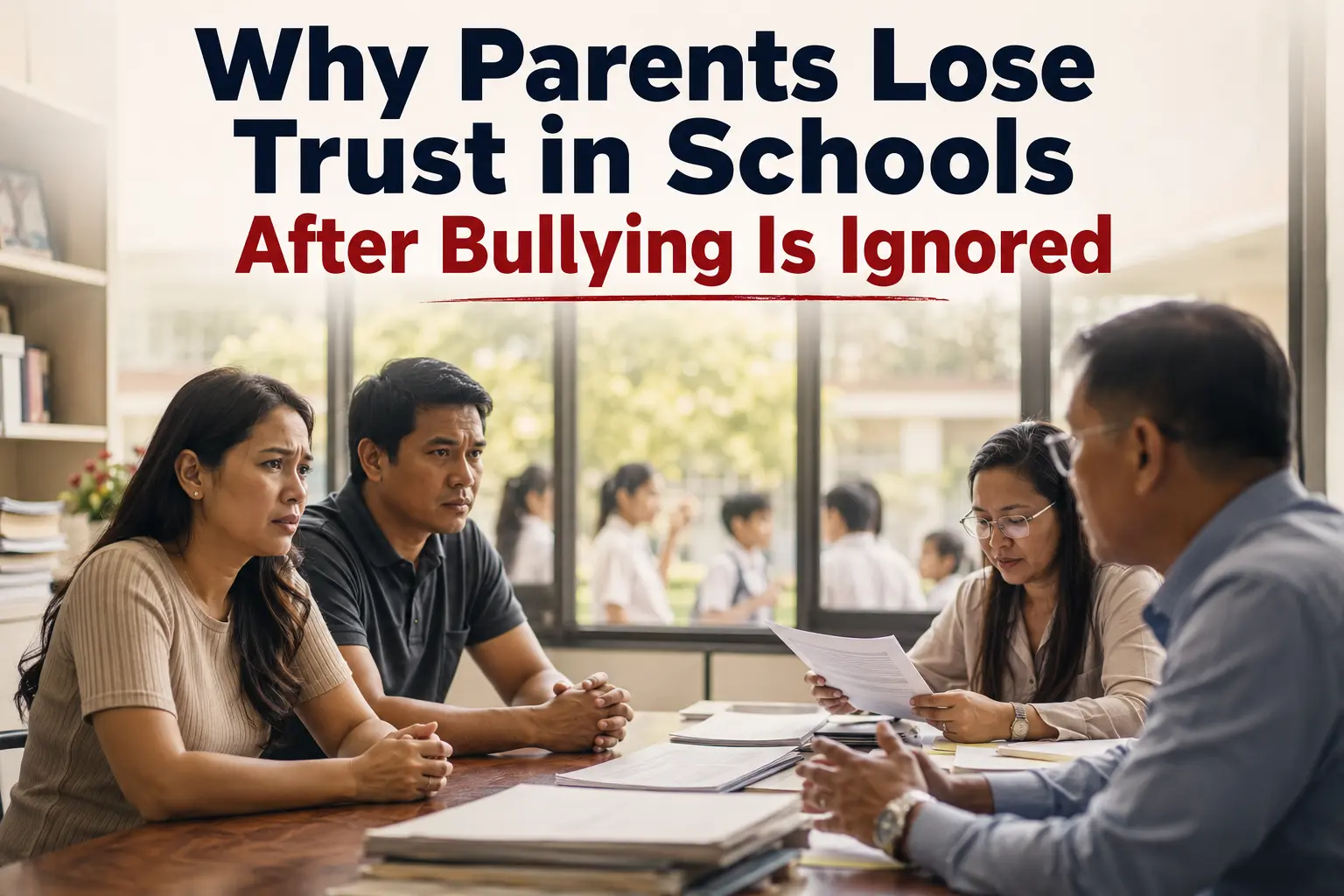
Parents Send Their Children to School with Trust
Every morning, millions of parents send their children to school believing they will return home not only smarter, but also safe.
Schools are expected to provide more than education.
They are entrusted with protecting children during some of the most formative years of their lives.
Teachers are expected to guide.
Principals are expected to lead.
School staff is expected to respond when problems arise.
For most families, this partnership is built on trust.
Parents trust schools to listen when concerns are raised.
They trust teachers to recognize warning signs.
They trust administrators to investigate fairly.
And they trust the education system to place students’ well-being above convenience or reputation.
Most of the time, that trust remains intact.
But when bullying is repeatedly ignored—or handled poorly—it begins to erode.
Not overnight.
One unanswered email.
One dismissed complaint.
One broken promise.
One unresolved incident at a time.
Eventually, many parents stop asking an important question:
“Will the school help my child?“
Instead, they begin asking a different one:
“Can I trust this school at all?“
That shift changes everything.
Why Trust Matters More Than Parents Realize
Trust is often invisible until it is broken.
Parents who trust a school are more likely to:
- Communicate openly with teachers.
- Participate in school activities.
- Support classroom decisions.
- Work collaboratively to solve problems.
- Encourage their children to feel confident at school.
This partnership benefits everyone.
Students learn better.
Teachers receive stronger parental support.
Schools develop healthier learning environments.
But trust is fragile.
Once parents believe their concerns are being ignored, every future interaction becomes more difficult.
Simple misunderstandings become major conflicts.
Routine conversations become confrontations.
Even well-intentioned decisions may be viewed with skepticism.
Trust affects education just as much as curriculum does.
Without it, cooperation becomes increasingly difficult.
Bullying Does More Than Hurt Students
Bullying is often discussed in terms of its impact on children.
And rightly so.
Victims may experience:
- Anxiety
- Depression
- Lower self-esteem
- Poor academic performance
- School avoidance
- Social isolation
Some children become afraid to attend school.
Others lose confidence in themselves.
Many struggle silently because they fear making the situation worse.
But there is another victim that receives far less attention.
The relationship between parents and schools.
Every unresolved bullying incident damages that relationship.
Parents begin wondering whether teachers are paying attention.
Whether school policies are actually followed.
Whether administrators genuinely care.
Over time, uncertainty becomes distrust
Why Ignoring Bullying Changes Everything
No school can realistically prevent every conflict between students.
Parents understand that.
Children argue.
Friendships change.
Disagreements happen.
What parents generally expect is not perfection.
They expect action.
When schools investigate concerns promptly, communicate clearly, and take reasonable steps to protect students, families are often willing to work through difficult situations together.
Problems become manageable.
Trust remains intact.
The situation changes dramatically when schools appear unwilling—or unable—to respond.
Repeated incidents with little visible action create the impression that bullying is tolerated.
Whether that perception is accurate or not, it can permanently alter how parents view the school.
Trust rarely disappears because of a single incident.
It disappears because parents begin seeing a pattern.
Common Reasons Parents Lose Confidence in Schools
Parents rarely lose trust because of one mistake.
Instead, confidence gradually fades when the same problems continue without meaningful improvement.
Some of the most common reasons include:
| School Response | How Parents Often Feel |
|---|---|
| Complaints receive little or no follow-up | Ignored and frustrated |
| Investigations lack transparency | Unsure whether anything happened |
| Communication is inconsistent | Left out of important decisions |
| Bullying continues after reports | Child is not being protected |
| Promised actions never occur | School cannot be relied upon |
| Victims are expected to adjust instead of offenders | The system feels unfair |
None of these situations automatically mean a school is acting in bad faith.
However, when several occur together, parents naturally begin questioning whether the school is capable of protecting their children.
Perception matters.
In education, trust is built as much through communication as through action.
The Difference Between a Difficult Situation and a Broken System
Every school experiences difficult situations.
No administrator can prevent every conflict.
No teacher can monitor every interaction.
Parents generally recognize these limitations.
What separates a trusted school from one that loses confidence is often how it responds after a problem is reported.
A trusted school typically:
- Acknowledges concerns quickly.
- Explains the next steps.
- Keeps parents informed.
- Documents incidents carefully.
- Reviews whether interventions are working.
A school that loses trust often appears reactive instead of proactive.
Parents may receive vague responses.
Meetings may be delayed.
Updates become infrequent.
Promises are forgotten.
Eventually, parents begin feeling that they must solve the problem themselves.
That is often the moment trust begins to collapse.
When Communication Breaks Down
Many parents are surprised to discover that poor communication can damage trust almost as much as bullying itself.
Silence creates uncertainty.
Uncertainty creates assumptions.
And assumptions often create conflict.
Imagine reporting that your child was repeatedly bullied.
Days pass.
Then weeks.
No updates arrive.
No investigation is explained.
No timeline is provided.
Even if school staff is quietly working behind the scenes, parents have no way of knowing.
Without communication, many families naturally assume nothing is happening.
Clear communication does not guarantee that every parent will agree with a school’s decisions.
But it demonstrates professionalism, transparency, and respect.
Those qualities are essential for maintaining long-term trust.
Trust Is Built Through Accountability
Parents understand that schools face complex challenges.
Managing hundreds—or even thousands—of students is never easy.
However, families also expect accountability from the adults responsible for children’s education and safety.
When teachers and school leaders consistently respond professionally, parents are more likely to maintain confidence even during difficult situations.
Conversely, repeated failures to address concerns can raise broader questions about leadership, school culture, and educator accountability. We explore this issue in greater detail in Should Teachers Be Graded Like Students? Why Incompetent Teachers Hurt Student Success, which examines whether teacher performance should be evaluated with the same seriousness as student achievement.
Trust grows when schools demonstrate that everyone—not just students—is accountable for maintaining a safe and supportive learning environment.
Why Some Bullying Complaints Are Handled Poorly
Most teachers enter the profession because they genuinely want to help children.
Likewise, most principals want safe, orderly schools where students can learn.
Yet bullying complaints are not always handled effectively.
That raises an important question.
Why do some schools respond quickly while others seem unable to stop repeated incidents?
The answer is rarely simple.
In many cases, multiple factors overlap.
Some schools struggle with limited resources.
Others face staffing shortages.
Some teachers have never received extensive training in conflict resolution or student behavior management.
Occasionally, administrators may underestimate the seriousness of repeated bullying until it escalates.
Whatever the reason, parents usually judge schools by one standard:
Did the school take reasonable steps to protect my child?
If the answer appears to be no, confidence begins to decline.
Not Every Teacher Is Equally Prepared
Teaching involves much more than delivering lessons.
Every day, teachers manage classrooms filled with students who have different personalities, backgrounds, emotions, and needs.
That responsibility requires a broad set of skills, including:
- Classroom management
- Conflict resolution
- Student observation
- Emotional intelligence
- Communication with parents
- Crisis response
These abilities develop through experience, mentoring, and ongoing professional development.
New teachers often improve significantly during their first several years in the classroom.
However, when educators receive limited support or insufficient training, responding effectively to bullying can become much more difficult.
Some teachers may dismiss early warning signs as ordinary disagreements.
Others may hesitate because they are unsure how to investigate fairly.
Still others may lack confidence when handling conflict between students.
These situations do not necessarily reflect bad intentions.
But they can still have serious consequences for children.
This broader issue is explored in How Teacher Inexperience Can Affect Student Learning and Grades, which examines how educator experience influences both classroom management and student outcomes.
Small Problems Often Become Bigger Problems
Bullying rarely begins with a major incident.
It often starts quietly.
A nickname.
Repeated teasing.
Social exclusion.
Online messages.
Pushing in the hallway.
Taking personal belongings.
Each event may appear minor when viewed in isolation.
Together, however, they can create an ongoing pattern that significantly affects a child’s emotional well-being.
When schools intervene early, many situations can be resolved before they escalate.
When warning signs are ignored, people may start to accept the behavior as normal.
Students notice.
Victims notice.
Parents notice.
The longer bullying continues, the more difficult it often becomes to restore trust.
Parents Are Usually Looking for Action—Not Perfection
A common myth is that parents want schools to end all bullying entirely.
Most understand that no school can supervise every interaction.
Children spend time in classrooms.
Hallways.
Sports fields.
School buses.
Online spaces after school.
Conflicts will inevitably occur.
What families generally expect is something more realistic.
They want schools to:
- Listen carefully.
- Investigate fairly.
- Communicate honestly.
- Respond consistently.
- Follow established policies.
Even when parents disagree with a particular decision, many remain supportive if they believe the process was transparent and sincere.
Problems become far more difficult when families feel ignored or excluded.
When Schools Prioritize Reputation Over Transparency
Schools naturally care about their reputation.
A positive reputation attracts families, supports enrollment, and reflects years of hard work by teachers and administrators. However, reputation should never matter more than student welfare.
When schools hesitate to address serious concerns, parents may fear that the school’s reputation matters more than student safety.
Transparency does not damage trust.
Avoiding difficult conversations often does.
Parents generally understand that mistakes happen.
What they struggle to accept is the perception that problems are minimized, delayed, or quietly dismissed.
Schools that communicate openly—even during difficult situations—often maintain stronger relationships with families than schools that remain silent.
The Emotional Cost Extends Beyond the Student
When a child experiences repeated bullying, the emotional impact rarely ends when the school day is over.
Parents often carry the burden as well.
Many experience:
- Constant worry.
- Sleepless nights.
- Anxiety before each school day.
- Frustration over unanswered questions.
- Feelings of helplessness.
Some begin checking their phones throughout the day.
Others repeatedly ask their children whether anything happened at school.
Many families find themselves discussing bullying every evening instead of celebrating what their child learned.
Over time, stress can affect the entire household.
Siblings notice.
Grandparents become concerned.
Family routines change.
Bullying rarely affects only one student.
It often affects everyone who cares about that child.
The Financial Cost Families Rarely Expect
The emotional burden is only part of the story.
Bullying can also create unexpected financial pressure.
Parents may need to pay for:
- Psychological counseling.
- Medical treatment after physical incidents.
- Private tutoring if academic performance declines.
- Transportation to a different school.
- New school uniforms and supplies after transferring.
- Lost work hours for meetings with teachers or administrators.
These costs are rarely discussed in public conversations about bullying.
Yet for many families, they become a significant burden.
Some parents even choose to transfer their children—not because they want to, but because they believe remaining at the same school poses greater risks.
When families leave rather than trust the system to improve, it means confidence is already deeply damaged.
High-Trust Schools vs. Low-Trust Schools
| High-Trust Schools | Low-Trust Schools |
|---|---|
| Respond quickly to reports | Delay responding to concerns |
| Communicate regularly with parents | Provide little or inconsistent communication |
| Document incidents thoroughly | Leave parents uncertain about investigations |
| Apply policies consistently | Responses appear inconsistent or unclear |
| Prioritize student safety | Focus primarily on avoiding conflict or complaints |
| Review whether interventions work | Assume the issue is resolved without follow-up |
| Encourage collaboration with families | Parents feel excluded from the process |
The difference is not that one school never experiences bullying while another does.
Rather, it is how each school responds after concerns are raised.
Parents are generally willing to work with schools that demonstrate openness, professionalism, and accountability.
Those qualities build confidence—even during difficult situations.
A Real-World Example of Why Trust Can Break Down
Sometimes the easiest way to understand why parents lose confidence is through real experiences.
While every school and every situation is different, firsthand accounts can illustrate how repeated bullying, delayed responses, and communication problems affect families over time.
One example is explored in Barrio Luz National High School: Why Parents Are Concerned, which discusses parent worries about bullying, how schools respond, and who should be held accountable.
For readers interested in the personal side of these challenges, Our Painful Experience in Public School in Cebu shares a firsthand account of repeated bullying, interactions with school officials, and the emotional toll the experience had on one family. Although every case is unique, stories like these help explain why rebuilding trust after unresolved bullying can be extremely difficult.
How Schools Can Rebuild Parents’ Trust
Trust may be difficult to earn, but it is even harder to rebuild once it has been broken.
Fortunately, rebuilding trust is possible.
It begins with acknowledging that parents deserve honest communication, consistent action, and genuine accountability.
Schools that successfully restore confidence often share several characteristics.
They admit when improvements are needed.
They communicate regularly.
They involve parents as partners rather than treating them as outsiders.
Most importantly, they place student welfare at the center of every decision.
Schools can strengthen trust by:
- Responding promptly to bullying reports.
- Keeping parents informed throughout investigations.
- Following anti-bullying policies consistently.
- Documenting incidents carefully.
- Providing counseling for both victims and offenders.
- Training teachers to recognize early warning signs.
- Reviewing whether interventions actually solved the problem.
- Encouraging students to report bullying without fear of retaliation.
Parents do not expect perfection.
They expect commitment.
A school that learns from mistakes often earns more trust than one that refuses to acknowledge them.
What Parents Can Do If They Believe a School Is Ignoring Bullying
Most bullying cases can be resolved through cooperation between parents and schools.
However, there are situations where families believe their concerns are not receiving adequate attention.
When that happens, parents should remain calm, organized, and focused on facts.
Instead of relying on memory alone, document everything.
Helpful records include:
- Dates and times of incidents.
- Names of witnesses.
- Screenshots of online harassment.
- Photos of injuries or damaged belongings.
- Copies of emails and written reports.
- Notes from meetings with school staff.
Documentation helps establish a clear timeline if additional action becomes necessary.
Parents should also:
- Speak with the classroom adviser or homeroom teacher.
- Meet with the school principal if concerns remain unresolved.
- Request written updates whenever possible.
- Familiarize themselves with the school’s anti-bullying policy.
- Escalate concerns through the appropriate education authorities when necessary.
Throughout the process, the primary goal should remain the same:
Protecting the child’s safety and well-being.
Why Strong Parent–School Partnerships Matter
Research consistently shows that students benefit when parents and schools work together.
Open communication creates better outcomes than conflict whenever possible.
When trust exists:
- Students feel more secure.
- Parents feel heard.
- Teachers receive valuable information.
- Problems are identified earlier.
- Solutions are more likely to succeed.
Bullying prevention should never be viewed as the school’s responsibility alone.
Nor should parents carry the burden alone.
Creating a safe learning environment requires cooperation among:
- Teachers
- School leaders
- Parents
- Students
- Guidance counselors
- The wider community
Each group plays an important role.
When one part of the partnership breaks down, everyone feels the consequences.
Every Bullying Report Is an Opportunity
Every complaint presents schools with two choices.
The first is to view it as an inconvenience.
The second is to view it as an opportunity.
An opportunity to improve.
To strengthen trust.
To prevent future harm.
To demonstrate that every student matters.
Parents may eventually forget the details of a difficult situation.
They rarely forget how they were treated while seeking help.
Sometimes, the school’s response becomes more memorable than the bullying itself.
That is why professionalism, empathy, and transparency matter so much.
A thoughtful response today can preserve years of trust tomorrow.
Creating Schools Where Parents Feel Confident Again
Parents should never have to wonder whether reporting bullying will make things worse.
Children should never fear that speaking up will accomplish nothing.
Schools should strive to create environments where reporting concerns is viewed as an act of courage—not an inconvenience.
That culture begins with leadership.
It continues through teachers.
It grows through consistent policies.
And it succeeds when parents believe their voices genuinely matter.
Trust cannot eliminate bullying.
But it determines how effectively schools handle bullying incidents.
Frequently Asked Questions (FAQs)
Parents often lose confidence when repeated reports receive little action, communication is inconsistent, or bullying continues despite complaints. Trust depends not only on school policies but also on how consistently those policies are applied.
No.
No school can prevent every disagreement or conflict between students.
However, schools can make a big difference in reducing bullying by responding quickly, following rules consistently, and creating a safe space for students to report problems.
Parents should document every incident, communicate concerns in writing whenever possible, request meetings with school administrators, and follow established reporting procedures. If concerns remain unresolved, they may escalate the matter to the appropriate education authorities.
Clear communication reassures parents that concerns are being taken seriously. Even when investigations take time, regular updates help maintain confidence and reduce misunderstandings.
Students who experience bullying may struggle to concentrate, participate less in class, miss school more frequently, and develop anxiety that interferes with learning. Over time, these challenges can contribute to declining academic performance.
Yes.
Parents often share their experiences with other families, both online and offline. Schools that consistently demonstrate transparency, fairness, and accountability are generally more likely to maintain public trust than those perceived as dismissive or unresponsive.
Teachers are often the first adults to witness or receive reports of bullying. Strong classroom management, observation skills, and conflict-resolution training can help educators identify problems early and intervene before situations escalate.
Parents play a vital role by encouraging open conversations with their children, documenting concerns, working constructively with schools, and teaching empathy and respectful behavior at home. Bullying prevention is most effective when families and schools work together.
Yes.
Although rebuilding trust takes time, schools can restore confidence through honest communication, consistent follow-up, accountability, and a clear commitment to protecting every student’s well-being.