

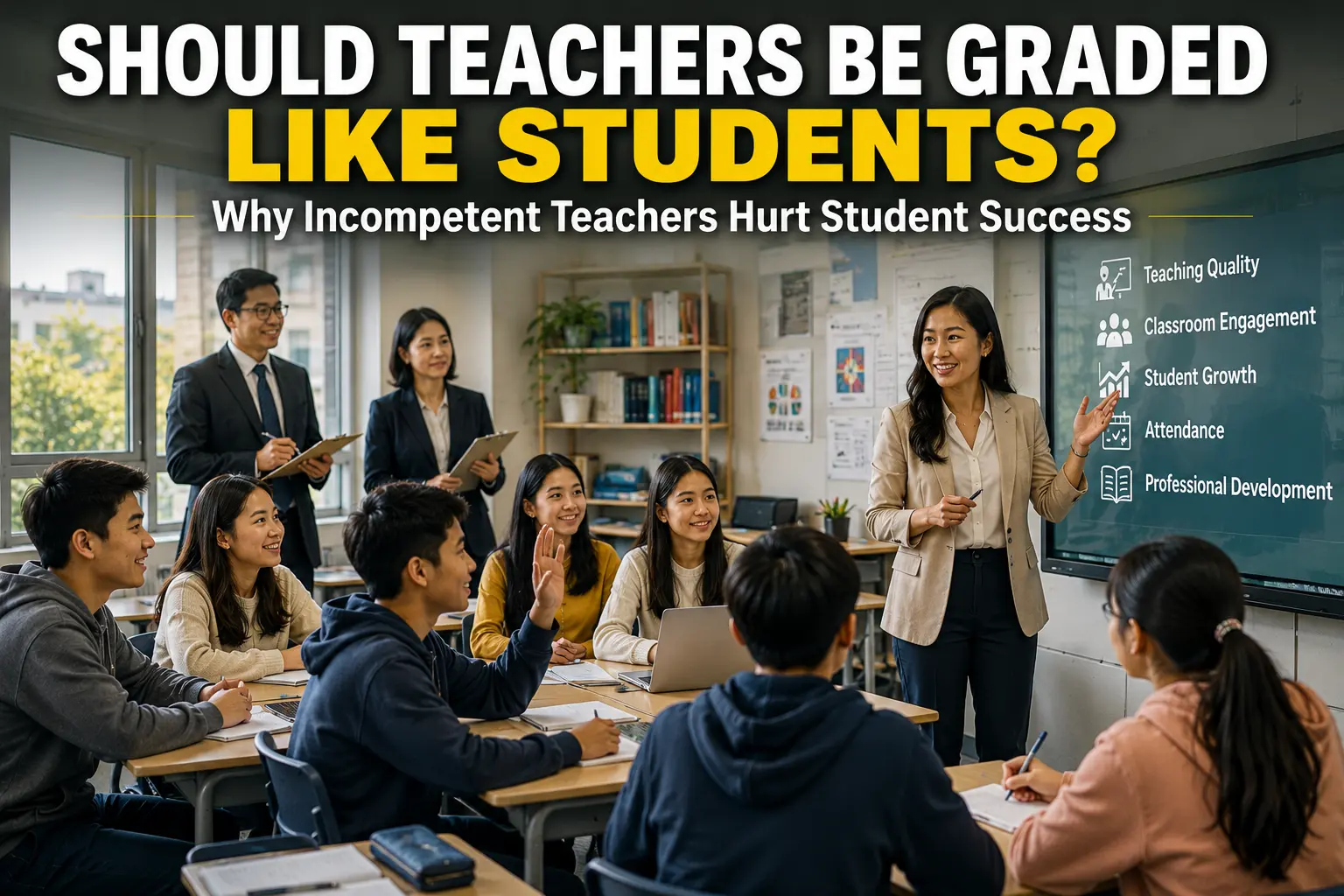
For most students, school is built around accountability.
Assignments are graded.
Exams measure progress.
Attendance is monitored.
Behavior is evaluated.
Promotion to the next grade depends on meeting academic standards.
From an early age, children learn that their performance has consequences.
If they fail to study, their grades may suffer.
If they repeatedly miss school, they may fall behind.
If they do not meet learning requirements, they may have to repeat a subject or even an entire school year.
This system exists because education depends on accountability.
Students are expected to demonstrate that they are learning.
But this raises an important question.
The debate over teacher accountability is not new. Business leader and philanthropist Bill Gates has argued that measuring teacher effectiveness and providing meaningful feedback are essential to improving education. His position is not that teachers should be publicly shamed or punished, but that, like professionals in other fields, they should receive regular evaluations, coaching, and opportunities to improve. If schools regularly assess students to measure learning, it is reasonable to ask whether teaching performance should also be evaluated to help ensure every child receives a quality education.
Should the same principle apply to teachers?
Every day, teachers influence dozens—sometimes hundreds—of young lives.
A highly effective teacher can inspire curiosity, build confidence, and help students discover their potential.
A consistently poor teacher can leave students confused, discouraged, and academically behind.
The difference between the two can shape a child’s future long after graduation.
Yet while students are constantly evaluated, many parents wonder whether teachers receive the same level of meaningful performance assessment.
This is not about criticizing teachers as a profession.
In fact, many educators work tirelessly under difficult conditions.
They spend their own money on classroom materials.
They stay after school to help struggling students.
They continue learning throughout their careers to become better educators.
These teachers deserve recognition and support.
However, every profession also includes individuals who consistently struggle to meet professional expectations.
Teaching is no exception.
When poor teaching becomes a recurring problem, students—not teachers—often pay the highest price.
That is why conversations about teacher accountability are becoming increasingly important around the world.
The question is no longer whether teachers should be evaluated.
The real question is whether current evaluation systems are strong enough to ensure that every student receives the quality education they deserve.
Why Teacher Quality Matters More Than Most People Realize
Parents often focus on school facilities, textbooks, technology, or class sizes.
While these factors certainly matter, research has consistently shown that teacher quality is one of the strongest school-based influences on student achievement.
A knowledgeable, prepared, and engaged teacher can transform an average classroom into an environment where students thrive.
Good teachers do far more than deliver lessons.
They help students:
- Understand difficult concepts
- Develop confidence
- Build critical thinking skills
- Stay motivated during challenges
- Develop curiosity about learning
- Prepare for future careers
Students may forget individual lessons over time.
They rarely forget the teachers who inspired them to believe in themselves.
Unfortunately, the opposite is also true.
A teacher who consistently performs poorly can affect students in ways that extend far beyond a single school year.
Poor instruction may lead to:
- Learning gaps
- Lower academic confidence
- Increased anxiety
- Reduced classroom participation
- Declining motivation
- Poor long-term academic performance
For younger students especially, one difficult year can create challenges that continue into future grades.
Education builds upon previous knowledge.
When that foundation becomes weak, every subsequent year becomes more difficult.
What Does an Incompetent Teacher Actually Mean?
The word “incompetent” is often used emotionally.
However, professional competence should be viewed objectively.
An incompetent teacher is not simply someone whose students receive low grades.
Nor is it someone who teaches a particularly difficult subject.
Instead, competence is reflected by consistent professional behavior and effective teaching practices.
A teacher may be considered underperforming when there are persistent issues such as:
| Professional Standard | Signs of Poor Performance |
|---|---|
| Classroom instruction | Lessons are confusing, poorly organized, or incomplete. |
| Preparation | Little evidence of lesson planning or student engagement. |
| Communication | Students regularly leave class without understanding the material. |
| Classroom management | Frequent disruptions prevent effective learning. |
| Feedback | Assignments are graded without meaningful explanations. |
| Professionalism | Repeated lateness, absenteeism, or failure to fulfill responsibilities. |
| Student support | Struggling students receive little guidance or assistance. |
Importantly, one difficult semester does not automatically make someone an incompetent teacher.
Every professional experiences challenges.
The concern arises when poor performance becomes consistent over long periods without improvement.
Like doctors, engineers, pilots, and other professionals, teachers carry significant responsibility.
Because their work directly influences children’s education and future opportunities, maintaining professional standards is essential.
Why Students Often Pay the Highest Price
When an employee performs poorly in many industries, the company pays most of the cost.
A company may lose customers.
A project may be delayed.
Revenue may decline.
Education works differently.
When teaching quality declines, the people most affected are often children who have no control over the situation.
Students cannot choose another classroom.
They cannot replace their teacher.
They continue learning under whatever conditions exist.
Over time, this may result in:
- Lower grades
- Reduced confidence
- Loss of interest in learning
- Poor study habits
- Increased absenteeism
- Higher transfer rates
- Greater risk of dropping out
Many parents initially assume that falling grades indicate laziness or lack of effort. Sometimes that is true.
However, there are also situations where broader educational issues contribute to poor academic outcomes.
For example, inconsistencies in grading practices can make it difficult to determine whether report cards accurately reflect student learning.
You can learn more in Are Public School Grades Reliable in the Philippines—or Systemically Flawed?, which looks at whether grades truly measure student performance fairly
Similarly, teacher experience can significantly influence classroom effectiveness.
As discussed in How Teacher Inexperience Can Affect Student Learning and Grades, even well-intentioned educators may struggle without adequate training, mentoring, or classroom experience.
These discussions highlight an important point.
Student performance should never be evaluated in isolation.
The quality of teaching must also be part of the conversation.
Accountability Exists in Every Profession—Why Should Teaching Be Different?
Nearly every profession includes some form of performance evaluation.
Doctors undergo licensing, continuing education, and peer review.
Pilots complete regular proficiency checks.
Engineers follow professional standards and safety regulations.
Police officers undergo performance reviews.
Business leaders are evaluated based on organizational outcomes.
These systems are not designed to punish poor performers.
They exist to maintain quality, protect the public, and encourage continuous improvement.
Teaching should be viewed through the same lens.
Teacher evaluations should not exist to create fear.
They should exist to identify strengths, address weaknesses, provide additional training, and ensure that every classroom delivers high-quality instruction.
A well-designed accountability system benefits everyone.
Students receive better education.
Parents gain greater confidence.
Schools improve their overall performance.
Teachers receive constructive feedback and professional development opportunities that help them grow throughout their careers.
Should Teacher Evaluations Include Student Performance?
This question often generates strong opinions.
Some believe student grades should be the main indicator of how well a teacher is performing.
Others believe that using student performance alone would be unfair because many factors influence learning.
The reality is somewhere in the middle.
A teacher should never be evaluated solely on exam scores.
Students come from different backgrounds, possess different learning abilities, and face different challenges outside the classroom.
Many things affect student grades, including family support, Attendance, nutrition, health, and family income.
However, student learning should still be one important indicator.
If nearly every student consistently struggles to understand lessons over several years, it raises legitimate questions about whether teaching methods, classroom management, or instructional quality need improvement.
Effective teacher evaluations should consider multiple factors rather than relying on a single measurement.
A Balanced Teacher Evaluation System
| Evaluation Area | Why It Matters |
|---|---|
| Classroom observation | Measures teaching quality, lesson delivery, and student engagement. |
| Student learning growth | Evaluates whether students are making meaningful academic progress over time. |
| Lesson preparation | Assesses organization, curriculum planning, and instructional quality. |
| Professional development | This pushes teachers to keep getting better at their job. |
| Attendance and punctuality | Promotes professionalism and consistent instruction. |
| Student and parent feedback | Identifies recurring concerns that may not appear during formal evaluations. |
| Peer and administrator review | Provides constructive feedback from experienced educators. |
A comprehensive evaluation system recognizes that teaching is both an art and a profession.
Rather than chasing perfection, it should spot opportunities for improvement while celebrating excellence when it happens.
Can Poor Teaching Affect a Child’s Future?
Many people underestimate the long-term impact of ineffective teaching.
Education is cumulative.
Students build new knowledge upon what they learned the previous year.
If those foundations are weak, future learning becomes increasingly difficult.
Consider a student who never fully understands basic mathematics because instruction was unclear.
That student may struggle with algebra.
Difficulty with algebra may later affect physics, engineering, economics, computer science, and many technical careers.
The same principle applies to reading comprehension.
Students who fail to build strong literacy skills often struggle across all subjects because reading is the foundation of learning.
Poor teaching does not simply affect report cards.
It can influence:
- Career opportunities
- College readiness
- Self-confidence
- Problem-solving ability
- Lifetime earning potential
- Interest in lifelong learning
This is why teacher quality is often described as an investment rather than simply another education expense.
Every effective teacher creates benefits that extend far beyond the classroom.
Teacher Accountability Is Not About Punishment
One of the biggest misconceptions is that accountability means punishment.
It does not.
The best-performing education systems around the world focus on improvement rather than blame.
An effective accountability system should help teachers succeed.
For example, if evaluations identify recurring weaknesses in classroom management or lesson planning, schools can provide:
- Professional coaching
- Mentorship from experienced teachers
- Additional training
- Classroom observations with constructive feedback
- Continuing education opportunities
The goal is simple.
Help teachers become better educators.
Only when serious problems persist despite repeated support should stronger administrative action become necessary.
This approach benefits both teachers and students.
Strong teachers become even stronger.
Struggling teachers receive meaningful assistance.
Students receive higher-quality education.
Everyone wins.
Why Parents Should Have a Voice
Parents are their children’s first teachers.
They spend years observing how education affects their children’s confidence, motivation, and academic growth.
For this reason, parents can provide valuable insights into school performance.
This does not mean every complaint is automatically correct.
However, recurring concerns from many families deserve careful attention.
Parents may notice patterns such as:
- Students consistently failing despite studying diligently
- Frequent teacher absences
- Limited classroom communication
- Unclear grading practices
- Little or no feedback on assignments
- Lack of academic support for struggling learners
When these concerns persist over time, schools should investigate them objectively rather than dismiss them.
Constructive collaboration between schools and families builds trust while helping identify problems before they become systemic.
Real-world examples also demonstrate why transparency matters. In Barrio Luz National High School: Why Parents Are Concerned, parents describe concerns ranging from teacher absenteeism to academic performance and student transfers. If similar concerns arise elsewhere, they demonstrate why accountability systems should be open to feedback while ensuring fairness for teachers and students.
Great Teachers Deserve to Be Recognized Too
Teacher accountability should never focus only on identifying poor performance.
It should also celebrate excellence.
Outstanding teachers change lives.
Many students succeed because one teacher believed in them when no one else did.
Exceptional educators often:
- Inspire confidence
- Encourage curiosity
- Support struggling learners
- Adapt lessons for different learning styles
- Continue improving their own teaching
- Build positive relationships with families
Unfortunately, when schools fail to distinguish between exceptional and consistently underperforming teachers, everyone is treated the same.
Recognition matters.
High-performing teachers should have opportunities for:
- Career advancement
- Leadership roles
- Professional recognition
- Mentoring newer teachers
- Performance-based incentives where appropriate
Rewarding excellence encourages continuous improvement throughout the education system.
It also demonstrates that accountability is about recognizing quality—not simply identifying problems.
Should Teaching Be Viewed as a Profession of Continuous Learning?
Students are expected to learn every year.
Teachers should be no different.
Education evolves continuously.
New research emerges.
Technology changes how students learn.
Artificial intelligence is transforming classrooms.
Teaching methods that worked twenty years ago may no longer be sufficient today.
Professional learning should therefore be viewed as an essential part of teaching rather than an optional activity.
The strongest education systems invest heavily in teacher development because improving teachers ultimately improves student outcomes.
Being an effective teacher today requires more than subject knowledge.
It requires adaptability, communication, empathy, technological literacy, and a willingness to keep learning throughout one’s career.
These qualities define great professionals in every field.
Teaching should be no exception.
Should Poor Teachers Lose Their Jobs?
This is perhaps the most controversial question in the debate over teacher accountability.
The answer should not be based on emotion.
It should be based on fairness.
Every teacher deserves support, training, mentoring, and opportunities to improve.
No professional should lose a career because of a single difficult year, a challenging group of students, or circumstances beyond their control.
However, accountability must also protect students.
If a teacher consistently demonstrates poor performance over many years despite repeated coaching, professional development, and administrative support, schools have a responsibility to act.
Education is unlike many other professions.
A year of ineffective teaching cannot simply be repeated.
Students lose valuable learning time that can never be fully recovered.
The priority should always be improvement first.
But when improvement does not happen, student welfare must come first.
A profession that shapes future generations should have high standards—not to punish teachers, but to make sure every child receives a quality education.
Should Poor Teachers Lose Their Jobs?
This is perhaps the most controversial question in the debate over teacher accountability.
The answer should not be based on emotion.
It should be based on fairness.
Every teacher deserves support, training, mentoring, and opportunities to improve.
No professional should lose a career because of a single difficult year, a challenging group of students, or circumstances beyond their control.
However, accountability must also protect students.
If a teacher consistently demonstrates poor performance over many years despite repeated coaching, professional development, and administrative support, schools have a responsibility to act.
Education is unlike many other professions.
A year of ineffective teaching cannot simply be repeated.
Students lose valuable learning time that can never be fully recovered.
The priority should always be improvement first.
But when improvement does not happen, student welfare must come first.
A profession that shapes future generations requires high standards—not to punish educators, but to ensure every child has access to quality learning.
How Can Schools Identify Teaching Problems Earlier?
One reason educational problems persist is that they often go unnoticed until significant damage has already occurred.
By the time parents begin asking questions, students may have spent months—or even years—struggling academically.
Schools can reduce this risk by monitoring multiple indicators instead of waiting until examination results decline.
Early warning signs may include:
- Unusually high failure rates over multiple years
- Repeated complaints from different parents
- Consistently poor classroom observations
- High numbers of student transfers
- Low student engagement
- Chronic teacher absenteeism
- Declining graduation rates
- Large achievement gaps compared with similar schools
None of these indicators alone proves that a teacher is ineffective.
However, together they may reveal patterns that deserve careful investigation.
Effective school leadership identifies problems early and provides support before those problems become permanent.
What Would a Fair Teacher Accountability System Look Like?
A strong accountability system should balance responsibility with professional support.
Rather than relying on a single test score or one classroom observation, evaluations should be based on multiple sources of evidence collected over time.
An effective framework might include:
| Area | Purpose |
|---|---|
| Classroom observations | Evaluate teaching methods and student engagement. |
| Student academic growth | Measure learning progress rather than raw test scores. |
| Lesson planning | Ensure lessons are organized and aligned with curriculum standards. |
| Professional development | Encourage continuous learning and updated teaching practices. |
| Attendance and professionalism | Promote reliability and accountability. |
| Parent communication | Assess responsiveness and collaboration with families. |
| Student feedback (age-appropriate) | Identify recurring classroom concerns. |
| Peer mentoring and review | Encourage professional collaboration and improvement. |
Such a system protects both teachers and students.
Excellent teachers receive recognition.
Teachers who need help receive meaningful support.
Schools gain better insight into instructional quality.
Most importantly, students benefit from stronger teaching.
Teacher Accountability Is Also About Public Trust
Parents place enormous trust in schools.
Every morning they send their children into classrooms believing they will receive a quality education.
That trust should never be taken for granted.
Transparent accountability strengthens confidence in the education system.
When schools regularly review teaching quality, invest in teacher development, and deal with concerns fairly, parents can trust that their children are receiving the best education possible.
Likewise, dedicated teachers also benefit.
Most educators want to work alongside colleagues who share the same commitment to excellence.
Strong accountability helps ensure that high professional standards become the norm rather than the exception.
The Future of Teaching Requires Continuous Improvement
Education is changing faster than at almost any point in history.
Artificial intelligence is reshaping learning.
Digital technologies continue transforming classrooms.
Students entering school today will likely work in careers that do not yet exist.
Teachers therefore face an extraordinary challenge.
They must prepare students for an uncertain future while continuously adapting themselves.
The most successful teachers will likely be lifelong learners.
They will:
- Embrace new teaching methods.
- Learn emerging technologies.
- Encourage critical thinking instead of rote memorization.
- Help students solve real-world problems.
- Inspire curiosity beyond the classroom.
Teaching has never been a profession where learning stops after graduation.
In today’s rapidly changing world, continuous improvement may be one of the most important professional responsibilities an educator can embrace.
Why This Conversation Matters
Discussions about teacher accountability should never become attacks on teachers.
Most educators enter the profession because they genuinely want to help children succeed.
Many overcome limited resources, crowded classrooms, and increasing workloads every day.
Their dedication deserves respect.
At the same time, every child deserves competent, professional, and effective instruction.
These two ideas are not contradictory.
Supporting teachers and holding them accountable can—and should—exist together.
A strong education system does not ignore poor performance.
It identifies problems, provides support, rewards excellence, and takes action when necessary.
Ultimately, teacher accountability is not about judging educators.
It is about protecting the quality of education that every student deserves.
Frequently Asked Questions (FAQs)
Not in the same way. However, teachers should be evaluated regularly using multiple measures, including classroom observations, student learning growth, professionalism, ongoing training, and feedback from administrators. The goal is continuous improvement rather than punishment.
An incompetent teacher is generally one who consistently fails to meet professional teaching standards. This may include poor lesson preparation, ineffective instruction, repeated absenteeism, weak classroom management, lack of student support, or ongoing failure to improve despite receiving assistance.
No. Student test scores should be only one part of a broader evaluation system. Factors such as classroom observations, lesson quality, professional development, and student progress over time provide a more balanced assessment.
Teachers influence how students learn, think, and develop confidence. Effective teaching can improve academic achievement, while consistently poor instruction may create learning gaps that affect students for many years.
Yes. Weak instruction can reduce academic confidence, create knowledge gaps, lower motivation, and limit future educational and career opportunities. Early learning difficulties often become harder to overcome in later years.
Schools can invest in mentoring, professional development, classroom coaching, regular evaluations, peer collaboration, and constructive feedback. Supporting teachers before problems become severe benefits both educators and students.
Parents observe how education affects their children over time and can identify recurring concerns that schools may not immediately recognize. Constructive parent feedback can help schools improve educational quality while strengthening trust between families and educators.
Absolutely. Strong accountability systems recognize and reward outstanding educators while identifying opportunities for professional growth. Excellent teachers deserve recognition for the positive impact they have on students and schools.