
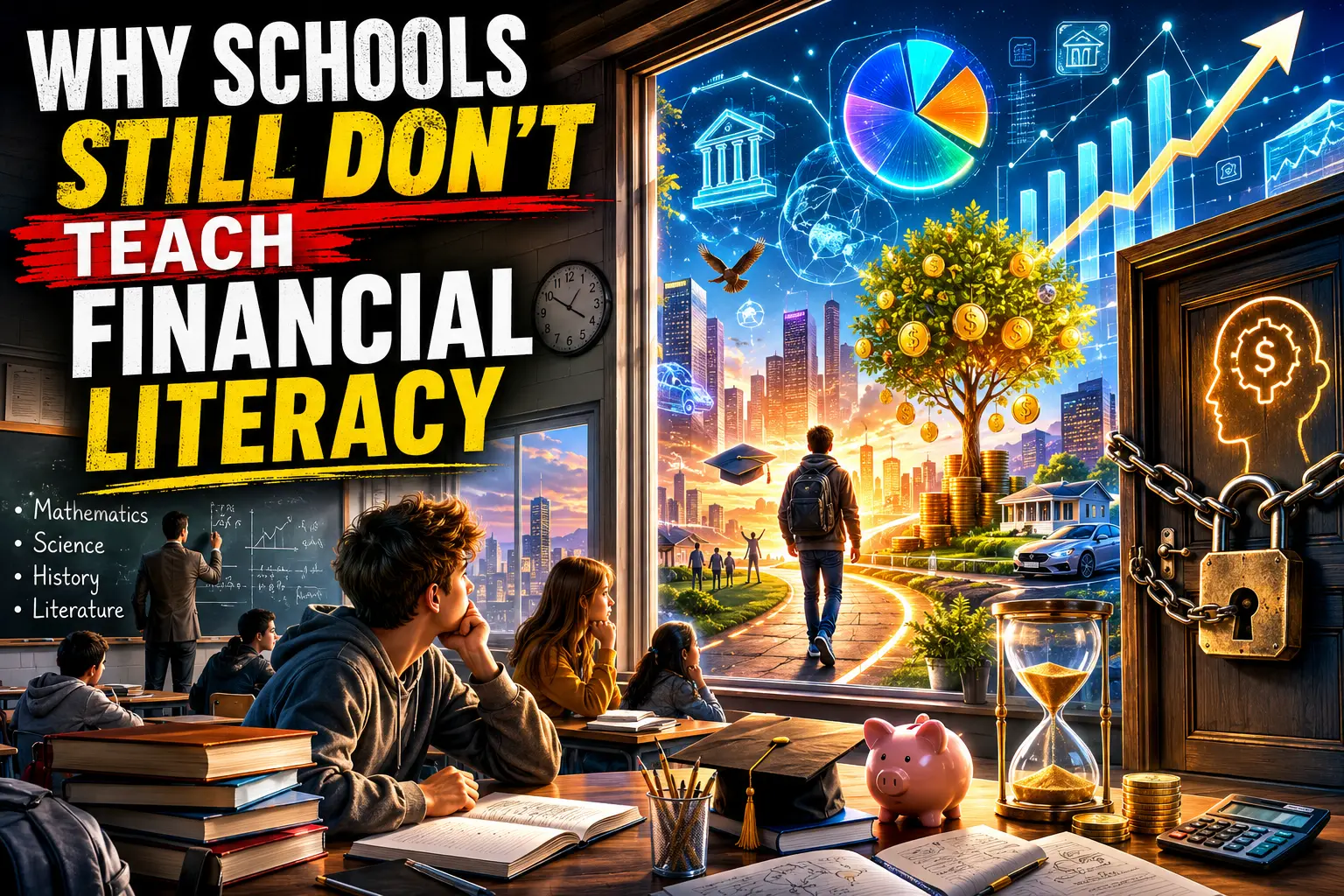
Most students spend years learning mathematics.
Yet many graduate without knowing how to:
. Create a budget
. Understand taxes
. Manage debt
. Build credit
. Invest money
. Prepare for retirement
It is one of the most common criticisms of modern education.
Schools teach students how to solve equations, memorize historical events, and pass examinations.
But many students leave school with little understanding of the financial decisions that will shape the rest of their lives.
This raises a question that parents, students, educators, and financial experts have debated for years:
Why do schools still teach so little about money?
The answer involves history, curriculum priorities, teacher preparation, and the evolving role of education itself.
The Financial Skills Many Adults Wish They Had Learned Earlier
Many adults look back on their school years and realize there was one subject largely missing from their education:
Money.
After graduation, they suddenly face financial responsibilities such as:
- Paying bills
- Opening bank accounts
- Managing credit cards
- Filing taxes
- Financing vehicles
- Saving for emergencies
- Planning for retirement
These decisions can have lifelong consequences.
Yet many people enter adulthood with little formal financial education.
The result is often confusion, costly mistakes, and years of learning through trial and error.
Why Money Education Is Often Missing From the Classroom
The modern education system was originally designed to prepare students for industrial-era economies.
Historically, schools focused on:
- Literacy
- Mathematics
- Science
- History
- Vocational skills
Financial literacy was often viewed as something families would teach at home.
However, economic realities have become significantly more complex.
Today, young adults face:
- Fising living costs
- Increasing debt
- Digital banking
- Online investing
- Cryptocurrency
- Complex financial products
Despite these changes, many school systems have struggled to integrate comprehensive financial education into their curricula.
Critics argue that some education systems continue to prioritize traditional academic outcomes while overlooking practical life preparation. This issue is explored further in The Hidden Damage of an Incompetent Education System, which examines how educational priorities can leave students unprepared for real-world challenges.
Some countries are rethinking these priorities entirely. Why Finland’s Students Spend Less Time in School Yet Still Succeed explores how Finland’s education model challenges traditional assumptions about learning time, testing, and academic pressure.
The Real Cost of Financial Illiteracy
Financial illiteracy affects more than just wealth.
Poor financial decisions can affect:
- Career choices
- Stress levels
- Relationships
- Mental well-being
- Long-term security
Common problems include:
- Excessive debt
- Poor spending habits
- Inadequate savings
- Investment mistakes
- Vulnerability to scams
The consequences often extend far beyond money. Many graduates report feeling unprepared for adult responsibilities, a concern explored further in Why Many Students Feel Unprepared for Real Life After Graduation.
Financial literacy is not simply about becoming wealthy.
It is about making informed decisions that improve long-term stability and independence.
What Students Actually Need to Know About Money
Financial literacy is much broader than balancing a checkbook.
Students increasingly need practical knowledge in areas such as:
Budgeting
Understanding income, expenses, and spending habits.
Saving
Building emergency funds and financial security.
Investing
Learning how wealth grows through long-term investing.
Debt Management
Understanding loans, interest rates, and responsible borrowing.
Taxes
Understanding how taxation affects earnings and financial planning.
Credit
Learning how credit scores work and why they matter.
Financial Risk
Recognizing scams, fraud, and predatory financial products.
Financial literacy reveals a broader truth: academic achievement alone is no longer enough. Experts argue that good grades no longer guarantee real-life success, emphasizing the growing importance of practical skills. As automation and AI transform the workplace, soft skills like emotional intelligence are becoming equally critical. For more on this shift, see Why Emotional Intelligence Matters More Than Ever in the AI Age.
Financial Skills Schools Rarely Teach
| Financial Skill | Why It Matters | Potential Consequences If Ignored |
|---|---|---|
| Budgeting | Controls spending | Overspending and debt |
| Saving | Builds emergency funds | Financial instability |
| Investing | Creates long-term wealth | Missed growth opportunities |
| Taxes | Ensures compliance | Costly mistakes and penalties |
| Credit Management | Improves borrowing options | Poor credit history |
| Retirement Planning | Supports future security | Insufficient retirement savings |
| Scam Awareness | Protects assets | Fraud and financial losses |
Why Financial Literacy Matters More Than Ever Today
The modern financial landscape is far more complex than it was for previous generations.
Young adults now face:
- Online banking
- Digital payments
- Investing apps
- Cryptocurrencies
- Global markets
- Rising living expenses
Financial decisions are becoming increasingly important and increasingly difficult.
Organizations such as the OECD Financial Education Program and the World Bank Financial Inclusion Initiative have repeatedly emphasized the importance of financial literacy for long-term economic well-being.
As economies become more complex, financial knowledge becomes increasingly essential
Should Financial Literacy Be a Core School Subject?
A growing number of educators, policymakers, and economists believe the answer is yes.
Supporters argue that financial literacy:
- Affects nearly every adult
- Improves decision-making
- Reduces financial mistakes
- Promotes economic stability
- Encourages responsible money management
Unlike many specialized subjects, financial education has practical applications for virtually everyone.
The debate is no longer whether financial literacy matters.
The debate is whether schools can afford to keep treating it as optional.
The Bigger Question Education Must Answer
If schools exist to prepare students for life, then financial literacy deserves a larger place in education.
Students will eventually forget many facts they memorize for exams.
But they will spend their entire lives making financial decisions.
Every paycheck.
Every purchase.
Every investment.
Every loan.
Every retirement plan.
These choices shape opportunities, security, and long-term well-being.
As the world becomes more financially complex, one question becomes increasingly difficult to ignore:
Why are students still graduating without learning one of life’s most important skills?
Frequently Asked Questions (FAQs)
Financial literacy is the ability to understand and effectively manage personal finances, including budgeting, saving, investing, debt management, taxes, and financial planning.
Financial literacy helps people make informed decisions, avoid costly mistakes, manage debt responsibly, and build long-term financial security.
Some schools offer financial literacy programs, but many education systems still provide limited instruction compared to other academic subjects.
Financial literacy was sidelined in curricula designed around traditional academic subjects, despite its practical significance.
Students can benefit from learning about budgeting, saving, investing, taxes, credit management, debt management, retirement planning, and scam awareness.
Research suggests that financial education can improve money management habits and help individuals make better borrowing and spending decisions.
Basic investing concepts can be taught in simple ways and can help students understand long-term wealth building and financial planning.