
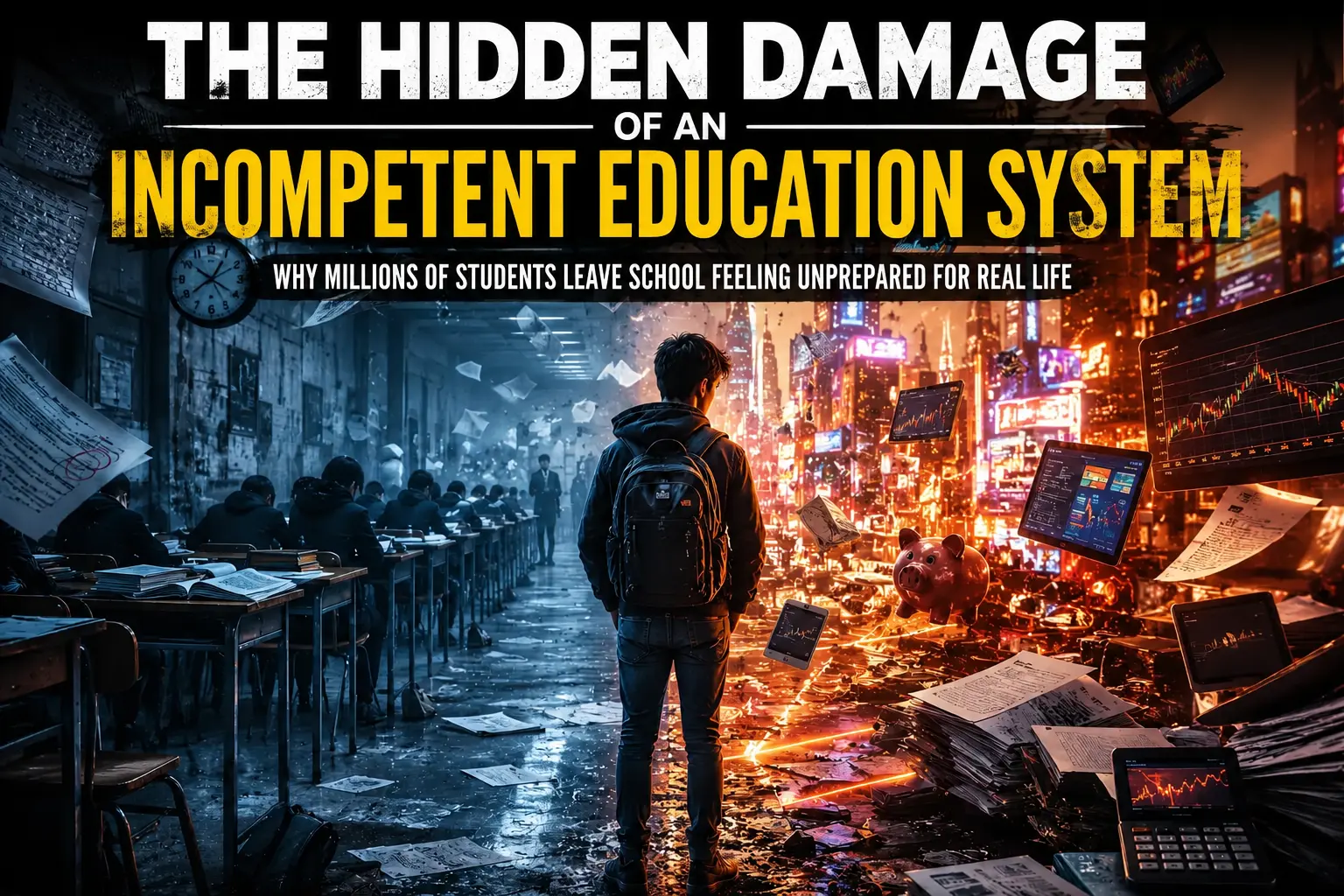
Most students grow up believing that school is preparing them for the real world.
Study hard. Pass exams. Get good grades. Build a stable future.
That is the promise.
But for many graduates, adulthood feels less like a prepared transition and more like walking into a storm without instructions.
They understand formulas but not finances.
They know how to pass tests but not handle uncertainty.
They spent years inside classrooms—yet still feel lost when facing the real world.
The problem is bigger than difficult homework or strict teachers.
The uncomfortable truth is that many education systems were designed for a world that no longer exists.
And millions of students may be paying the price for it.
The Education System Was Designed for a Different Era
Many modern school structures still reflect industrial-era thinking.
Most education systems organize students by age brackets.
Learning is standardized.
Success is measured mostly through exams and memorization.
The system rewards:
- Following instructions
- Repeating information accurately
- Avoiding mistakes
- Staying within structured rules
But the modern world increasingly rewards something entirely different:
- Adaptability
- Creativity
- Critical thinking
- Communication
- Financial intelligence
- Digital problem-solving
This growing disconnect is creating a widening gap between what students learn in school and what real life actually demands.
Why Good Grades No Longer Guarantee Success in Real Life analyzes how academic success does not always translate into real-world results.
Why Good Students Still Struggle After Graduation
One of the biggest misconceptions about education is that academic success automatically translates into life success.
In reality, many top-performing students still struggle with:
- Financial stress
- Career confusion
- Decision-making
- Anxiety about the future
- Real-world independence
Why?
Schools focus on short-term grades instead of preparing students for real life.
Academic success does not always translate into real-world knowledge of:
- Taxes
- Investing
- Debt management
- Salary negotiation
- Entrepreneurship
- Emotional resilience
The Financial Literacy Problem Nobody Talks About
Schools teach students how to solve equations.
But we are rarely taught how to survive financially.
We learn about compound interest in math, but not really how it grows your money over many years.
One of the most frequently cited gaps in modern education is financial literacy. Many students graduate unprepared for adult finances—lacking skills in budgeting, investing, taxes, and wealth-building. Why Schools Still Don’t Teach Financial Literacy examines why this critical life skill remains absent from many classrooms and the consequences that follow.
Real-World Financial Skills Missing From Many Schools
| Life Skill | Common School Coverage | Real-World Importance |
|---|---|---|
| Budgeting | Minimal | Essential for daily survival |
| Investing | Rarely taught properly | Core wealth-building skill |
| Taxes | Limited exposure | Necessary adult responsibility |
| Debt Management | Almost absent | Critical financial protection |
| Negotiation Skills | Rare | Direct impact on income and career |
The Psychological Damage Often Starts Early
Many students begin school naturally curious.
But over time, some lose confidence, creativity, and motivation.
Why?
Because many systems unintentionally teach students:
- Mistakes are dangerous
- Grades define worth
- Obedience matters more than exploration
- There is intense pressure to avoid failure entirely.
It can create students who fear making mistakes instead of learning through experimentation.
For some, the long-term effects include:
- Anxiety around performance
- Fear of public mistakes
- Burnout
- Low self-confidence
- Dependency on external validation
The Teacher Problem Is More Complicated Than People Think
Not all problems come from individual teachers.
Many educators are overworked, underfunded, and trapped inside rigid systems themselves.
However, students can still experience serious damage from:
- Inconsistent teaching quality
- Public humiliation in classrooms
- Favoritism
- Outdated teaching methods
- Lack of emotional awareness
- Poor communication
The issue is not that every teacher is bad, but that some ineffective or harmful teachers do exist, and denying this reality does not solve the problem.
The issue is that education systems often lack strong accountability and modernization mechanisms.
Students Are Expected to Adapt — But Systems Often Don’t
Technology changes every year.
Entire industries evolve within a decade.
But education reform often moves painfully slowly.
It creates a strange reality:
Students are preparing for future jobs using school systems based on old economic ideas.
That is why conversations around future-ready education are becoming increasingly important.
You can explore this further in:
- How Schools Across the World Are Preparing Students for Future Jobs
- How Schools in Australia Are Preparing Students for Modern Jobs
These internal links fit naturally here because they show how some education systems are beginning to recognize the changing demands of the modern economy.
The Rise of “Self-Education”
Because formal education leaves gaps, millions now turn elsewhere to learn essential life skills.
Students increasingly rely on:
- YouTube
- Online courses
- Podcasts
- Financial creators
- Independent research
- Real-world trial and error
- ChatGPT
In many ways, a second education system now exists outside classrooms.
And for some people, it becomes more practical than the first.
The Most Dangerous Hidden Damage
Perhaps the biggest problem is not missing information.
It is false confidence.
Many students believe finishing school means they are ready for adult life.
But real life demands far more than memorization and exam performance.
It demands:
- Adaptability
- Financial awareness
- Emotional resilience
- Independent thinking
- Continuous learning
These are often the skills that receive the least emphasis in traditional education systems.
Frequently Asked Questions (FAQs)
Why do many students feel unprepared after graduation?
Academic education and real-world demands are often disconnected. Schools tend to focus on exams and memorization, with less emphasis on practical skills like money management, communication, and decision-making.
Do schools teach financial literacy properly?
In many countries, financial education is limited or highly theoretical. Students may learn basic economic concepts but rarely receive practical training in budgeting, taxes, investing, or debt management.
Are all teachers responsible for education problems?
No. Many teachers work under difficult conditions, outdated curricula, and administrative pressure. Systemic design problems often have a larger impact than individual educators alone.
Why are education systems slow to change?
Large education systems involve government policies, bureaucracy, standardized testing frameworks, and political factors, making reform much slower than technological or economic change.
What skills are most commonly missing from traditional education?
Common gaps include:
• Financial literacy
• Critical thinking
• Communication skills
• Emotional intelligence
• Entrepreneurship
• Real-world problem-solving
Is self-education becoming more important today?
Yes. Online learning platforms, digital resources, and independent research have become increasingly important because many students seek skills not fully covered in traditional schooling
Can good grades still help in life?
Yes. Academic achievement still matters in many careers and industries. However, grades alone are no longer enough to guarantee long-term success in a rapidly changing economy.
What is the biggest hidden damage of an incompetent education system?
One major issue is that students may appear academically prepared but still feel unready for real-world emotional, financial, or professional challenges.