
India is at a critical stage in its development. As the world’s most populous country and one of the largest economies by GDP (PPP), it is both large and complex. Fast growth, digital change, and a young population create big opportunities, but they also expose key weaknesses in the system.
This premium analysis identifies the 10 biggest problems in India through a policy and data lens. Each issue is examined not as an isolated concern but as part of an interconnected system that shapes long-term national outcomes.
Top 10 Issues Facing India: Economy, Society, and Governance
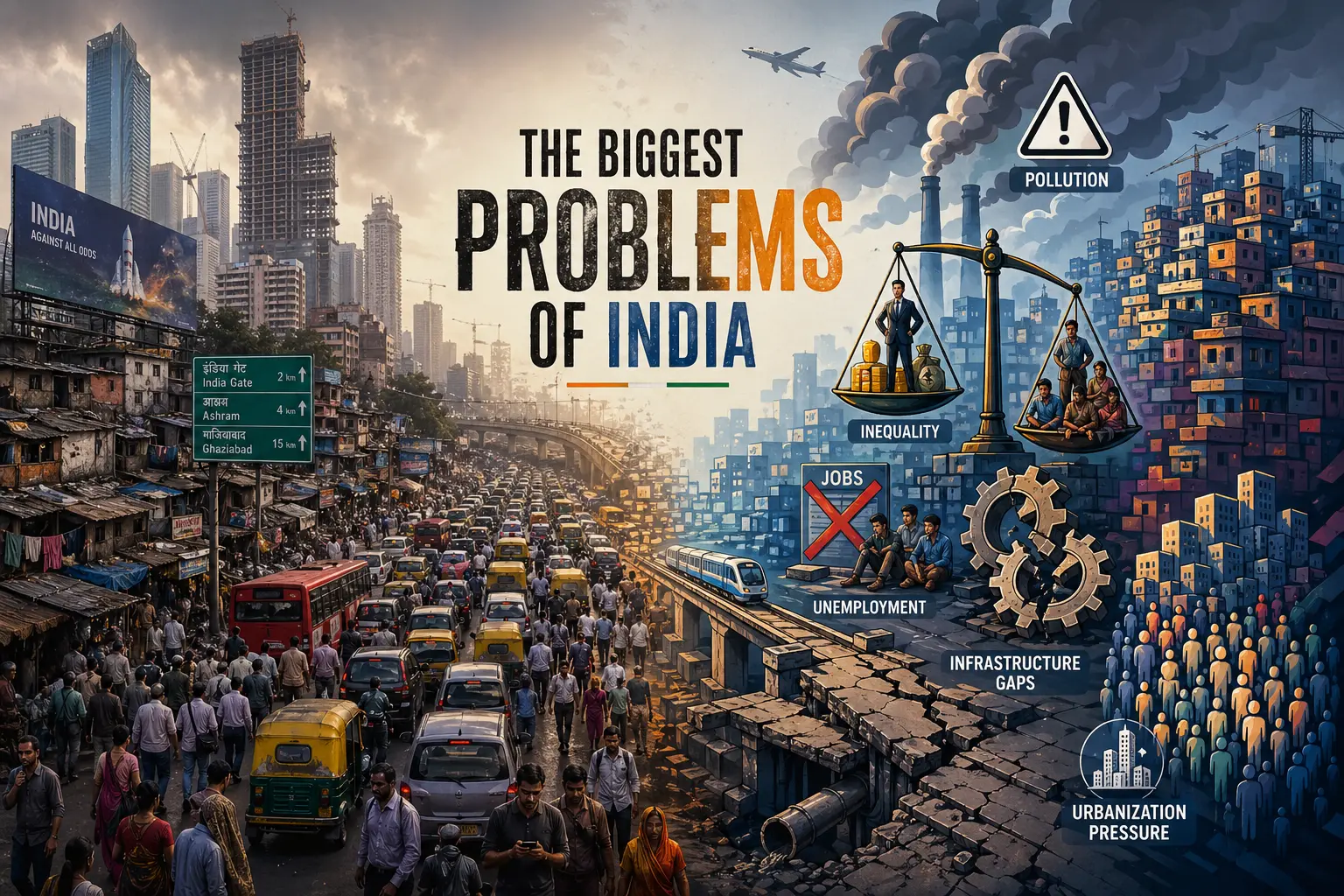
1. Unemployment and Underemployment
India’s employment challenge is structural rather than cyclical.
- Youth unemployment remains disproportionately high
- Over 80% of jobs are in the informal sector
- Skill mismatch persists despite rising education levels.
Data Point: According to the International Labour Organization, informal employment dominates India’s workforce, limiting productivity and income stability.
Strategic Insight: Economic expansion without labor absorption creates “jobless growth,” weakening consumption and social mobility.
2. Income Inequality
Growth in India has been imbalanced and unevenly shared.
- Top 10% controls a majority of the national wealth
- Rural and urban income disparities remain wide
- A small segment controls most access to capital and opportunity.
Source Insight: The World Inequality Lab highlights the widening concentration of wealth in India over the past two decades.
Implication: High inequality constrains inclusive growth and increases systemic vulnerability.
3. Pollution and Environmental Stress
India faces one of the most severe environmental crises globally.
- Air pollution levels in several cities remain among the highest in the world.
- Water scarcity affects hundreds of millions
- Climate change intensifies extreme weather patterns.
Evidence: The World Health Organization identifies air pollution as a major health risk in India, contributing to millions of premature deaths.
| Environmental Issue | Important Drivers | National Impact |
|---|---|---|
| Air Pollution | Transport, coal energy | Public health crisis |
| Water Scarcity | Overuse, climate change | Agricultural disruption |
| Waste Management | Urbanization | Urban degradation |
4. Population Pressure and Demographic Complexity
India’s population scale is both an asset and a constraint.
- High density increases pressure on infrastructure
- Public service delivery becomes uneven
- Resource consumption continues to rise.
Reference: United Nations population data underscores India’s demographic scale and urban expansion trends.
Policy Challenge: Converting demographic size into a productive demographic dividend.
5. Infrastructure Deficit
Infrastructure development has improved—but remains uneven.
- Logistics inefficiencies increase business costs
- Urban congestion reduces productivity
- Rural connectivity gaps persist.
Source: The World Bank notes that infrastructure gaps directly affect India’s competitiveness and economic efficiency.
6. Education System Limitations
India’s education system faces a dual challenge: access and quality.
- Learning outcomes lag behind global standards
- Curriculum often lacks practical skill alignment
- Rural-urban education divide remains significant.
Data Insight: Reports from the ASER Centre consistently show gaps in foundational literacy and numeracy.
Core Issue: Education is not reliably translating into employability.
7. Healthcare Accessibility and Affordability
Healthcare remains structurally imbalanced.
- Public healthcare spending is relatively low
- Private sector dominates service delivery
- High out-of-pocket expenses burden households
| Indicator | Status in India |
|---|---|
| Public Spending | Low (as % of GDP) |
| Rural Access | Limited |
| Private Dependence | High |
Reference: The National Health Authority highlights ongoing reforms, but access gaps persist.
8. Governance, Corruption, and Bureaucratic Friction
Institutional inefficiencies remain a key constraint.
- Regulatory complexity slows business formation
- Corruption increases transaction costs
- Policy execution gaps weaken reforms.
Insight: Transparency International’s data suggests that many governance issues remain unresolved.
Housing affordability and wage stagnation are global concerns. Countries like Portugal are also dealing with rising costs and demographic shifts—explored in The 10 Biggest Problems in Portugal.
9. Agricultural Instability
Agriculture remains critical—but vulnerable.
- Dependence on monsoon cycles
- Fragmented landholdings reduce efficiency
- Price volatility affects farmer income.
Source: The Food and Agriculture Organization emphasizes climate risks and productivity constraints in Indian agriculture.
10. Urbanization and Housing Pressure
India’s urban growth is accelerating rapidly.
- Expansion of informal settlements
- Housing affordability crisis in major cities
- Infrastructure strain across transport and utilities
Reference: UN-Habitat research shows that cities need a stronger focus on long-term sustainability.
An overview comparing major problems
| Category | Core Problem | Systemic Impact |
|---|---|---|
| Economic | Unemployment | Weak consumption |
| Social | Inequality | Reduced mobility |
| Environmental | Pollution | Health and climate risk |
| Infrastructure | Deficit | Productivity loss |
| Governance | Corruption | Institutional inefficiency |
Frequently Asked Questions (FAQs)
What is the most critical issue facing India today?
Unemployment remains central due to its direct link to economic growth, inequality, and social stability.
Why is pollution severe in India?
Rapid industrialization, vehicle emissions, and coal dependency are primary contributors.
How does inequality affect development?
It limits access to opportunity, reduces economic participation, and slows inclusive growth.
Is India’s population a problem or an advantage?
Both. It offers a large workforce but strains infrastructure and public services if not managed effectively.
What is holding back India’s infrastructure growth?
Financing gaps, regulatory delays, and uneven regional development.
- For a Nordic-Baltic perspective on modernization, demographics, and economic pressure, see: The 10 Biggest Problems in Estonia
- For a European comparison of structural and governance challenges, see: The 10 Biggest Problems in Hungary Today