
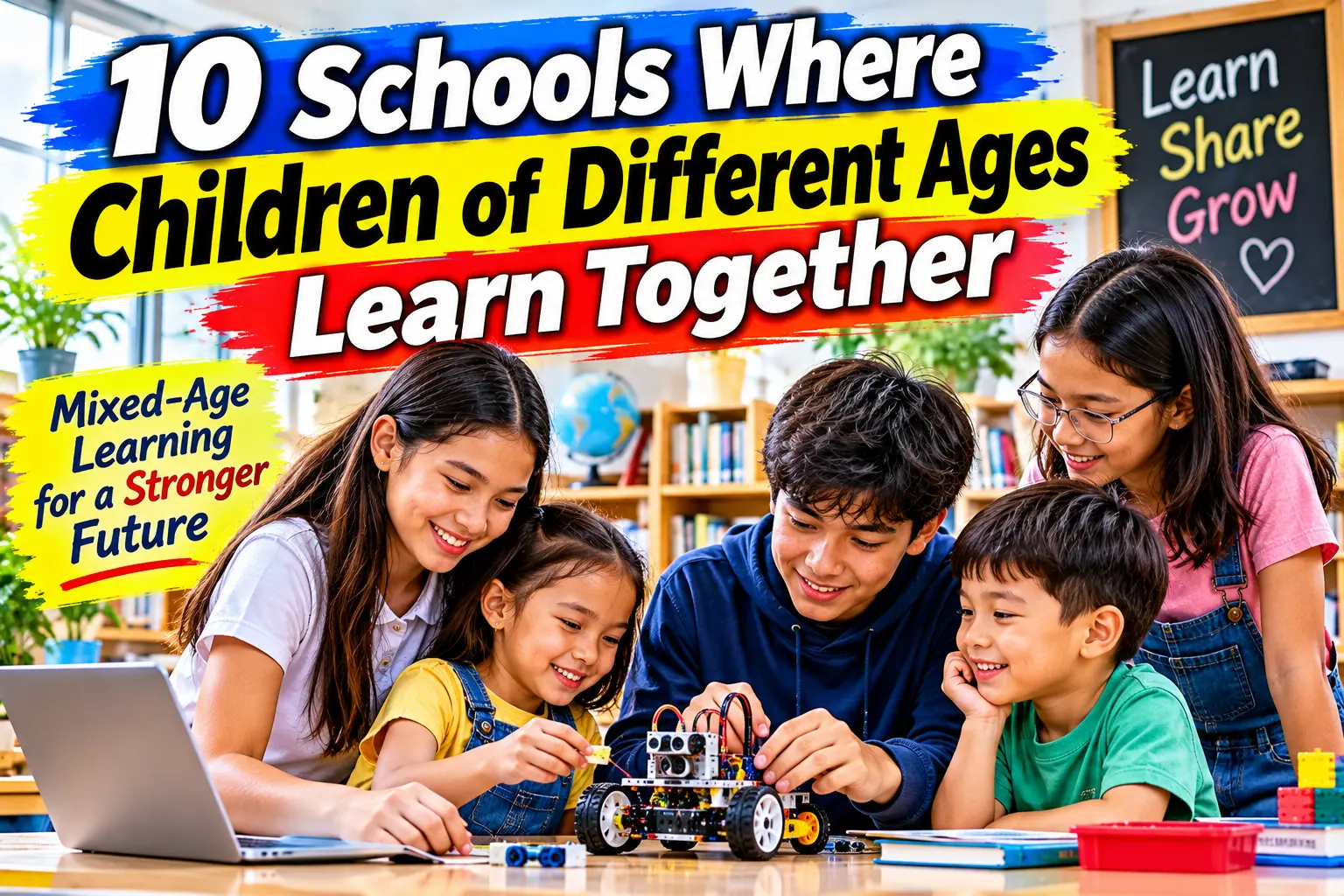
Most traditional schools organize children by age. Six-year-olds learn with other six-year-olds, ten-year-olds attend classes with ten-year-olds, and students move through grades as they grow older.
But not every school follows this structure.
Some schools deliberately bring younger and older children together in the same learning environment. They may share classrooms, work on collaborative projects, teach one another, or progress through learning activities at their own pace.
This approach is often called mixed-age learning or multi-age education. It challenges the assumption that children must always learn alongside classmates born in the same year.
The idea is not simply to put children of different ages in one room. Well-designed mixed-age environments give students meaningful opportunities to learn from one another while receiving instruction suited to their individual development.
Here are ten schools that demonstrate different ways children of different ages can learn together.
1. Sudbury Valley School – Framingham, Massachusetts, USA
At Sudbury Valley School, students ages four to 19 share a learning community rather than being separated into conventional grade levels.
The school does not follow a traditional system of required classes, grades, or a fixed curriculum. Students have considerable freedom to choose how they spend their days and which interests they want to pursue.
This structure creates opportunities for younger and older students to interact naturally. They may play together, work on projects, exchange ideas, or learn skills from one another.
A younger student might observe an older student working on something unfamiliar and become interested in learning it. Interactions with younger community members can help older students strengthen their leadership, communication, and mentoring skills.
The school considers these relationships an important part of its educational environment. Learning happens not only through individual interests but also through everyday conversations and shared experiences.
How different ages learn together: Students of different ages interact freely throughout the school day without conventional grade-based classroom divisions.
Age group: Approximately 4–19 years old.
2. The Bay School – Blue Hill, Maine, USA
The Bay School is an independent Waldorf school that uses combined-grade classrooms as part of its educational model.
Bringing students from different grade levels together creates opportunities for meaningful relationships across age groups.
For example, the school combines second and third grades. Students continue learning together as they progress through the school, creating a classroom community that develops over several years.
This arrangement gives older students opportunities to support younger classmates, while younger children can observe and learn from students who have already experienced certain activities.
Teachers also adapt lessons and expectations to suit the needs of students at different ages and learning stages.
The school describes its combined-grade approach as an important part of its identity. The aim is to create a classroom community where students of different ages develop relationships similar to those found among siblings.
How different ages learn together: Students from neighboring grade levels share classrooms and progress through a combined-grade learning structure.
Age group: Early childhood through Grade 8, with combined grades in the school-age program.
3. Community School – Kirkland, Washington, USA
Community School uses a multi-age learning structure in which students work in mixed-grade classrooms and participate in activities with children from other classes.
Its classroom arrangement includes three mixed-age groups: first and second grades, second and third grades, and fourth and fifth grades.
Its approach to mixed-age learning goes beyond simply grouping students from different grades together.
Students also participate in cross-grade activities throughout the school year. Children from different classes are placed in small groups called triads, where they complete projects and take part in field trips together.
The school also uses a buddy system. Older students are paired with younger children to guide them and help them adjust to daily school routines.
Reading buddies offer another opportunity for students to interact across age groups. Children meet regularly to read to one another and develop relationships beyond their usual classrooms.
This structure makes age diversity part of the wider school community rather than limiting it to classroom placement.
How different ages learn together: Mixed-grade classrooms, cross-grade project groups, reading buddies, and older-younger student partnerships.
Age group: Elementary school, approximately Grades 1–5.
4. Meraki School of Democracy – Portland, Oregon, USA
Meraki School of Democracy brings together students aged five to 18 in a mixed-age learning environment.
Its approach draws on democratic and self-directed education, giving students opportunities to participate in decisions that affect their learning community.
Rather than organizing the entire school around conventional age-based classrooms, Meraki encourages interaction among students of different ages.
Younger children learn by watching older students and joining them in activities. Older students can develop leadership and mentoring skills through their relationships with younger classmates.
The school considers age mixing an important part of its educational philosophy. The school views relationships across differences in experience, ability, and perspective as an important source of learning and personal growth.
This approach also gives children opportunities to develop social skills through everyday interactions rather than relying exclusively on formal lessons about cooperation and responsibility.
How different ages learn together: Students aged five to 18 participate in a shared democratic learning community with opportunities for cross-age interaction.
Age group: Approximately 5–18 years old.
5. Montessori Integrated School – Antipolo, Philippines
Montessori Integrated School demonstrates how mixed-age learning can work in a Philippine educational setting.
The school uses Montessori-style classrooms where children of different ages learn together.
In its elementary program, students are grouped into lower elementary and upper elementary classrooms. The lower elementary group generally includes children aged six to nine, while upper elementary serves children aged nine to 12.
The school also brings preschool and kindergarten children together in a shared learning environment.
These groupings give younger students opportunities to observe older classmates and learn from their experiences. Older children can reinforce their understanding by explaining concepts, demonstrating activities, or helping younger classmates.
Teachers still provide lessons and guidance suited to different developmental levels. The focus is on allowing students to progress at their own pace while benefiting from learning alongside children at different stages.
This example shows that mixed-age education is not limited to schools in Europe or North America. It is also available within the Philippine education landscape.
How different ages learn together: Montessori classrooms group children into developmental age ranges, with individualized activities and opportunities for peer learning.
Age group: Preschool through elementary, with mixed-age groupings including approximately 2.5–6, 6–9, and 9–12 years old.
6. The Laren School – Makati City, Philippines
The Laren School is another Philippine example of an educational institution that uses mixed-age groupings.
Founded in 2008, the school follows Montessori educational principles. Its programs include Casa, Lower Elementary, Upper Elementary, and an Adolescent Program.
Rather than organizing classrooms strictly by grade level, the school creates shared learning environments for children at different stages of development.
Younger students can observe how older classmates approach activities and solve problems. Spending time with younger classmates gives older students opportunities to take responsibility and become more independent.
The Montessori structure also supports individualized work. Students work at their own pace and take on activities that match their current abilities.
The Laren School demonstrates how educational structure and developmental flexibility can coexist within a shared learning environment.
How different ages learn together: Students share Montessori classrooms organized into developmental groupings rather than strictly single-age classes.
Age group: Early childhood through adolescence.
7. Lisbjerg School – Aarhus, Denmark
Lisbjerg School is an example of a school that has used larger mixed-age learning groups rather than relying exclusively on conventional grade divisions.
An OECD report on innovative learning environments describes the school as organizing students into two broad age groups: children aged six to nine and those aged ten to 13.
Within these larger groups, students are also organized into smaller mixed-age teams.
This arrangement allows teachers to balance whole-group instruction with smaller, more focused activities. Students follow individualized learning paths and document their progress through portfolios.
This structure gives children opportunities to work with classmates of different ages while still receiving instruction suited to their individual needs.
The school shows that mixed-age learning involves more than placing students from two grade levels in the same classroom. It can also influence how an entire school organizes its learning spaces, student groups, and teaching methods.
How different ages learn together: Students work in larger three-year age groups and smaller mixed-age teams, supported by individualized learning paths.
Age group: Approximately 6–13 years old.
8. Richard Taylor Church of England Primary School – North Yorkshire, England
The school shows how a mainstream primary school can teach children from different age groups together.
The school has used mixed-age whole-class teaching, including arrangements that combine Reception, Year 1, and Year 2 pupils.
Rather than treating different year groups as completely separate classes, teachers organize learning around carefully planned curriculum sequences.
It allows students to strengthen their understanding of key concepts as they move through different stages of learning.
Teachers must plan lessons that offer suitable challenges for different learners while keeping the class connected through shared learning experiences.
This example shows that mixed-age teaching can be part of mainstream education without requiring an entirely alternative educational philosophy. A conventional primary school can also organize some of its classrooms around different age groups.
How different ages learn together: Mixed-age primary classrooms combine pupils from different year groups through planned teaching and differentiated learning activities.
Age group: Early primary school, including Reception through Year 2 in the documented example.
9. Kirkby Malzeard Church of England Primary School – North Yorkshire, England
Kirkby Malzeard Church of England Primary School is another example of a mainstream school using mixed-age classroom arrangements.
The school serves a smaller rural community, where combining year groups helps organize teaching across different enrollment levels.
Its approach includes split classes involving Reception and Year 1, as well as arrangements for Year 2 pupils.
Through deliberate curriculum planning and consistent classroom routines, the school provides a structured learning environment for students of different ages.
Teachers must plan lessons that support pupils at different developmental stages without holding back advanced learners or leaving others behind.
This requires careful planning, particularly in subjects where children are expected to develop specific skills in a particular sequence.
It demonstrates how smaller schools can bring different age groups together while keeping lessons organized and suited to their needs.
How different ages learn together: Pupils from different primary year groups share classrooms, with lessons planned to address their respective learning needs.
Age group: Early primary school, including Reception through Key Stage 1 in the documented example.
10. Palmer Primary School – Western Australia
Palmer Primary School offers another example of multi-age education in a small-school setting.
According to an Australian Curriculum case study, the school organizes its 26 students into two classes: Junior Primary (Reception to Year 2) and Upper Primary (Years 3 to 6).
This arrangement brings children from several year levels together in the same classroom.
The school can organize learning through different approaches depending on the subject. Some activities can be shared across age groups, while others require students to work at different levels or follow separate year-level expectations.
This flexibility is important because children in a multi-age classroom do not necessarily have the same academic abilities or learning needs.
The school demonstrates how a small primary school can serve students across several year levels without needing a separate classroom for every grade.
How different ages learn together: Students from multiple year levels share two broad classroom groups, with teaching organized around their different learning needs.
Age group: Primary school, Reception through Year 6.
What Can Children Learn From Classmates of Different Ages?
Mixed-age learning creates opportunities that may be less common in classrooms where nearly every student is the same age.
Children can learn from teachers, but they can also learn from one another through conversations, shared projects, observation, and everyday interactions.
This kind of collaborative learning can also happen through hands-on activities where students design, create, and test their ideas. See 10 Schools Where Students Learn by Building Things for examples of schools that make learning through practical projects a central part of education.
| Learning opportunity | How it can happen |
|---|---|
| Peer teaching | Older students explain activities or concepts to younger classmates |
| Leadership | Students take responsibility for helping others |
| Collaboration | Children of different ages work toward shared goals |
| Independence | Younger learners observe how others approach tasks |
| Communication | Students learn to interact with people at different developmental stages |
| Confidence | Older students can recognize their own progress when helping others |
| Adaptability | Children learn to cooperate with classmates who have different abilities and experiences |
These opportunities do not automatically appear just because children of different ages share a classroom. Teachers and school leaders need to create activities and routines that encourage meaningful interaction.
Does Mixed-Age Learning Work for Every Child?
Mixed-age education offers interesting possibilities, but it is not automatically better than conventional age-based classrooms.
Children of different ages may have different academic needs, social abilities, and levels of independence. Teachers must account for these differences while ensuring that each student receives instruction suited to their needs.
A poorly organized mixed-age classroom can create learning difficulties if older students are expected to support younger classmates without proper guidance or if individual learning needs receive insufficient attention.
There is a difference between choosing to teach children of different ages together and doing so because a school has too few students or teachers to maintain separate classes.
Both arrangements can work, but they require different planning and teaching approaches.
The strongest examples show that successful multi-age learning requires thoughtful classroom organization, well-planned curricula, and teachers who can support students at different stages.
What Can Traditional Schools Learn From These Examples?
Mixed-age learning can complement traditional grade levels rather than replace them.
They can introduce opportunities for students to work with children from other year groups through reading partnerships, mentoring programs, collaborative projects, and shared activities.
For example, an older student might help a younger child develop reading skills. Students from different grades could also work together on an environmental project, school exhibition, or community activity. Some schools take this further by making environmental responsibility part of everyday learning, as shown in 10 Schools That Teach Children to Care for the Planet.
These experiences can help children develop relationships beyond their usual classrooms.
Schools can also reconsider whether every activity needs to be organized strictly by age. Some subjects and projects may benefit from grouping students according to interests, abilities, or the skills they bring to a task.
Some schools give students even more freedom to choose their activities and direct parts of their learning. Learn more in 10 Schools Where Students Have More Freedom Than You Might Expect.
As discussed in 10 Schools Where Children Can Follow Their Own Interests, giving students more room to learn at their own pace can create different opportunities for engagement.
Mixed-age learning offers another way to rethink how schools organize their communities.
Conclusion
Children do not always need to learn alongside classmates who are the same age. Some schools bring different age groups together to encourage collaboration, peer teaching, independence, and stronger learning communities.
These examples show that mixed-age education can take several forms. Some schools deliberately organize their entire educational approach around age diversity, while others combine grades to serve smaller communities or create more flexible classrooms.
The important lesson is not that every school should eliminate grade levels. The value lies in giving children opportunities to build learning relationships with students outside their own age group.
Children can learn valuable things from students of different ages and perspectives.
Frequently Asked Questions (FAQs)
Mixed-age learning is an educational approach in which children of different ages or grade levels learn together. They may share classrooms, participate in group activities, or work on projects while receiving instruction suited to their individual development.
The terms are sometimes used interchangeably, but they can describe different arrangements. Multi-grade education often refers to combining formal grade levels in one classroom, particularly in smaller schools. Some schools intentionally bring children of different ages together so they can learn and work with one another.
Schools may combine age groups to encourage peer learning, create stronger classroom communities, support individualized learning, or respond to smaller student populations. The reason depends on the school’s educational philosophy and circumstances.
They can. Older students may explain activities, demonstrate skills, or guide younger classmates. However, teachers remain responsible for instruction and must ensure that older students are not expected to take on the teacher’s role.
There is no universal answer. Mixed-age education can encourage collaboration, peer learning, and individualized support. Its effectiveness depends on good classroom organization, prepared teachers, and students’ needs. It is not the right approach for every child.
References
- Sudbury Valley School
- Meraki School of Democracy
- The Bay School
- Community School
- Montessori Integrated School
- The Laren School
- OECD report on innovative learning environments
- National Centre for Excellence in the Teaching of Mathematics (NCETM)
- Australian Curriculum – Multi-age classes