
Around the world, classroom lessons introduce children to environmental challenges, from climate change and pollution to deforestation and declining wildlife populations. But learning about environmental problems is not the same as learning how to address them.
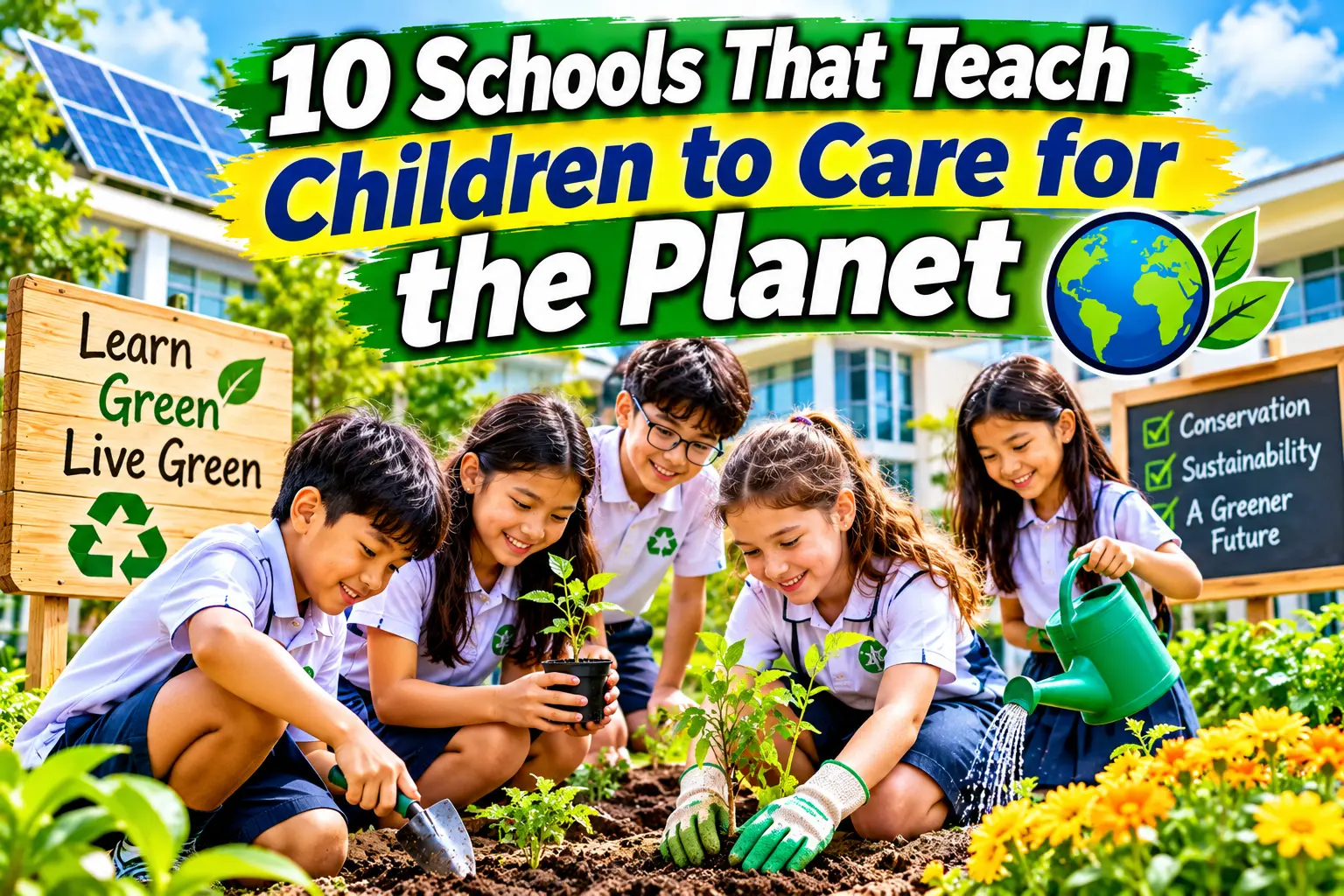
Some schools take a more practical approach. They integrate environmental responsibility into everyday education through school gardens, renewable energy, conservation projects, waste reduction, sustainable buildings, and community involvement.
Students may grow food, monitor local ecosystems, study biodiversity, reduce waste, or investigate how their school affects the environment.
These experiences help children recognize that environmental responsibility extends beyond scientific research and government policy to everyday choices and community action. It can begin with everyday decisions and practical action in their own communities.
Here are ten schools that demonstrate different ways environmental responsibility can become part of education.
1. Green School Bali – Bali, Indonesia
Green School Bali was founded on the belief that education should prepare children to help create a more sustainable world.
Its campus is built largely with bamboo and designed to connect students with the natural environment. However, its environmental approach goes beyond architecture. The school makes sustainability part of how students learn and what they do each day.
Students explore topics such as organic agriculture, renewable energy, permaculture, and environmental conservation through practical projects.
One particularly interesting example is the school’s Bio Bus initiative. Students helped develop a transportation project that uses biodiesel made from used cooking oil. The idea began as an effort to reduce the environmental impact of school transportation and developed into a wider social enterprise and learning initiative.
The project gives students a practical example of how waste materials can become useful resources.
Green School Bali demonstrates that environmental education can involve more than learning about nature. Students can investigate challenges within their school community and develop practical responses with broader applications.
What students learn: Sustainable agriculture, renewable energy, waste reduction, environmental entrepreneurship, and ecological responsibility.
Age group: Approximately 3–18 years old.
2. United World College of Southeast Asia (UWCSEA) – Singapore
UWCSEA integrates environmental responsibility into its service-learning program and broader educational experience.
Students participate in environmental initiatives involving biodiversity, waste management, conservation, gardening, composting, and rainforest restoration.
The school encourages students to investigate environmental challenges and take informed action rather than discuss sustainability in the classroom.
One example is its student-led environmental work on campus. Students collaborate across school sections to support projects such as creating green spaces, improving composting practices, and restoring rainforest areas.
UWCSEA also encourages students to consider how everyday consumption affects the environment. Its environmental initiatives introduce concepts such as circular economies and sustainable resource use.
The school gives students opportunities to work with community organizations and other partners, showing them why environmental challenges often require cooperation beyond the school. Students can also learn collaboratively across age groups, as shown in 10 Schools Where Children of Different Ages Learn Together.
Its approach connects environmental education with practical responsibility and community involvement.
What students learn: Biodiversity protection, waste management, circular economy, conservation, and environmental service.
Age group: Approximately 4–18 years old, across its different school sections.
3. The Island School – Eleuthera, The Bahamas
The Island School uses its surrounding marine and coastal environment as an important part of education.
Its location on Eleuthera Island gives students opportunities to learn about the surrounding ecosystems, local communities, and environmental challenges in The Bahamas.
Its programs include marine ecology, sustainable systems, environmental research, and community engagement. Students can investigate coral reefs, mangrove ecosystems, fisheries, renewable energy, water use, and waste management.
The school also works closely with the Cape Eleuthera Institute, where researchers and students participate in environmental and conservation-related work.
This gives students opportunities to take part in scientific research rather than only learning about environmental issues through reading.
For example, marine ecology activities can involve identifying fish and invertebrates, surveying coral reefs, and studying mangrove ecosystems.
The school also operates an aquaponics system that combines fish production with growing vegetables. This offers a practical example of how food production systems can use resources more efficiently.
The Island School demonstrates how education can help students understand the relationship between human communities and the natural systems they depend on.
What students learn: Marine conservation, coral reef ecology, sustainable food production, renewable energy, and environmental research.
Age group: Programs range from early childhood through high school, with additional research opportunities for older students and visiting participants.
4. The Scindia School – Gwalior, India
The Scindia School has developed a whole-school sustainability initiative called the Biosphere Project.
Launched in 2020, the project focuses on five major areas: rewilding, water conservation, waste management, energy conservation, and regenerative farming.
Rather than treating sustainability as a separate classroom subject, the school uses its campus as a place where students can study environmental systems and take part in practical improvements.
One part of the project involves restoring native grassland. The school is replacing invasive plants with native species that grow naturally in the area.
The project also gives students opportunities to examine water use, waste practices, and the relationship between human activity and biodiversity.
This approach encourages students to understand that environmental protection requires attention to several connected systems.
A school can reduce waste, but it also needs to consider energy consumption, water management, soil health, and the plants and animals living around it.
The Biosphere Project shows how a school campus can serve as a living environment for sustainability education.
What students learn: Biodiversity restoration, regenerative agriculture, water conservation, energy efficiency, and waste management.
Age group: School-age students, including middle and senior school learners.
5. Forster Public School – New South Wales, Australia
Forster Public School shows how a vegetable garden can serve as a hands-on learning space for the entire school community.
The school developed its permaculture garden with funding from an Eco Schools grant. The garden features compost bins, a worm farm, and a water tank.
Students grow and harvest food while learning how plants grow, how soil works, and how to conserve water.
The garden also connects environmental education with nutrition and everyday life.
After harvesting vegetables, students can use the produce in cooking activities. This helps them understand the journey from planting seeds to preparing food.
They also learn practical skills such as collecting seeds, maintaining soil, rotating crops, and making compost.
The project illustrates how meaningful environmental education can grow from practical, hands-on experiences rather than costly technology or extensive research facilities.
A well-managed school garden can teach children about ecosystems, food production, natural resources, and responsible consumption.
What students learn: Permaculture, composting, food production, soil health, water conservation, and sustainable eating.
Age group: Primary school students.
6. Croydon Hills Primary School – Victoria, Australia
Croydon Hills Primary School has developed an on-campus farm that brings environmental learning into everyday school life.
The farm includes an orchard, composting areas, a chicken yard, and vegetable plots with specialized growing beds.
Students and staff have worked together to transform unused areas of the school grounds into spaces that support food production and biodiversity.
The school has also introduced sustainability measures involving energy efficiency and water collection.
Its rainwater system can store up to 120,000 litres, while the school diverts a large proportion of its food waste into composting.
These activities allow students to see how different environmental practices work together.
Food scraps can become compost, compost can support plant growth, and harvested produce can become part of the school community’s food supply.
The farm also gives students opportunities to study how plants, animals, soil, water, and people interact.
Croydon Hills puts sustainability into practice through its grounds and resources.
What students learn: Food production, composting, biodiversity, water conservation, and sustainable resource management.
Age group: Primary school students.
7. Heany Park Primary School – Victoria, Australia
Heany Park Primary School has a student-led Green Team that helps organize environmental activities across the school community.
The team works on projects involving composting, waste reduction, biodiversity, and environmental awareness.
Students have helped organize school cleanups, gardening activities, and campaigns encouraging classmates to reduce waste.
The Green Team has also worked with local environmental organizations and conservation groups.
Student leadership is another important part of the school’s approach, with learners encouraged to take active roles in planning and leading activities.
They can help communicate environmental messages, organize projects, and encourage other students to adopt more sustainable habits.
This helps students connect what they learn about the environment with their own responsibilities.
Instead of treating sustainability as something that only teachers or school administrators manage, the school gives students a role in shaping its environmental culture.
Heany Park demonstrates how student leadership can help turn small environmental activities into shared school habits.
What students learn: Environmental leadership, waste reduction, composting, biodiversity, teamwork, and community engagement.
Age group: Primary school students.
8. Albert Park College – Melbourne, Australia
Albert Park College has worked to reduce the environmental impact of its school operations through several sustainability initiatives.
Its efforts include solar panels, energy monitoring, waste management, composting, and water efficiency.
The school reports that its solar installation has helped reduce electricity consumption. It also uses technology to monitor energy use and carbon emissions.
The school collects paper, cardboard, compostable waste, and other recyclables in separate bins.
These improvements help students understand how schools use resources and how those practices can become more sustainable.
The example illustrates how sustainability can extend beyond the classroom to influence a school’s management practices and daily operations.
Everyday school operations can help students understand resource use, waste management, and the environmental impact of purchasing decisions.
A sustainable school is not simply one that teaches environmental awareness. It also puts those ideas into action.
What students learn: Renewable energy, energy efficiency, waste management, composting, and sustainable school operations.
Age group: Secondary school students.
9. Trawden Forest Primary School – Lancashire, England
Trawden Forest Primary School has created an extensive garden where children can learn about food production and environmental care through direct experience.
Its garden includes growing areas, composting bays, a polytunnel, and rainwater collection systems.
Students take part in the process from planning and designing growing spaces to planting, maintaining, and harvesting crops.
They also make compost from garden and school waste and learn how worm farms help break down organic materials.
Students can use the garden to study plant life cycles, understand soil health, observe biodiversity, and explore how living organisms interact. Other schools take outdoor learning further by making natural environments central to education, as seen in 10 Schools Where the Forest Is the Classroom.
Students can grow different crops and learn which plants grow best in different conditions.
What makes this example interesting is how the school has developed a practical environmental learning space that supports different subjects.
Children can connect gardening with science, mathematics, nutrition, and responsible resource use.
The experience makes environmental responsibility part of daily school life rather than something addressed only through occasional activities.
What students learn: Gardening, composting, plant biology, food production, water conservation, and biodiversity.
Age group: Primary school students.
10. Diosdado P. Macapagal Public Elementary School – Quezon City, Philippines
Diosdado P. Macapagal Public Elementary School provides a Philippine example of how school environments can be redesigned to support environmental awareness and climate resilience.
The school became the first site of the OASIS Schoolyard Project in the Philippines and Southeast Asia.
OASIS stands for Openness, Adaptation, Sensitization, Innovation, and Social Ties. The project demonstrates how collaboration between local government and partner organizations can support environmental initiatives.
Its schoolyard includes shaded seating, nature-based learning elements, and play areas designed with input from students, teachers, and other community members.
The project aims to create a more comfortable, climate-responsive environment that helps protect children from extreme heat, flooding, and other environmental risks.
It also gives students opportunities to experience how school design, green spaces, and environmental planning can improve everyday life.
Rather than serving as a standalone environmental curriculum, the project illustrates how a school’s physical environment can become an active part of climate education.
It also highlights the importance of involving children and communities in designing spaces that respond to local environmental challenges.
What students learn: Climate resilience, nature-based design, environmental awareness, and community participation.
Age group: Elementary school students.
What Do Children Learn When Schools Make Sustainability Part of Everyday Life?
Environmental education can involve much more than memorizing facts about climate change or identifying different types of pollution.
Practical projects help students learn how the environment works and how their choices affect it.
| Learning area | What students experience |
|---|---|
| Biodiversity | Studying plants, animals, habitats, and local ecosystems |
| Food systems | Growing vegetables, composting, and understanding where food comes from |
| Waste management | Reducing waste, reusing materials, and recycling |
| Energy | Understanding renewable energy and reducing electricity consumption |
| Water | Conserving water and learning how natural water systems work |
| Climate resilience | Exploring how communities can prepare for environmental challenges |
| Leadership | Organizing projects and encouraging others to take action |
| Conservation | Participating in activities that protect natural environments |
These experiences help students connect environmental knowledge with everyday responsibilities.
A student who helps maintain a vegetable garden may begin to understand why healthy soil matters. Another who participates in a cleanup may become more aware of how litter affects waterways and wildlife.
The learning becomes more meaningful when children can see the results of their efforts.
Can Schools Really Change How Children Treat the Environment?
Schools cannot solve environmental problems on their own. Climate change, pollution, habitat destruction, and biodiversity loss require action from governments, businesses, communities, and individuals.
Schools help students understand environmental problems and think about possible solutions.
These projects give children opportunities to build practical skills, investigate environmental issues, and work with others. This approach reflects a broader educational model in which students learn by addressing practical challenges, as demonstrated in 10 Schools That Teach Children How to Solve Real-World Problems.
They may also apply these habits in their daily lives outside school. A student who learns to reduce food waste at school may begin paying attention to waste at home. Someone who studies local biodiversity may become more interested in protecting nearby habitats.
But environmental education should go beyond asking children to make small personal sacrifices.
Students also need to understand larger environmental systems, including how industries, infrastructure, consumption, and public policies affect the planet.
The strongest programs combine scientific understanding with practical action and critical thinking.
What Can Other Schools Learn From These Examples?
These schools show that environmental education does not require every institution to build a sustainable campus or establish a large conservation center.
Schools can start with projects that reflect their location, available resources, and community needs.
For example, a school with limited space could start a small vegetable garden or composting program. A school near a river could organize water-quality activities. Students in coastal communities could study marine ecosystems and local pollution.
Other schools might focus on reducing electricity use, improving waste segregation, planting native species, or developing student-led environmental organizations.
In the Philippines, programs such as the Youth for Environment in Schools Organization (YES-O), Gulayan sa Paaralan, and school-based waste management activities provide opportunities to connect environmental education with practical participation.
The most important step is to make environmental responsibility part of the way students learn and participate in their communities.
It should not be limited to one celebration or a single classroom lesson each year.
Conclusion
Environmental education becomes more practical when students can apply what they learn through activities that support environmental protection.
The examples in this article show different ways schools can make sustainability part of everyday education. Some focus on conservation research, others on food production, renewable energy, waste reduction, or climate-resilient school environments.
Each school takes a different approach and works with the resources available to it.
What matters is helping children understand the connection between human activities and the natural world, then giving them opportunities to act on that understanding.
A generation that learns to care for the planet needs more than environmental information. It needs the knowledge, skills, and responsibility to put that learning into practice.
Frequently Asked Questions (FAQs)
Through environmental education, students explore natural systems, examine environmental problems, and consider how people are connected to the planet. It can include classroom lessons, conservation projects, gardening, recycling, climate education, and community activities.
Schools can introduce practical activities such as planting trees, maintaining gardens, composting food waste, conserving water, reducing plastic use, and studying local ecosystems. Student-led environmental projects can also help children take responsibility for their school communities.
A sustainable school tries to reduce its environmental impact while helping students understand sustainability. This may involve renewable energy, efficient water use, waste reduction, sustainable buildings, biodiversity projects, and environmental learning.
Children will grow up making decisions that affect communities, natural resources, and the environment. Learning about environmental protection helps them understand these responsibilities and develop the knowledge and skills needed to make informed choices.
Yes. Public schools can begin with practical activities such as vegetable gardens, composting, tree planting, waste segregation, water conservation, and student environmental organizations. Many projects can use locally available materials and community partnerships.
Reference
- Green School Bali
- UWCSEA Environmental Initiatives
- The Island School
- The Scindia School Biosphere Project
- Forster Public School garden case study
- Croydon Hills Primary School
- Heany Park Primary School
- Albert Park College
- Trawden Forest Primary School
- Diosdado P. Macapagal Public Elementary School