
For many generations, students have been told that academic success is the path to a successful future.
Study hard.
Get good grades.
Pass exams.
Earn a diploma.
The assumption is simple: education prepares people for life.
Yet many graduates discover something surprising after leaving school.
Despite years of education, they often feel unprepared for the most important life challenges.
Managing money.
Making major decisions.
Building professional relationships.
Handling conflict.
Communicating effectively.
Adapting to change.
These skills influence careers, finances, and personal success, yet many receive little attention in traditional classrooms.
As the world changes faster than ever, the gap between academic knowledge and real-world readiness is becoming increasingly difficult to ignore.
The Surprising Gap Between School and Life
Schools have traditionally focused on academic subjects such as mathematics, science, history, and language arts.
These subjects are valuable and remain important.
However, many students discover after graduation that success in adult life often depends on a different set of abilities.
Employers consistently value communication, adaptability, teamwork, critical thinking, and problem-solving.
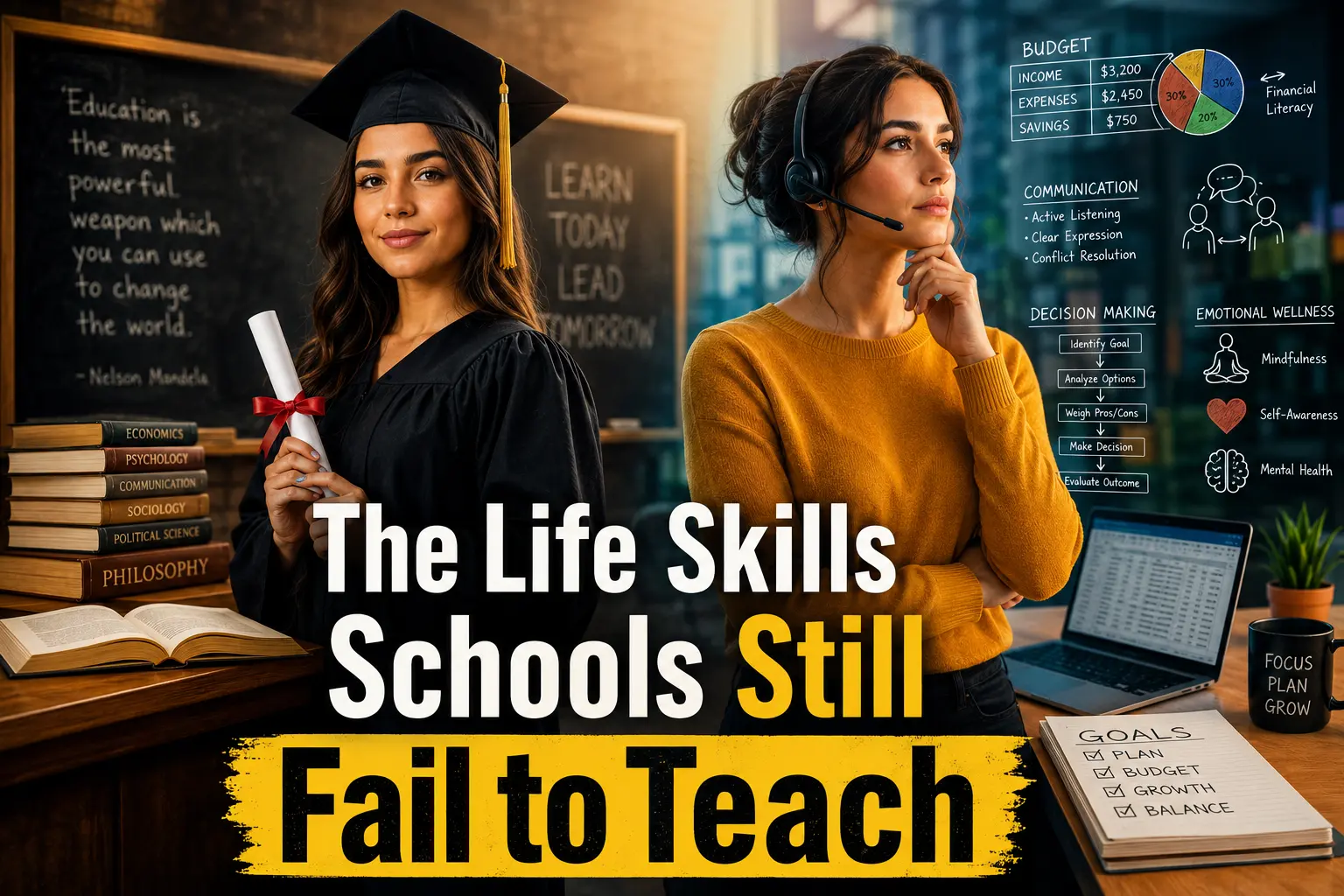
At the same time, everyday life requires skills such as financial planning, decision-making, emotional resilience, and time management.
Academic achievement still matters—but employers increasingly demand skills beyond test scores. Grades alone cannot guarantee future professional or personal success, as revealed in Why Good Grades No Longer Guarantee Success in Real Life.
Life Skill #1: Financial Literacy
One of the most commonly cited gaps in modern education is financial literacy.
Many students spend years studying academic subjects, yet receive little formal education on:
- Budgeting
- Saving
- Investing
- Taxes
- Credit management
- Debt management
- Retirement planning
As a result, many young adults face major financial decisions without prior instruction.
Financial literacy—encompassing budgeting, saving, investing, taxes, and debt management—is one of the most important skills many students never formally learn. Despite its lifelong impact on every person, these topics remain missing from traditional curricula. Why Schools Still Don’t Teach Financial Literacy examines why this gap persists and why graduates enter adulthood without essential money-management skills.
Life Skill #2: Communication
Communication affects nearly every aspect of life.
Strong communicators are often better equipped to:
- Build relationships
- Resolve conflicts
- Lead teams
- Negotiate opportunities
- Advance professionally
Yet many students spend years writing essays without receiving substantial training in practical communication skills such as public speaking, active listening, persuasion, and workplace communication.
In the current economy, the ability to communicate ideas clearly may be just as valuable as technical expertise.
Life Skill #3: Critical Thinking
Information has never been more accessible.
Unfortunately, misinformation has never been easier to spread.
Students increasingly need the ability to:
- Evaluate evidence
- Identify bias
- Verify sources
- Analyze complex issues
- Make informed decisions
Critical thinking helps people navigate everything from financial decisions to career choices and civic participation.
As artificial intelligence becomes more common, the ability to think independently may become even more important. AI can generate answers, summarize information, and produce content in seconds, but humans still need the ability to evaluate evidence, question assumptions, and determine what information is trustworthy. This growing challenge is explored in Why Critical Thinking May Become the Most Valuable Skill in the Age of AI, which examines why many experts believe critical thinking could become one of the most important human skills in the decades ahead.
Life Skill #4: Emotional Intelligence
Many life challenges are not academic.
They are emotional.
Understanding emotions, managing stress, and building healthy relationships often influence success as much as intellectual ability.
Emotional intelligence includes:
- Self-awareness
- Empathy
- Self-control
- Social awareness
- Relationship management
Research consistently shows that emotional intelligence contributes to stronger leadership, better workplace performance, and healthier personal relationships.
Life Skill #5: Time Management
Time is one of the few resources everyone shares equally.
Yet many students leave school without structured training in:
- Prioritization
- Goal setting
- Productivity systems
- Long-term planning
Learning how to manage time effectively can improve academic performance, career growth, and personal well-being.
In a world filled with distractions, time management has become an increasingly valuable skill.
Life Skill #6: Decision-Making
Every significant life outcome relies on a decision.
Choosing a career.
Managing finances.
Selecting opportunities.
Building relationships.
Students learn to solve equations but get little instruction on making real-world decisions under uncertainty.
Good decision-making often requires:
- Risk assessment
- Long-term thinking
- Self-awareness
- Information gathering
- Adaptability
These skills can significantly influence future success.
Life Skill #7: Adaptability
The modern world changes rapidly.
Technology evolves.
Industries transform.
New careers emerge while others disappear.
Many students entering school today may eventually work in jobs that do not yet exist.
Adaptability allows people to learn, pivot, and succeed despite uncertainty.
This may become one of the defining skills of the twenty-first century.
Why Some Education Systems Are Changing
Around the world, some education systems are beginning to recognize that preparing students for life requires more than academic instruction.
Schools are increasingly emphasizing collaboration, creativity, communication, and real-world problem-solving.
Finland has become one of the most frequently discussed examples of education reform. Rather than focusing on longer school days and heavier workloads, Finland emphasizes student well-being, teacher quality, and meaningful learning experiences. Why Finland’s Students Spend Less Time in School Yet Still Succeed explores how this alternative approach has attracted worldwide attention.
These reforms reflect a growing belief that education should help students develop the skills needed to navigate an increasingly complex and rapidly changing world.
The Skills Gap: A Quick Overview
| Life Skill | Why It Matters | Real-World Impact |
|---|---|---|
| Financial Literacy | Money management | Reduced debt, better financial security |
| Communication | Relationship building | Career advancement and leadership |
| Critical Thinking | Problem-solving | Better decision-making |
| Emotional Intelligence | Self-management | Stronger relationships and resilience |
| Time Management | Productivity | Improved performance and balance |
| Adaptability | Future readiness | Career flexibility and growth |
Why This Matters More Than Ever
Technology is changing the workforce.
Artificial intelligence is transforming industries.
Career paths are becoming less predictable.
Success increasingly depends on the ability to learn, adapt, communicate, and make informed decisions.
Schools continue to play a vital role in society.
However, many experts argue that academic achievement alone is no longer enough.
The future may belong not only to those who know the most, but also to those who can apply knowledge effectively in the real world.
Frequently Asked Questions (FAQs)
Life skills are practical abilities that help people manage everyday challenges, make decisions, communicate effectively, and adapt to change.
Traditional education systems were originally designed to emphasize academic knowledge. Many schools face curriculum limitations that leave little room for additional subjects.
Yes. Financial literacy is widely regarded as one of the most important life skills because it affects budgeting, saving, investing, and long-term financial security.
There is no single answer, but communication, critical thinking, financial literacy, adaptability, and emotional intelligence are consistently ranked among the most valuable.
Yes. Many education systems are introducing project-based learning, career readiness programs, digital literacy, and real-world skill development.
Technology and workforce demands are changing rapidly. Adaptability helps individuals succeed in uncertain and evolving environments.
Absolutely. Many people develop life skills through work experience, mentorship, family guidance, personal study, and real-world challenges.
Many graduates possess academic knowledge yet lack practical experience in finances, major decisions, workplace challenges, and everyday responsibilities.