

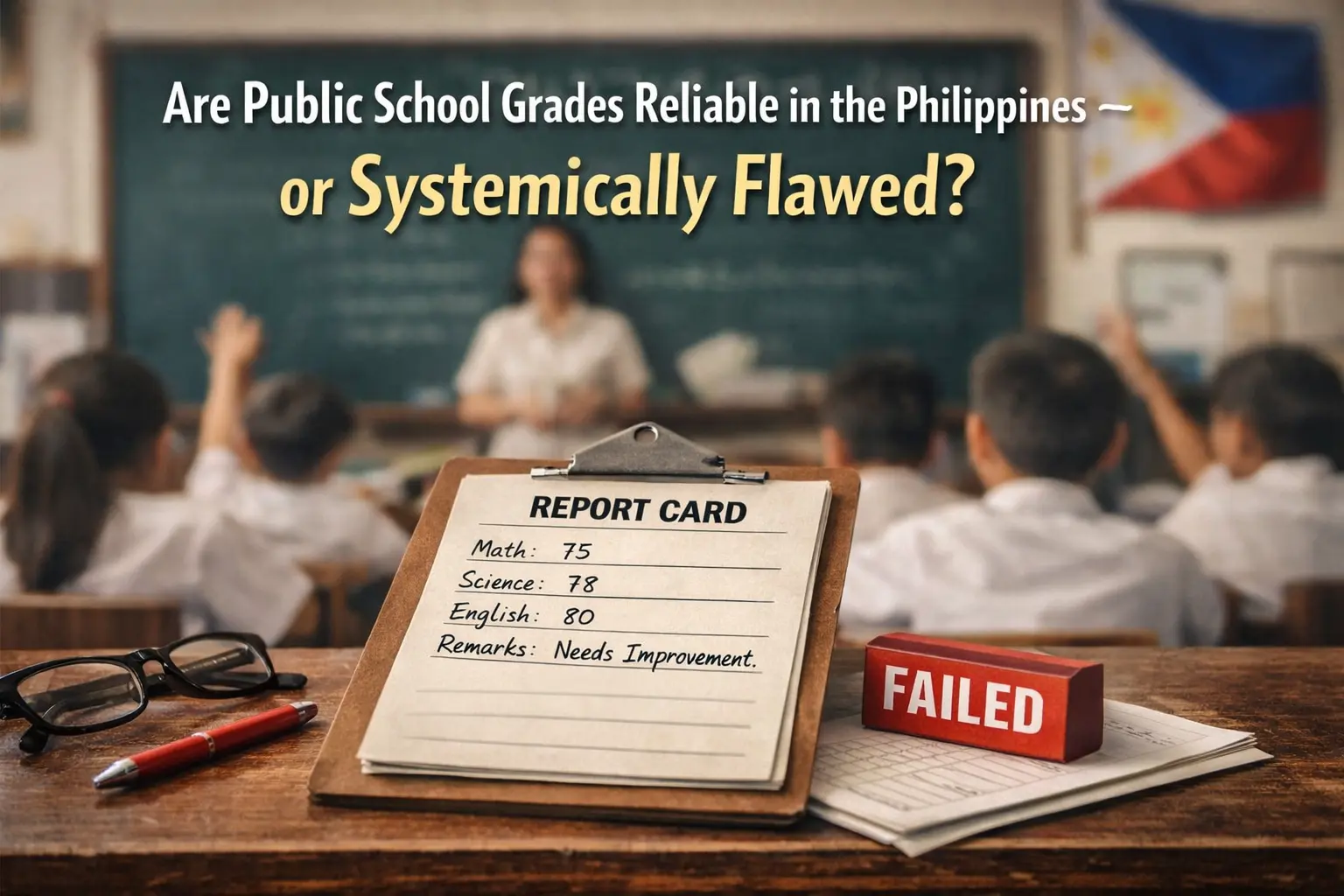
Grading is supposed to measure learning.
It determines academic progression, scholarship eligibility, honors recognition, and, in many cases, future opportunity.
But an uncomfortable question continues to surface in policy discussions:
Do public school grades in the Philippines accurately reflect student learning, or do structural weaknesses undermine their integrity?
This article analyzes grading reliability through the frameworks of governance, workload, and accountability. The focus is systemic design — not individual blame.
Why Grading Reliability Matters
Grades influence:
- Academic ranking
- Promotion and retention decisions
- Scholarship qualifications
- College admissions
- Student confidence and motivation
When schools fail to enforce consistent grading standards and oversight, the consequences extend beyond a single classroom.
The OECD has emphasized that assessment reliability and transparency are critical components of high-performing education systems. Similarly, the World Bank has identified teacher assessment standards as a key driver of student learning outcomes in developing education systems.
Assessment is not merely administrative. It is structural accountability.
What Makes a Grading System Reliable?
A reliable grading framework typically includes:
- Standardized rubrics
- Clear performance criteria
- Calibration among teachers
- Assessment moderation processes
- Periodic audits or review mechanisms
- Balanced use of formative and summative evaluation
Without these elements, grading becomes more inconsistent.
Structural Pressures in Philippine Public Schools
Many public school classrooms in the Philippines have 40 or more students per teacher.
Large class sizes create workload compression, which affects:
- Feedback depth
- Rubric application consistency
- Grading turnaround time
- Monitoring of learning gaps
When grading dozens of papers across multiple sections, precision can suffer.
It does not suggest any deliberate manipulation.
It highlights how system capacity influences assessment quality.
Where Vulnerabilities Can Emerge
In high-volume, low-supervision environments, grading systems may become vulnerable to:
The Accountability Imbalance Question
A recurring concern in reform discussions is perceived imbalance:
- Students face consequences for low or failing grades.
- Teachers, in many cases, operate within limited performance audit mechanisms.
If grading systems lack transparency or standardized review, students bear outcomes without clarity on evaluation standards.
It raises a governance question:
Is there equal accountability across all levels of the assessment process?
High-performing systems institutionalize grading moderation, requiring teachers to cross-check and align grading standards to preserve fairness.
Without such checks, reliability depends largely on individual discretion.
Can Grades Be Manipulated?
The more precise question is:
Could grading be compromised under certain systemic conditions?
Potential vulnerabilities may include:
- Non-standardized grading policies across schools
- Absence of independent moderation
- Pressure to meet performance quotas
- Inconsistent documentation of rubric use
These are design risks — not automatic proof of abuse.
Systems that lack transparency are more susceptible to credibility concerns.
The Psychological Impact on Students
When students perceive grading as:
- Unpredictable
- Overly harsh
- Inconsistent
- Poorly explained
It can result in:
- Reduced academic confidence
- Increased disengagement
- Higher dropout risk
- Long-term distrust in institutions
The fairness of assessments is closely associated with student motivation and participation in the classroom.
When grades do not align with perceived effort or learning, morale declines.
Experience and Assessment Quality
Research consistently shows that assessment literacy improves with teaching experience — particularly during the first five years.
Early-career teachers may struggle with:
- Rubric calibration
- Balanced grading design
- Constructive qualitative feedback
- Aligning assessments with learning objectives
When mentorship is missing, young teachers are left to navigate grading on their own—often resulting in inconsistent outcomes.
Structured teacher induction programs, common in countries like Singapore and Finland, provide assessment training before teachers gain full classroom autonomy.
The Philippine system needs to determine whether similar structures are applied uniformly.
Are Public School Grades Currently Reliable?
Reliability is not binary.
The issue is not whether all grades are unreliable.
The more nuanced question is:
Are there enough safeguards to guarantee consistent, transparent, and standardized grading across schools?
If oversight mechanisms are uneven, reliability becomes variable.
Variable reliability reduces system credibility.
Reform Priorities for Grading Integrity
If the objective is to strengthen trust in public school grades, reforms may include:
- Mandatory grading rubric standardization across subjects
- Peer-based grading calibration workshops
- Randomized assessment audits
- Clear documentation of grading criteria
- Structured mentoring for early-career teachers
- Digital grading transparency systems
- Reduced classroom sizes to improve evaluation accuracy
Grading reform is not anti-teacher.
It is pro-transparency.
Frequently Asked Questions (FAQs)
Can teachers intentionally manipulate grades?
Any system without oversight carries vulnerability. However, structural design — not individual assumption — determines systemic reliability.
Are students unfairly blamed for low grades?
Students are typically held accountable for performance outcomes. The question is whether grading systems provide equal clarity and accountability upstream.
Does class size affect grading reliability?
Yes. Large class sizes increase workload pressure, which can reduce assessment precision.
Is grading reform achievable without major disruption?
Yes. Calibration workshops, standardized rubrics, and digital systems can significantly improve transparency without a structural overhaul.
Conclusion
Grades shape opportunity.
When grading systems are transparent, standardized, and monitored, trust increases.
When oversight is inconsistent, credibility weakens.
The question is not whether teachers are good or bad.
The question is whether the system provides:
- Clear standards
- Accountability symmetry
- Structured oversight
- Professional support
To improve national education outcomes, Philippine public schools must prioritize grading reliability as a governance priority rather than a classroom afterthought.
- How Teacher Inexperience Can Affect Student Learning and Grades
- How Philippine Education Compares to Other Southeast Asian Countries
- Our Painful Experience in Public School in Cebu