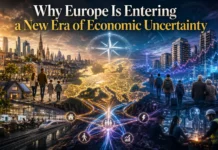

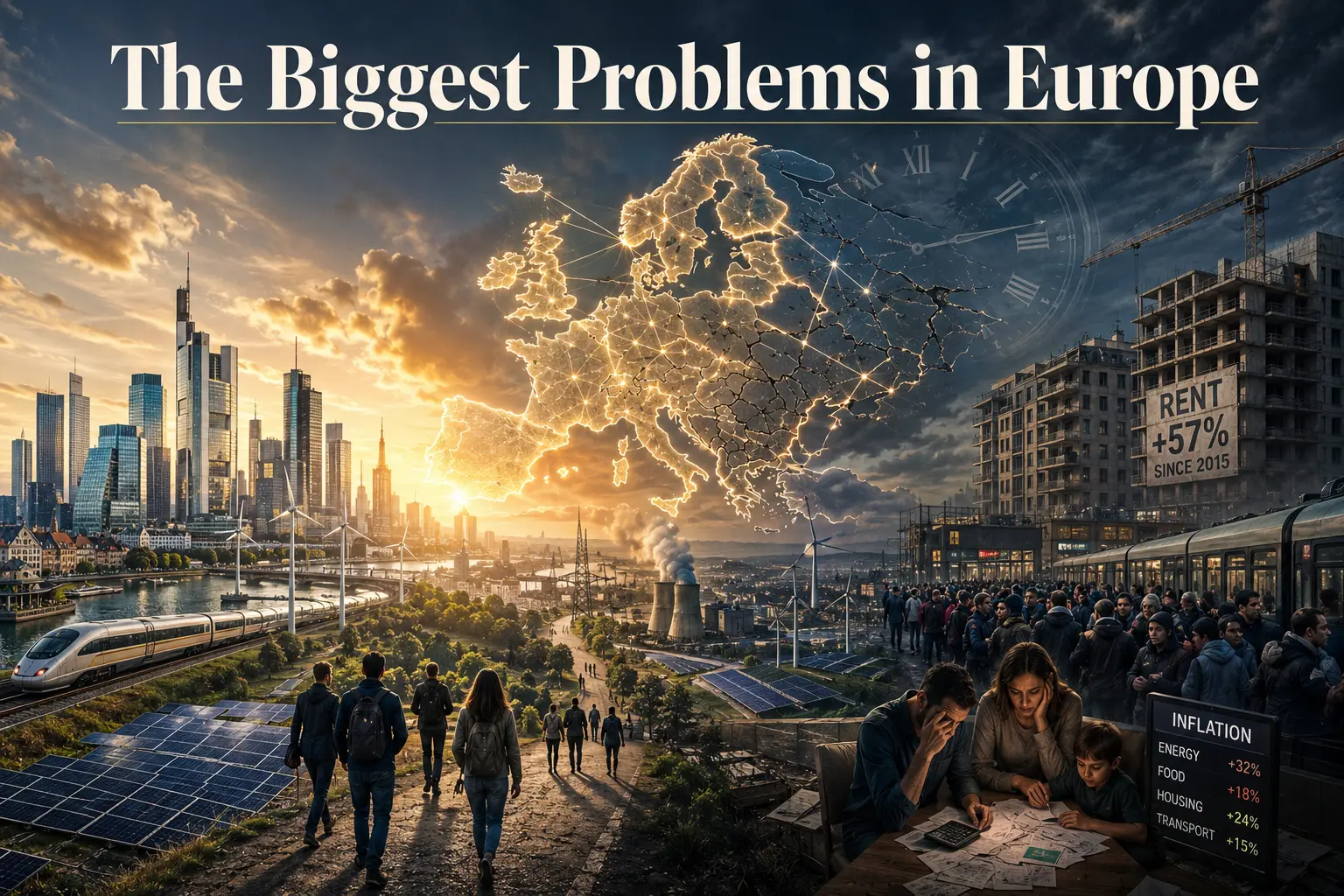
Europe is still widely seen as one of the most stable and developed regions in the world.
For decades, it represented economic strength, political stability, and predictable long-term living standards.
But underneath that image, a quieter shift has been unfolding.
Not a collapse—but a steady accumulation of structural pressure across multiple systems at once.
Housing is becoming less accessible. Living costs continue to rise. Younger generations struggle to build financial security. And in many countries, long-term stability feels less certain than it once did.
In some regions, these pressures are even more visible. These challenges are not unique to Europe as a whole. Similar patterns emerge in The 10 Biggest Problems in Serbia and The 10 Biggest Problems in Bosnia and Herzegovina, where economic hardship, institutional pressure, and persistent youth migration are reshaping the future of entire nations.
Europe is not in crisis in a dramatic sense.
But it is under long-term structural stress—and that is what makes it important.
Overview of Europe’s biggest structural problems
Cost of living crisis — rising pressure on daily essentials
Housing affordability crisis — declining access to ownership and rent stability
Population decline — aging societies and shrinking workforce
Political polarization — increasing social and ideological division
Migration pressure — uneven national responses across countries
Youth emigration — skilled workers leaving weaker economies
Weak wage growth — incomes lagging behind inflation
Economic inequality — widening regional and social gaps
Energy insecurity — volatility in supply and pricing
Declining institutional trust — weakening confidence in governance systems
What is the biggest problem in Europe today?
The most widely recognized issue across Europe is the cost-of-living crisis.
According to the European Commission and OECD, inflation has significantly increased the cost of:
- food
- housing
- energy
- transportation
Even in economically stable countries, real purchasing power has declined.
It has created a structural shift where employment no longer guarantees financial comfort.
Why is Europe becoming more expensive?
Multiple overlapping forces drive the rising cost of living:
- post-pandemic inflation effects
- energy market instability
- global supply chain disruption
- wage stagnation in key sectors
- housing shortages in major cities
These pressures vary by country but produce a similar outcome: reduced affordability across the continent.
Why is housing becoming unaffordable in Europe?
Housing affordability is now one of the most serious long-term challenges in Europe.
In many urban centers:
- Property prices have risen faster than wages for over a decade
- Rental demand continues to exceed supply
- Younger generations delay independent living.
It creates a generational divide where housing is no longer just expensive—it is structurally inaccessible in many markets.
Is Europe facing population decline?
Yes. Eurostat and UN demographic data confirm long-term population decline in several European countries.
Key drivers include:
- Low fertility rates. aging populations
- Outward migration of young workers
Long-term consequences include:
- labor shortages
- pressure on pension systems
- slower economic expansion
This trend is most visible in Eastern and Southern Europe.
Why are young people leaving Europe?
Youth emigration is one of the most important structural shifts in Europe.
One of the most significant consequences of Europe’s structural pressures is the growing outflow of younger populations. This trend is explored further in Why Young People Are Leaving Europe, which breaks down the main economic and social forces driving it.
Common reasons include:
- higher wages in Western Europe or abroad
- stronger job markets
- better career mobility
- perceived institutional stability
This trend is especially strong in countries such as Serbia and Bosnia and Herzegovina, where long-term migration patterns continue to reshape population structure and economic capacity.
Is Europe politically stable?
Europe remains institutionally stable, but political polarization is increasing.
Key divisions include:
- migration policy
- economic inequality
- energy transition
- national identity debates
This polarization often reduces trust in institutions and slows policy implementation.
Why is economic inequality increasing in Europe?
Economic inequality in Europe stems from uneven opportunities, incomes, and regional development:
- Western vs Eastern Europe
- Urban vs rural regions
- High-income vs low-income populations
Investment concentration in major cities further amplifies these differences.
Is Europe facing an energy crisis?
Europe is not in a permanent energy crisis, but it is undergoing a structural energy transition.
Key challenges include:
- dependency on imports
- price volatility
- transition from fossil fuels
- industrial competitiveness pressure
Energy has become both an economic and geopolitical issue.
Why is trust in institutions declining in Europe?
Institutional trust is weakening due to:
- perceived political inefficiency
- rising cost of living pressure
- slow reform cycles
- increasing social fragmentation
It is reflected more in disengagement and skepticism than in direct political collapse.
Europe’s structural problems (system view)
Europe’s challenges are interconnected:
Population decline → labor shortages → economic slowdown
Housing crisis → wealth inequality → generational divide
Energy transition → cost volatility → industrial pressure
Political polarization → weaker policy coordination
These feedback loops make long-term reform more complex.
Europe by the numbers (long-term trends)
Population: aging societies → labor shortages
Housing: rising prices → reduced affordability
Economy: uneven growth → widening inequality
Politics: polarization → weaker stability
Energy: transition pressure → cost volatility
(Data sources: European Commission, Eurostat, OECD, World Bank, IMF)
Why Europe feels more uncertain today
Europe remains one of the strongest economic regions in the world.
But many citizens now experience increasing uncertainty around:
- housing access
- long-term financial stability
- political direction
- economic competitiveness
- future quality of life
Among younger generations, uncertainty has emerged as the dominant condition shaping perceptions of modern Europe, rather than an acute crisis.
Frequently Asked Questions (FAQs)
The most widely reported issue across Europe is the rising cost of living, driven by inflation, higher energy prices, and expensive housing in major cities.
Life is becoming more expensive due to a combination of inflation, housing shortages, energy market instability, and wage growth that is not keeping pace with rising costs.
Yes. Many European countries are experiencing low birth rates and aging populations, which create long-term pressure on labor markets, pensions, and healthcare systems.
Housing prices have increased faster than wages in many regions, especially in major cities where demand is high and supply is limited, making home ownership and renting more difficult.
Young people often migrate to countries with higher wages, stronger job markets, and more stable economic conditions, particularly from parts of Eastern and Southern Europe.
Yes. Europe remains one of the strongest economic regions globally, but it faces structural challenges such as inequality, demographic shifts, and uneven growth across countries.