

Most people assume academic success comes from a simple formula:
More classroom hours.
More homework.
More testing.
More pressure.
For decades, education systems around the world have largely followed this approach.
Students spend long days in classrooms.
Assignments follow them home.
Exams determine progress.
Competition drives performance.
Yet one country has challenged many of these assumptions.
Finland.
Finnish students often spend fewer hours in school than students in many developed countries.
They generally receive less homework.
They face fewer standardized tests.
And yet Finland’s education system has attracted global attention for decades.
This raises an important question:
How can students spend less time in school and still succeed?
The answer reveals a very different philosophy of education—one that prioritizes quality over quantity and learning over testing.
Why Finland’s Education System Attracted Global Attention
Finland rarely appears at the center of international headlines.
However, in education circles, it has become one of the most studied school systems worldwide.
Beginning in the early 2000s, Finland gained worldwide recognition for strong student outcomes and innovative educational practices.
Researchers, policymakers, and educators from around the world began asking:
What is Finland doing differently?
Unlike many countries, Finland did not pursue higher performance through longer school days or more examinations.
Instead, it focused on creating an environment where students could learn effectively without excessive academic pressure.
Do Finnish Students Really Spend Less Time in School?
The short answer is yes.
Finnish students typically spend fewer classroom hours than their peers in many other countries, particularly during early education.
School days tend to be shorter.
Students receive regular breaks.
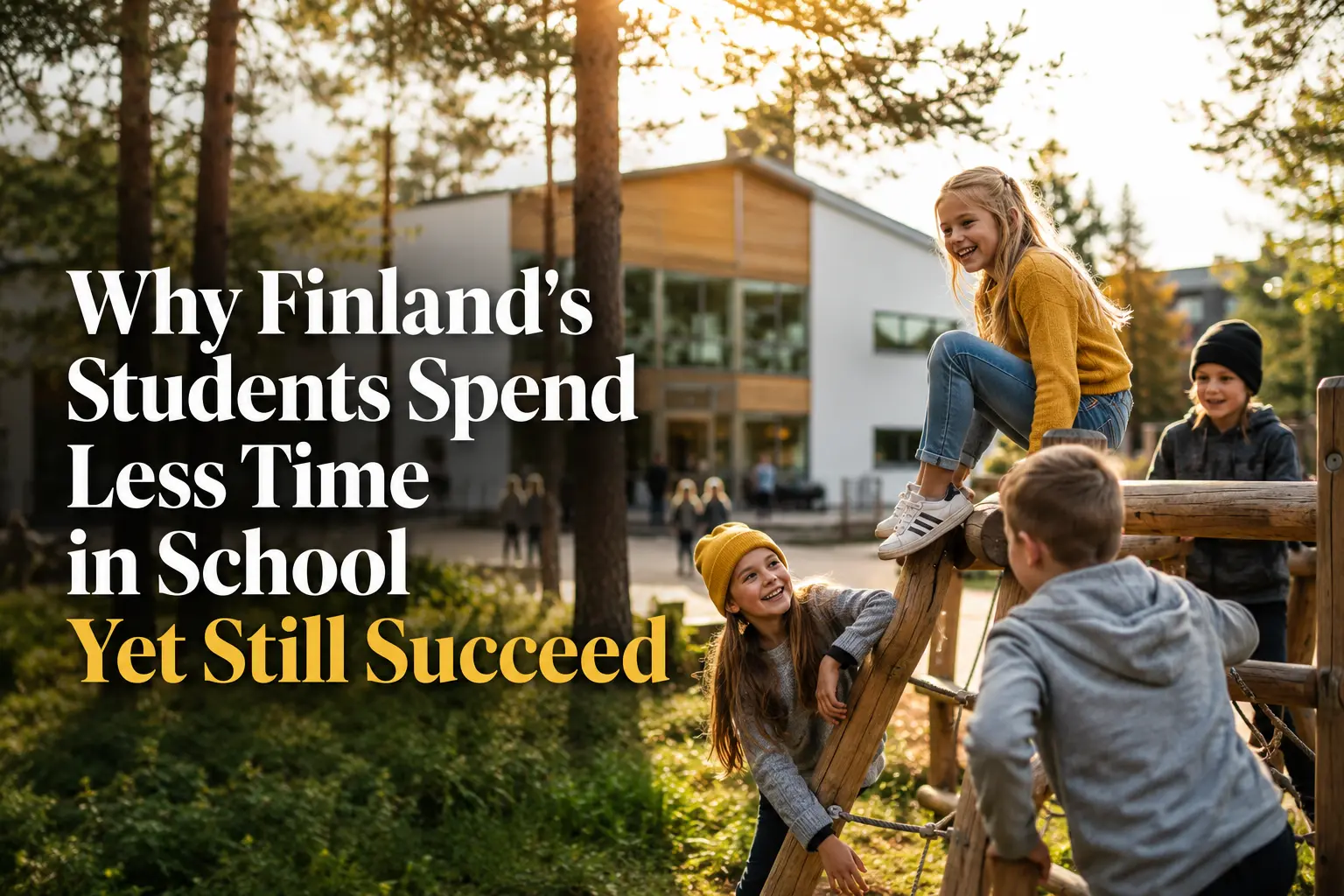
Play and recreation are viewed as important components of learning.
Contrary to popular myths, Finnish students do not simply attend school for a few hours and go home.
They still receive a comprehensive education.
However, the overall structure places greater emphasis on focused learning rather than maximizing classroom time.
The philosophy is simple:
More time sitting in a classroom does not automatically produce better learning outcomes
The Homework Difference
One of the most widely discussed aspects of Finnish education is homework.
Many Finnish students receive significantly less homework than students in highly competitive education systems.
For younger students, homework may average around 30 minutes per day.
The goal is not to eliminate learning outside school.
Rather, the goal is balance.
Finnish educators generally believe children benefit from:
- Family time
- Play
- Sleep
- Physical activity
- Independent exploration
Supporters argue that excessive homework can sometimes create stress without necessarily improving long-term understanding.
The focus remains on meaningful learning rather than simply increasing workload.
Less Testing, More Learning
Perhaps the biggest difference between Finland and many other countries is its approach to testing.
Many education systems rely heavily on:
- Standardized tests
- Frequent examinations
- Performance rankings
Finland takes a different approach.
Students experience far fewer high-stakes standardized tests.
Teachers conduct ongoing assessments to understand student progress rather than constantly preparing students for national examinations.
The result is a learning environment that often places less emphasis on test preparation and more emphasis on understanding concepts.
The Secret Most People Miss: Teacher Quality
When people discuss Finland’s education system, they often focus on shorter school days or lighter homework.
But many experts believe the real secret lies elsewhere:
Teachers.
Teaching is a highly respected profession in Finland.
Becoming a teacher is competitive.
Most teachers hold advanced university degrees.
Teacher preparation programs are rigorous and selective.
Unlike systems that rely heavily on standardized oversight, Finland places significant trust in educators.
Teachers are given greater professional autonomy and flexibility in how they teach.
This allows them to focus on student needs rather than simply following rigid testing requirements.
Student Well-Being Is Treated as Part of Education
Many education systems separate academic achievement from student well-being.
Finland tends to view them as connected.
The Finnish approach recognizes that students learn more effectively when they are:
- Healthy
- Rested
- Supported
- Motivated
- Emotionally secure
This philosophy influences everything from classroom culture to workload expectations.
Rather than treating well-being as a secondary concern, it is considered an essential part of educational success.
Finland vs Traditional Education Systems
| Traditional Approach | Finland’s Approach |
|---|---|
| Longer school days | Shorter, focused learning periods |
| Heavy homework loads | Limited homework |
| Frequent standardized testing | Minimal standardized testing |
| Competition-driven | Collaboration-focused |
| Strict oversight | Teacher autonomy |
| Academic pressure | Student well-being |
What Other Countries Can Learn From Finland
Finland’s success does not mean every country should copy its system exactly.
Different nations face different challenges.
However, Finland demonstrates several important lessons:
One lesson often highlighted in education debates is the importance of practical life skills.
While many school systems continue focusing heavily on traditional academic subjects, critics argue that students also need a stronger understanding of money management, budgeting, investing, and financial decision-making.
Why Schools Still Don’t Teach Financial Literacy explores why one of life’s most important skills remains largely absent from many classrooms.
This discussion extends beyond financial knowledge. The Life Skills Schools Still Fail to Teach examines the broader range of essential skills students need but often don’t receive in traditional education settings.
Quality Matters More Than Quantity
Longer school hours do not automatically produce better outcomes.
Great Teachers Matter
Strong teacher training can have a larger impact than more testing.
Student Well-Being Supports Learning
Mental health and academic success are not competing goals.
Trust Can Be Powerful
When educators are trusted as professionals, they often gain greater flexibility to meet student needs.
The Global Debate About Modern Education
Finland’s model has become part of a broader conversation about education reform.
Many critics argue that traditional systems place too much emphasis on memorization, testing, and rigid academic structures.
Similar concerns are explored in The Hidden Damage of an Incompetent Education System, which examines how outdated educational practices can affect long-term student development.
As technology, artificial intelligence, and workforce expectations continue to evolve, education systems around the world face increasing pressure to adapt.
Preparing Students for the Future
Finland’s approach also reflects a growing emphasis on future-ready skills.
Students increasingly need:
- Critical thinking
- Creativity
- Communication
- Collaboration
- Adaptability
These skills are becoming just as important as academic knowledge.
This shift is also discussed in How Schools Around the World Are Preparing Students for the Future of Work, which explores how different countries are rethinking education for a rapidly changing future.
Why Finland’s Model Matters More Than Ever
The future of work is changing.
Technology is changing.
Society is changing.
Many students entering school today will eventually work in jobs that do not yet exist.
This reality has forced educators to rethink a fundamental question:
Should education focus on maximizing classroom hours—or maximizing learning?
Finland’s answer is clear.
Success is not measured by how long students sit in classrooms.
Success is measured by how effectively they learn, think, grow, and adapt.
That idea continues to challenge many traditional assumptions about education around the world.
Frequently Asked Questions (FAQs)
Yes. Finnish students generally spend fewer hours in formal classroom instruction compared with students in many developed countries, especially during the early years of education.
Homework levels vary, but Finnish students generally receive less homework than students in many highly competitive education systems. Younger students may average around 30 minutes per day.
Finland uses significantly fewer standardized tests than many countries. Teachers primarily assess student progress through classroom evaluation.
Teaching is a competitive profession in Finland. Teachers typically complete extensive university training and are trusted with substantial professional autonomy.
There is no universally accepted “best” education system. However, Finland is widely respected for its emphasis on student well-being, teacher quality, and balanced learning.
Some practices can be adapted, but education systems must consider local cultures, resources, and societal needs.
Research suggests that excessive homework does not always improve outcomes, particularly for younger students. Finland’s experience shows that strong results can coexist with lighter homework loads.
Finland challenges traditional assumptions that more testing, more homework, and longer school hours automatically produce better learning outcomes.
References
For readers interested in learning more about Finland’s education system:
These organizations regularly publish research on educational outcomes, student well-being, teacher quality, and future workforce readiness.