

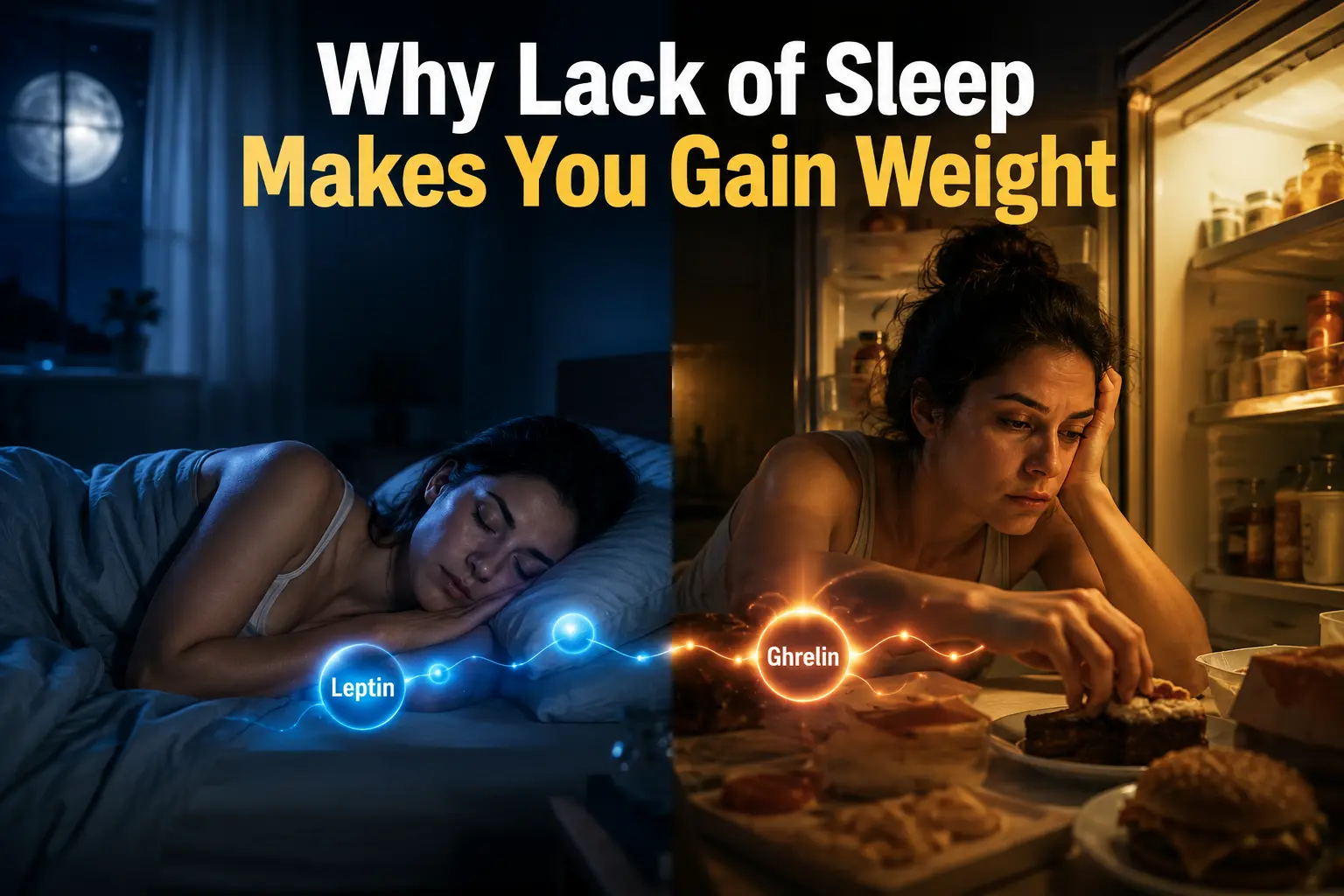
You try to eat better.
You try to move more.
You even think about dieting.
But there’s one factor most people ignore completely.
Sleep.
Because when you don’t sleep enough.
Your body doesn’t just feel tired.
It starts behaving differently around food.
You feel hungrier.
You crave more.
And you gain weight without changing much else.
So what is actually happening?
It’s not just fatigue.
It’s a full metabolic and hormonal shift.
Quick Truth
What Happens Inside Your Body When You Don’t Sleep Enough
Sleep is not just rest.
It is a regulatory system for metabolism, hormones, and appetite control.
When Sleep drops, your body changes:
- hunger hormones increase.
- fullness signals weaken
- stress hormones rise
- Energy regulation becomes unstable.
And the result is simple:
The Two Hormones That Control Your Appetite
Ghrelin (Hunger Hormone)
Increases when you lack Sleep
→ makes you feel hungry more oftenLeptin (Fullness Hormone)
Decreases with poor Sleep
→ leaves you feeling hungry even after eating
The Hidden Problem Most People Miss
It’s not just that you feel tired.
It’s that your brain becomes:
- more sensitive to food cues
- less satisfied after meals
- more driven toward high-calorie foods
So even normal eating starts to feel “not enough.”
Well-Rested vs Sleep-Deprived Body Response
| Well Rested | Sleep Deprived |
|---|---|
| Balanced hunger signals | Increased appetite |
| Normal cravings | Strong junk food cravings |
| Stable energy use | Reduced energy efficiency |
| Fullness after meals | Less satisfaction after eating |
Why Sleep Loss Leads to Weight Gain
There are three main pathways:
You eat more without realizing it
Sleep-deprived brains misread hunger signals.You crave high-calorie food
Your brain seeks fast energy (sugar, carbs, fats).You burn energy less efficiently
Fat metabolism becomes less optimal.
Sleep disruption doesn’t just affect metabolism—it can also trigger nighttime hunger and cravings that lead to overeating. Read more:
→ Why You Wake Up Hungry or Craving Food at Night
Why Your Brain Keeps Craving Junk Food
When you are tired:
- decision-making weakens
- impulse control drops
- reward sensitivity increases
So your brain chooses:
How This Connects to Your Existing Cluster System
This article connects strongly to your behavioral nutrition ecosystem:
→ Why Stress Makes You Eat More Even When You’re Not Hungry
explains how stress changes both emotions and the body in ways that influence eating habits.
→ True Hunger vs Emotional Hunger
explains how real hunger signals are often confused with brain-driven cravings.
The Sleep–Hunger Loop
Poor Sleep creates a loop:
lack of sleep → higher hunger → more eating → worse energy → worse sleep
Over time, this becomes self-reinforcing.
Why Dieting Alone Doesn’t Work Without Sleep
Even perfect dieting becomes less effective because:
- hormones are misaligned
- Hunger signals are stronger
- Cravings override discipline
So people often think:
When the real issue is:
Insight
Frequently Asked Questions (FAQs)
Yes. It affects hunger hormones, cravings, and metabolism.
Because ghrelin increases and leptin decreases.
Yes. Sleep deprivation increases cravings for high-calorie foods.
Most adults need 7–9 hours for optimal metabolic and appetite regulation.
Yes. Better Sleep improves hormone balance and reduces overeating.