
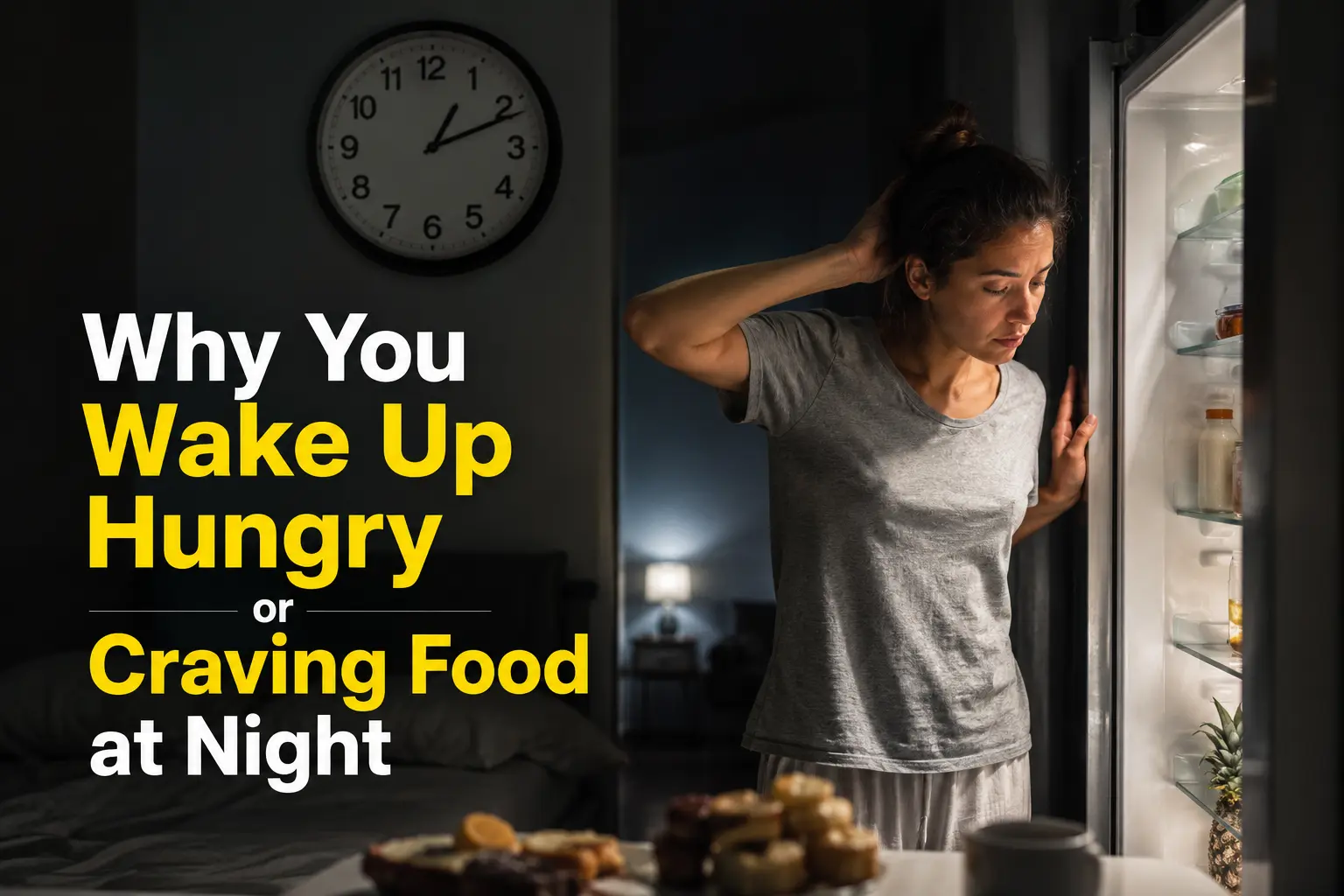
You’re in bed.
You were not hungry earlier.
But now — something feels different.
Your stomach feels “empty.”
Your brain starts thinking about food.
Maybe you even get up and check the kitchen.
And you ask yourself:
It is not random.
It’s a sleep-driven shift in your hunger system that most people never notice.
Quick Truth
What Happens to Your Body at Night
At night, the body typically shifts into a recovery state.
But when sleep is short, delayed, or low quality:
- hunger signals become unstable
- cravings become stronger
- self-control weakens
- emotional sensitivity increases
So your brain starts misreading signals.
Why Sleep Problems Trigger Hunger
There are three main biological reasons:
1. Hormonal imbalance
Poor sleep increases:
- ghrelin (hunger hormone)
and decreases:
- leptin (fullness hormone)
So your brain literally feels:
2. Brain energy confusion
A tired brain thinks:
And it prioritizes:
- sugar
- carbs
- fast energy foods
3. Reward system activation
When you are tired, your brain becomes more responsive to certain signals, such as:
- comfort food
- emotional eating triggers
- quick dopamine rewards
The Hidden Pattern Most People Miss
Night hunger is often not “physical hunger.”
It feels like:
- restlessness
- craving
- urge to snack
- emotional discomfort
And it often leads to:
- eating without planning
- snacks before sleep
- waking up again later
Real Hunger vs Sleep-Driven Craving
| Physical Hunger | Sleep-Driven Craving |
|---|---|
| Builds slowly over time | Appears suddenly at night |
| Any food is acceptable | Specific cravings (sweet/salty) |
| Stops after eating | May continue after eating |
| Body-driven signal | Brain + hormone-driven signal |
Why It Feels Stronger at Night
Night amplifies cravings because:
- Decision fatigue is highest
- Emotional processing increases
- Distractions are minimal
- Self-control is lowest
Tiny cues suddenly feel amplified and hard to ignore.
At night, reduced self-control and stronger reward sensitivity can also make it harder to stop eating once fullness signals appear, leading to continued consumption beyond actual hunger. This behavior is explored in more detail here:
→ Why You Can’t Stop Eating After You Feel Full
→ Why Blood Sugar Spikes Make You Hungrier and More Tired
How This Connects to Your Existing Articles
This behavior is part of your broader eating psychology system:
→ Why Lack of Sleep Makes You Gain Weight Over Time
explains how sleep affects hormones that control hunger and metabolism.
→ Why Stress Makes You Eat More Even When You’re Not Hungry
shows how emotional pressure increases food-driven coping behavior.
Together, they form one system:
The Night Loop That Controls Eating
Once this pattern forms:
Poor sleep → hunger signals → cravings → eating → worse sleep
It becomes a self-reinforcing loop.
And your brain starts expecting food at night—even without hunger.
Why This Leads to Weight Gain
Over time, night eating leads to:
- extra calorie intake without awareness
- stronger sugar dependency
- disrupted metabolic rhythm
- poorer sleep quality
It can create a cycle that becomes difficult to break.
Insight
You wake up hungry because your sleep system is out of balance.
Frequently Asked Questions (FAQs)
Because sleep disruption can override normal fullness signals.
Occasionally, no, but frequent night eating can reinforce hunger patterns.
Because tired brains seek fast dopamine and energy sources.
Yes. It disrupts ghrelin and leptin balance.
By improving sleep quality, stabilizing meal timing, and reducing emotional triggers.