
Europe has long embodied stability, predictable growth, and a strong middle class.
For decades, European families maintained stability without severe financial strain. Housing, energy, and wages remained in balance.
That balance is now under strain.
Essential living costs have climbed faster than incomes across Europe. What was once considered a temporary inflationary cycle is increasingly being viewed as a structural shift affecting long-term affordability.
For younger generations in particular, the pressure is becoming more visible: delayed homeownership, reduced savings capacity, and increasing financial uncertainty even among full-time workers.
This trend connects to broader structural issues explored in Why Housing Is Becoming Unaffordable Across Europe and Why Young People Are Leaving Europe—where economic pressure reshapes migration and life decisions.
It is not a uniform crisis but a widespread affordability squeeze across Europe.
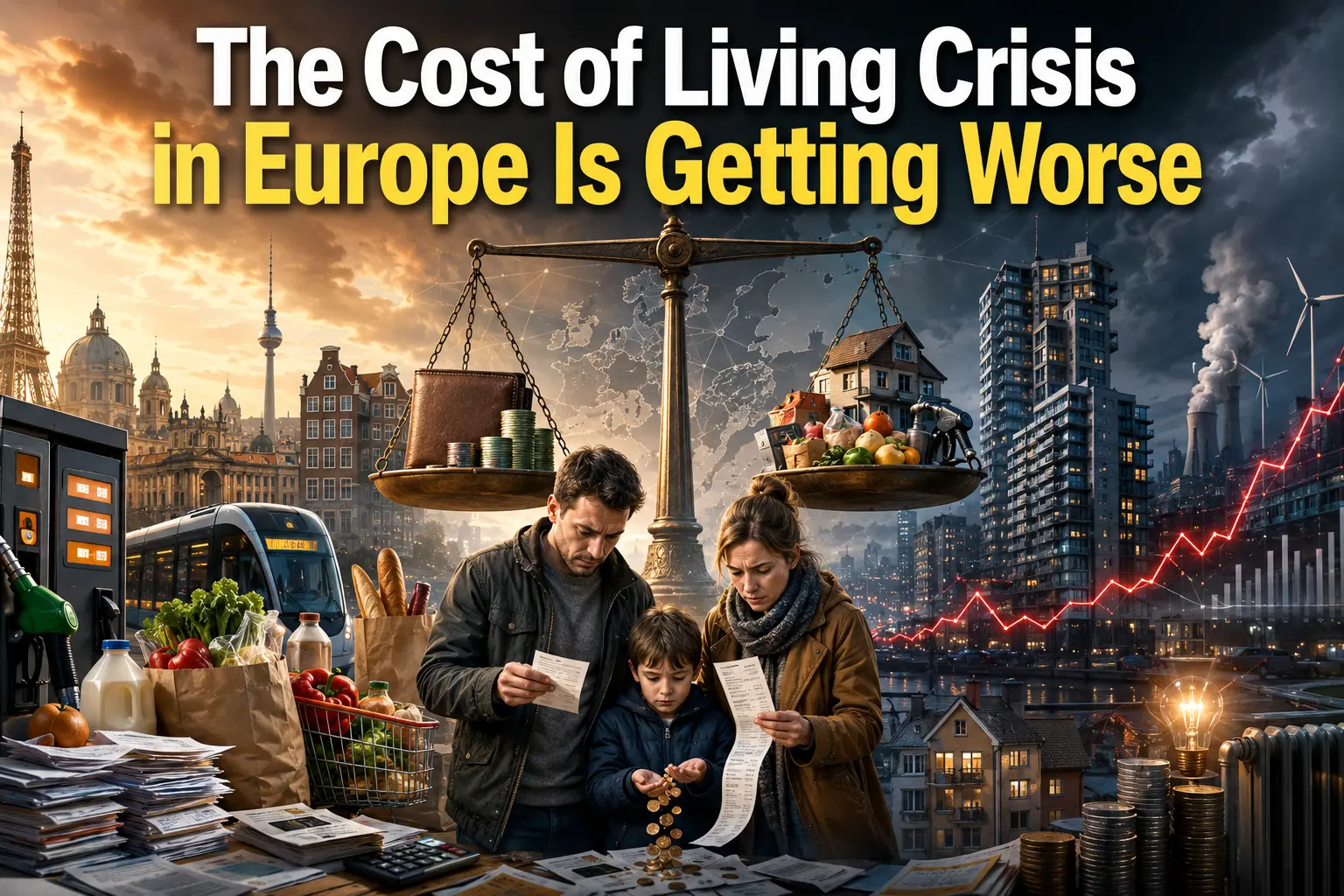
Rising costs strain European households across the continent.
| Pressure Point | Main Impact | Most Affected |
|---|---|---|
| Rising housing costs | Reduced affordability | Young adults & renters |
| Energy price volatility | Higher monthly bills | Households & industry |
| Food inflation | Reduced purchasing power | Low & middle-income groups |
| Wage stagnation | Income gap widening | Workers |
| Transport costs | Reduced mobility | Urban commuters |
| Interest rate increases | Higher borrowing costs | Homebuyers |
| Healthcare costs | Financial strain | Aging populations |
| Tax pressure variation | Uneven disposable income | Middle class |
1. Housing costs represent the largest financial pressure point
In many European cities, housing is now the single biggest monthly expense for households.
Rent and property prices have increased significantly in major urban centers such as Lisbon, Dublin, Amsterdam, Berlin, Madrid, and Paris.
Housing inflation consistently exceeds wage growth across most markets.
According to data trends reported by institutions such as Eurostat, housing costs have become one of the most persistent contributors to household financial strain across the EU.
2. Energy prices have introduced long-term volatility
Energy costs in Europe have become more unpredictable in recent years, influenced by:
- Supply chain disruptions
- Geopolitical instability
- Transition toward renewable systems
- Dependence on imported energy in some regions
Long-term price trends reveal a clear reality: households face declining budgeting stability.
Energy costs are no longer affecting utility bills alone. They are increasingly influencing inflation, industrial competitiveness, household spending, and economic growth, a broader shift explored in Why Energy Prices Are Reshaping the Economy in Europe
3. Food inflation is quietly reshaping daily life
Food prices have risen steadily across many European countries, affecting:
- Grocery bills
- Restaurant pricing
- Household budgeting
- Low-income purchasing power
Unlike housing, food inflation impacts nearly every household equally, making it one of the most visible aspects of the cost-of-living crisis.
Even slight price increases translate to significant yearly financial pressure.
4. Wages fail to keep pace with living expenses
Structural imbalance emerges as wage growth trails living expenses.
Many countries saw nominal wage gains, yet real purchasing power remains limited by rising expenses.
- Housing costs
- Energy bills
- Food prices
- Transportation expenses
It creates a situation where income rises do not translate into improved financial comfort.
This growing disconnect between employment and economic security is explored further in Why Working Hard No Longer Guarantees Financial Security in Europe, which examines why many workers are finding that stable employment no longer guarantees the financial stability that previous generations often achieved.
5. Interest rates have changed financial behavior
Higher interest rates across Europe have affected:
- Mortgage affordability
- Business investment
- Consumer borrowing capacity
For potential homebuyers, this means higher monthly repayments even when property prices stabilize.
For households with variable debt exposure, financial planning has become more complex and less predictable.
6. Transport and mobility costs add hidden pressure
Transportation costs are often underestimated but play a key role in overall affordability.
Commuting, fuel prices, and public transport costs vary significantly across Europe but have generally trended upward in recent years.
It affects not only urban workers but also regional mobility and employment flexibility.
7. The widening gap between regions and income groups
The cost-of-living crisis is not uniform across Europe.
Key divides include:
- Western vs Eastern Europe
- Urban vs rural regions
- High-income vs low-income households.
In wealthier cities, income may be higher, but so are expenses. In lower-income regions, costs may be lower, but wage levels often lag significantly behind.
This imbalance is contributing to internal migration and labor mobility across the continent.
8. The psychological impact of financial pressure
Beyond numbers, the cost-of-living crisis is also reshaping how people perceive financial stability.
Common effects include:
- Delayed family formation
- Increased financial anxiety
- Reduced long-term planning confidence
- Higher sensitivity to economic shocks
These pressures are particularly visible among younger Europeans, who face a combination of high housing costs and slower wage progression.
Cost pressures overview across Europe
| Category | Current Situation | Long-Term Risk |
|---|---|---|
| Housing | High and rising costs | Reduced affordability |
| Energy | Volatile pricing | Household instability |
| Food | Persistent inflation | Lower real income |
| Wages | Slower real growth | Stagnant purchasing power |
| Transport | Rising costs | Reduced mobility |
| Inequality | Expanding gaps | Social fragmentation |
Frequently Asked Questions (FAQs)
A combination of housing shortages, energy volatility, supply chain pressures, and slower real wage growth is contributing to rising living costs.
Housing and energy costs have been among the fastest-rising categories, followed by food and transportation in many regions.
Young adults face higher housing costs, slower wage growth relative to expenses, and increased difficulty entering asset markets.
No. Structural factors such as housing supply, energy dependency, and wage stagnation also play a major role.
Yes. Economic pressure is one of the key factors influencing internal and external migration patterns across Europe.