

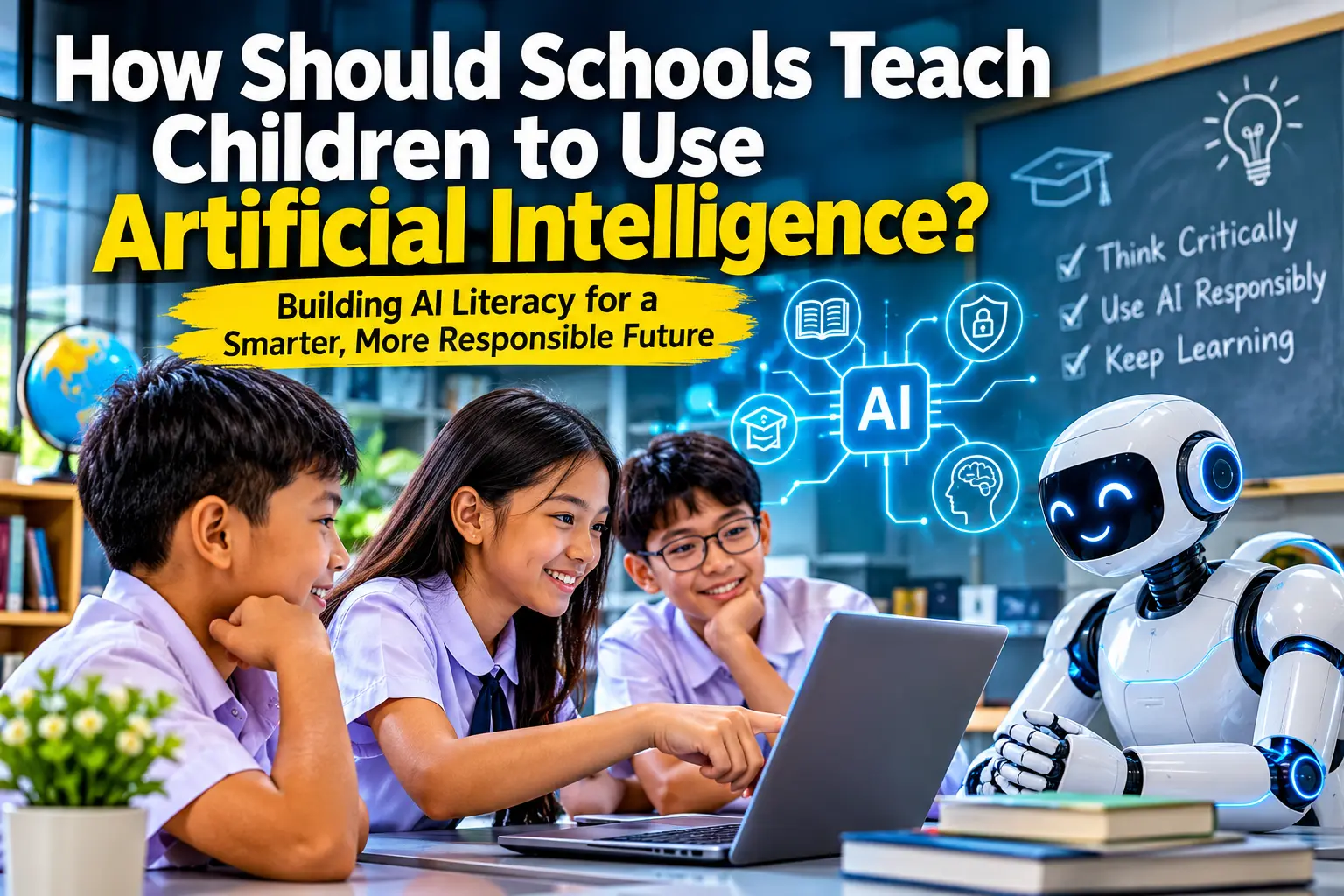
Artificial intelligence is becoming part of everyday life. Students can use AI tools to explain difficult lessons, generate ideas, summarize information, translate languages, and answer questions within seconds.
These tools create new educational opportunities. The challenge is not simply whether students use artificial intelligence, but whether they understand how to apply it without weakening their own ability to think, reason, and solve problems.
Schools cannot ignore AI. Banning every tool may leave students unprepared for a world where artificial intelligence is increasingly common. Education must help students distinguish between tasks where AI can provide useful support, situations that require careful evaluation, and problems they should learn to solve independently.
The challenge is to teach students when to use AI, how to evaluate its answers, and when to rely on their own knowledge and skills.
Why AI Literacy Belongs in Education
Students do not need to become computer scientists to understand artificial intelligence.
They do need to know what AI can do, how it produces answers, and why its results are not always reliable.
Generative AI tools can produce convincing explanations, essays, images, and other content. However, an answer that sounds confident may still contain incorrect information, outdated details, or misleading conclusions.
AI literacy should therefore go beyond teaching students how to write effective prompts.
Students should learn to:
- Understand the basic principles behind AI systems.
- Recognize the limitations of AI-generated information.
- Evaluate answers using reliable sources.
- Identify possible bias and misleading content.
- Protect personal information.
- Use AI honestly and responsibly.
The OECD and European Commission’s 2026 AI Literacy Framework for Primary and Secondary Education emphasizes the knowledge, skills, and attitudes students need to understand, evaluate, and use AI responsibly.
Teach Students to Question AI Answers
One of the most important lessons schools can teach is that artificial intelligence can make mistakes.
Students should not automatically accept an answer simply because an AI tool presents it clearly.
For example, a student researching a historical event could ask an AI assistant to explain what happened. The student should then compare the response with textbooks, historical records, and trustworthy educational sources.
Unrestricted AI use risks replacing the very thinking, writing, and problem-solving practice students need to build essential skills.
This approach develops several important skills:
- Checking facts against independent sources.
- Recognizing missing information.
- Comparing different explanations.
- Identifying unsupported claims.
- Explaining why an answer may be unreliable.
Instead of treating AI as an unquestionable authority, students learn to evaluate it as one source of information.
Use AI to Support Learning, Not Replace Thinking
Although AI can clarify difficult concepts, schools must ensure that students remain actively involved in reasoning, analysing information, and solving problems.
Although AI can clarify difficult concepts, schools must ensure that students remain actively involved in reasoning, analysing information, and solving problems.
The student should still solve the problems independently afterward.
Teachers could use similar activities across different subjects:
| Subject | Appropriate AI-supported activity |
|---|---|
| Mathematics | Request step-by-step explanations, then solve similar problems independently. |
| Science | Ask AI to explain scientific concepts and compare its answers with textbooks. |
| English | Request feedback on grammar and sentence structure before revising an original essay. |
| History | Compare AI-generated explanations with historical documents and reliable sources. |
| Languages | Practice conversations and examine suggested vocabulary or grammar corrections. |
The purpose is not to make assignments easier. AI can provide personalized explanations by breaking complex mathematical concepts into smaller steps that students can understand at their own pace.
The OECD’s Digital Education Outlook 2026 warns that completing tasks with generative AI does not automatically produce meaningful learning gains. When students outsource their work, they may produce better results without developing the knowledge and skills the assignment was intended to teach.
Teach Responsible AI Use and Academic Honesty
Students also need clear rules about when and how they may use artificial intelligence in schoolwork.
Using AI to understand a difficult topic is different from submitting an AI-generated essay as entirely their own work.
Schools should explain these differences rather than relying on vague warnings against cheating.
For example, teachers could establish guidelines requiring students to:
- Disclose significant AI assistance when an assignment requires it.
- Identify which parts of their work they completed independently.
- Check AI-generated facts before including them.
- Avoid presenting generated content as original work.
- Follow classroom rules about permitted AI assistance.
Teachers should also explain why academic honesty matters. Students need to demonstrate their own understanding, not simply produce assignments that look complete.
Clear expectations can reduce confusion for both learners and teachers.
Protect Students’ Privacy and Safety
Students may unknowingly share personal or sensitive information when entering details into AI-powered applications.
Young learners may not understand the risks of sharing personal details, photographs, school information, or private conversations with online services.
Schools should teach students to protect their information before encouraging them to use AI tools.
Important lessons include:
- Never enter passwords or sensitive personal information into AI tools.
- Avoid sharing private details about classmates, teachers, or family members.
- Understand that some AI services collect and process user data.
- Report harmful, inappropriate, or suspicious AI-generated content.
- Use only tools approved by the school when approval is required.
Schools must also evaluate whether AI platforms are appropriate for children’s ages and comply with relevant privacy and child-protection requirements.
UNICEF’s 2025 Guidance on AI and Children, Version 3.0, emphasizes child safety, privacy, fairness, transparency, inclusion, and preparing children for developments in artificial intelligence.
Keep Learning Activities That Do Not Depend on AI
Teaching students to use artificial intelligence should not mean using it in every lesson.
Children still need opportunities to read books, write independently, solve problems, conduct experiments, discuss ideas, and develop their own arguments.
These activities help build abilities that students cannot develop simply by asking a machine to complete a task.
Schools could use a balanced approach:
Learning without AI: Students complete selected exercises, essays, calculations, and assessments independently.
Learning with AI: Students use approved tools to receive explanations, practice skills, or improve their understanding.
Learning about AI: Students examine how AI works, where it can fail, and how it affects individuals and society.
This balance allows students to benefit from technology without becoming dependent on it.
Prepare Teachers to Guide AI Use
Students cannot receive effective AI education if teachers are expected to understand every new tool without adequate training.
Schools must equip teachers with the knowledge and resources to evaluate AI tools, develop suitable assignments, protect student privacy, and ensure that technology supports rather than replaces learning.
Professional development should also help teachers distinguish between tasks where AI can provide useful assistance and activities that require students to demonstrate their own abilities.
Schools should not leave teachers to manage the challenges of AI integration on their own. Clear policies, technical support, appropriate resources, and time for professional learning are essential.
Make AI Education Accessible to All Students
Access to artificial intelligence is not equal.
Some students have personal computers, reliable internet connections, and paid subscriptions to advanced AI services. Others depend on shared devices, limited mobile data, or school facilities.
If schools make AI access a requirement without addressing these differences, existing educational inequalities could become worse.
Schools should therefore consider:
- Providing access to approved educational tools where possible.
- Offering alternatives for students without reliable internet access.
- Avoiding assignments that require paid AI subscriptions.
- Supporting students with disabilities through appropriate accessibility tools.
- Providing teachers with adequate equipment and training.
AI education should not become another advantage available only to students from wealthier households.
How the Philippines Is Approaching AI in Basic Education
The Philippines has started developing a national framework to guide the responsible use of artificial intelligence in basic education.
In February 2026, the Department of Education issued DepEd Order No. 003, s. 2026, titled Foundational Guidelines on Artificial Intelligence in Basic Education.
The framework covers three interconnected areas:
- AI in Education – Using AI to support teaching, learning, and assessment.
- Education on AI – Developing AI literacy, ethical awareness, and critical use among learners and education personnel.
- AI for Education Systems – Applying AI to improve education governance, planning, monitoring, and school operations.
It calls for AI to support teaching and learning in ways that remain inclusive, preserve human judgment, and include safeguards suited to potential risks.
This is an important starting point. However, publishing a national framework is only one part of the work. Schools also need practical implementation guidance, teacher training, suitable infrastructure, and consistent safeguards.
Ultimately, the framework must help students become capable AI users while preserving their ability to think, communicate, and solve problems independently.
What Should AI Education Ultimately Achieve?
Schools should not measure successful AI education by how many students can use chatbots or write complicated prompts.
The more important question is whether students can think independently, evaluate information, recognize mistakes, protect themselves online, and make responsible decisions when using these technologies.
Artificial intelligence will continue to change. Today’s tools may become outdated, and new applications may introduce capabilities that schools have not yet encountered.
That makes adaptability, critical thinking, creativity, and sound judgment especially important.
These skills are also central to a broader question facing modern education: Are Traditional Schools Preparing Children for the Future?
Schools should prepare students not simply to operate artificial intelligence, but to understand its influence and decide when its use is appropriate.
Preparing students for the future requires more than teaching academic skills. Protecting education also means preparing schools to keep learning on track when disasters and emergencies disrupt classroom activities. This challenge is explored in What Happens When Climate Disasters Keep Children Out of School?
The future of education may require more than introducing new technology. It may also involve rethinking familiar teaching practices, as we examine in What If School Had No Classrooms, Exams, or Homework?
The goal is not to produce students who depend on AI for every answer. It is to prepare learners who can use powerful technology without surrendering their ability to think for themselves.
Frequently Asked Questions (FAQs)
Yes, with appropriate safeguards and clear educational purposes. Schools can allow AI to support learning while setting limits on its use in assignments, assessments, and activities that require independent work.
AI literacy is the ability to understand artificial intelligence, recognize its capabilities and limitations, evaluate its outputs, and use it safely, ethically, and responsibly.
No. AI may improve the efficiency of certain teaching activities, but education depends on more than delivering information. Teachers also guide students, recognize their individual needs, build trust, and make decisions that require professional experience.
Teachers can combine AI-supported activities with independent assignments, classroom discussions, practical exercises, oral explanations, and assessments that require students to demonstrate their own understanding.
Children are already encountering AI in digital services and everyday applications. Schools can help them understand how these systems work, recognize potential risks, protect their information, and make informed decisions about their use.
Authoritative References
- OECD and European Commission – Empowering Learners for the Age of AI: An AI Literacy Framework for Primary and Secondary Education (2026)
- OECD – OECD Digital Education Outlook 2026: Exploring Effective Uses of Generative AI in Education
- UNESCO – Guidance for Generative AI in Education and Research
- UNICEF – Guidance on AI and Children, Version 3.0 (2025)
- Philippine Department of Education – DepEd Order No. 003, s. 2026: Foundational Guidelines on Artificial Intelligence in Basic Education