
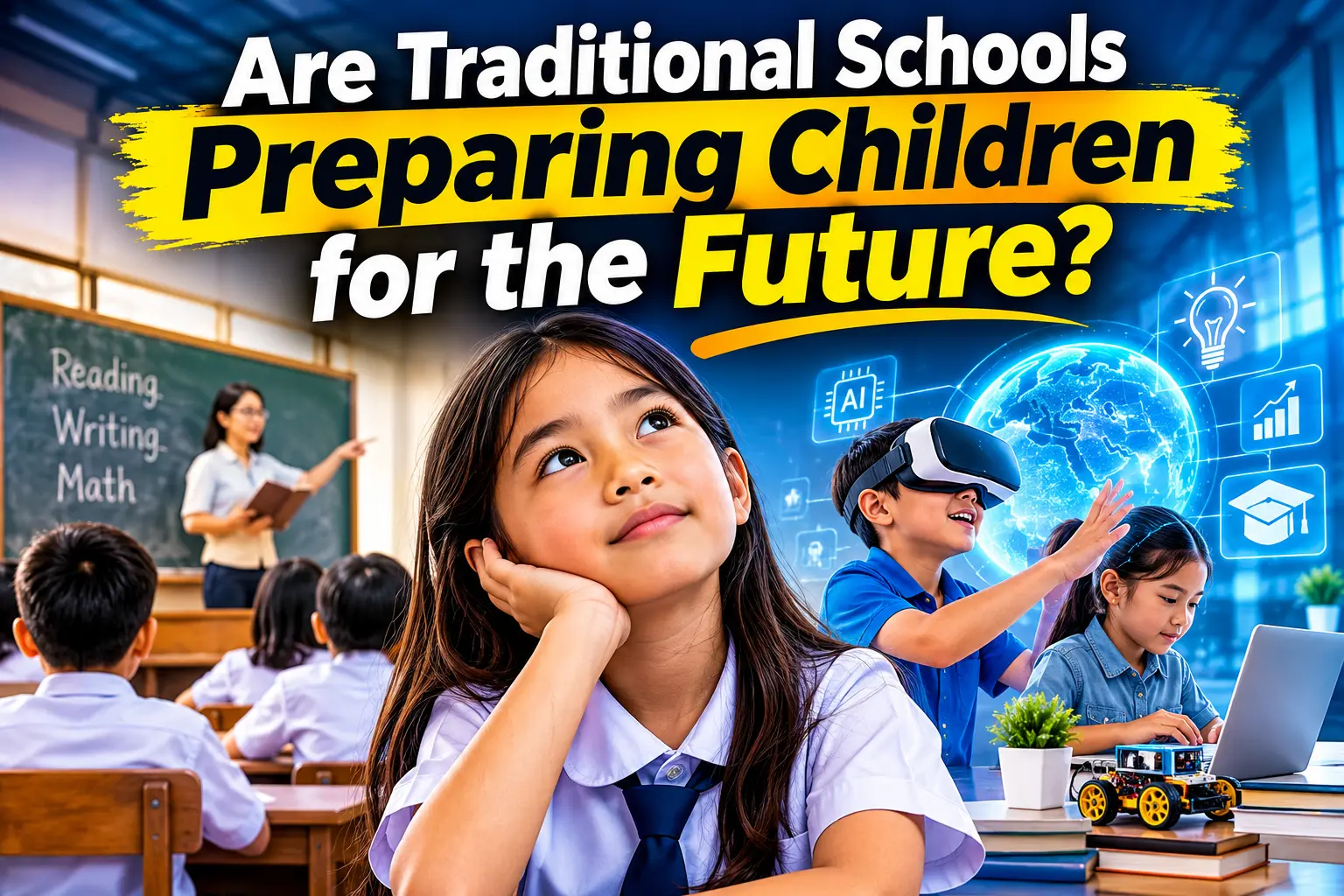
For generations, traditional schools have provided the foundations of education.
Children develop essential skills in reading, writing, mathematics, and science while studying history and building the knowledge needed to navigate life.
But the world children are entering is changing.
Artificial intelligence is transforming workplaces, technology is reshaping industries, and many careers will require people to learn new skills throughout their lives.
This raises an important question: Are traditional schools preparing children for the future, or are they still placing too much emphasis on preparing students for examinations?
The answer is not entirely straightforward.
Schools continue to play an essential role, but academic knowledge alone may not be enough.
Children also need practical judgment, adaptability, communication skills, and the confidence to handle unfamiliar situations.
Here are 10 areas worth examining.
1. Applying Knowledge to Real-World Problems
Students can spend years studying mathematics, science, and other subjects without always understanding how those lessons apply to everyday situations.
Knowing mathematical formulas helps, but children also need to calculate expenses, compare prices, interpret information, and solve practical problems.
The same applies to science. Scientific concepts become more meaningful when students apply them to real-world questions, assess evidence, and make informed decisions.
Traditional education provides important academic foundations. The challenge is helping students move beyond memorization and apply what they learn.
2. Developing Critical Thinking Instead of Memorizing Answers
Remembering information is an important part of learning. However, knowing an answer is not the same as understanding why it is correct.
Children need opportunities to question information, examine evidence, recognize misleading claims, and consider different explanations.
This ability is becoming increasingly important as information spreads rapidly across social media, websites, and artificial intelligence platforms.
The OECD’s Learning Compass 2030 identifies critical thinking, problem-solving, and student agency as important elements of future-oriented education.
Schools do not need to abandon textbooks or examinations to develop these abilities. They can encourage students to explain their reasoning, investigate questions, discuss opposing viewpoints, and support conclusions with evidence.
Some alternative education models take these ideas even further by questioning whether conventional classrooms, examinations, and homework are always necessary for meaningful learning. Could Schools Work Without Classrooms, Exams, or Homework? examines what education might look like if schools moved beyond some of their most familiar structures.
3. Understanding Technology and Artificial Intelligence
Today’s children are growing up surrounded by digital technology. They use smartphones, computers, online platforms, and increasingly sophisticated artificial intelligence tools.
However, being comfortable with technology does not automatically mean knowing how to use it responsibly.
Digital literacy requires students to distinguish credible information from misleading content, protect their privacy, recognize online fraud, and critically assess AI-generated responses.
They should also learn about the limitations of automated systems, including inaccurate information, bias, and privacy risks.
The World Economic Forum’s Future of Jobs Report 2025 identifies AI and big data, cybersecurity, and technological literacy among the skills expected to grow in importance through 2030.
Schools cannot predict every technological development, but they can teach children how to approach new tools with curiosity, caution, and sound judgment.
4. Learning Financial Literacy and Money Management
Many students graduate knowing how to solve mathematical equations but having limited experience managing personal finances.
Understanding money involves more than performing calculations. As young people grow older, they face practical financial choices, from managing savings and daily expenses to borrowing money and planning a budget.
They should understand concepts such as interest, inflation, debt, emergency savings, and the difference between needs and wants.
Financial literacy can also help young adults recognize misleading investment promises and avoid common money-management mistakes.
These lessons do not necessarily require an entirely new school subject. Students can learn basic money management through mathematics, economics, and classroom activities based on everyday financial situations.
Preparing children for adulthood should include helping them understand how financial decisions affect their lives.
5. Building Communication and Collaboration Skills
Most people eventually need to work with others, whether in an office, business, community, or family setting.
Academic knowledge provides an important foundation, yet success beyond the classroom also depends on interpersonal abilities, including effective communication, active listening, constructive conflict resolution, and collaboration.
Students benefit from activities that require them to explain ideas, present their work, listen to different perspectives, and share responsibilities.
Group activities can create valuable opportunities for collaboration, but their educational value depends on thoughtful structure, individual accountability, and meaningful participation from every student.
These skills matter even more in the workplace, where people must communicate and work with colleagues who have different backgrounds, experiences, and areas of expertise.
6. Becoming Adaptable in a Changing Job Market
For previous generations, choosing a career sometimes meant following a relatively predictable professional path.
That expectation is becoming harder to maintain. Industries change, new technologies emerge, and some occupations grow while others decline.
According to the World Economic Forum’s 2025 report, approximately 39% of workers’ existing skills are expected to change or become outdated between 2025 and 2030.
This does not mean schools should train every child for a particular future occupation. In fact, doing so could leave students unprepared when industries change.
Instead, education should help young people become adaptable. They need to learn how to acquire new knowledge, respond to setbacks, and transfer existing skills to unfamiliar situations.
A strong education should prepare children not just for their first job, but also for the possibility of changing careers later in life.
7. Connecting Education With Career and Workplace Experiences
Many students study different subjects for years without seeing how what they learn connects to actual jobs and career opportunities.
Career guidance offers a useful starting point, but students gain a fuller understanding of a profession when they can observe workplaces and experience the realities of working life firsthand.
Schools can build stronger connections with local businesses, universities, technical institutions, and community organizations.
Depending on students’ ages and local opportunities, these connections could include workplace visits, supervised projects, career talks, job-shadowing, and vocational activities.
These experiences reveal what different careers demand in terms of qualifications, responsibilities, and practical skills.
They can also help young people see that successful careers don’t all follow the same academic path.
8. Developing Independence and Decision-Making
A student may perform well when given clear instructions but struggle when expected to make decisions independently.
Adult life often requires people to navigate unfamiliar situations and make decisions without someone providing step-by-step guidance. People must set priorities, manage responsibilities, evaluate choices, and accept the consequences of their decisions.
Schools can help develop independence by giving students appropriate responsibility for their learning.
For example, students can plan projects, manage deadlines, research topics, assess their progress, and reflect on mistakes.
This does not mean teachers should stop providing guidance. Children still need structure, support, and clear expectations.
The goal is to gradually help students become more confident in making thoughtful decisions rather than depending on instructions for every task.
9. Understanding Society, the Environment, and Civic Responsibility
Preparing children for the future is not only about finding employment. It also involves helping them become responsible members of their communities.
Young people will face issues involving environmental protection, public health, misinformation, social inequality, and technological change.
Climate change also creates direct challenges for education. Floods, typhoons, extreme heat, and other climate-related disasters can damage school facilities, disrupt lessons, and keep children from attending class. What Happens When Climate Disasters Keep Children Out of School? This article examines how these disruptions affect children’s access to education and why schools and communities need to prepare.
They need to understand how individual decisions connect with wider social and environmental consequences.
Subjects such as science, history, geography, and social studies help students develop the foundational knowledge needed to understand these broader issues.
Schools can strengthen it by encouraging students to examine local problems, evaluate different perspectives, and understand how communities respond to shared challenges.
Some schools take this responsibility further by making environmental awareness part of everyday learning. 10 Schools That Teach Children to Care for the Planet highlights educational institutions that help students develop environmental responsibility through hands-on activities, sustainability projects, and meaningful connections with nature.
Education should help children recognize that they have responsibilities beyond their personal achievements.
10. Learning How to Keep Learning
One of the most valuable abilities children can develop is the capacity to keep learning long after they leave school.
No curriculum can cover every skill or situation a person will encounter throughout adulthood.
New technologies, professional requirements, and social changes will continue to create unfamiliar challenges.
Students therefore need to develop curiosity, research skills, self-discipline, and the ability to recognize what they do not yet understand.
The OECD’s Future of Education and Skills 2030 framework highlights the need to prepare students to navigate unfamiliar situations rather than follow established instructions.
A school education should provide more than a collection of completed subjects. It should give children the confidence and ability to continue developing their knowledge throughout life.
What Traditional Schools Already Do Well
Questioning traditional education does not mean dismissing its value.
Schools provide essential foundations that children need before they can develop more advanced abilities. Reading, writing, mathematics, scientific knowledge, and an understanding of history remain important regardless of how technology or employment changes.
Schools also provide structured learning environments where children interact with others, receive guidance from teachers, and develop routines and responsibilities.
For many children, schools are also an important source of stability, social support, and access to educational opportunities.
The issue is not whether traditional schooling should disappear. The central issue is whether existing education systems can adapt their teaching approaches to integrate academic foundations with practical competencies and the evolving demands of society.
Are Education Systems Already Changing?
Education systems in various countries are beginning to address these shortcomings through curricular restructuring, technological integration, and more comprehensive approaches to student development.
The OECD’s Learning Compass 2030 framework identifies knowledge, skills, attitudes, values, and student agency as essential elements of meaningful education. It views education as a process that extends beyond simply delivering information to students.
In the Philippines, the Department of Education introduced the MATATAG Curriculum, with phased implementation beginning in School Year 2024–2025. The reform involves changes to the basic education curriculum, with a particular focus on strengthening students’ foundational learning.
However, curriculum changes alone cannot guarantee better outcomes. Their success also depends on teacher preparation, learning materials, classroom conditions, school leadership, and consistent implementation.
The challenge is particularly pressing in the Philippines. In April 2026, the World Bank reported that approximately 91% of Filipino 10-year-olds could not read and comprehend an age-appropriate text, highlighting persistent gaps in the country’s foundational learning outcomes.
This shows why future-ready education cannot focus exclusively on advanced technology or workplace skills. Children must first develop the foundational abilities that make further learning possible.
What Should Schools Prioritize?
Preparing children for the future does not require replacing every traditional subject or turning schools into job-training centers.
Instead, schools need to balance academic foundations with opportunities to apply knowledge, develop practical judgment, and adapt to unfamiliar challenges.
| Area of education | What students should develop |
|---|---|
| Academic foundations | Strong reading, writing, mathematics, and scientific knowledge |
| Critical thinking | Evaluating evidence and solving problems |
| Digital literacy | Using technology and AI safely and responsibly |
| Financial literacy | Managing money and understanding financial risks |
| Communication | Expressing ideas and working with others |
| Adaptability | Learning new skills and responding to change |
| Career readiness | Understanding workplaces and professional expectations |
| Independence | Making decisions and managing responsibilities |
| Civic awareness | Understanding social and environmental issues |
| Lifelong learning | Continuing to learn beyond formal education |
These priorities do not compete with academic learning. They build on it.
Frequently Asked Questions (FAQs)
Yes. Traditional schools remain important because they provide structured education, foundational knowledge, qualified teachers, and opportunities for social development. However, they need to keep adapting to changes in technology, society, and the workplace.
Important abilities include critical thinking, communication, creativity, adaptability, digital literacy, problem-solving, and lifelong learning. The importance of particular technical skills will also change as industries and technologies develop.
Not necessarily. Practical skills should complement academic knowledge, not replace it. Students need strong foundations in reading, mathematics, science, and other subjects to understand and solve more complex problems.
Parents can encourage curiosity, reading, responsible technology use, practical money management, independent decision-making, and problem-solving at home. Everyday activities can provide valuable learning opportunities beyond formal lessons.
No. AI can support learning, provide explanations, and help students access information, but it cannot replace the full role of teachers and schools. Children still need teachers to guide them, opportunities to interact with others, the ability to think critically, and a clear understanding of what they learn.
The Future of Education Is About More Than Passing Exams
Traditional schools play an essential role in equipping children with the knowledge and skills they need to lead meaningful and fulfilling lives.
Academic achievement remains valuable, but it should not be the only measure of whether students are ready for adulthood.
Children also need to develop the ability to solve unfamiliar problems, manage responsibilities, communicate effectively, assess information critically, and adapt to changing circumstances.
The future is difficult to predict. That is precisely why education should prepare children to handle uncertainty rather than train them only for situations that already exist.
A successful education should not simply teach children how to pass their next examination. Ultimately, education should prepare them to face future challenges with confidence and competence.
Sources
- World Bank – Education and Skills
- Philippine Department of Education – MATATAG Curriculum
- World Bank – Better Learning for 21 Million Filipino Students
- OECD – The Learning Compass 2030