

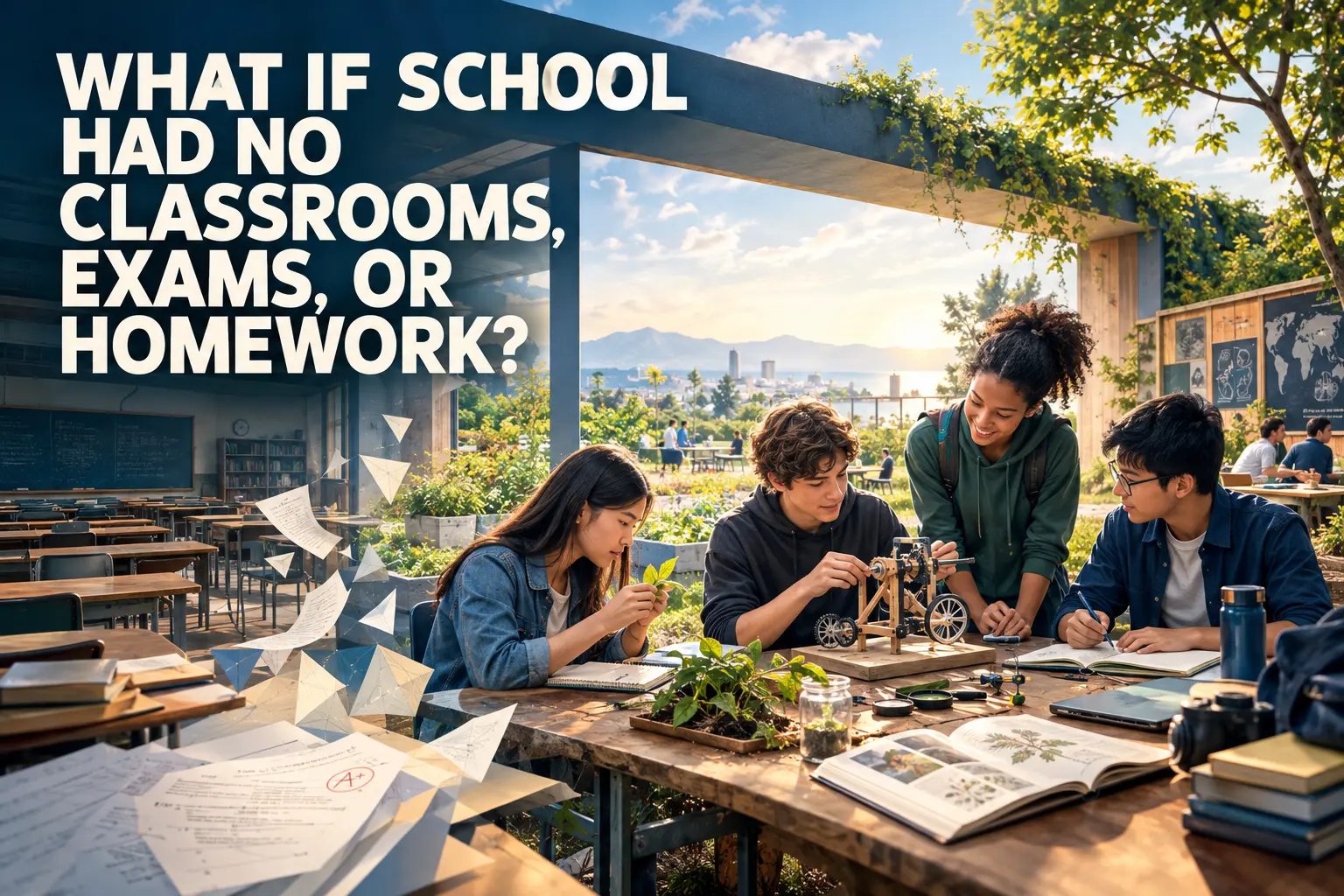
For generations, school has followed a familiar pattern. Students sit in classrooms, listen to teachers, complete assignments, take examinations, and move from one grade to the next.
But what if schools changed that system?
What if learning happened in workshops, libraries, gardens, businesses, and local communities? What if students showed their development through practical work instead of relying mainly on test scores? What if the school day included enough time to practise lessons without requiring hours of work at home?
These ideas may sound unusual, but they raise serious questions about how education should work. The goal is not simply to remove classrooms, exams, or homework. It is to understand which parts of traditional schooling help students learn and which could be improved.
1. What If Schools Had No Traditional Classrooms?
Learning could take place in more than one kind of environment.
Traditional classrooms give students a place to learn together. Teachers can explain lessons, answer questions, organise activities, and support students who need extra help.
However, students can learn in many ways beyond the traditional classroom.
Imagine students studying plant growth in a school garden instead of reading about it only in a textbook. They could measure plant height, record changes, compare results, and discuss why some plants grow faster than others.
Instead of learning local history only from textbooks, students could visit museums, hear stories from older residents, examine historic buildings, and study original records in a library. Instead of studying business concepts alone, students could plan a small business project, calculate the costs, and decide how to attract customers.
Students can see how their classroom lessons relate to everyday life. Read The World’s Most Unusual Schools—and What They Teach Us About Learning to see how schools adapt to different situations.
What students could gain
Learning in different environments may help students:
- Apply ideas to practical situations.
- Develop observation and problem-solving skills.
- Work with other people.
- Understand how school subjects connect to everyday life.
- Become more active participants in their education.
This approach could also give students more opportunities to discover their interests and learn through direct experience.
But classrooms still have a purpose
Removing traditional classrooms would not automatically improve education.
Some subjects require quiet study, specialised equipment, or structured explanations. Students may also need a predictable environment where they can concentrate without unnecessary distractions.
Outdoor activities depend on weather and safety. Community-based learning requires planning, transport, supervision, and cooperation with local organisations. Not every school has the money or facilities to provide these opportunities.
Learning may happen beyond classroom walls, but students still need spaces where they can learn effectively. The difference would be that students could use several environments rather than depending on one room for almost everything.
2. What If Schools Had No Exams?
Students could demonstrate what they know instead of depending mainly on examination scores.
Examinations are a familiar part of education. They help schools measure knowledge, compare performance, and determine whether students are ready to progress.
However, a written examination can capture only part of what a student knows and can do.
A student might understand a scientific concept but struggle to explain it under time pressure. Another student may memorize enough information to pass a test but struggle to use that knowledge to solve a new problem.
This does not mean examinations are useless. This means their results should be looked at carefully.
How students could be assessed instead
Schools could use several methods to evaluate learning.
| Alternative assessment | What it could measure |
|---|---|
| Projects | Research, planning, and application of knowledge |
| Portfolios | Long-term development and continuous improvement. |
| Presentations | Understanding and communication |
| Practical demonstrations | Capability to perform a task or apply a skill |
| Class discussions | Reasoning, explanation, and participation |
| Consistent teacher feedback | Student strengths, learning gaps, and opportunities for improvement. |
For example, instead of solving equations on paper alone, a student could use mathematics to work out the cost of materials for a real project. A science student could conduct an experiment, record the findings, and explain the results.
These activities may reveal abilities that a single examination does not fully capture.
The OECD distinguishes between assessments that help students improve through feedback and assessments that summarise achievement or support decisions such as promotion. Both purposes matter, but they do not have to rely on the same method.
Would removing exams solve the problem?
Not necessarily.
Without clear assessment criteria, projects and presentations can be evaluated inconsistently or unfairly. Students may receive different marks for similar work. Some projects may reflect parental assistance, access to technology, or paid tutoring rather than the student’s own understanding.
Examinations can provide a more standardised way to check certain types of knowledge. They may also help teachers identify gaps that need attention.
A better approach could combine regular feedback, practical assignments, classroom assessments, and well-designed tests. Schools could reduce the pressure of high-stakes examinations without abandoning measurement altogether.
For a related discussion, see Why Exam Results Don’t Always Reflect What Students Know.
3. What If Students Had No Homework?
Learning would take place mainly during the school day, leaving more time after lessons.
Homework is one of the most debated parts of school life.
Some students spend their afternoons finishing worksheets, memorising lessons, preparing projects, or studying for upcoming tests. Others have household responsibilities, long commutes, limited internet access, or no quiet place to work.
Removing homework could give students more time to sleep, exercise, enjoy hobbies, help their families, and pursue personal interests.
Teachers could also include more guided practice in their lessons, giving students time to ask questions and get help before going home.
The potential advantages of eliminating homework.
A school that does not assign routine homework could offer several advantages.
First, students could relax more after spending the day in class. This could be especially helpful for children who already spend long hours at school or face long journeys home.
Second, students would have more time to pursue interests beyond schoolwork. Reading for pleasure, playing sports, helping at home, learning an instrument, and spending time with family can all contribute to a child’s development.
Third, students would have less dependence on the resources available at home. Not every child has a computer, reliable internet access, a quiet room, or an adult who can help with schoolwork.
However, these benefits would depend on how schools use the time available during the day.
Does research show that homework is unnecessary?
No. The evidence does not support that simple conclusion.
The Education Endowment Foundation’s Teaching and Learning Toolkit reports that homework has a positive average impact on learning, particularly at secondary-school level. It also notes that homework tends to be more effective when it is connected to classroom lessons and includes useful feedback.
The same evidence review indicates that homework quality matters more than workload alone. It also identifies barriers for students who lack adequate study spaces or access to essential learning materials.
This suggests that the debate should focus on the purpose of homework rather than whether every student should receive it. What matters is whether an assignment has a clear purpose and helps students make progress.
A school could reduce repetitive worksheets while keeping useful activities such as reading, practising essential skills, or completing meaningful independent projects.
It could also provide supervised study time for students who need extra help.
The goal would be to avoid unnecessary workload without removing opportunities for practice.
4. What Would a School Day Look Like Without These Three Things?
Removing traditional classrooms, high-stakes exams, and routine homework would require schools to organise learning differently.
Students would still need a curriculum, qualified teachers, clear expectations, and ways to measure progress. Without those elements, greater freedom could turn into confusion.
Consider a possible school day built around practical activities and guided learning.
| Time | Possible activity |
|---|---|
| Morning | Teacher-led lessons and group discussions |
| Late morning | Practical work, experiments, or guided practice |
| Afternoon | Projects, reading, research, or community activities |
| End of day | Feedback, reflection, and time to complete essential tasks |
This is only one possible model, not a proven formula for every school.
The important idea is that students could spend more of the school day practising what they learn, asking questions, and receiving guidance.
Teachers would still introduce new concepts and explain difficult topics. Students would still need to practise reading, writing, mathematics, and other essential skills.
The approach would place greater emphasis on integrating instruction, guided practice, and assessment into the regular school day.
5. Would Every Student Benefit From This System?
Not necessarily.
Students have different needs, interests, abilities, and home circumstances. A flexible school system might work well for some children but create difficulties for others.
Some students enjoy independent projects and learn quickly through practical activities. Other students learn better with structured lessons, clear routines, regular practice, and frequent guidance from teachers.
Younger children may need more direct instruction and carefully organised activities. Students preparing for professional qualifications may still need examinations that test specific knowledge and skills.
Fairness is another important consideration.
A project-based system could favour students who have access to computers, books, transportation, or family support. If schools do not assess students clearly, they may struggle to recognise who needs additional support.
Schools would need to ensure that alternative learning methods are accessible to all students and that teachers use clear, consistent standards to assess their work.
The aim should not be to replace one rigid system with another. The aim is to let students learn in different ways while making sure they still meet clear learning goals.
6. Could This Work in Public Schools?
Some parts of this idea could be introduced without completely redesigning a school.
Public schools could take a practical first step by using existing school facilities, libraries, community spaces, and local resources to support selected lessons. Teachers could include more practical assignments and discussions alongside conventional teaching.
Schools could also review their homework policies. Instead of giving students many repetitive tasks, teachers could prioritise work that reinforces essential knowledge and provides useful feedback.
Students could also show what they have learned in different ways. Short quizzes, classroom discussions, practical demonstrations, and projects could complement formal examinations.
However, implementation would depend on teacher workloads, class sizes, available facilities, curriculum requirements, and funding.
Overcrowded classrooms and limited learning materials can make individual projects and off-site activities difficult to organise. For assessments to be fair and useful, teachers need the training and time to prepare them properly.
The challenge for public education systems extends beyond introducing new approaches. The goal is to make sure these ideas work in practice and benefit students from different backgrounds.
7. What Should Schools Keep—and What Should They Change?
Improving learning does not require schools to replace all traditional teaching methods.
Classrooms can remain valuable places for instruction. Examinations can help measure knowledge. Homework can provide opportunities to practise skills independently.
Their value depends on how well they support student learning.
| Traditional practice | A more balanced approach |
|---|---|
| Students learn almost entirely in classrooms | Combine classroom teaching with practical and community-based learning |
| Exam results carry most of the weight | Use tests alongside projects, feedback, and practical assessments |
| Homework is assigned by routine | Set purposeful tasks that reinforce important learning |
| Students follow the same activity regardless of their needs | Provide different forms of support while maintaining shared learning goals |
| Grades summarise performance | Give students clear feedback on what they understand and how they can improve |
These changes would not require every school to abandon textbooks, formal lessons, or examinations.
They would require schools to examine whether each activity serves a clear educational purpose.
This question also connects to a wider debate about what students should learn in the first place. For example, Is Algebra Really Necessary in School? examines the value of a subject that students often question when they struggle to see how it connects to everyday life.
Frequently Asked Questions (FAQs)
Yes. Students can learn through practical activities, outdoor lessons, libraries, online resources, and community projects. However, they still need suitable learning environments, teacher guidance, and access to educational materials.
Schools can assess students through projects, portfolios, presentations, practical tasks, and regular feedback. However, they still need reliable ways to measure knowledge, identify learning gaps, and make important academic decisions.
Not every assignment is necessary. Research suggests that purposeful homework can support learning, particularly for older students. Its value depends on the task, the student’s needs, the connection to classroom lessons, and the quality of feedback.
Not automatically. Students can develop responsibility through deadlines, group projects, independent work, and clear expectations. However, they still need guidance and routines that help them manage their time and complete tasks.
It depends on how the school is designed and how well it supports students. Removing traditional structures alone does not guarantee better learning. A successful system would need effective teaching, fair assessment, sufficient resources, and clear educational goals.
Reference
- Education Endowment Foundation: Homework — Teaching and Learning Toolkit. Reviews evidence on homework, its average impact, and the importance of task quality and feedback.
- OECD: PISA 2018 Results, Volume V — Student Assessment. Explains different purposes of student assessment, including feedback for improvement and the measurement of achievement.
- UNESCO Institute for Statistics: Data for Education — Learning Assessments. Explains how assessments measure knowledge and skills and help monitor education quality.
The future of education does not have to be a choice between traditional schools and a system with no rules. Schools can keep the practices that help students learn while changing those that create unnecessary pressure or fail to meet students’ needs. The real test is whether students leave school with stronger knowledge, useful skills, and the ability to keep learning beyond the classroom.