

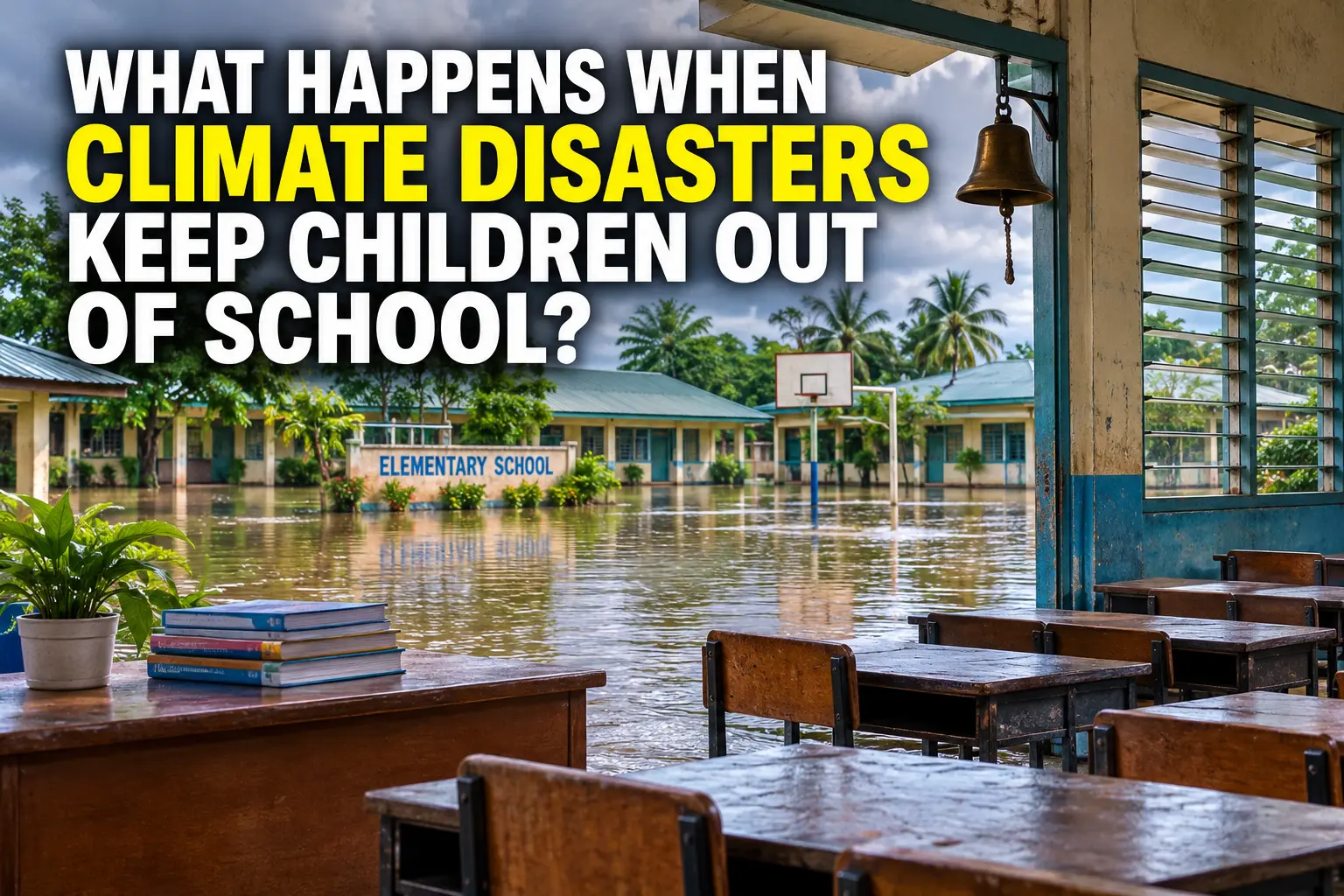
A single school day can be disrupted or lost within just a few hours.
Heavy rain floods classrooms. Strong winds damage school buildings. Extreme heat makes it difficult for students to concentrate.
In some communities, families must leave their homes, roads become impassable, and children cannot safely reach their schools.
For many students, these disruptions are no longer rare events. Climate-related hazards are increasingly affecting when, where, and how children receive an education.
A UNICEF report published in September 2026 estimated that climate-related disruptions affected at least 171 million students in 2025, equivalent to roughly one in every ten students worldwide.
But the problem goes beyond missed lessons. For many children, school provides more than a place to learn. School disruptions affect far more than classroom instruction. They can interrupt access to school meals, safe spaces, educational materials, and teacher support, placing children from already disadvantaged backgrounds at an even greater risk of falling behind.
So what happens when climate disasters repeatedly interrupt education, and what can schools do to protect children’s learning?
How Climate Disasters Interrupt Education
Climate hazards affect schools in different ways. Some force authorities to suspend classes temporarily, while others damage facilities or make normal learning conditions unsafe.
Several types of extreme weather create particularly serious challenges.
1. Floods Make Schools and Roads Inaccessible
Flooding can make schools inaccessible to both students and teachers, even when the buildings themselves remain intact.
In communities near rivers, coastlines, and low-lying areas, heavy rainfall can cover roads, schoolyards, and nearby bridges. Water may also enter classrooms, damage books, destroy equipment, and contaminate sanitation facilities.
When floodwater takes days to recede, reopening schools becomes difficult. Families may also need to prioritize cleaning their homes, finding temporary accommodation, or replacing damaged belongings.
The consequences can extend well beyond the initial closure. Students who miss several weeks of lessons may struggle to keep up when classes resume.
2. Typhoons Damage Classrooms and Learning Facilities
Powerful storms can cause more than temporary class suspensions.
Strong winds may remove roofs, break windows, damage electrical systems, and destroy classroom furniture. Flooding and fallen trees can also make school grounds unsafe.
In particularly severe cases, entire school buildings require major repairs before students can return.
The problem is especially serious in countries frequently affected by tropical cyclones. In the Philippines, powerful storms repeatedly threaten communities, damage infrastructure, and disrupt services that people depend on.
When schools suffer repeated damage, education systems must spend time and money rebuilding facilities instead of directing all available resources toward teaching and learning.
3. Extreme Heat Makes Classrooms Difficult Places to Learn
Schools do not need to close completely for extreme weather to affect education.
High temperatures can make poorly ventilated classrooms uncomfortable and difficult to use. Students may suffer from fatigue, dehydration, headaches, and reduced concentration.
Teachers also face challenges when classrooms become excessively hot.
The World Bank’s 2024 report, Choosing Our Future: Education for Climate Action, explains that rising temperatures can affect learning even when schools remain open. Its analysis highlights the importance of classroom ventilation, temperature control, and climate-resilient school infrastructure.
In places experiencing prolonged heat, schools may need to adjust schedules, reduce outdoor activities, improve ventilation, or temporarily change how lessons are delivered.
4. Droughts and Water Shortages Disrupt School Life
Droughts can affect education in ways that are less immediately visible than floods or storms.
When water supplies become unreliable, schools may struggle to maintain clean toilets, handwashing facilities, drinking water stations, and food preparation areas.
Some students may also have to help their families collect water or manage household responsibilities, leaving them with less time to complete schoolwork.
Water shortages can therefore affect attendance, health, and the overall learning environment.
Schools in drought-prone areas need dependable water supplies and clear plans to maintain essential services throughout extended dry periods.
5. Wildfires and Smoke Create Health Risks
Wildfires can threaten schools directly, but smoke can also affect communities far from the flames.
Poor air quality may make outdoor activities unsafe and create health concerns for students and school personnel. Authorities may suspend classes when smoke levels become dangerous or when fires threaten nearby communities.
Even after a wildfire is contained, damaged roads, buildings, and local infrastructure can delay the return to normal school operations.
These disruptions show why school safety planning must consider more than the physical distance between a school and a natural hazard.
Why Repeated School Disruptions Matter
Missing a few lessons may seem manageable. However, repeated interruptions can create problems that become harder to correct over time.
Learning Gaps Can Grow
Interrupted instruction can create gaps in students’ understanding, making subsequent lessons more difficult to follow.
This is especially concerning in subjects such as mathematics, reading, and science, where understanding new concepts often depends on previously acquired knowledge and skills.
A student who misses an important lesson may need additional instruction before moving forward. If disruptions happen repeatedly, these gaps can accumulate.
A 2024 review published in the World Bank Research Observer found evidence that extreme weather can negatively affect education outcomes. The review identified school closures, excessive heat, health problems, and household economic pressures as important pathways through which weather events affect learning.
Disadvantaged Children Face Greater Risks
Not every student can continue studying when schools close.
Some families have reliable internet connections, computers, and quiet places for children to work. Others have none of these resources.
Children in low-income households may also lose access to school meals, electricity, transportation, and other forms of support.
UNICEF’s 2026 report found that 75 percent of the 171 million students affected by climate-related school disruptions in 2025 lived in low- and lower-middle-income countries.
This highlights an important inequality: children who already have fewer educational opportunities may also have fewer resources to recover when disasters interrupt their schooling.
Families and Teachers Carry Additional Responsibilities
Disasters affect more than students.
Parents may need to find temporary housing, replace damaged belongings, or deal with lost income. These responsibilities can make it difficult to supervise schoolwork or provide learning materials.
Teachers also face additional pressure. They may need to prepare alternative lessons, communicate with families, assess students’ progress, and help communities recover.
In some cases, teachers are dealing with damage to their own homes while trying to support their students.
Education recovery therefore requires support for entire school communities, not just the reopening of classroom doors.
How Schools Can Keep Children Learning During Disasters
Closing a school when conditions are unsafe is sometimes necessary. Children’s safety must come before academic schedules.
However, education systems can prepare ways to reduce learning interruptions and help students return to their studies.
1. Build Schools That Can Withstand Local Hazards
School buildings should reflect the environmental risks of the communities they serve.
Flood-prone areas may require elevated classrooms, improved drainage, and protected electrical systems. Schools in areas exposed to strong winds need durable roofing and reinforced structures to withstand severe weather.
In hotter regions, shaded outdoor areas, natural ventilation, and appropriate building materials can help create more comfortable learning environments.
Climate-resilient infrastructure requires investment, but repeated repairs and prolonged closures also carry high costs.
2. Prepare Learning Materials Before Emergencies Happen
Schools should not wait until a disaster occurs before deciding how students will continue studying.
Printed learning modules, activity sheets, textbooks, and prepared lesson materials can help students continue learning when electricity or internet access becomes unavailable.
These resources are especially valuable for families in remote communities or areas with limited internet access.
When schools prepare in advance, teachers can focus on student safety and communication rather than arranging lessons during an emergency.
3. Use Flexible Learning Methods
Online learning can help students stay connected with their teachers when they can no longer attend classes in person.
However, digital learning should not be treated as a universal solution.
Many households lack reliable internet access, suitable devices, or electricity during emergencies. In these situations, printed modules, radio lessons, educational broadcasts, and other low-technology approaches may be more practical.
The best approach depends on the local situation and the resources available to families.
4. Support Students When Classes Resume
Reopening a school does not automatically mean students are ready to return to normal academic requirements.
Some children may have missed valuable learning time, been forced to leave their homes, or experienced distressing circumstances during the disaster.
Teachers may need to revisit key concepts, assess students’ learning gaps, and provide additional support before resuming the regular curriculum.
Schools should also consider students’ emotional well-being. Children who have experienced serious disasters may need reassurance, counselling, or other forms of psychosocial support.
5. Coordinate With Families and Local Communities
Schools cannot manage disaster-related education disruptions alone.
Local governments, parents, community organizations, and emergency responders all play essential roles in supporting children and maintaining educational continuity.
Families need clear information about class suspensions, school reopening arrangements, learning materials, and safety procedures.
Local authorities can help identify temporary learning spaces, restore damaged facilities, and coordinate support for affected households.
Strong communication makes it easier for students to return to learning when conditions become safe.
What the Philippines Is Doing to Protect Learning
The Philippines demonstrates why protecting children’s access to education must be central to disaster preparedness.
Typhoons, flooding, extreme heat, and other emergencies can disrupt classes across different regions. Some schools experience repeated interruptions, while others face damage that takes considerable time and resources to repair.
In June 2026, the Department of Education adopted a national Learning Continuity Framework through DepEd Order No. 14, s. 2026.
The framework introduces four levels of response:
| Level | Meaning | Education response |
|---|---|---|
| Hayo | Continue | Regular face-to-face learning when conditions are safe |
| Hinay | Ease in | Flexible or reduced learning arrangements during minor to moderate disruptions |
| Hinga | Check-in | Greater attention to well-being, recovery, and reduced academic requirements |
| Hinto | Stop | Suspend academic activities when conditions are unsafe |
The framework enables schools to adapt their learning arrangements to the severity and circumstances of an emergency. Depending on local conditions, teaching may continue through face-to-face classes, printed materials, online instruction, or other delivery methods.
It also recognizes that learning should not continue at the expense of children’s safety and well-being.
This is an important distinction. A resilient education system does not simply keep classes running regardless of conditions. It recognizes when learning can continue, when adjustments are needed, and when activities must temporarily stop.
Can Education Systems Become More Resilient to Climate Change?
Protecting education requires more than preparing for the next typhoon or repairing a damaged classroom.
Governments need to consider climate risks when planning school locations, designing buildings, allocating education budgets, and developing emergency procedures.
They also need reliable information about which schools face the greatest risks and which communities have the fewest resources to recover.
The World Bank’s Choosing Our Future: Education for Climate Action identifies several priorities for strengthening education systems, including better management, resilient infrastructure, learning continuity, and the involvement of teachers and students.
The effectiveness of these measures depends largely on whether schools develop and implement them before emergencies arise.
Schools also need to recognize that climate resilience is not only about buildings. It involves protecting teachers, supporting families, preparing learning resources, and ensuring that vulnerable students are not left behind.
Schools also have a role in developing environmental responsibility. Through practical activities and sustainability projects, students can learn how their everyday actions affect the planet. We highlight examples in 10 Schools That Teach Children to Care for the Planet.
Frequently Asked Questions (FAQs)
Climate change can increase the risks of extreme weather events, including floods, storms, heatwaves, droughts, and wildfires. These hazards can damage schools, interrupt classes, affect attendance, and make learning environments unsafe or uncomfortable.
Not necessarily. The impact depends on how long schools remain closed, whether students have access to alternative learning methods, and how effectively teachers support them when classes resume. However, repeated interruptions can create learning gaps, particularly when students have limited access to educational resources.
Students may use printed modules, textbooks, online lessons, educational broadcasts, or other learning materials. The most suitable method depends on internet access, electricity, available devices, and the needs of the affected community.
DepEd Order No. 14, s. 2026 established a national framework for continuing education during emergencies. Its four levels—Hayo, Hinay, Hinga, and Hinto—guide schools in adjusting learning activities according to safety conditions and the severity of disruptions.
The Challenge Goes Beyond Reopening Schools
When a disaster interrupts education, reopening classrooms is only the first step.
Students may return to damaged facilities, missed lessons, financial difficulties, and emotional stress. Some students may require additional support to catch up before they can keep pace with their classmates.
Climate-related disruptions will require education systems to plan beyond the next school closure. A resilient education system depends on climate-resilient school infrastructure, adaptable teaching arrangements, trained educators, and coordinated support for families.
These challenges also raise a bigger question: Are today’s education systems preparing children for an uncertain future? We examine this in Are Traditional Schools Preparing Children for the Future?
Children should not have to sacrifice their education every time extreme weather affects their communities.
A resilient education system protects students while ensuring they have meaningful opportunities to continue learning, recover from disruptions, and make academic progress.
References
- UNICEF – Learning Interrupted: Global Snapshot on Climate-related School Disruptions in 2025
- UNICEF – More Than 171 Million Students Had Their Schooling Disrupted by Climate Hazards in 2025
- World Bank – Choosing Our Future: Education for Climate Action
- World Bank Research Observer – Impacts of Extreme Weather Events on Education Outcomes
- Philippine Information Agency – DepEd Adopts National Learning Continuity Framework for Emergencies