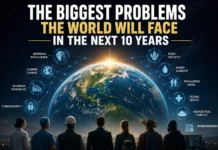


The Middle East is entering one of the most decisive decades in its modern history.
Population growth, climate stress, technological disruption, and geopolitical realignment are converging at a pace few regions have experienced before.
Developments in the Middle East over the next ten years will extend far beyond its borders.
It will shape global energy markets, migration flows, security dynamics, and economic stability far beyond the region.
Below are the most critical challenges the Middle East will face by 2035—and why they matter to the world.
A Region at a Turning Point
Water Scarcity and Climate Stress
Water scarcity is no longer a future risk; it is already redefining daily life across much of the Middle East.
Rising temperatures, declining rainfall, and over-extraction of groundwater are pushing several countries toward absolute water scarcity. Agriculture, food prices, and urban stability are directly at risk.
Without large-scale desalination, water reuse, and cross-border cooperation, water stress could become the region’s most destabilizing force.
Why it matters:
Water scarcity increases food dependency, raises living costs, and heightens the risk of internal unrest and regional disputes.Youth Unemployment and Demographic Pressure
The Middle East has one of the youngest populations in the world.
In many countries, over 60% of the population is under the age of 30.
While this presents an opportunity, it also creates enormous pressure on labor markets. Job creation has not kept pace with population growth, particularly for educated youth.
A generation with rising expectations, but limited economic mobility, is a volatile combination.
Why it matters:
Persistent unemployment fuels frustration, emigration, and political instability—especially in urban centers.Economic Diversification Beyond Oil
Oil remains central to many Middle Eastern economies, but its long-term dominance is fading.
Global energy transitions, electric vehicles, and climate commitments are reshaping demand. Countries that fail to diversify risk face fiscal instability, budget deficits, and reduced global influence.
Those who succeed will redefine their economic futures.
Why it matters:
Diversification determines whether states can maintain social spending, stability, and global competitiveness in a post-oil world.Geopolitical Fragmentation and Proxy Conflicts
The Middle East remains one of the most geopolitically complex regions on Earth.
Proxy conflicts, shifting alliances, and unresolved rivalries continue to drain resources and delay development. Even localized conflicts have regional and global consequences.
Without sustained diplomatic frameworks, instability will remain a defining feature of the decade.
Why it matters:
Ongoing conflict discourages investment, displaces populations, and disrupts global trade routes.Food Security and Import Dependence
Most Middle Eastern countries import a significant portion of their food.
These shocks—climate change, supply chain disruptions, and geopolitical tensions—have laid bare the fragility of this dependence.
Food security is becoming a strategic issue, not just an economic one.
Why it matters:
Food shortages or price spikes can trigger social unrest and strain government budgets.Rapid Urbanization and Infrastructure Strain
Cities across the Middle East are expanding at unprecedented speed.
Mega-projects and urban expansion promise modernization, but they also strain housing, transport, energy, and water systems. Poor planning risks deepening inequality between urban cores and peripheral communities.
Smart growth will determine whether cities become engines of opportunity or centers of tension.
Why it matters:
Urban instability has cascading effects on employment, public services, and social cohesion.Governance, Reform, and Public Trust
Many governments are pursuing reform agendas, but progress remains uneven.
More connected and informed societies will test the limits of transparency, accountability, and institutional capacity. Managing reform without destabilization is one of the region’s most delicate challenges.
Why it matters:
Public trust is essential for implementing long-term reforms and navigating economic transitions.Technological Disruption and Workforce Readiness
Artificial intelligence, automation, and digital platforms are reshaping global labor markets.
The Middle East must rapidly upskill its workforce to remain competitive. Education systems designed for the past no longer align with future economic needs.
Those who adapt will leap ahead. Those who fail to adapt will quickly fall behind.
Why it matters:
Technological gaps translate directly into economic and geopolitical disadvantages.Migration, Displacement, and Social Integration
Conflict, climate stress, and economic disparity are driving continued migration within and beyond the region.
Managing displaced populations while maintaining social cohesion will be an ongoing challenge—especially for urban areas already under strain.
Why it matters:
Unmanaged displacement can destabilize host communities and strain public services.Energy Transition and Global Relevance
The Middle East sits at the center of the global energy system—but that system is adapting.
Balancing traditional energy leadership with renewable investment and climate commitments will define the region’s role on the world stage.
The next decade will determine whether the Middle East remains indispensable or becomes increasingly peripheral.
Why it matters:
Energy transition choices will shape geopolitical influence for decades to come.
Core Regional Challenges
| Challenge | Primary Pressure | Strategic Risk |
|---|---|---|
| Water scarcity | Climate, overuse | Instability |
| Youth unemployment | Demographics | Social unrest |
| Oil dependence | Energy transition | Fiscal stress |
| Geopolitical rivalry | Fragmentation | Prolonged conflict |
| Food dependence | Imports | Price shocks |
| Urban strain | Rapid growth | Inequality |
| Governance gaps | Institutional limits | Reform failure |
| Skills mismatch | Technology | Lost competitiveness |
| Displacement | Conflict, climate | Social tension |
| Energy transition | Global shifts | Reduced influence |
Frequently Asked Questions (FAQs)
Is the Middle East becoming more stable or more unstable?
The region is shifting toward complexity, not straightforward stability or instability. Progress in some countries contrasts with deepening challenges in others.
Which problem is the most urgent?
Policymakers view water scarcity and youth unemployment as the highest-priority challenges, given their immediate results on daily life and long-term societal stability.
Can economic diversification succeed without political reform?
Sustained diversification is difficult without institutional strength, transparency, and public trust.
How does climate change uniquely affect the Middle East?
The region is warming nearly twice as fast as the global average, intensifying water stress and heat extremes.
Why does this region matter globally?
Energy markets, trade routes, migration flows, and security dynamics link Middle Eastern stability directly to global outcomes.
Closing Perspective
The next decade in the Middle East won’t hinge on one event, but leaders will make policy choices under mounting pressure.
Countries that invest in institutional strength, human capital, and long-term sustainability will gain resilience. Those who postpone difficult reforms will face narrowing options.
As with Saudi Arabia, the region’s trajectory will increasingly influence global stability—economically, politically, and strategically.