
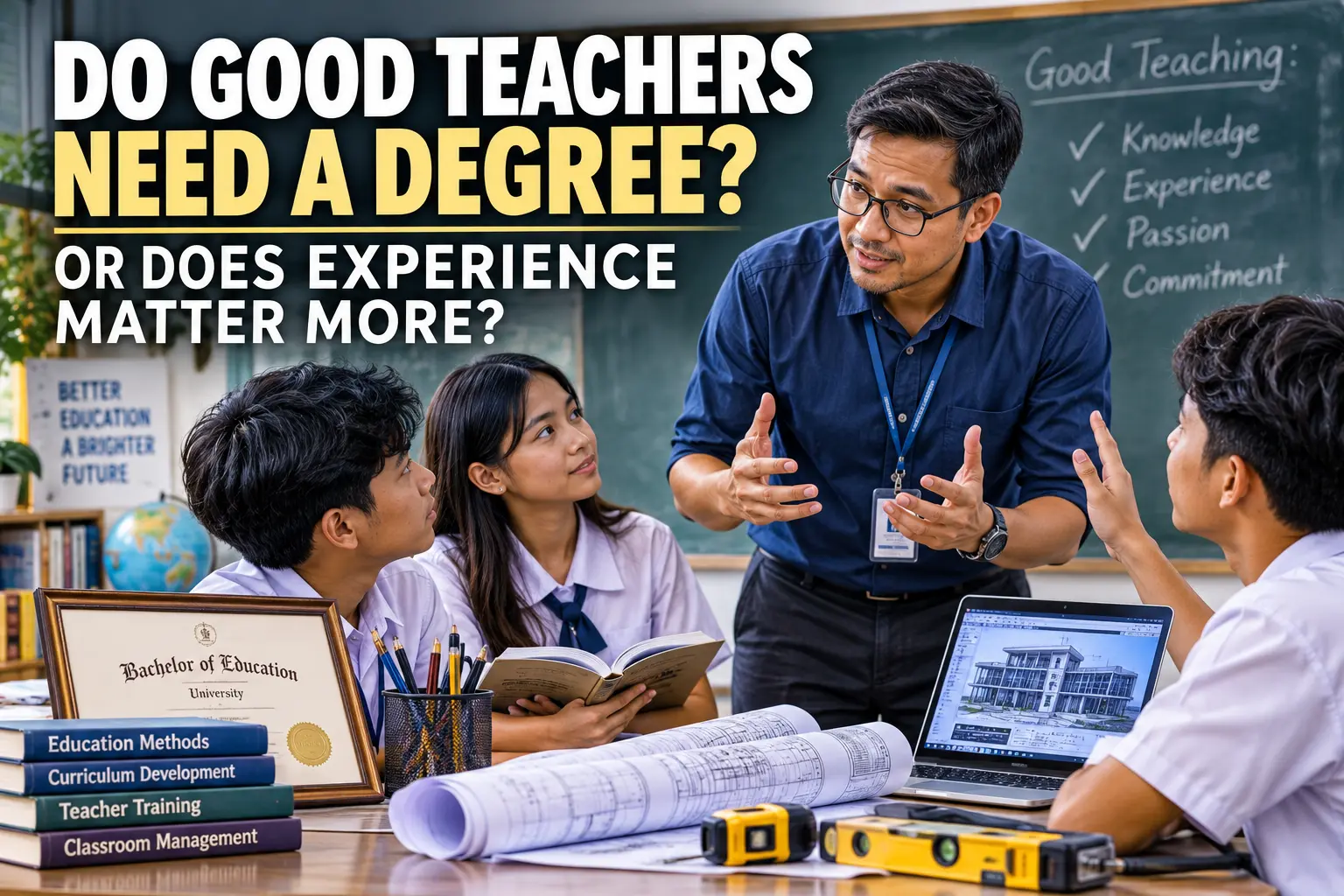
A person can hold a university degree, understand a subject thoroughly, and still struggle to explain it to a classroom full of students.
Qualified teachers, suitable classroom conditions, and adequate school resources all play an important role in student learning. Yet that person may have little or no formal training in education.
This raises an important question: What actually makes someone qualified to be a teacher?
For generations, formal education and professional qualifications have been central to entering the teaching profession.
In many countries, teachers must complete university programmes, undergo professional training, and obtain a teaching license before they can work in public schools.
However, alternative routes into the teaching profession are attracting increasing attention.
Some education systems are exploring ways to attract experienced professionals and subject specialists into teaching, particularly as schools struggle to recruit enough qualified educators.
These recruitment challenges are part of a wider problem examined in our article, Why Are Countries Struggling to Recruit and Retain Teachers?.
The debate is not simply about whether degrees matter.
It is about whether academic qualifications, professional experience, teaching ability, or a combination of these provide the strongest foundation for helping students learn.
Why Are Teaching Qualifications Being Questioned?
Teaching is a profession that requires several different abilities. Educators must understand their subjects, communicate effectively, manage classrooms, assess student progress, and recognize that children learn at different speeds.
A university degree can provide important academic and professional foundations. However, having a degree does not automatically mean someone can explain difficult concepts, motivate students, or respond effectively when learners struggle.
This distinction has encouraged education policymakers to reconsider how people enter the profession.
The OECD’s research on alternative pathways into teaching identifies several reasons countries are considering different recruitment and training approaches. These include teacher shortages, changing labour markets, and the need to recognize professional experience outside traditional education programmes.
Alternative pathways may allow people with relevant qualifications or professional backgrounds to enter teaching through different forms of preparation and assessment.
However, the OECD also identifies important challenges, including teacher preparation, quality assurance, fairness, and long-term sustainability.
The question, therefore, is not whether schools should abandon teaching qualifications. It is whether traditional qualification requirements are the only reliable way to identify people who can teach effectively.
The Case for Teachers Having Formal Education Degrees
Professional qualification requirements exist because teaching demands more than subject knowledge or practical experience.
Teaching requires more than subject knowledge. Educators must understand how students develop, how they learn, and how to explain ideas in ways that meet different learning needs.
For example, someone who is highly knowledgeable in mathematics may easily solve advanced equations. However, helping a 12-year-old understand those equations when they are still struggling with the fundamentals demands more than subject expertise.
Formal teacher education helps prepare future teachers for these responsibilities.
1. Teachers Need to Understand How Children Learn
Students do not all understand information in the same way or at the same speed.
Some learn better through demonstrations, while others benefit from discussion, reading, repetition, or practical activities.
Teachers must recognize these differences and adjust their methods accordingly.
Professional education programmes introduce future teachers to learning theories, child development, educational psychology, and different approaches to instruction.
Understanding child development and learning processes is particularly important when supporting younger students as they build the foundations for future learning.
2. Classroom Management Requires Professional Skills
Managing a classroom can be challenging, even for someone who knows a subject extremely well.
Teachers must also create a positive learning environment, manage disruptive behaviour, resolve conflicts, and encourage active student participation.
Teachers must establish clear, age-appropriate expectations that promote a safe, respectful, and well-managed classroom.
A professional who has spent years working in an office or managing a business may have valuable leadership experience. However, managing employees and guiding a classroom of children are not identical responsibilities.
Teacher preparation helps educators develop strategies for these situations.
3. Teachers Must Know How to Assess Learning
A teacher’s responsibility does not end after explaining a lesson.
Educators must determine whether students actually understand the material.
These responsibilities include evaluating student progress, identifying gaps in understanding, providing appropriate guidance, and adapting teaching methods to support better learning outcomes.
A student who repeatedly receives low scores may not simply need to study harder. The teacher may need to explain the subject differently or identify a gap in the student’s earlier understanding.
These responsibilities require professional knowledge that goes beyond subject expertise.
The Case for Experience and Subject Knowledge
Although formal teacher education provides essential preparation, experienced professionals can also bring valuable knowledge and practical skills into the classroom.
Many professionals build specialized expertise over time through industry experience, research, project management, and hands-on problem-solving.
Their experience may help students understand how classroom lessons connect to the world outside school.
1. Experienced Professionals Bring Real-World Knowledge
Consider a civil engineer teaching a lesson about structures, forces, and materials.
An engineer can connect classroom theory to real-world applications by explaining how these principles are used in designing bridges, buildings, and roads.
A professional accountant may provide practical examples of budgeting, taxation, and financial decision-making.
Professionals from fields such as agriculture, technology, science, and business can introduce students to real-world knowledge that complements traditional academic instruction.
This can make certain subjects more relevant and engaging.
2. Practical Experience Can Connect Theory With Reality
Students sometimes struggle to understand why they need to learn particular concepts.
For example, students may understand electricity more clearly when they see how electrical systems function in real buildings.
A business lesson may become more interesting when an experienced entrepreneur explains the challenges of managing costs, customers, and employees.
People who have worked directly in these fields can provide examples that connect academic knowledge with practical situations.
This does not mean they automatically know how to teach. It means their professional experience can become a valuable educational resource when combined with appropriate teaching preparation.
3. Alternative Recruitment Could Expand the Teacher Workforce
Growing teacher shortages have led some governments to explore alternative pathways for bringing more educators into the profession.
The OECD’s 2026 working paper, Alternative Pathways into Teaching, examines how countries are developing routes that recognize prior professional experience and other qualifications.
These pathways can create opportunities for people with strong subject knowledge to enter teaching, even if they did not follow the traditional route through teacher education.
However, alternative recruitment must not become an excuse to lower professional standards.
Candidates still need suitable preparation, classroom experience, assessment, and ongoing support.
Does Having More Experience Automatically Make Someone a Better Teacher?
Not necessarily.
Practical teaching experience can help educators build confidence, strengthen classroom management skills, and explain complex subjects more effectively.
However, extensive professional experience does not automatically translate into effective teaching.
A teacher who has spent 20 years using the same ineffective approach may not necessarily be more effective than someone with five years of experience who regularly evaluates and improves their methods.
The OECD has noted that research examining the relationship between teacher experience, professional certification, educational qualifications, and student achievement has produced mixed findings.
While some research points to the benefits of accumulated teaching experience, other studies indicate that professional growth may be particularly significant during the early years of teaching.
Some research links greater teaching experience to improved outcomes, while other studies suggest that the largest gains in teaching effectiveness occur during the early years of a career.
Good teachers reflect on their lessons, recognize when students are struggling, seek feedback, and adapt their approaches.
Obtaining a teaching degree or professional license marks the beginning of a teacher’s professional journey, not the end of their learning and development.
What Does Research Say About Teaching Qualifications?
Research findings reinforce the importance of formal teacher preparation in developing the knowledge and skills needed for effective teaching.
A 2019 OECD systematic review by Hannah Ulferts examined evidence involving 10,769 teaching professionals and 853,452 students across 21 countries.
The research found a positive relationship between general pedagogical knowledge, teaching quality, and student outcomes.
Its meta-analysis of 20 quantitative studies found significant effects on both teaching quality and student achievement.
The findings suggest that understanding how to teach is an important part of effective education.
However, the research does not establish that every person with an education degree will become an excellent teacher. Nor does it prove that professionals without traditional teaching degrees cannot become effective educators.
Instead, it highlights the importance of pedagogical knowledge: the ability to turn subject knowledge into meaningful learning experiences.
This is why the debate should not be reduced to choosing between academic qualifications and practical experience.
Both can contribute to effective teaching, but neither should be treated as a complete guarantee of quality.
How Does the Debate Apply to the Philippines?
The discussion is particularly relevant in the Philippines, where teaching is a regulated profession.
Republic Act No. 7836, also known as the Philippine Teachers Professionalization Act of 1994, establishes requirements for professional teacher registration and licensure.
The law sets minimum educational qualifications for different teaching levels.
For elementary teaching, the requirements include a bachelor’s degree in elementary education or its equivalent. For secondary teaching, candidates may qualify through an education degree with the appropriate specialization or a bachelor’s degree in arts and sciences with the required professional education units.
Republic Act No. 9293 amended parts of the original law, including the professional education unit requirement for certain secondary-level applicants.
This framework recognizes an important distinction: someone may have a degree in a subject other than education and still pursue the necessary professional preparation to qualify for teaching.
The University of the Philippines Open University offers an alternative route into teaching through its Professional Teaching Certificate programme, designed for bachelor’s degree holders from other academic fields. The programme provides professional education preparation and can help eligible graduates meet the educational requirement for taking the Licensure Examination for Teachers.
Policymakers have also begun examining whether different licensing pathways could help address barriers to entering the teaching profession.
In March 2025, the Philippine News Agency reported that senators and education stakeholders discussed proposals for alternative teacher licensing assessments. These included portfolios, projects, presentations, and multimedia presentations rather than relying exclusively on written examinations.
These discussions raise a broader question about how education systems should assess and recognize teaching competence.
Should professional readiness be measured only through academic credentials and examinations, or should practical teaching performance also receive greater attention?
The issue also connects with the wider challenges facing the country’s education system. Our article, Are Philippine Public Schools Teaching Effectively? The Reality Behind the Learning Crisis, examines the classroom conditions and wider challenges that shape students’ learning experiences in Philippine public schools.
The challenge is to improve opportunities for capable candidates without weakening the standards that protect students.
What Should Schools Look for in an Effective Teacher?
Rather than relying on a single qualification or measure of experience, schools could assess teachers through a combination of professional knowledge, practical teaching skills, and demonstrated classroom performance.
Several qualities deserve attention.
| Important quality | Why it matters |
|---|---|
| Subject knowledge | Teachers must understand the material they are expected to explain. |
| Pedagogical knowledge | They must know how to make lessons understandable and meaningful. |
| Communication skills | Students need clear explanations, guidance, and feedback. |
| Classroom management | A productive learning environment helps students participate. |
| Adaptability | Teachers must respond to different learning needs and difficulties. |
| Practical experience | Real-world knowledge can make lessons more relevant. |
| Continuous development | Effective educators must continue developing their skills as the needs of students and education systems evolve. |
Schools should also consider how prospective teachers perform in actual classrooms.
A candidate might deliver a demonstration lesson, explain a difficult concept to students, respond to questions, and show how they would support someone who is falling behind.
These assessments would not replace professional qualifications. They would provide additional evidence of whether someone can apply their knowledge in a real teaching environment.
Could Schools Combine Formal Training With Practical Experience?
One possible way forward is to recognize that good teaching requires both preparation and practice.
Someone with a strong academic background in science, mathematics, technology, or another subject could enter a structured teacher preparation programme.
That programme could include professional education, supervised classroom practice, mentoring, and performance assessments.
Similarly, experienced educators should have opportunities to refine their teaching skills and update their knowledge through continuing professional development.
This approach would recognize the value of different backgrounds while maintaining clear standards.
It would also help schools avoid two mistakes: assuming that a university degree guarantees teaching ability, or assuming that professional experience alone is enough to prepare someone to teach children.
The objective should be to develop capable educators, not simply to increase the number of people who can enter the profession.
Frequently Asked Questions (FAQs)
Not necessarily. An education degree provides important preparation in pedagogy, classroom management, assessment, and student development. However, effectiveness also depends on subject knowledge, communication, practical skills, and the ability to support different learners.
In some education systems, graduates from other fields can enter the teaching profession through alternative preparation programmes, provided they complete the required professional training and meet licensing requirements. In the Philippines, the applicable requirements depend on the teaching level and position.
Experience can improve teaching ability, but years of service alone do not guarantee effectiveness. Effective teaching also requires continuous learning, regular reflection, constructive feedback, and the ability to adapt to changing educational needs.
Schools may benefit from recruiting subject specialists and experienced professionals through approved alternative pathways. However, candidates should still demonstrate the pedagogical knowledge and classroom skills needed to teach responsibly.
Both matter. Effective teaching also requires continuous learning, regular reflection, constructive feedback, and the ability to adapt to changing educational needs. A strong system should assess both.
The Best Teachers Need More Than a Certificate
The debate over teaching qualifications and professional experience highlights an important distinction: knowing a subject well is not the same as knowing how to teach it effectively.
A person may understand mathematics, science, history, or technology exceptionally well but struggle to communicate that knowledge to students. Another person may have excellent classroom skills but lack sufficient subject knowledge to explain lessons accurately.
Neither situation represents the complete preparation students deserve.
Formal qualifications remain important because teaching requires specialized knowledge about learning, assessment, child development, and classroom management. At the same time, schools should recognize that practical experience, subject expertise, and demonstrated teaching ability can also contribute to effective education.
The goal should not be to choose between degrees and experience. The goal should be to build an education system that recognizes different forms of expertise while ensuring every teacher has the professional skills needed to support student learning.
This debate is part of a broader discussion about whether education systems are adapting to prepare students for changing social, professional, and technological demands. As we examine in Are Traditional Schools Preparing Children for the Future?, schools must consider not only what students learn but also how effectively their education prepares them for life beyond the classroom.
Ultimately, the question extends beyond whether someone holds a teaching degree or has years of professional experience.
It is whether that person can help students understand, think critically, develop their abilities, and become more confident learners.
References
- OECD – Alternative Pathways into Teaching (2026)
- OECD – Developing Teacher Expertise: Results from TALIS 2024
- OECD – The Relevance of General Pedagogical Knowledge for Successful Teaching (2019)
- OECD – What Do Teachers and Schools Do That Matters Most for Student Achievement?
- Republic Act No. 7836 – Philippine Teachers Professionalization Act of 1994
- University of the Philippines Open University – Professional Teaching Certification