
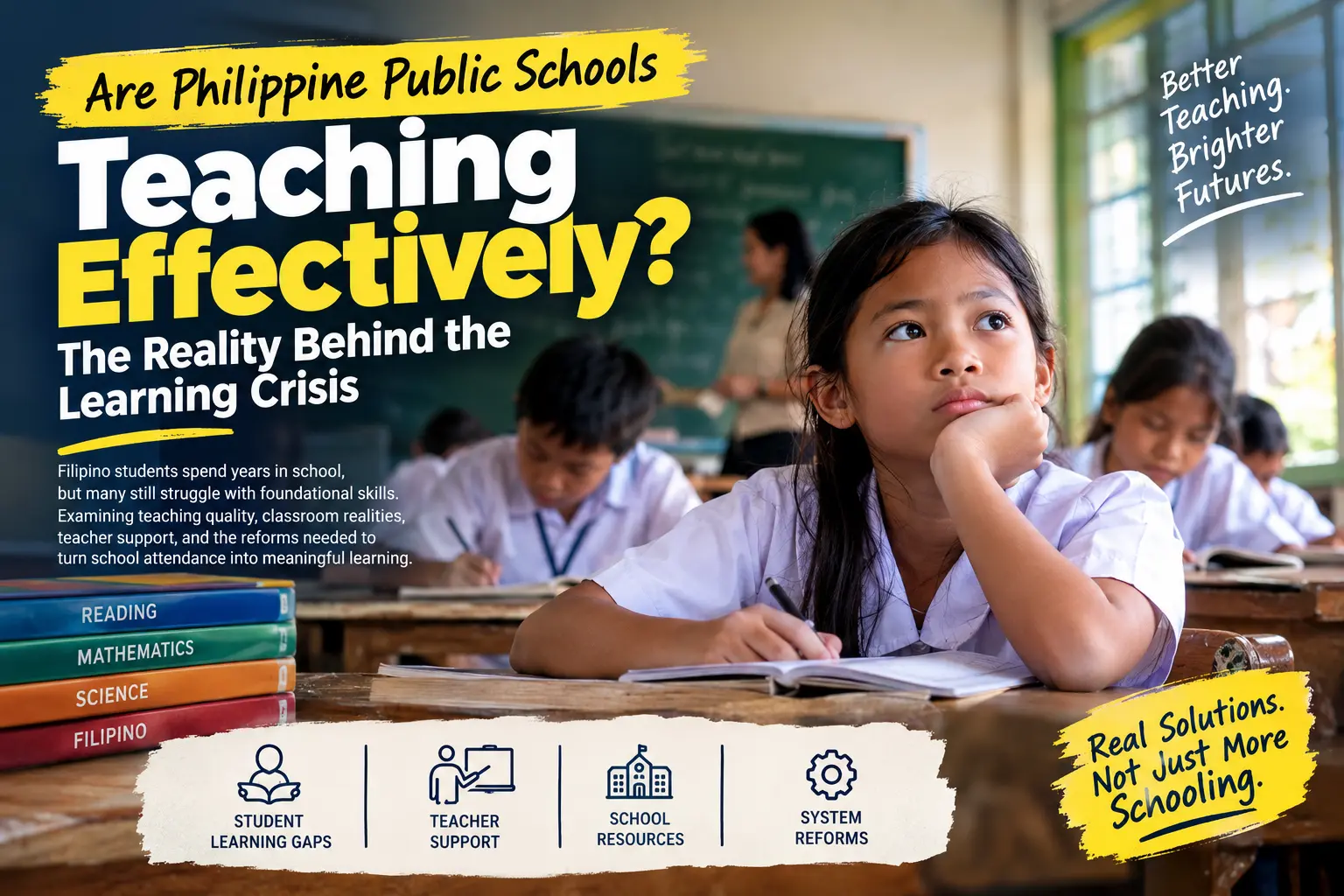
Filipino students spend years in school, but many still struggle with foundational skills. Examining teaching quality, classroom realities, teacher support, and the reforms needed to turn school attendance into meaningful learning.
A student attends school every day.
The student listens to lessons, copies notes, completes assignments, takes examinations, and moves from one grade level to the next.
Yet years later, that same student may still struggle to understand what they read, explain basic concepts, solve mathematical problems, or apply what they have learned to real-life situations.
This raises an uncomfortable question.
If students spend years in school but still struggle with essential skills, are Philippine public schools teaching effectively?
The answer cannot be reduced to blaming teachers or students.
Some teachers work in difficult conditions while doing their best to help students learn. Some students need additional support, more time, or different explanations. Some schools face shortages of classrooms, learning materials, and personnel.
But these challenges do not change education’s main responsibility: ensuring that students learn.
Completing lessons is not the same as ensuring understanding. Passing exams does not always mean students have mastered the subject. And advancing to the next grade does not necessarily mean a student has developed all the skills expected at that level.
The Philippines has expanded access to basic education, but persistent weaknesses in learning outcomes show that access alone is not enough.
The question now is whether the education system can turn school attendance into meaningful learning for every student.
Why Going to School Does Not Always Mean Learning
For generations, going to school has been considered an important step toward a better future.
Students are expected to attend classes, complete requirements, pass examinations, and earn their diplomas.
These milestones matter. Schools provide knowledge, social development, structure, and opportunities that many children might otherwise lack.
However, completing school requirements is different from mastering the skills education aims to develop.
A student may memorize a lesson well enough to pass a test but struggle to explain the underlying concept.
Another may complete a mathematics worksheet by following a demonstrated procedure without understanding when or why to use it.
A student may read a passage aloud but struggle to identify its main idea, interpret its meaning, or draw conclusions from the information.
These are not merely differences in academic performance. They raise questions about whether students are developing the knowledge and abilities they need for the next stage of learning.
The distinction is especially important in elementary education.
Reading comprehension, basic numeracy, and foundational knowledge support nearly every subject that follows. When these skills remain weak, students can struggle increasingly as lessons become more complex.
When students struggle to understand written instructions, tasks in science, mathematics, history, and research can become harder, even though each subject presents different challenges.
The real measure of effective teaching is not simply whether a lesson was delivered. It is whether students learned what the lesson was supposed to teach.
The Learning Crisis Is More Than Just an Opinion
Concerns about Philippine education are supported by research and official assessments.
In its 2026 final report, the Second Congressional Commission on Education (EDCOM II) described a serious decline in proficiency as students progress through the education system. Findings cited by the Philippine Institute for Development Studies indicated that around 30.5% of Grade 3 learners met proficiency standards, compared with just 0.4% of Grade 12 learners.
These figures illustrate the extent of the challenge. They do not mean that every school, teacher, or student performs poorly, but they reveal a significant gap between the country’s educational goals and actual learning outcomes.
The World Bank also reported in April 2026 that approximately 91% of Filipino children around age 10 could not read and understand an age-appropriate text, using the learning-poverty measure cited in its announcement.
Learning poverty measures whether children can read and understand a simple text by around age 10, taking schooling and learning proficiency into account. The figure does not suggest that 91% of children are completely unable to read.
Nevertheless, the figure points to a serious foundational-learning problem.
These findings suggest that the education system must look beyond enrollment, attendance, and promotion rates. It must also assess whether students are developing the skills they need to keep learning successfully.
Are Teachers Delivering Lessons or Ensuring Understanding?
Public education must consider how effectively teachers deliver lessons and help students understand them.
A teacher can explain a topic, write examples on the board, give out worksheets, and finish the lesson on schedule.
But what happens when half the class does not understand the explanation?
Does the teacher try another example?
Does the teacher identify which students are struggling?
Does the class revisit the concept before moving forward?
Or does the lesson continue because the syllabus needs to be completed?
Effective teaching requires different approaches because students have different learning needs. Some students understand a concept immediately. Others need simpler explanations, additional examples, guided practice, or more time.
Effective teaching requires teachers to recognize these differences and respond appropriately.
It also requires a reasonable balance between completing the curriculum and checking whether students have understood it.
Just because a lesson has been taught does not mean students have understood it.
What research says about classroom instruction
A 2026 report discussed an evaluation by the Philippine Institute for Development Studies of the MATATAG curriculum’s first year in selected public schools during School Year 2023–2024.
The study found improved assessment outcomes among participating students and noted that most observed classes met proficiency standards in classroom management, lesson delivery, and evaluation.
However, 52% of observed classes were rated non-proficient in differentiated instruction, which involves adapting teaching to students’ different learning needs and abilities.
This finding deserves attention.
It does not establish that 52% of all Philippine public-school classes are ineffective. The study examined selected schools during a specific period. However, it identifies an important instructional challenge: helping teachers respond effectively when students in the same classroom learn at different rates or require different kinds of support.
The lesson is not that teachers are incapable of teaching.
Effective teachers must do more than explain a topic; they must also address students’ different learning needs. It also requires recognizing when that explanation has not worked for some learners.
Why Some Students Struggle Despite Attending Every Class
Students do not enter the classroom with identical abilities, experiences, or circumstances.
Some have strong reading foundations. Others have struggled with reading for years.
Some receive help at home. Others have limited access to books, internet connectivity, tutoring, or a quiet place to study.
Some learn quickly through verbal explanations. Others benefit from visual examples, repeated practice, or step-by-step guidance.
Without support for their different learning needs, struggling students may become increasingly disengaged from classroom learning.
Consider a student who has not yet mastered multiplication but is expected to solve more advanced math problems.
The teacher may explain the new topic correctly. The lesson may follow the curriculum. The worksheet may be appropriate for the grade level.
The student may struggle to keep up because an earlier learning gap remains unresolved.
The same problem can occur in reading, science, language, and other subjects.
That is why schools need to recognize learning gaps as early as possible.
A student who needs help with a foundational skill should not simply be given more advanced work and expected to catch up independently.
The school must identify which skills the student has not yet mastered and provide appropriate support.
Moving forward in the curriculum without addressing foundational weaknesses can allow small learning gaps to become larger problems.
The Classroom Reality: One Teacher, Many Learners
Managing a classroom and helping students learn requires considerable effort.
A teacher may need to explain lessons, maintain order, check assignments, assess performance tasks, prepare instructional materials, record grades, communicate with parents, and complete administrative requirements.
In a large class, these responsibilities become even more demanding.
One student may understand the lesson quickly and finish early.
Another may need the teacher to repeat the explanation.
A third may struggle to concentrate.
Another may remain quiet even when confused.
Some students may struggle to follow classroom rules, while others may lack the confidence to participate.
The teacher must respond to these different needs while keeping the class moving.
This is one reason why ineffective teaching cannot always be explained by an individual teacher’s ability or attitude.
Schools need sufficient staffing, suitable learning materials, manageable administrative demands, effective school leadership, and opportunities for professional development.
However, difficult conditions should not prevent us from asking whether students are actually learning.
Instead, they should help identify the support teachers need and the steps schools must take to improve classroom instruction.
When Classroom Management Takes Priority Over Learning
A classroom needs order.
Teachers need to manage disruptions, set clear expectations, and create a safe classroom where students can focus on learning.
Schools should identify the skills students still struggle with and provide the right support.
A teacher may spend substantial time enforcing rules, collecting requirements, correcting behavior, and maintaining silence.
These activities can make lessons more engaging, but teachers still need to check whether students understand the material.
Even when students remain quiet and attentive, they may not fully understand the lesson.
An active classroom may have students deeply engaged in meaningful discussions or hands-on activities.
Likewise, a student who talks frequently is not necessarily academically weak, and a student who rarely speaks is not necessarily struggling.
Teachers should distinguish behavior from learning outcomes.
Teachers need to address behavior that repeatedly interrupts learning. When a student appears withdrawn or struggles to participate, the teacher may need to understand why.
The goal is not to ignore classroom behavior. It is to manage behavior in ways that protect learning while recognizing that students have different needs.
This also means avoiding premature judgments about students based on a single observation.
A teacher who notices a concern should examine the pattern, communicate appropriately with the student and family, and consider whether additional support is needed.
Why One Teaching Pace Does Not Work for Every Student
One challenge highlighted in the PIDS evaluation of the MATATAG curriculum was the use of differentiated instruction.
This matters because classrooms contain students with different levels of understanding.
Imagine a teacher explaining fractions.
Some students understand the concept after the first example. Others need to see how fractions relate to real objects. Students who have not yet mastered multiplication or division may struggle to understand the new lesson.
If the teacher continues at the same pace without checking understanding, some students may keep up while others fall further behind.
Differentiated instruction does not mean preparing an entirely separate lesson for every student.
It can involve practical adjustments, such as:
- Giving additional examples to students who need them.
- Providing guided practice before independent work.
- Using visual aids or concrete materials to explain abstract concepts.
- Offering more challenging exercises to students who have already mastered the basics.
- Checking understanding before introducing a more difficult topic.
- Providing targeted remediation when students have significant learning gaps.
These strategies help teachers respond to differences without abandoning curriculum standards.
The goal is not to eliminate difficulty from the learning process.
The goal is to make learning accessible enough for students to work toward the required standards.
Are Grades Showing What Students Have Actually Learned?
Grades remain an important part of schooling.
They help communicate student performance, identify areas of difficulty, and determine whether students meet the requirements for a subject or grade level.
However, a grade alone cannot explain everything about a student’s learning.
Two students may receive similar scores for different reasons. One may have mastered the concepts but made several careless mistakes. Another may have memorized procedures without fully understanding them.
A student may also perform well on one assessment but struggle to apply the same knowledge in a different context.
This is why assessment should help teachers understand student learning, not just record results.
Teachers need to understand what students know, what they can do, where they are struggling, and what support would help them improve.
Clear rubrics, meaningful feedback, appropriate examinations, classroom observation, and diagnostic assessments can all contribute to a more complete picture.
Grades should help schools identify learning needs, not simply record performance after the lesson is over.
This concern connects to the broader issue discussed in Why Good Grades No Longer Guarantee Success in Real Life: academic results matter, but they do not always reflect what students truly understand or can apply.
The Difference Between Assigning More Work and Helping Students Learn
When students struggle, assigning more work may seem like an obvious solution.
Additional exercises can be useful when they provide meaningful practice and reinforce key lessons. Homework is most useful when it serves a specific learning goal and is neither too easy nor too difficult for the student.
Increasing the workload does not guarantee stronger skills or more in-depth understanding.
When students struggle with a concept, they may need a clearer explanation or additional support rather than simply more exercises.
If several teachers assign major requirements at the same time, students may spend hours completing tasks without receiving enough feedback to understand their mistakes.
If assignments focus mainly on submission and compliance, students may prioritize finishing the work rather than understanding it.
The main concern is not the quantity of work students do.
Their value depends on whether they help students strengthen essential knowledge and skills.
Teachers should use assignments strategically, explain their purpose, and provide feedback that helps students improve.
Schools should also examine the combined workload students receive across subjects.
A Practical Framework for Evaluating Teaching Effectiveness
Assessing teaching effectiveness requires a broader view of classroom practices and student progress.
Evaluating it requires looking at student learning outcomes, classroom practices, and the support teachers receive.
| Area to examine | Main question |
|---|---|
| Lesson delivery | Do students understand the lesson, or are they simply copying notes? |
| Differentiated instruction | Do teachers adapt explanations and activities to different learning needs? |
| Assessment and feedback | Do students understand their mistakes and how to improve? |
| Classroom management | Is classroom order supporting meaningful instruction? |
| Learning resources | Do teachers and students have the materials needed for effective lessons? |
| Teacher workload | Do administrative responsibilities reduce time for preparation and student support? |
| Learning outcomes | Can students demonstrate the skills expected at their grade level? |
| Accountability | Are schools identifying learning gaps and taking action to address them? |
These questions are not a checklist for automatically declaring a teacher effective or ineffective.
They are a starting point for examining whether classroom instruction is achieving its purpose.
Schools should combine classroom observations, student assessments, teacher feedback, and evidence of progress over time.
That approach is fairer than judging teachers solely by test scores and more informative than assuming that completing the syllabus proves that students have learned.
Why Better Teacher Support Must Come With Meaningful Accountability
Any serious discussion about teaching effectiveness must recognize the work teachers do.
Public-school teachers often manage substantial workloads and diverse classrooms. Some work with limited instructional materials or facilities. Others must balance classroom responsibilities with administrative requirements that compete for their time.
These challenges can make it harder for teachers to teach effectively.
Teachers need relevant professional development, instructional coaching, usable learning materials, adequate staffing, and opportunities to collaborate with colleagues.
They also need enough time to review student work, plan lessons, and respond to learning difficulties.
But improving teaching requires both adequate support and meaningful accountability.
The real measure of professional development is whether it helps teachers improve instruction and support student learning.
School leaders should determine where classroom instruction needs improvement and provide practical support.
Teachers should receive constructive feedback based on observable classroom practice and student learning—not merely administrative compliance.
If issues persist, schools should have appropriate procedures to resolve them.
Accountability should focus on improving classroom instruction and protecting students’ right to meaningful learning, rather than encouraging blame or making teachers afraid to discuss difficulties.
A stronger education system needs teachers who are supported, competent, reflective, and accountable for the quality of their professional practice.
What Philippine Public Schools Should Change
Improving teaching effectiveness requires more than announcing a new curriculum.
The value of curriculum reform depends not only on its design but also on how well schools put it into practice.
Several practical changes deserve attention.
1. Check understanding before moving forward
Teachers should regularly check whether students understand essential concepts before introducing more advanced material.
Short exercises, questioning, written responses, and targeted assessments can reveal gaps early.
2. Strengthen foundational literacy and numeracy
Students need strong reading comprehension and solid mathematical foundations.
Schools should identify students who are behind and provide structured, targeted support rather than expecting them to catch up through ordinary classroom instruction alone.
3. Make teacher development practical
Training should help teachers address real classroom challenges, including differentiated instruction, formative assessment, classroom management, and remediation.
Coaching and collaboration can help teachers apply what they learn.
4. Reduce unnecessary administrative burdens
Teachers need time to prepare lessons, assess student work, and support learners.
Where feasible, non-teaching personnel and more efficient administrative processes should reduce work that unnecessarily competes with instructional responsibilities.
5. Improve access to learning materials
Students and teachers need appropriate textbooks, instructional resources, classroom facilities, and accessible materials.
Technology can help, but digital tools cannot compensate for every shortage or replace effective instruction.
6. Use assessments to improve teaching
Assessment results should help teachers determine what students have mastered and where they need further instruction.
Schools should avoid treating testing as an end in itself. Results must lead to practical decisions about teaching and student support.
7. Monitor learning progress, not just promotion
Moving a student to the next grade should not make unresolved learning gaps invisible.
Schools should track progress in foundational skills and ensure students who need help receive it.
8. Strengthen school leadership
School heads should have the capacity and time to support teachers, observe instruction, identify systemic weaknesses, and organize improvement efforts.
Good school leadership bridges the gap between education policy and classroom practice.
Lasting reform requires more than promises and brief training sessions; it depends on resources, planning, and consistent follow-through.
Are Current Education Reforms Addressing the Root Causes of the Problem?
There are indications of improvement, but more careful evaluation is needed to understand the results.
The MATATAG curriculum is intended to decongest the curriculum and strengthen foundational competencies. The PIDS evaluation of its first year in selected public schools found improved assessment performance among participating students and stronger teacher collaboration.
These findings are encouraging, but they do not prove that the reform has solved the country’s learning crisis.
The World Bank announced a $600 million project for learning upgrade support and decentralization in April 2026. The initiative aims to support foundational literacy, numeracy, mathematics, teacher development, school leadership, and learning recovery across the basic education system.
EDCOM II’s 2026–2035 reform roadmap also calls for sustained action on learning outcomes, teacher support, governance, and accountability.
These efforts acknowledge that the problem requires more than changes to lesson plans.
Curriculum design, teacher preparation, classroom resources, school leadership, assessment, and learning recovery all affect whether students benefit from education.
The challenge now is implementation.
Schools need sufficient resources, clear responsibilities, and reliable ways to measure whether reforms improve learning over time.
Real progress depends on what students learn and can demonstrate, rather than how many policies or programs are launched.
How Parents Can Support Better Learning at Home and in School
Parents cannot fix the education system alone, but they can ask useful questions and help identify learning difficulties early.
Rather than focusing exclusively on grades, parents can ask:
- Can my child tell me what they learned and what it means?
- Can my child apply the concept without copying an example?
- Which skills is my child struggling with?
- What feedback has the teacher provided?
- What support is available if my child falls behind?
- Are there specific steps we can take at home to reinforce learning?
If a child repeatedly struggles to understand lessons, parents should seek a clear explanation of the learning gap rather than immediately assuming that the student is lazy or that the teacher is incompetent.
Teachers and parents should work together to identify the problem and agree on practical next steps.
At the same time, parents should feel able to raise reasonable concerns when instruction is consistently unclear, feedback is missing, or a student is not receiving appropriate support.
Constructive communication is not about attacking teachers. It is about making sure students receive the education they need.
To understand the wider challenges influencing Filipino families, see The State of Philippine Education: Challenges, Reforms, and What Parents Need to Know, which examines student learning, school conditions, and education reform.
The Real Measure of an Effective School
A school should be assessed by more than its facilities, student numbers, attendance records, and examination performance.
These indicators offer valuable insights, but they do not explain everything.
An effective school should help students build knowledge, develop skills, gain confidence, and become lifelong learners.
Singapore offers insight into how education systems can combine academic excellence with students’ overall development. Read How Singapore Balances Academic Excellence With Student Development to explore this approach.
Students should be able to ask questions, receive meaningful feedback, correct mistakes, and seek help when they do not understand.
Teachers should have the tools and support necessary to teach effectively.
School leaders should identify problems and act on them.
Parents need clear information about their children’s progress and an accessible way to discuss concerns with the school.
Education reforms should produce measurable improvements in student learning.
These are not excessive demands; they are part of what education should provide.
Final Thoughts: Better Learning Must Be the Priority in Philippine Education
The Philippine public-school system faces a difficult challenge.
Evidence points to serious gaps in foundational learning, while research on curriculum implementation shows both encouraging progress and areas where teaching practices need further support.
Neither conclusion should be ignored.
It would be unfair to blame every teacher for a system-wide problem. It would be equally unhelpful to let difficult working conditions discourage efforts to evaluate teaching quality.
Both realities can exist at the same time: teachers can face serious constraints, and students can still be receiving less effective instruction than they need.
The solution is to identify what works, address what does not, support teachers in improving their practice, and hold institutions accountable for student learning.
The country does not need schools that merely keep students busy until graduation.
It needs schools that help them understand, think critically, solve problems, and apply what they learn.
The ultimate test of Philippine public education is not how many students attend school or complete their requirements. It is about whether those students leave school with the knowledge and skills they were promised.
That should be the standard for measuring teaching effectiveness and guiding education reform.
Frequently Asked Questions (FAQs)
Teaching effectiveness differs across schools and classrooms. Research identifies serious learning challenges, including weak foundational skills and gaps in differentiated instruction, but it also identifies areas of progress. A complete assessment should consider learning outcomes, teaching effectiveness, and the resources and support provided to teachers.
Students may lack foundational reading or math skills, receive too little targeted support, or struggle with lessons beyond their current level of understanding. Poverty, limited learning resources, attendance difficulties, and other circumstances can also affect progress.
No. System-wide learning problems do not prove that every teacher is ineffective. Many teachers work under difficult conditions, and classroom effectiveness varies. Improving outcomes requires both teacher support and meaningful accountability.
Differentiated instruction means recognizing that students learn at different levels and adapting teaching methods and support without lowering learning expectations.
Not necessarily. Purposeful practice can strengthen understanding, but extra assignments may have limited value if students have not understood the lesson or receive little feedback. Effective assignments matter more than a large volume of tasks.
MATATAG is a Philippine basic education curriculum reform designed to streamline learning competencies, strengthen foundational skills, and make the curriculum more manageable for learners and teachers. Its effectiveness depends on implementation, teacher support, and whether students’ learning outcomes improve.
Schools can combine classroom observations, assessments, student work, feedback, and progress over time. They should examine whether students are mastering the required competencies and whether teaching adjustments help struggling learners improve.
Parents should ask the teacher which skills the child has not mastered, request specific feedback, and discuss appropriate support. If the problem persists, they can seek assistance from the school administration and ask what steps will be taken to address the learning gap.
There is no single solution. Priorities include strengthening foundational literacy and numeracy, supporting effective teaching, improving classroom resources, reducing unnecessary administrative burdens, providing targeted learning recovery, and ensuring that assessment results lead to action.
Authority References
- Philippine Institute for Development Studies (PIDS)—Teaching through Transition: What Influences Teachers’ Practices amidst Curriculum Reform? Research on the first year of MATATAG implementation in selected public schools. Read the study announcement.
- Second Congressional Commission on Education (EDCOM II)—Turning Point: A Decade of Necessary Reforms (2026–2035). Explore the final report.
- World Bank—World Bank Backs Better Learning for 21 Million Filipino Students, April 3, 2026. Read the announcement.
- UNICEF Philippines—UNICEF calls EDCOM2 Report a critical guide for education reforms, February 2026. Read the report announcement.
- Department of Education (DepEd)—National curriculum, classroom assessment, learning recovery, and teacher-development policies. Visit the official website.