
AI is changing how people work across the globe faster than ever.
Much of the public conversation focuses on the jobs AI may replace.
But history tells a more balanced story.
Every major technological revolution has eliminated certain occupations while creating entirely new industries and career opportunities.
The Industrial Revolution created factory managers, mechanical engineers, and industrial designers.
The internet gave rise to web developers, digital marketers, app developers, cybersecurity specialists, and social media managers.
Artificial intelligence will likely follow a similar path.
Rather than simply replacing workers, AI is likely to reshape existing careers while creating entirely new professions that barely exist today.
This evolving job market is closely connected to Top 10 Jobs AI Is Most Likely to Replace by 2035, which explores why automation affects some occupations more than others.
The future workforce may reward people who learn how to work with AI—not compete against it.
Why AI Creates Jobs as Well as Replaces Them
Artificial intelligence automates repetitive work.
However, every new technology also creates demand for people who can:
- Build AI systems
- Train AI models
- Supervise AI decisions
- Improve AI performance
- Integrate AI into businesses
- Solve problems that AI cannot.
As AI adoption accelerates across healthcare, finance, education, manufacturing, and government, entirely new career paths are emerging.
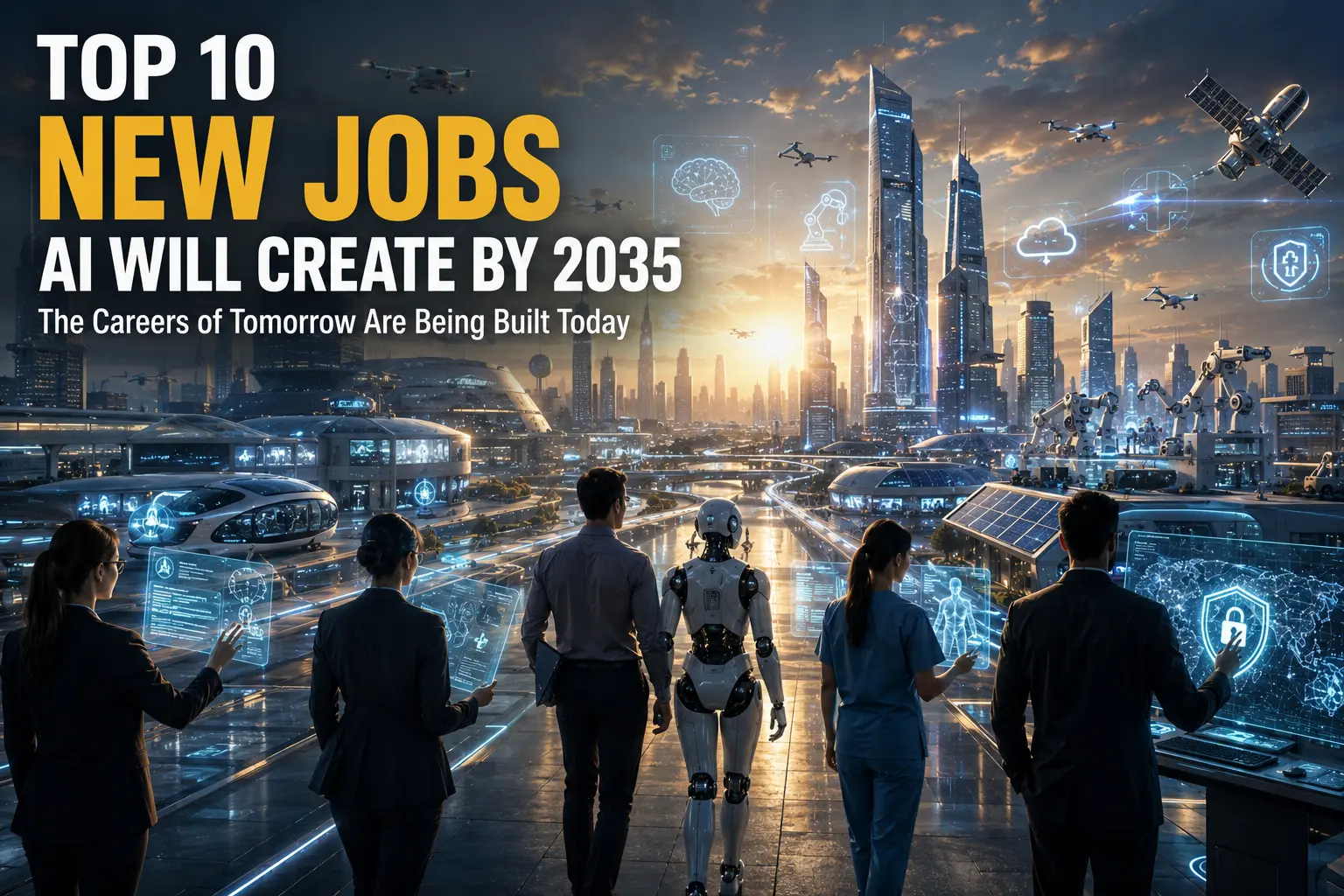
Top 10 New Jobs AI Will Create by 2035
| Future Career | Why It Will Matter |
|---|---|
| AI Prompt Engineer | Creates effective instructions that maximize AI performance |
| AI Trainer | Teaches AI systems using human feedback |
| AI Auditor | Detects bias, errors, and regulatory risks |
| AI Ethics Specialist | Ensures responsible and ethical AI deployment |
| Human-AI Collaboration Manager | Optimizes teamwork between employees and AI systems |
| AI Automation Consultant | Helps organizations implement AI solutions |
| Synthetic Media Specialist | Creates AI-generated videos, images, and digital content responsibly |
| AI Healthcare Coordinator | Integrates AI into clinical workflows while maintaining patient care |
| AI Cybersecurity Analyst | Protects AI systems from attacks and manipulation |
| AI Education Designer | Develops AI-powered learning experiences for schools and businesses |
1. AI Prompt Engineer
AI systems perform better when given clear instructions.
Prompt engineers design effective prompts that help AI generate:
- Better reports
- Higher-quality code
- Marketing content
- Research summaries
- Business insights
As organizations adopt AI across departments, prompt engineering is becoming a valuable practical skill.
2. AI Trainer
AI models improve through human feedback.
AI trainers help systems learn by:
- Reviewing outputs
- Correcting mistakes
- Labeling data
- Improving accuracy
- Teaching context
Human expertise remains essential for making AI more reliable.
3. AI Auditor
As AI influences hiring, healthcare, finance, and legal decisions, organizations need professionals who can evaluate AI systems.
AI auditors examine:
- Accuracy
- Fairness
- Transparency
- Compliance
- Security risks
Their role helps build trust in AI-powered decision-making.
4. AI Ethics Specialist
Powerful technology requires responsible governance.
AI ethics specialists develop policies that address:
- Bias
- Privacy
- Accountability
- Responsible data use
- Human oversight
As AI regulations evolve, this profession is expected to grow significantly.
5. Human-AI Collaboration Manager
The future workplace will increasingly involve people working alongside intelligent systems.
Human-AI collaboration managers help organizations determine:
- Which tasks should AI perform
- Which tasks require human judgment
- How employees can work more effectively with AI
- How productivity can improve without sacrificing quality
Rather than replacing people, AI often works best when combined with human expertise.
6. AI Automation Consultant
Businesses across nearly every industry are adopting AI.
Automation consultants help organizations:
- Identify repetitive workflows
- Select AI tools
- Implement automation
- Train employees
- Measure business impact
Demand for these specialists is expected to expand as AI adoption accelerates.
7. Synthetic Media Specialist
AI can now generate realistic:
- Images
- Videos
- Voice recordings
- Animations
- Interactive media
Synthetic media specialists oversee the creation of AI-generated content while maintaining quality, authenticity, and ethical standards.
8. AI Healthcare Coordinator
Healthcare professionals increasingly use AI to assist with:
- Medical imaging
- Diagnostics
- Patient monitoring
- Administrative tasks
AI healthcare coordinators help integrate these technologies while ensuring that patient care remains human-centered.
9. AI Cybersecurity Analyst
As AI systems become more widespread, they also become attractive targets for cybercriminals.
AI cybersecurity specialists protect:
- AI models
- Training data
- Automated systems
- Enterprise AI platforms
Securing intelligent systems is expected to become a major cybersecurity discipline.
10. AI Education Designer
Education is rapidly evolving.
AI education designers create personalized learning experiences using intelligent tutoring systems, adaptive assessments, and AI-powered educational tools.
This ties into Why China Is Rebuilding Higher Education Around AI, which explores how universities are redesigning programs for the AI economy.
Many of these emerging AI professions are expected to offer excellent long-term career prospects. However, their earning potential may vary significantly depending on demand, specialization, and industry. If you’re curious which AI careers could offer the biggest financial rewards, explore Top 10 Highest-Paying AI Careers in 2035, where we examine the AI roles projected to command the highest salaries over the next decade.
Human Skills Will Become Even More Valuable
Ironically, the rise of AI increases the importance of uniquely human capabilities.
Future professionals will still need:
- Critical thinking
- Creativity
- Emotional intelligence
- Communication
- Leadership
- Adaptability
These complementary skills are explored in Top 10 Skills That Will Matter Most in the AI Economy, which explains why technical knowledge alone may no longer be enough.
Industries Expected to Create the Most AI Jobs
AI-driven careers are expected to expand across:
- Healthcare
- Education
- Finance
- Manufacturing
- Cybersecurity
- Software Development
- Government
- Logistics
- Marketing
- Scientific Research
Rather than being limited to technology companies, AI-related careers are likely to appear in almost every sector of the economy.
Preparing for the Careers of Tomorrow
The best preparation for the AI economy is not simply learning how AI works.
It is learning how to work with AI effectively.
Professionals who combine technological literacy with creativity, judgment, communication, and continuous learning may enjoy the greatest opportunities over the coming decade.
The future workforce will likely belong to those who see AI as a powerful tool—not a competitor.
Frequently Asked Questions (FAQs)
Most experts believe AI will eliminate some tasks while creating new occupations, though the transition may differ across industries and regions.
An AI Prompt Engineer designs effective instructions that help AI systems produce more accurate, relevant, and useful outputs.
Healthcare, education, finance, cybersecurity, manufacturing, software development, and scientific research are expected to see significant growth in AI-related roles.
No. Many emerging AI careers focus on business, education, healthcare, ethics, design, communication, and management rather than software engineering.
AI literacy, critical thinking, creativity, communication, adaptability, emotional intelligence, and continuous learning are expected to remain among the most valuable long-term skills.