
Cryptocurrency was created to eliminate the need for trusted intermediaries.
Bitcoin introduced a decentralized monetary system immune to control by any founder, corporation, or government.
That vision inspired thousands of new blockchain projects.
But not every cryptocurrency followed Bitcoin’s example.
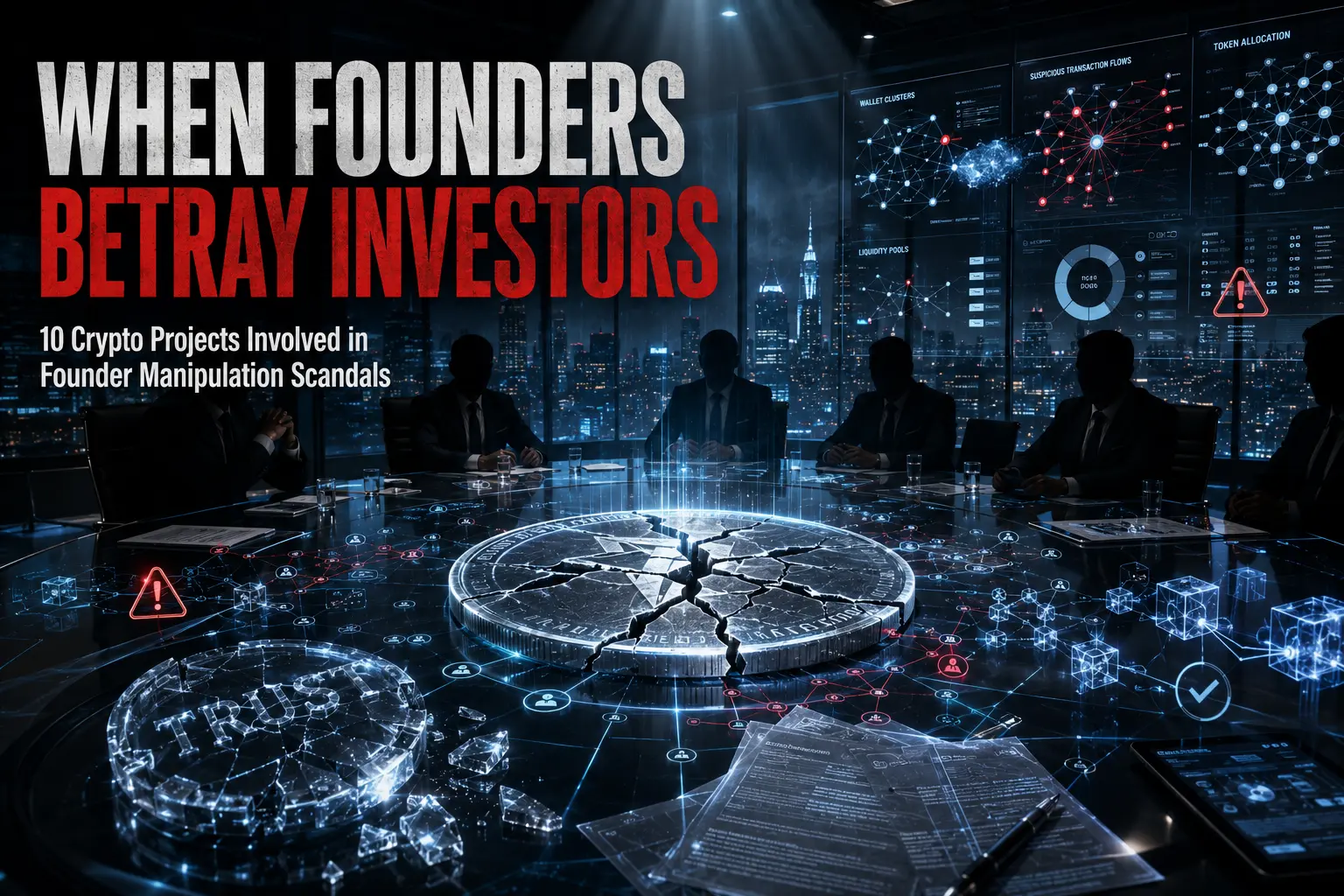
Over the years, some projects gave founders and insider teams enormous influence over token supply, liquidity, governance, or trading activity. In several high-profile cases, regulators, prosecutors, or courts later alleged—or found—that this control was abused through practices such as wash trading, misleading disclosures, insider selling, or market manipulation.
The consequences were severe.
Some projects collapsed almost overnight.
Others became the subject of criminal investigations, civil lawsuits, or regulatory enforcement actions that shook investor confidence across the crypto industry.
These events also highlighted an important lesson.
The greatest risk is not always the blockchain technology itself.
Sometimes the biggest risk comes from the people behind the project.
That is why experienced investors increasingly examine more than price charts.
They also look at founder incentives, token distribution, governance, liquidity, and transparency before investing.
In our previous guide, Top 10 Most Manipulation-Resistant Cryptocurrencies: The Cleanest Crypto Projects for Long-Term Investors, we explored projects with fair launches, decentralized governance, and limited founder control.
This article examines the opposite side of the market.
This article doesn’t celebrate successful projects. Instead, it examines the worst manipulation scandals involving founders and insiders in crypto—and what investors can learn from them.
Why Founder Manipulation Is So Dangerous
Most cryptocurrencies begin with a small group of founders or developers.
That alone is not a problem.
Many legitimate blockchain projects start this way.
The problem arises when founders retain excessive control over the token or market while presenting the project as decentralized.
Examples include:
- Large undisclosed founder wallets
- Artificial trading volume
- Wash trading between related accounts
- Secret market-making arrangements
- Misleading statements about liquidity
- Hidden token allocations
- Artificial price support
- Insider dumping after promotional campaigns
These practices can create the illusion that a project is healthier, more valuable, or more popular than it actually is.
Retail investors often enter the market believing demand is genuine.
In reality, the activity may be driven largely by insiders.
When that support disappears, prices can fall dramatically.
This is why many long-term investors look for projects with transparent governance, fair token distribution, and no single owner in control.
Common Types of Crypto Market Manipulation
Although every scandal is different, many share similar patterns.
Understanding these tactics can help investors recognize warning signs before investing.
Wash Trading
Wash trading occurs when the same individual or coordinated group repeatedly buys and sells tokens among accounts they control.
The objective is to create fake trading volume and make a token appear more active than it really is.
Insider Dumping
Founders or early investors accumulate large token positions before public interest grows.
After aggressive marketing or rising prices attract retail buyers, insiders sell substantial portions of their holdings into the increased demand.
Artificial Price Support
Instead of letting the market establish token value naturally, insiders leverage treasury funds or customer assets to buy their own tokens and maintain artificially elevated prices.
Misleading Tokenomics
Some projects publicly promote decentralization while insiders quietly control a significant percentage of the token supply through undisclosed wallets or private allocations.
Liquidity Manipulation
Projects may claim liquidity is permanently locked or inaccessible while retaining hidden mechanisms that allow insiders to withdraw funds or otherwise influence the market.
These tactics differ in execution.
But they often produce the same outcome:
Ordinary investors bear the greatest losses.
Want to spot warning signs before investing? Many manipulation scandals share the same early warning signals long before prices collapse. Before buying any cryptocurrency, read our guide 10 Red Flags Every Crypto Investor Should Know Before Buying a Token, where we explain how to identify suspicious tokenomics, concentrated founder ownership, fake trading volume, hidden wallet allocations, and other risks that every crypto investor should recognize.
1. FTX Token (FTT)
Type of Manipulation
Artificial valuation and collateral abuse
Before its collapse in 2022, FTX was one of the world’s largest cryptocurrency exchanges.
Its native token, FTT, played a central role in the company’s business model.
Unlike decentralized cryptocurrencies with broad ownership, much of FTT’s supply remained under the control of FTX and its affiliated trading firm, Alameda Research.
According to prosecutors, customer funds were improperly diverted to Alameda, while the inflated market value of FTT helped support billions of dollars in borrowing and other financial activities.
Because relatively little of the token traded freely on the open market, critics argued that its quoted price overstated the value of the overall supply.
When confidence in FTX deteriorated, the market quickly realized that FTT’s valuation depended heavily on trust in the exchange itself.
The result was one of the largest collapses in financial history.
FTX filed for bankruptcy.
Billions of dollars in customer assets became trapped.
Founder Sam Bankman-Fried was later convicted on multiple federal fraud-related charges in the United States.
Investor Lesson
A token largely controlled by the company that created it should be evaluated carefully.
If the project’s financial health depends heavily on its own token maintaining a high price, investors should consider the additional risks this creates.
2. Terra (LUNA)
Type of Manipulation
Misleading claims surrounding algorithmic stability
Terraform Labs developed one of crypto’s most ambitious ecosystems.
Its vision centered on UST, an algorithmic stablecoin designed to maintain a one-dollar value through its relationship with LUNA.
For a time, the system appeared remarkably successful.
Billions of dollars flowed into the ecosystem.
However, in 2022, UST lost its peg to the U.S. dollar.
As confidence disappeared, the mechanism designed to stabilize the system instead accelerated its collapse.
LUNA’s supply expanded rapidly, destroying much of its value in what became known as a “death spiral.”
The combined collapse erased tens of billions of dollars in market value.
Following the collapse, regulatory authorities in several jurisdictions charged Terraform Labs and Do Kwon with misleading investors regarding the project’s stability mechanisms and operational practices.
The legal proceedings that followed became one of the most significant enforcement actions in crypto history.
Investor Lesson
Complex financial mechanisms should never be accepted based solely on marketing claims.
Understanding how a protocol performs under extreme market conditions is just as important as understanding how it works during periods of growth.
3. Celsius (CEL)
Type of Manipulation
Artificial price support using customer funds
Celsius Network marketed itself as a safer alternative to traditional banking.
Users deposited cryptocurrency to earn attractive yields while the company promoted CEL as the centerpiece of its ecosystem.
Federal prosecutors later alleged that founder Alex Mashinsky publicly promoted CEL while the company secretly purchased large amounts of its own token to support its market price.
Investigators also alleged that customer assets were used in ways that differed from public representations.
When broader crypto markets weakened, Celsius suspended customer withdrawals.
The company later entered bankruptcy, leaving many users unable to access their assets for an extended period.
The U.S. charges brought against Mashinsky, and the legal proceedings that ensued, have underscored a fundamental lesson: transparency is non-negotiable in centralized crypto businesses.
Investor Lesson
Investors should be cautious when a company’s business model depends heavily on maintaining the value of its own token.
Independent reserves, transparent financial reporting, and clear governance are often more important than unusually high advertised yields.
4. TRON (TRX)
Type of Manipulation
Alleged wash trading and undisclosed promotional activities
Founded by entrepreneur Justin Sun, TRON quickly became one of the largest blockchain ecosystems, promoting itself as a high-speed platform for decentralized applications.
Its native cryptocurrency, TRX, attracted millions of investors worldwide.
In 2023, however, the U.S. Securities and Exchange Commission (SEC) filed a civil complaint alleging that Justin Sun and affiliated entities engaged in extensive wash trading to create the appearance of active market demand for TRX.
According to the SEC, hundreds of thousands of trades were allegedly executed between accounts under common control without any real change in beneficial ownership.
The regulator also alleged that celebrity endorsements promoting TRX and related tokens were arranged without properly disclosing compensation, which is generally required under U.S. securities laws.
Justin Sun has denied the SEC’s allegations, and the case remains ongoing.
Whatever its final verdict, the case stands as one of the most prominent illustrations of how regulators approach artificial trading activity in cryptocurrency markets.
Investor Lesson
High trading volume does not always reflect genuine investor demand.
Before investment, investors should assess whether token activity reflects genuine market participation or if regulators and independent analysts have raised red flags about artificial volume.
5. HEX (HEX)
Type of Manipulation
Alleged misleading promotion and misuse of investor funds
HEX positioned itself as a blockchain-based certificate of deposit alternative, offering users rewards in exchange for token lock-up commitments.
Founder Richard Heart frequently promoted HEX as a revolutionary financial system and publicly described it as having exceptional long-term appreciation potential.
In 2023, the SEC filed a civil lawsuit alleging that Richard Heart raised more than $1 billion through unregistered crypto asset offerings involving HEX and related projects.
The complaint further alleged that millions of dollars in investor funds were misappropriated for luxury purchases, including expensive cars, watches, and a large diamond.
Richard Heart has denied the SEC’s allegations, and the litigation remains ongoing.
The case attracted significant attention because it raised broader questions about aggressive token marketing, founder incentives, and investor protection.
Investor Lesson
Marketing alone should never replace fundamental research.
When founders make extraordinary promises about future returns, investors should evaluate the project’s technology, governance, token distribution, and financial transparency rather than relying on promotional claims.
6. SafeMoon (SFM)
Type of Manipulation
Alleged liquidity misuse and investor deception
SafeMoon became one of the fastest-growing cryptocurrencies during the 2021 bull market.
Its tokenomics promised automatic rewards for long-term holders while assuring investors that liquidity pools were securely protected.
The project built a large online community and generated enormous social media attention.
In 2023, U.S. authorities charged several executives associated with SafeMoon with securities fraud, wire fraud, and conspiracy.
According to prosecutors, executives allegedly misrepresented the security of the project’s liquidity while secretly retaining access to funds that investors believed were permanently locked.
Authorities further alleged that millions of dollars were diverted for personal purchases, including luxury real estate and high-end vehicles.
The allegations sharply contrasted with the project’s public messaging and contributed to a dramatic decline in investor confidence.
The legal proceedings remain an important reminder that blockchain transparency does not automatically eliminate governance risks.
Investor Lesson
Claims that liquidity is “locked forever” should always be independently verified.
Whenever possible, investors should review whether liquidity is genuinely secured through verifiable smart contracts rather than relying solely on promotional statements.
7. Mango Markets (MNGO)
Type of Manipulation
Oracle price manipulation and market exploitation
Unlike several other cases in this article, the Mango Markets incident did not involve the project’s founders manipulating their own token.
Instead, it demonstrated how weaknesses in decentralized financial infrastructure can be exploited through market manipulation.
In 2022, trader Avraham Eisenberg accumulated a significant position in Mango’s native governance token, MNGO.
Prosecutors alleged that he then executed a series of large trades that artificially increased the token’s market price.
Given that Mango’s lending system relied on this price data, the inflated valuation permitted him to extract approximately $110 million in crypto assets from the protocol.
Eisenberg publicly described the strategy as a “highly profitable trading strategy.”
Federal prosecutors disagreed.
The Department of Justice filed charges against him, while the SEC and CFTC initiated parallel enforcement actions stemming from the same incident.
This incident became a defining case study for the crypto industry on oracle manipulation and the vulnerabilities inherent in decentralized finance protocols.
Investor Lesson
Even decentralized protocols can be vulnerable if their pricing mechanisms or risk controls are not sufficiently robust.
When evaluating DeFi projects, investors should consider not only the quality of the underlying blockchain but also how the protocol protects itself against market manipulation and exploits.
The Bigger Picture
Although these cases differ significantly, several common themes continue to emerge.
Many of the projects shared one or more of the following characteristics:
- Significant insider control over token supply
- Heavy reliance on aggressive marketing
- Limited transparency around treasury management
- Conflicts of interest between founders and investors
- Weak governance or risk controls
- Artificial trading activity or misleading market signals
These similarities highlight an important reality.
The greatest risks in crypto often stem not from blockchain technology itself, but from human incentives and governance decisions.
As discussed in our guide, How to Identify the Next Big Crypto Before Everyone Else: 7 Signals Smart Investors Watch, evaluating factors such as tokenomics, decentralization, developer activity, governance, and real-world adoption can provide a much clearer picture of a project’s long-term potential than price movements alone.
8. M3M3 (Meteora)
Type of Manipulation
Alleged insider coordination and token dumping
M3M3 emerged as a Solana-based token associated with the broader Meteora ecosystem.
Shortly after its launch, the project became the subject of a high-profile civil lawsuit alleging that insiders coordinated trading activity to inflate the token’s market price before selling large holdings into the resulting demand.
According to the complaint, investors lost tens of millions of dollars after the token’s value collapsed.
The defendants have disputed the allegations, and the litigation remains ongoing.
Although the legal process has not concluded, the controversy serves as another reminder that newly launched tokens can be especially vulnerable to insider influence before ownership becomes widely distributed.
Investor Lesson
New projects often experience extreme volatility.
Before investing in recently launched tokens, examine wallet concentration, token unlock schedules, and insider allocations rather than relying solely on early price momentum.
9. Gotbit and “Operation Token Mirrors”
Type of Manipulation
Industrial-scale wash trading as a service
Unlike the other entries in this article, Gotbit was not itself a cryptocurrency project.
Instead, it operated as a crypto market-making firm that allegedly helped numerous token projects create the appearance of legitimate market activity.
According to U.S. authorities, Gotbit offered services that allegedly generated artificial trading volume through automated bots executing circular trades between controlled accounts.
The objective was to make client tokens appear more active, improve exchange rankings, and attract unsuspecting investors.
In 2024, U.S. prosecutors announced charges against individuals linked to Gotbit as part of Operation Token Mirrors—a broader enforcement effort targeting alleged market manipulation across multiple crypto projects.
The investigation highlighted that manipulation is not always carried out directly by founders.
Some projects allegedly hired outside firms to manufacture the illusion of liquidity and investor interest.
Investor Lesson
Large trading volume should never be accepted at face value.
Independent tools that analyze wallet activity and liquidity can help investors distinguish genuine adoption from artificially generated market activity.
10. BitConnect (BCC)
Type of Manipulation
Fraudulent investment scheme and misleading marketing
Few names are as infamous in crypto history as BitConnect.
The platform promised extraordinarily high and consistent returns through what it described as a proprietary trading and lending system.
Investors were encouraged to purchase BCC tokens and lock them into the platform in exchange for daily profits.
Authorities later found out the operation was a huge Ponzi scheme.
As new investors entered, earlier participants were paid using incoming deposits rather than legitimate investment profits.
When regulators began taking action in early 2018, BitConnect abruptly shut down its lending platform.
The value of BCC collapsed by more than 90% within days.
Billions of dollars in market value disappeared in just days.
Several promoters and individuals connected to the scheme later faced criminal charges, civil enforcement actions, and substantial financial penalties.
Although BitConnect differed from many modern token manipulation cases, it remains one of the clearest examples of how founder control, misleading promises, and unsustainable business models can devastate investors.
Investor Lesson
Promises of guaranteed or unusually consistent returns should always be treated with skepticism.
If an investment opportunity sounds too good to be true, it usually deserves much closer scrutiny.
Common Red Flags Every Crypto Investor Should Watch
While every project is different, many manipulation scandals share similar warning signs.
Before investing, consider the following questions.
Do founders control a large percentage of the supply?
Heavy insider ownership increases the risk of coordinated selling or governance control.Is trading volume unusually high compared with community activity?
Artificial volume can create the illusion of demand.
Compare exchange activity with developer updates, user adoption, and on-chain transactions.Are token allocations transparent?
Legitimate projects typically disclose founder allocations, treasury holdings, vesting schedules, and token unlock dates.Is liquidity genuinely locked?
Always verify liquidity through blockchain explorers or reliable analytics tools—not just marketing promises.Does the project rely more on hype than development?
Healthy ecosystems usually demonstrate consistent progress through software updates, partnerships, documentation, and active developer communities.Are independent audits available?
Security audits cannot eliminate risk, but they can identify vulnerabilities and improve transparency.Is governance becoming more decentralized over time?
Projects that gradually reduce founder influence often provide stronger long-term alignment with community interests.
How Investors Can Better Protect Themselves
No investment is completely risk-free.
However, investors can reduce unnecessary risks through careful research.
Useful resources include:
- Bubble maps for visualizing wallet concentration.
- DexScreener for monitoring liquidity and trading activity.
- TokenSniffer for identifying common smart contract risks.
- RugCheck for reviewing newly launched tokens.
- CoinGecko and CoinMarketCap for project data, tokenomics, and market information.
- Public blockchain explorers for verifying wallet transactions and token distributions.
Research cannot guarantee success.
But it can help investors identify warning signs before committing capital.
Likewise, understanding broader industry trends can provide additional context. Our article, The 5 Crypto Narratives That Could Define the Next Decade, explains how genuine technological innovation—not short-lived speculation or aggressive marketing—is more likely to drive long-term adoption.
Final Thoughts
Blockchain technology was designed to reduce the need for trust.
Ironically, many of crypto’s biggest failures occurred because investors placed too much trust in founders rather than in transparent, decentralized systems.
The scandals in this article differ in their details.
Some resulted in criminal convictions.
Others remain the subject of ongoing civil litigation or regulatory proceedings.
Yet they all reinforce a common lesson.
Technology alone cannot protect investors from poor governance, undisclosed conflicts of interest, or unethical leadership.
Successful long-term investing requires looking beyond price charts and promotional campaigns.
Understanding tokenomics.
Evaluating governance.
Examining founder incentives.
Verifying transparency.
These habits may not eliminate risk, but they can significantly improve an investor’s ability to distinguish durable projects from those built on hype or hidden conflicts.
In the end, one of the most valuable assets in crypto is not simply owning the right token.
It is developing the discipline to recognize the warning signs before the market does.
Authority References
For factual background and legal developments referenced in this article, readers may consult:
- U.S. Securities and Exchange Commission (SEC) – Enforcement actions involving TRON, HEX, SafeMoon, and Terraform Labs.
- U.S. Department of Justice (DOJ) – Criminal cases involving FTX, Celsius, Mango Markets, BitConnect, and Operation Token Mirrors.
- Commodity Futures Trading Commission (CFTC) – Enforcement actions involving Mango Markets and other digital asset manipulation cases.
- Official bankruptcy filings and court records, where applicable.
- Reputable reporting from organizations such as Reuters, Bloomberg, and The Wall Street Journal for historical coverage.