

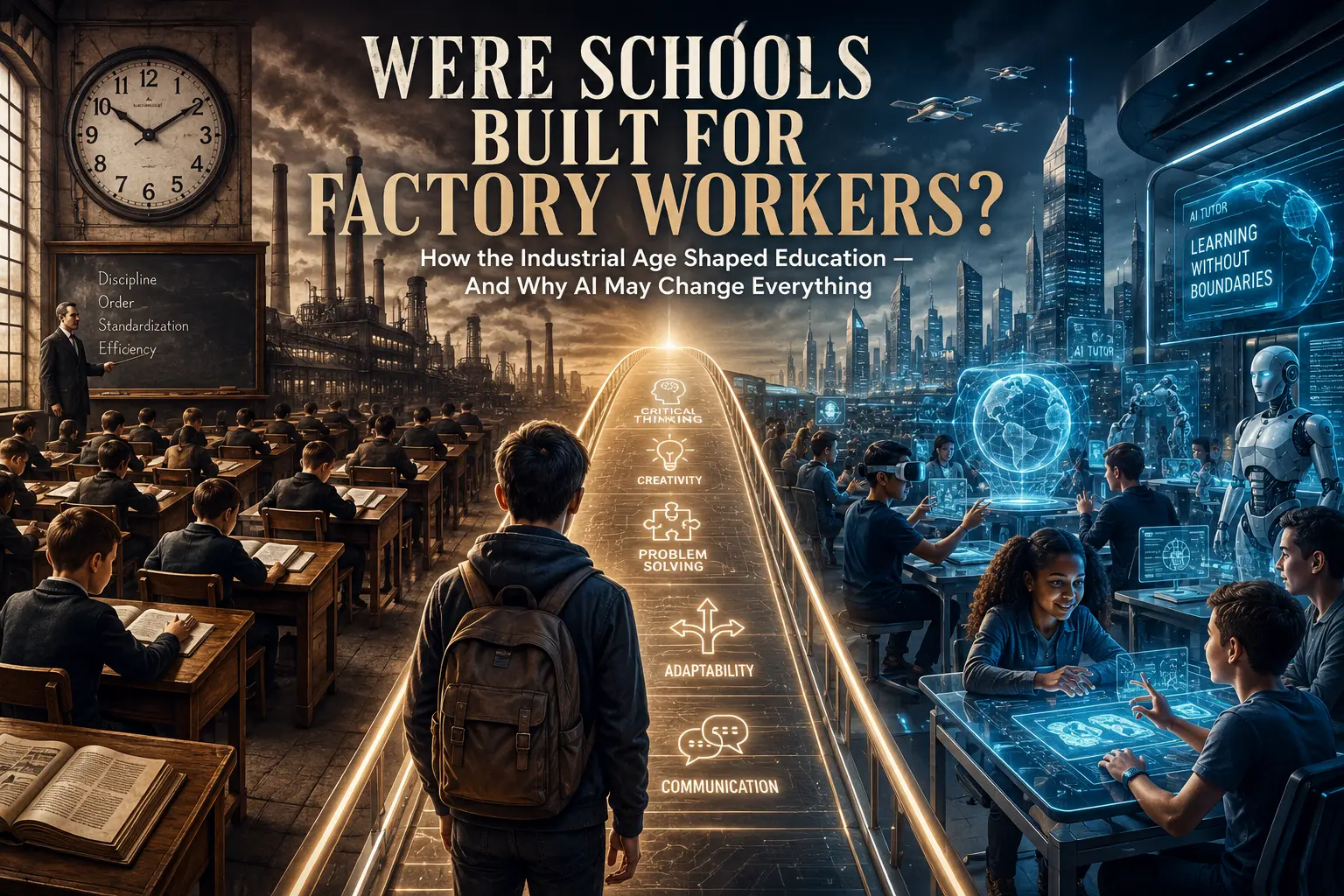
For generations, students around the world have followed a familiar path.
Go to school.
Sit in a classroom.
Follow a schedule.
Complete assignments.
Take exams.
Earn grades.
Graduate.
Find a career.
This system feels natural because it has existed for so long.
But a deeper question remains:
Why do schools operate this way?
Why do modern students still learn through models designed around older educational systems?
A popular idea suggests that modern schools were designed to create factory workers during the Industrial Revolution.
The reality is more complex.
Schools were not created only to produce laborers. Education has always served broader purposes, including literacy, citizenship, personal development, and social opportunity.
However, the Industrial Age strongly influenced modern education, creating systems focused on organization, efficiency, standardization, and measurable results.
Today, as artificial intelligence transforms the economy, a new question is emerging:
Can an education system shaped by the Industrial Age prepare students for the AI Age?
The Industrial Revolution Changed Education Forever
Before industrialization, formal education was often limited.
Many people learned through:
- Families
- Apprenticeships
- Religious institutions
- Local communities
As societies industrialized during the 18th and 19th centuries, public education expanded.
A growing economy needed more people who could:
- Read
- Write
- Calculate
- Communicate
- Understand basic information
Mass education helped create opportunities for millions of people.
The rise of modern schooling was connected to major social changes, including industrialization, urbanization, and the growth of modern economies.
Organizations such as UNESCO and OECD continue studying how education systems evolve alongside economic and technological changes.
Were Schools Really Built for Factory Workers?
The answer requires a deeper understanding.
The claim that schools were created only to produce factory workers is an oversimplification.
Education was developed for many reasons:
- Creating educated citizens
- Expanding literacy
- Increasing opportunity
- Supporting society
- Preparing people for different careers
However, industrialization influenced how schools were organized.
As societies became more industrial, education systems adopted structures that valued:
- Discipline
- Time management
- Organization
- Standardization
- Efficiency
These qualities were useful for industrial economies.
Myth vs Reality: The Factory School Debate
| Popular Claim | More Accurate Reality |
|---|---|
| Schools were created only for factory jobs | Schools developed for literacy, citizenship, opportunity, and economic needs |
| Students were trained only to become workers | Education also focused on knowledge, personal growth, and society |
| Classrooms copied factories exactly | Industrial society influenced schedules, structure, and standardization |
The stronger argument is:
Modern schools inherited structures from the Industrial Age, but their role goes beyond industrial preparation.
Why Schools Started Looking More Structured
Industrial societies needed systems that could educate large numbers of people.
Schools developed features that helped organize millions of students:
- Fixed schedules
- Classroom routines
- Age-based learning groups
- Standardized testing
- Defined subjects
For the Industrial Age, this model was effective.
It helped expand education and create a more educated workforce.
The challenge is that society has changed.
The World Changed Faster Than Schools
The Industrial Age rewarded:
- Repetition
- Efficiency
- Following procedures
- Consistency
The modern economy increasingly rewards:
- Creativity
- Critical thinking
- Communication
- Adaptability
- Problem-solving
Artificial intelligence is accelerating this shift.
AI can now:
- Generate written content
- Analyze information
- Translate languages
- Create images
- Automate repetitive tasks
The advantage is moving away from simply knowing information.
The advantage is knowing how to use information.
Industrial Age Education vs AI Age Education
| Industrial Age Focus | AI Age Focus |
|---|---|
| Memorizing information | Analyzing information |
| Following instructions | Solving complex problems |
| Standard answers | Creative solutions |
| Fixed career paths | Adaptability |
| Knowledge recall | Judgment and decision-making |
Why Critical Thinking Is Becoming More Important
In the past, education focused heavily on helping students access information.
Today, information is everywhere.
The challenge is determining:
- What is true?
- What is reliable?
- What should be trusted?
- How should information be used?
As explained in Why Critical Thinking May Become the Most Valuable Skill in the Age of AI, AI can find answers quickly, but people still need to think, question, and make choices.
Critical thinking may become one of the most valuable skills in the future economy.
Why Grades Alone Cannot Define Success
Traditional education has long placed academic achievement at the center of Success.
Grades can show:
- Effort
- Discipline
- Knowledge
- Academic ability
However, real-world achievement requires skills that exams cannot fully measure.
People also need:
- Communication skills
- Emotional intelligence
- Financial knowledge
- Decision-making ability
- Adaptability
This is why many graduates discover that academic achievement does not always equal life readiness.
As discussed in Why Good Grades No Longer Guarantee Success in Real Life, the modern world increasingly rewards skills beyond traditional academic performance.
The Skills Schools May Need To Teach More
Critical Thinking
The ability to analyze information and make sound decisions.
Creativity
The ability to think creatively and find solutions.
Communication
The ability to share ideas and cooperate effectively.
Emotional Intelligence
The ability to understand emotions, relationships, and human behavior.
Financial Literacy
The ability to manage real-world financial decisions.
Adaptability
The ability to continue learning as the world changes.
Why Some Education Systems Are Already Changing
Around the world, education systems are beginning to rethink traditional approaches.
Many are emphasizing:
- Collaboration
- Creativity
- Technology skills
- Real-world projects
- Problem-solving
Finland is often discussed as an example of an education system that focuses on meaningful learning, student well-being, and teacher quality.
Why Finland’s Students Spend Less Time in School Yet Still Succeed explores why this alternative approach has gained global attention.
The Future of Schools Is Not About Removing Education
The question is not whether schools are unnecessary.
Schools remain essential.
They provide:
- Knowledge
- Community
- Guidance
- Opportunity
The challenge is adapting education for a world where technology can perform more tasks than ever before.
The future may require schools to move from:
Teaching students what to remember
toward:
Teaching students how to think.
The Future of Learning Requires a Different Kind of Preparation
Were schools built for factory workers?
The most accurate answer is:
Not exactly.
Modern education developed for many reasons, but the Industrial Age influenced how schools became structured.
The challenge today is not the past.
It is the future.
A system shaped during the Industrial Revolution must now prepare students for a world of artificial intelligence, rapid technological change, and unpredictable careers.
The question is no longer:
“Were schools built for factories?”
The bigger question is:
“Can education systems evolve fast enough to meet future demands?”
Frequently Asked Questions (FAQs)
No. Schools were created for many purposes, including literacy, citizenship, and opportunity. Industrialization helped shape the way education systems operate today.
Because large education systems adopted structures that helped organize many students, including schedules, classrooms, and standardized assessments.
Education systems may need to adapt to the skills required in the modern world.
Critical thinking, communication, creativity, emotional intelligence, and adaptability are expected to become increasingly valuable.
No. AI changes what students need to learn, but education remains important for developing knowledge, judgment, and human abilities.
Technology, globalization, and changing workforce demands are pushing schools to focus more on future-ready skills.
No. Traditional subjects remain important. The challenge is combining knowledge with practical skills and real-world application.