
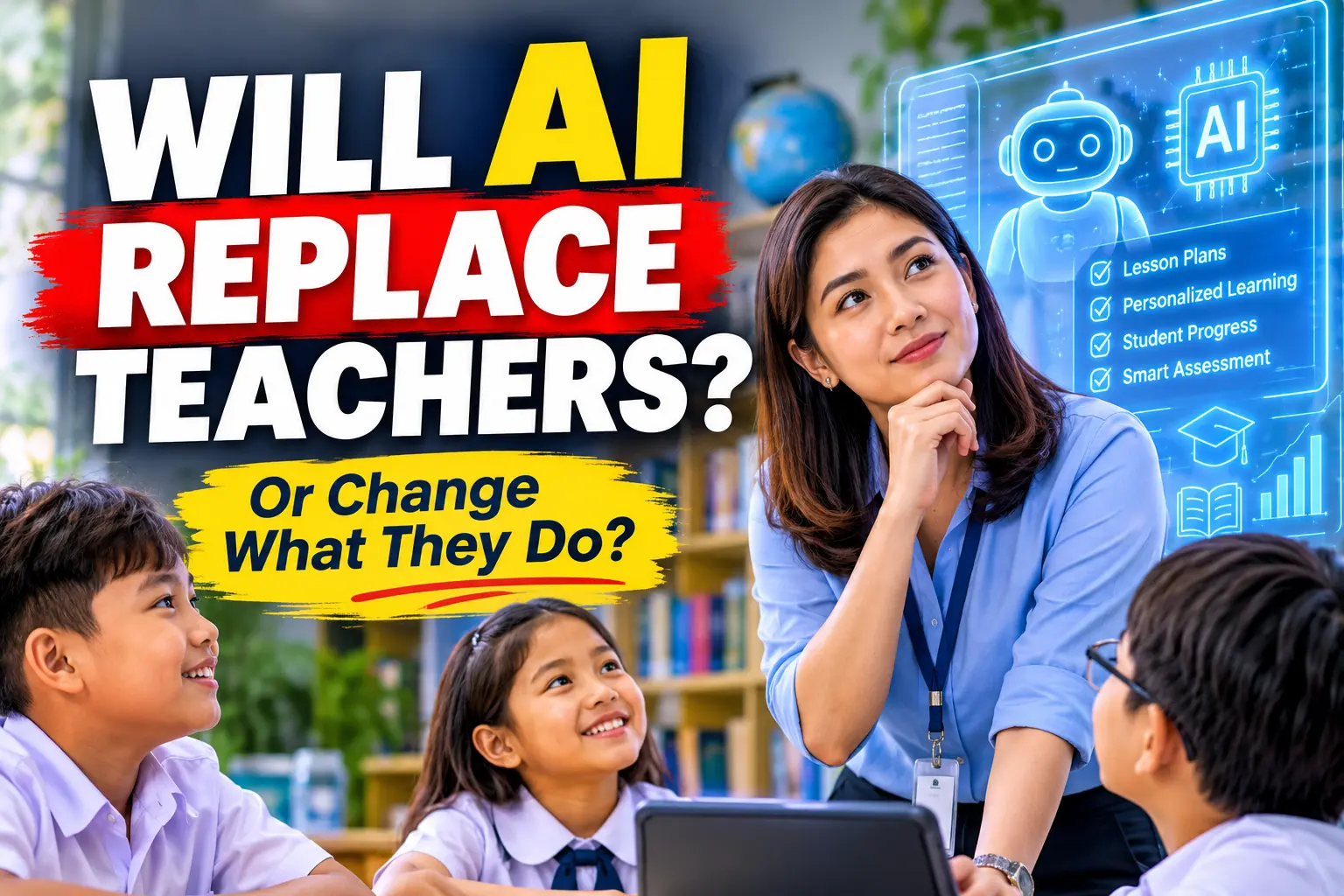
AI can now help plan lessons, explain concepts, and assess student work.
But teaching involves far more than delivering information.
Artificial intelligence is changing how people learn, work, and access information.
AI tools offer teachers several ways to support learning, from preparing lesson plans and explaining challenging subjects to creating exercises, translating materials, and reviewing student work.
More advanced systems can also adjust learning activities as students progress.
These capabilities raise an important question: if machines can perform more teaching-related tasks, will schools eventually need fewer human teachers?
The answer is not simply YES or NO.
AI can handle some tasks and help teachers with others, but teaching involves much more than technology can replace.
It involves professional judgement, classroom relationships, motivation, safeguarding, and an understanding of each learner’s circumstances.
Research published in 2026 suggests that educational automation is changing how teaching work is distributed.
The bigger question may not be whether teachers will disappear, but how their responsibilities will evolve—and whether schools will use AI to strengthen or weaken the teaching profession.
What Can AI Already Do in a Classroom?
AI systems can perform several tasks that previously required considerable teacher time. Their usefulness varies by subject, age group, software quality, and the way schools implement them.
For example, teachers can use AI to:
- Prepare lessons: Generate lesson outlines, discussion questions, examples, and classroom activities.
- Adapt learning materials: Simplify explanations, adjust reading levels, and create alternative exercises for students with different needs.
- Provide practice and explanations: Offer additional examples, answer questions, and guide students through selected problems.
- Support feedback: Identify possible errors in written work and suggest areas that need improvement.
- Organise information: Summarise learning materials, prepare reports, and assist with routine administrative tasks.
These uses can reduce some repetitive work and help teachers prepare materials more quickly. The OECD notes that teachers already use generative AI for lesson planning, learning about teaching topics, and marking student work.
However, faster production does not automatically mean better teaching. AI-generated explanations can contain mistakes, activities may not match curriculum requirements, and feedback may overlook the circumstances behind a student’s answer. Teachers still need to review the material and decide whether it is appropriate.
Which Teaching Tasks Could AI Take Over?
Tasks are easier to automate when they follow clear patterns and use well-organized information.
| Teaching task | How AI may contribute | Why teacher involvement still matters |
|---|---|---|
| Lesson preparation | Draft plans, examples, and activities | Teachers check curriculum alignment and learning needs |
| Practice exercises | Generate quizzes and question sets | Teachers choose suitable difficulty and learning goals |
| Basic feedback | Identify common errors and suggest corrections | Teachers interpret misunderstandings and provide guidance |
| Routine marking | Assist with objective or structured assessments | Teachers review accuracy, fairness, and context |
| Administrative work | Draft reports and organise information | Staff remain responsible for decisions and records |
| Learning progress | Summarise patterns in student performance | Teachers investigate what the data actually means |
This distinction is important. Automating a task is not the same as replacing the person responsible for the wider job.
A system may suggest that a student has misunderstood a mathematics concept. But a teacher can ask follow-up questions, notice a lack of confidence, consider language difficulties, or recognise that the student has missed several lessons.
AI can help identify a possible problem. It cannot automatically understand the full situation behind it.
Why Teaching Is More Than Delivering Information
One reason the debate over replacing teachers is complicated is that it often reduces teaching to the simple delivery of information.
But students do not learn only by receiving explanations. They also need encouragement, feedback, structure, discussion, correction, and opportunities to practise. Teachers guide students, encourage questions, and build an environment where learning can take place.
Consider a student who suddenly stops participating in class. An AI system might identify a decline in activity or test performance. A teacher might notice subtle changes in a student’s behavior, such as becoming withdrawn, dealing with family difficulties, or hesitating to speak for fear of making mistakes.
These situations require context and human interaction, not simply the analysis of available data.
Teachers also make professional decisions that affect students. Teachers use their judgment to adjust explanations, encourage deeper thinking, provide targeted support, and respond to challenges that affect learning beyond the classroom.
These responsibilities also raise questions about what makes someone an effective teacher. Beyond formal qualifications, practical experience, professional judgment, and understanding students all contribute to effective teaching.
The OECD’s 2026 discussion of AI in education highlights the risk that relying too heavily on automated feedback and assessment could weaken teacher-student relationships by reducing meaningful interaction. It argues that human judgement, relationships, and responsibility should remain central to education.
This doesn’t mean every task must stay manual. It means schools should be careful about automating work whose value depends on understanding the learner.
Research Suggests Teaching Work Is Being Redistributed
Recent research offers a clearer picture of how AI may affect teachers.
A September 2026 systematic review published in Frontiers in Education examined 58 empirical studies on educational automation and intelligent technologies. It found that technology primarily redistributed teaching tasks rather than replacing teachers. The review also highlighted the importance of teacher competence, professional agency, institutional support, and governance.
Another 2026 systematic review examined 79 empirical studies on teachers’ use of generative AI in pre-K–12 education. It found that instructional design and collaborative lesson planning were among the most prominent uses. The review described AI mainly as a tool supporting teachers’ professional practice, particularly during lesson preparation.
These findings are encouraging, but they should not be treated as proof that teaching jobs are protected from future automation. The research examines existing studies and practices; it does not establish what employment levels will look like in ten or twenty years.
The evidence instead points to a more immediate change: teachers may spend less time producing routine materials and more time selecting, checking, adapting, and supervising technology-assisted learning.
The Teacher’s Role May Become More Complex
As AI becomes more common in schools, teachers may take on responsibilities that were less central to traditional classroom instruction.
1. Learning designers
Teachers may increasingly decide how to combine classroom instruction, independent practice, digital resources, and AI-supported activities. Their role will involve designing learning experiences rather than simply preparing and delivering lessons.
2. Evaluators of AI-generated information
AI can produce convincing explanations that are inaccurate or incomplete. Teachers will need to check outputs, identify misleading information, and help students question what they read.
3. Guides for independent learning
Students may use AI to receive explanations or practise skills outside class. Teachers will need to help them use these tools without becoming dependent on ready-made answers.
4. Protectors of student welfare and privacy
Schools must consider how AI tools collect, process, and use student information. Teachers and school leaders will need clear policies to protect students and address inappropriate, misleading, or harmful AI-generated content.
5. Mentors and learning coaches
If AI reduces some routine work, teachers may have more opportunities to support individual learners, encourage persistence, discuss ideas, and provide personal guidance. Whether this actually happens will depend on how schools organise workloads and staffing.
These responsibilities require more than knowing how to write prompts. Using AI effectively requires more than knowing how to operate it. Teachers must also question its answers, recognize its limits, protect student privacy, and know when to leave it out of the learning process.
Will AI Make Teachers More Effective—or Add More Work?
AI is often promoted as a way to reduce teacher workload. That benefit is possible, but it is not guaranteed.
A teacher may save time by generating a worksheet in minutes. However, teachers must still review the questions, correct inaccuracies, adjust the difficulty, and ensure that the materials align with the curriculum, adding to their workload.
Schools may also introduce new responsibilities involving digital platforms, student data, AI policies, and technology-related troubleshooting. Without proper training and institutional support, teachers may find that managing AI tools adds to their workload rather than easing it.
OECD analysis of TALIS 2024 data found that approximately one-third of teachers used AI for work. Among those who used it, one in four reported using the technology to assess or mark student work. The OECD also noted that many teachers lacked formal policies or consistent training for these practices.
This shows why access to AI tools alone is not enough. Schools need to evaluate whether the technology genuinely improves teaching and learning, rather than simply adding another system for teachers to manage.
What Must Schools Do to Prepare Teachers?
If AI is changing teaching responsibilities, professional development cannot focus only on showing teachers how to use new applications.
UNESCO’s AI Competency Framework for Teachers identifies 15 competencies across five areas: a human-centred mindset, AI ethics, AI foundations and applications, AI pedagogy, and AI for professional learning. It also describes three progression levels: acquire, deepen, and create.
This approach recognises that teachers need both technical understanding and professional judgement.
Preparing teachers is only one part of the challenge. Schools must also help students understand how AI works, question the information it produces, recognise its limitations, and use it responsibly in their own learning.
Schools and education authorities should therefore:
- Provide practical training: Teachers need opportunities to use AI for real classroom tasks and evaluate its limitations.
- Protect professional judgement: AI recommendations should not automatically determine grades, disciplinary decisions, or important learning pathways.
- Establish clear privacy rules: Schools should understand what student data AI tools collect and how that information is handled.
- Provide reliable infrastructure: Teachers cannot use digital tools effectively when devices, connectivity, or technical support are inadequate.
- Measure actual results: Schools should examine whether AI improves learning, reduces workload, and supports students fairly.
- Include teachers in decisions: Educators should help select, test, and evaluate the tools they are expected to use.
The goal should not be to turn every teacher into a technology specialist. The priority should be to equip teachers to use AI responsibly while ensuring that they retain control over how it is integrated into teaching and learning.
Could Some Schools Eventually Employ Fewer Teachers?
It would be unrealistic to claim that AI will not affect teacher employment.
Some education providers may use automated platforms to deliver standardised lessons, provide basic tutoring, or handle routine feedback. Institutions facing financial constraints may view technology as a way to expand access to education without increasing their staffing levels.
The real question is not whether these tools can deliver information, but whether they can provide the quality of education that students receive from a well-supported teacher. Nor does it establish that reducing teacher numbers would improve learning outcomes.
The effects will likely differ across education systems. Schools with reliable technology, strong infrastructure, and well-trained staff may integrate AI differently from schools facing overcrowded classrooms, limited resources, or poor internet access.
Unequal access to AI technologies may reinforce existing disparities in educational opportunities and outcomes. Students in well-resourced schools may receive both human guidance and useful AI support, while disadvantaged learners could be left with automated instruction but limited personal assistance.
For this reason, education authorities should assess AI adoption not only by its cost or speed, but also by its effect on teaching quality, access, fairness, and student welfare.
What Does This Mean for the Future of Teaching?
AI will likely change how teachers work, but there is no clear evidence that human teachers will disappear from schools.
Routine tasks may become increasingly automated. Lesson preparation, practice activities, basic feedback, and administrative work could all involve more AI assistance. At the same time, teachers may need stronger skills in instructional design, evaluation, digital ethics, and the responsible use of educational technology.
These changes also raise broader questions about the future of traditional education. As AI takes on more learning-related tasks, schools may need to reconsider which parts of conventional classroom instruction remain essential and which could evolve.
The outcome will depend partly on decisions made by governments, schools, and education providers. The real difference lies in how schools choose to use AI: as a tool that strengthens teaching or as a way to cut costs and make instruction more uniform.
The most important question is therefore not simply whether AI can teach. It is whether schools can use AI without losing the human guidance, professional judgement, and relationships that make education meaningful.
Frequently Asked Questions (FAQs)
AI may automate some teaching-related tasks, but current research does not establish that it will replace teachers as a profession. Teaching also involves judgement, relationships, motivation, and responsibility.
AI can assist with lesson planning, generating exercises, explaining concepts, drafting feedback, organising information, and supporting some forms of assessment. Teachers still need to review its outputs and make important educational decisions.
AI tools can explain concepts and guide students through practice, but they cannot independently address the full range of learners’ educational, social, and emotional needs. Human supervision remains important, particularly for children.
It may reduce some repetitive tasks, but the result depends on implementation. Reviewing AI-generated materials, managing digital tools, and checking automated feedback can create additional work.
Teachers will need AI literacy, critical evaluation skills, knowledge of data privacy and ethics, and the ability to integrate AI into effective teaching practices. Strong classroom management and communication skills will remain essential.
AI can support structured assessments, but teachers must retain oversight of important grading decisions. Schools should check accuracy, fairness, transparency, and the effect on students before relying on automated marking.
Not necessarily. AI may change how teachers prepare lessons and support learning, but students still need human guidance, feedback, encouragement, and responsible supervision.
Research References
- OECD. Reimagining Teaching in an Accelerating World. Discusses how artificial intelligence is changing teachers’ work, including lesson preparation, assessment, workload, and professional judgement.
- Frontiers in Education. Teachers’ Use of Generative AI in K–12 Education: A Systematic Review (2026). Reviews research on how teachers use generative AI in primary and secondary education, including lesson planning and instructional support.
- Frontiers in Education. Transformation of the Teaching Role Through Educational Automation and Intelligent Technologies (2026). Examines how automation and intelligent technologies are changing teaching responsibilities and redistributing educational tasks.
- UNESCO. AI Competency Framework for Teachers. Outlines the knowledge and skills teachers need to use artificial intelligence responsibly and effectively in education.