

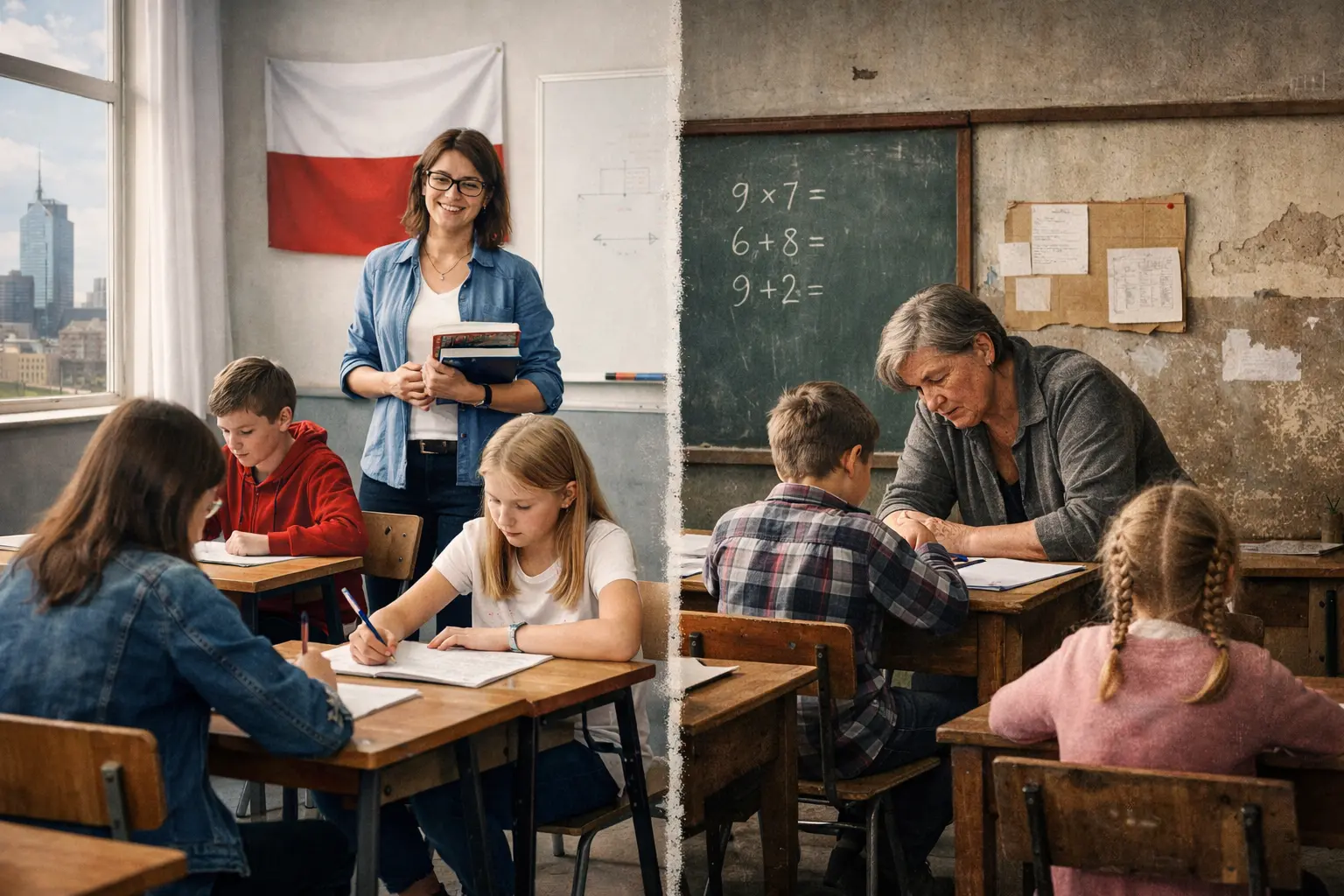
The Polish education system is a success.
International assessments remain strong. Graduation rates are high. Official indicators suggest the system is stable and competitive, a view supported by OECD reports and PISA results.
But education systems rarely collapse overnight.
Staffing pressures mount, governance becomes destabilized, demographics shift, and misaligned incentives gradually erode their effectiveness. When outcomes falter, the damage is already entrenched.
This guide outlines 10 warning signs suggesting that the Polish education system is under quiet but growing structural pressure.
Not a crisis.
Not a collapse.
But a system is at risk of long-term erosion.
| Public System | Core Failure | Primary Impact | Who Is Most Affected | Long-Term Risk |
|---|---|---|---|---|
| Public Education | Credential inflation, weak accountability | Low workforce skills | Students, employers | Productivity stagnation |
| Healthcare | Unequal access, underfunding | Preventable illness and death | Low-income populations | Human capital erosion |
| Justice | Selective enforcement | Loss of trust in law | Citizens, small businesses | Institutional decay |
| Social Welfare | Poor targeting, leakage | Persistent poverty | Vulnerable households | Social fragmentation |
| Infrastructure | Politicized projects | High logistics costs | Firms, commuters | Growth suppression |
| Tax & Revenue | Elite evasion, weak enforcement | Low state capacity | Compliant taxpayers | Fiscal instability |
| Policing | Coercive enforcement | Public fear, underreporting | Urban communities | Security breakdown |
| Housing and Urban Development | Unmanaged urban growth | Informal settlements | Urban poor | Chronic urban instability |
| Public Procurement | Cronyism, weak audits | Fiscal waste | Taxpayers | Corruption entrenchment |
| Civil Service | No merit-based incentives | Policy paralysis | General public | Reform failure |
Here are the Quiet Threats to Polish Education
1. Strong Test Scores Mask Structural Weakness
High scores measure outcomes, not system health.
They reveal what students know today, not whether the institutions producing those results can sustain quality tomorrow. Outcomes often lag structural decline by years.
Why it matters: Systems can appear healthy long after foundations begin to weaken.
References: OECD Education Reports, PISA Student Assessment
2. Teacher Pay No Longer Competes With the Labor Market
Teacher salaries have not kept pace with broader wage growth.
As a result:
- Fewer young graduates enter the profession
- The workforce continues to age
- Shortages grow in key subjects.
Why it matters: The impact of education depends less on content and more on the instructor.
Reference: World Bank Education Research
3. The Teaching Profession Is Losing Prestige
Beyond pay, teaching faces a declining social status.
Heavy workloads, administrative pressure, and limited opportunities for career advancement undermine long-term retention.
Why it matters:
Once a profession loses prestige, recovery can take decades.
4. Centralization Is Weakening School Autonomy
Curriculum and policy changes increasingly flow from the center.
Frequent reforms driven by political cycles create uncertainty and compliance-driven behavior.
Why it matters:
Stable systems depend on predictability, not constant redesign.
5. Urban–Rural Education Gaps Are Widening
Major cities attract talent and resources.
Smaller towns and rural areas face:
- Staffing shortages
- School consolidation
- Reduced subject availability
Why it matters:
Geographic inequality hardens into social immobility.
6. Curriculum Density Crowds Out Critical Skills
The curriculum remains content-heavy.
It leaves limited space for:
- Critical thinking
- Adaptability
- Practical problem-solving
Why it matters:
Labor markets reward flexibility more than memorization.
7. Student Stress Is Rising Beneath Stable Results
Academic pressure continues to increase.
School-based psychological support falls short of actual need.
Why it matters:
Burnout erodes human capital even when grades remain high.
8. Mental Health Support Lags System Demands
Counselors and psychologists are often overstretched or absent.
Early intervention gaps allow problems to compound.
Why it matters:
Education systems that neglect well-being sacrifice long-term resilience for short-term gains.
9. Demographic Decline Is Reshaping Access
Falling birth rates force school closures and consolidation.
Efficiency improves on paper, while access worsens locally.
Why it matters:
Demographic pressure tests equity and long-term planning.
10. The System Relies on Past Reforms
Current performance continues to benefit from reforms implemented years ago.
However, the conditions that enabled those reforms — teacher supply, institutional trust, demographic stability — are weakening.
Why it matters:
Past success does not guarantee future strength
What This Means Going Forward
Poland’s education system still functions.
That is precisely why its vulnerabilities are easy to ignore.
Strong outcomes today can coexist with weakening foundations. Systems decay quietly, then suddenly.
Poland’s education system is not failing, but ten structural warning signs suggest that long-term resilience is weakening beneath strong performance metrics.
Frequently Asked Questions (FAQs)
Is the Polish education system performing well?
Poland consistently ranks high in international assessments such as PISA. However, high test scores do not fully reveal underlying challenges, including teacher shortages, centralized governance, and student stress.
What are the main challenges facing Polish schools?
The system faces multiple pressures, including aging teachers, low pay and prestige, urban-rural disparities, curriculum overload, student stress, and demographic decline, all of which threaten its long-term sustainability.
Why are teacher shortages a concern in Poland?
Teacher shortages result from an aging workforce, limited inflow of young educators, and stagnant salaries. It impacts classroom quality, student outcomes, and the long-term stability of the education system.
How does urban-rural inequality affect education in Poland?
Urban schools enjoy better staffing, resources, and programs, whereas rural schools struggle with fewer subjects, school consolidations, and less qualified staff, deepening long-term social and economic gaps.
Does Polish education focus too much on exams?
Yes. Overemphasis on standardized testing and academic content can suppress critical thinking, creativity, and the practical skills essential for modern careers.
How does student stress impact Polish education?
Rising academic pressure without adequate mental health support leads to burnout and anxiety. High-performance masks these hidden risks, which erode long-term human capital.
Is the Polish education system sustainable in the long term?
Although current outcomes reflect past reforms, structural weaknesses—such as teacher shortages, governance challenges, and demographic decline—jeopardize future resilience.
How can Poland strengthen its education system?
Solutions include higher teacher pay and clear career pathways, decentralized governance, curricula aligned with labor-market needs, support for student well-being, and measures to reduce urban-rural disparities.
- Why More Asians Are Choosing Poland for University Studies
- Is K–12 Delivering Results in the Philippines—or Just Adding Costs?
- The Hidden Crisis in Global Education Systems
- 10 Countries Where Education Is Changing the Fastest