
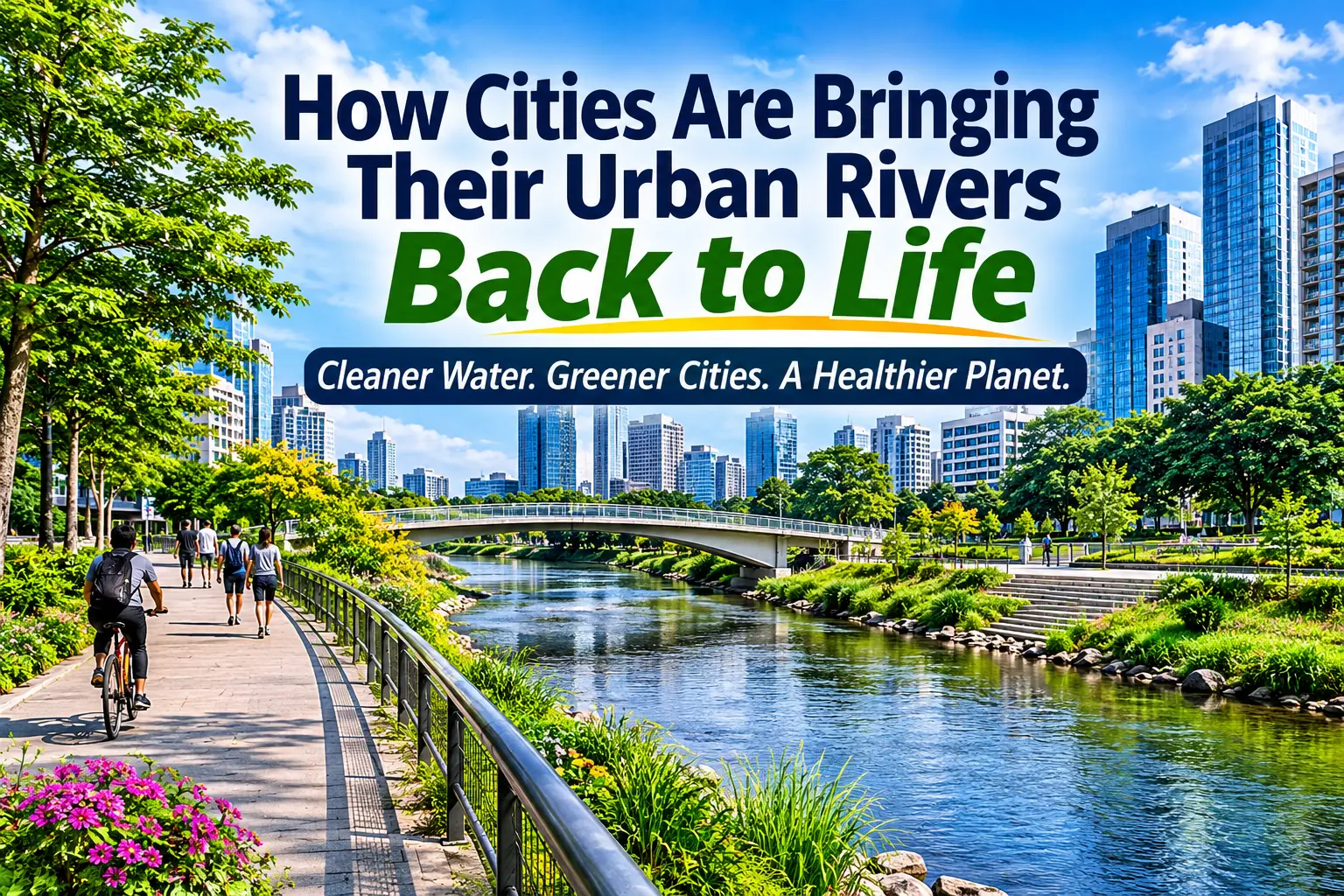
For generations, rivers helped cities grow.
They provided water, supported trade, connected communities, and shaped neighborhood development.
But as cities expanded, many rivers became little more than drainage channels or industrial waterways.
Wastewater, plastic pollution, concrete embankments, and uncontrolled development damaged natural habitats and pushed communities away from the water.
Some rivers were even buried beneath roads and buildings.
That relationship is beginning to change.
Across the world, cities are investing in river restoration projects to improve water quality, restore natural habitats, reduce flood risks, and make waterways accessible to residents again.
River restoration takes many forms.
Certain restoration projects involve dechannelization, replacing artificial concrete channels with more natural river systems.
Others focus on cleaning polluted water, restoring riverbanks, creating wetlands, or reconnecting waterways with surrounding parks and neighborhoods.
The results also vary.
A beautiful riverside promenade does not automatically mean a healthy river. Genuine restoration requires improvements to the water, the surrounding ecosystem, and the way the city manages its waterways.
These five examples show how cities are using different approaches to address river pollution, restore ecosystems, and improve urban environments.
1. Seoul, South Korea: Bringing a Buried Stream Back Into the City
The approach: Removing major road infrastructure and restoring an urban waterway
For decades, the Cheonggyecheon Stream in central Seoul remained buried beneath roads and an elevated highway. What had once been an important natural waterway became covered by infrastructure as the city expanded.
That changed in the early 2000s.
Between 2003 and 2005, Seoul removed the elevated highway and carried out a major project to restore the stream. The redevelopment created a long public corridor with walking paths, bridges, water features, and landscaped areas.
Where traffic once dominated the landscape, flowing water and pedestrian paths now offer a different experience in the heart of Seoul.
The project also demonstrated how removing outdated infrastructure can create opportunities for environmental improvements and public space.
However, the restored stream is not simply a return to its original natural condition. Maintaining water levels requires an engineered system, and the project has faced questions about long-term maintenance, energy use, and the wider effects of its redevelopment.
What makes it notable: Seoul showed that a covered urban waterway could become a visible part of city life again, even in a densely developed downtown area.
Source: Seoul Metropolitan Government — Cheonggyecheon Stream Restoration
2. Munich, Germany: Giving the Isar River More Room to Flow
The approach: Restoring natural river features while improving flood protection
During the nineteenth and twentieth centuries, urban development and flood-control projects significantly altered sections of the Isar River as it passed through Munich.
Sections of the river were straightened and reinforced with concrete and stone embankments. These changes helped control the river, but they also reduced its natural character and limited the space available for water during high flows.
The Isar Plan, a major restoration initiative launched in the 1990s, took a different approach.
Instead of relying entirely on rigid riverbanks, the project redesigned sections of the river to create a more natural landscape. The work included widening the riverbed, introducing gravel banks and islands, creating shallow and deeper water areas, and improving habitats for wildlife.
These changes also supported flood management by giving the river more space to carry water.
The project was completed in 2011 after restoration work began in 2000.
The result is a river corridor that combines ecological improvements, recreational opportunities, and flood protection.
What makes it notable: Munich demonstrates that restoring a river’s natural features can support both environmental goals and practical water management.
Source: European Environment Agency — Isar Plan: Water Management and Restoration of the Isar River
3. Singapore: Turning a Concrete Canal Into a Natural River Landscape
The approach: Combining urban drainage, river naturalization, and public green space
Singapore has long faced the challenge of managing water in a densely populated city with limited land.
Bishan-Ang Mo Kio Park in Singapore provides a practical example of how river restoration can be incorporated into urban park design.
The Kallang River once ran through the area inside a concrete channel built to carry stormwater. Although the structure served an important purpose in managing stormwater, it offered limited opportunities for natural river habitats and public interaction with the water.
As part of Singapore’s Active, Beautiful, Clean Waters programme, the canal was transformed into a more natural river landscape.
The project introduced a meandering waterway, landscaped riverbanks, open green spaces, and areas where residents can enjoy the surroundings.
It also retained the river’s role in stormwater management. During heavy rainfall, the wider landscape provides space for water to flow through the park.
This is an important distinction: the project did not simply turn a drainage channel into a decorative stream. It redesigned the waterway as part of a larger urban system.
What makes it notable: Bishan-Ang Mo Kio Park shows how cities can combine drainage infrastructure, natural river features, and public recreation within one landscape.
Source: Active, Beautiful, Clean Waters (ABC Waters) Programme
4. Los Angeles, United States: Reimagining a River Built Around Flood Control
The approach: Restoring habitats while maintaining essential flood protection
The Los Angeles River has a very different history.
Following repeated floods, the river underwent a major transformation, with concrete replacing much of its natural banks to help contain rising water levels.
These flood-control measures reduced risks to surrounding communities but significantly altered the river’s ecosystem by restricting natural habitats and ecological processes.
Today, Los Angeles is pursuing a longer-term effort to change that relationship.
The Los Angeles River Revitalization Master Plan guides projects intended to improve the river corridor through habitat restoration, public spaces, recreational routes, and better connections with surrounding neighborhoods.
One major effort is the Los Angeles River Ecosystem Restoration Project, led by the U.S. Army Corps of Engineers in partnership with local authorities.
The project focuses on an approximately 11-mile stretch of the river and aims to restore more than 700 acres of riparian habitat while maintaining the existing level of flood protection.
Proposed work includes removing sections of concrete, restoring wetlands and natural river features, and reconnecting parts of the river with its historic floodplain.
This is a complex undertaking. The river cannot simply be returned to its original condition because it passes through a large, heavily developed metropolitan area.
What makes it notable: Los Angeles is attempting to balance ecological restoration with the flood-control infrastructure that protects a major urban population.
Source: USACE – Los Angeles River Ecosystem Restoration
5. Manila, Philippines: The Long Effort to Rehabilitate the Pasig River
The approach: Improving water quality while reconnecting communities with a historic waterway
The Pasig River has been central to Manila’s historical, economic, and urban development.
For generations, it supported transportation, trade, and communities along its banks. But rapid urban growth, wastewater discharge, improper waste disposal, and industrial pollution contributed to its environmental decline.
Efforts to rehabilitate the river have continued for decades, and the challenge remains significant.
The Philippine government’s Pasig River Rehabilitation Program focuses on improving water quality, reducing pollution, monitoring wastewater discharges, and coordinating cleanup activities across the river system.
More recently, the Pasig Bigyang Buhay Muli initiative has added another dimension to the effort.
Beyond improving the river itself, the programme seeks to bring people closer to the water through new walkways, public spaces, and riverfront facilities.
In 2025, the government continued expanding the project, including improvements around Plaza Mexico and the Intramuros area.
Although these developments improve public access and recreational opportunities, they should be distinguished from broader efforts to restore the river’s ecological health.
Cleaning the water, controlling pollution at its sources, improving wastewater treatment, and restoring aquatic habitats remain essential. Without sustained progress in these areas, attractive riverfront spaces alone cannot bring the Pasig River back to a healthy condition.
What makes it notable: The Pasig River illustrates how river rehabilitation requires more than construction. It depends on long-term pollution control, government coordination, environmental monitoring, and public participation.
What Successful Urban River Restoration Requires
These projects have different goals and levels of progress, but they reveal several important principles.
1. Cleaning the water must come first
A river cannot recover properly while untreated wastewater, industrial discharge, and unmanaged waste continue entering its system.
Cities need reliable wastewater treatment, regular water-quality monitoring, pollution enforcement, and better waste management.
Clearing rubbish from a river makes a visible difference, but it does not solve the deeper problems behind water pollution.
2. Rivers need room to function naturally
Concrete channels and rigid embankments can restrict how rivers behave.
Where conditions allow, widening river corridors, restoring wetlands, creating floodplains, and reintroducing natural riverbank vegetation can improve habitats and provide more space for floodwater.
These measures must be designed around local geography and flood risks rather than applied as a universal solution.
3. Wildlife habitats should be part of the plan
Healthy rivers support more than fish.
They provide habitats for aquatic insects, birds, amphibians, plants, and other wildlife. Restoring vegetation along riverbanks can also create ecological connections between otherwise separated green spaces.
A river project should therefore measure environmental progress, not just the number of trees planted or parks constructed.
4. Flood protection and restoration can work together
Urban rivers are often expected to carry large volumes of rainwater during storms.
This responsibility should remain central to every river restoration effort. Floodplains, wetlands, wider channels, and nature-based solutions can sometimes help manage water while supporting biodiversity.
However, these approaches do not eliminate flood risk. Cities still need appropriate drainage systems, warning systems, and protective infrastructure.
5. Local communities must remain involved
People living near rivers are directly affected by pollution, flooding, redevelopment, and changes in public access.
Their participation can help cities identify local problems, protect public spaces, monitor environmental conditions, and maintain restoration projects over time.
River rehabilitation is more likely to last when nearby communities see its benefits and have a meaningful role in protecting it.
Why Urban River Restoration Matters for the Future of Cities
Restoring rivers is about more than making cities look greener.
Restored waterways can bring several benefits to cities, from supporting wildlife and reducing flood risks to giving residents more opportunities to enjoy nature and connect with nearby communities.
They can also help cities respond to environmental pressures associated with urban growth and climate change.
These changes are part of a larger rethink of urban planning, with rivers taking on a more prominent role as cities reconsider how their spaces and infrastructure should serve residents.
This is also reflected in the wider movement to redesign urban waterfronts. Another part of urban renewal is giving neglected city spaces new purposes by turning them into places where communities can gather and connect. Places once defined by industrial activity or abandonment are taking on new identities as green spaces, cultural destinations, and community gathering areas. Our article, 10 Abandoned Places That Have Been Given a Second Life, examines examples of how these neglected places have been transformed for new purposes.
But river restoration goes a step further. It asks whether the water itself is becoming cleaner, whether natural habitats are recovering, and whether the river can function more safely within the city.
That environmental focus also connects with the ideas discussed in 10 Cities That Are Redesigning Urban Life for the Future, where urban planning increasingly considers green infrastructure, public spaces, and more sustainable ways of living.
The most successful projects will not necessarily be the ones with the most impressive promenades or the biggest redevelopment budgets. They will be the ones that produce lasting improvements for both people and nature.
Frequently Asked Questions (FAQs)
Urban river restoration refers to efforts to improve the ecological condition and function of rivers affected by pollution, artificial channel modifications, infrastructure development, and other pressures associated with urban growth. It can involve cleaning the water, restoring natural riverbanks, rebuilding habitats, and improving flood management.
Cities have often used concrete channels to control water flow, reduce erosion, manage drainage, and protect developed areas from flooding. The problem is that these structures can make it harder for wildlife to thrive and prevent rivers from functioning naturally.
Some polluted rivers can recover significantly through sustained pollution control, wastewater treatment, habitat restoration, and regular monitoring. The success of restoration efforts ultimately depends on the scale of ecological damage, the nature of pollution sources, and the consistency of government policies and community involvement.
It can help manage flood risks when projects restore floodplains, widen river channels, protect wetlands, and create space for excess water. However, river restoration alone cannot eliminate flooding, especially during extreme rainfall.
Munich’s Isar Plan and Seoul’s Cheonggyecheon project are notable examples of urban river restoration and revitalization. They demonstrate different approaches, from restoring natural river features to bringing a buried stream back into public view.
Yes. The Philippine government continues to implement rehabilitation efforts through pollution control, cleanup activities, water-quality monitoring, and riverfront development. However, the river still faces significant environmental challenges, and public-space improvements should not be mistaken for complete ecological recovery.
Residents can help by disposing of waste properly, avoiding the discharge of harmful substances into drains and waterways, participating in local cleanup activities, reporting illegal dumping, and supporting community-based environmental programmes.