
Some islands are famous for their beautiful beaches, tropical landscapes, and crystal-clear waters.
Others are remembered for something far more extraordinary: ancient civilizations, unusual wildlife, forgotten industries, and traditions that have survived for centuries.
Across the world’s oceans, islands have developed remarkable identities shaped by their geography and the people who call them home.
Some became important centres of scientific discovery, while others grew into trading settlements, cultural landmarks, and places of religious significance.
A few preserve stories that are difficult to imagine today, from enormous stone statues created by ancient communities to women who make their living diving underwater without oxygen equipment.
These ten islands reveal how geography, history, and human creativity have created places unlike anywhere else on Earth. Their stories also connect with other places around the world that seem almost impossible to live in, where communities have adapted to extraordinary environments.
1. Socotra, Yemen: The Island With Trees That Look Like Umbrellas
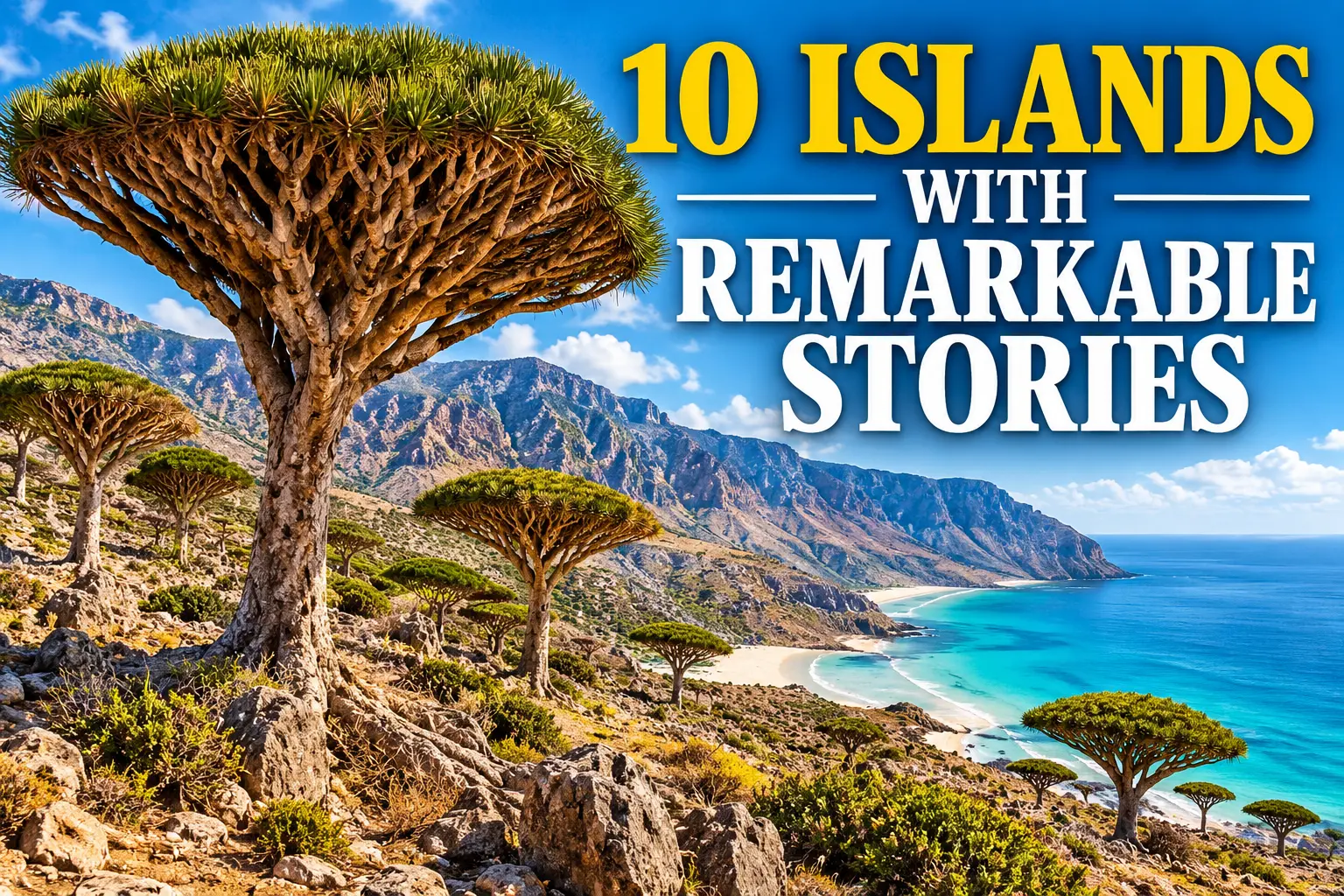
Socotra looks unlike almost anywhere else on Earth. Located in the Arabian Sea near the Horn of Africa, this Yemeni island is famous for its unusual plants, especially the dragon’s blood tree, with its distinctive umbrella-shaped branches.
The tree gets its name from its dark red resin, traditionally known as dragon’s blood. The substance has long played a role in traditional practices, adding to the plant’s cultural significance.
Socotra’s unusual appearance is not simply the result of its distinctive trees. The archipelago has developed an exceptional range of plants and animals through its long geographical isolation.
According to UNESCO, approximately 37% of its plant species, 90% of its reptile species, and 95% of its land snail species are found nowhere else on Earth. These figures make Socotra one of the world’s most important places for island biodiversity.
The island is also home to communities with a distinctive cultural heritage, including the Soqotri language, which remains closely connected to the island’s identity.
Socotra shows how geographical isolation can shape distinctive natural environments and allow unique cultural traditions to develop over generations.
Source: UNESCO – Socotra Archipelago and UNESCO – Socotra Biosphere Reserve.
2. The Galápagos Islands, Ecuador: Where Wildlife Helped Change Science
Located far west of mainland Ecuador, the Galápagos Islands provide valuable opportunities to study evolution, biodiversity, and ecological processes.
The Galápagos’ unique species provided important observations that helped Charles Darwin develop his theory of evolution by natural selection.
Darwin visited the islands in 1835 during the voyage of HMS Beagle. He observed differences among animals living on separate islands, including finches and other species adapted to their particular environments. These observations later contributed to Darwin’s understanding of how species evolve over successive generations.
The archipelago is especially famous for its giant tortoises, marine iguanas, flightless cormorants, and distinctive finches. Many of these animals developed characteristics suited to the islands’ different habitats.
The Galápagos are also geologically fascinating. Volcanic activity formed the islands, and some still experience eruptions and other geological changes.
UNESCO recognizes the archipelago as a remarkable example of ongoing ecological and evolutionary processes. Its surrounding marine environment also supports an extraordinary variety of wildlife.
Today, conservation is essential to protecting the islands. Human activities continue to disrupt the fragile ecosystem, with invasive species, tourism pressures, and illegal fishing among its major threats.
The Galápagos are known for more than their remarkable wildlife. They are a living reminder of how nature can shape scientific understanding.
Source: UNESCO – Galápagos Islands
3. Rapa Nui, Chile: The Island of the Enormous Stone Statues
Located thousands of kilometres off mainland Chile in the southeastern Pacific Ocean, Rapa Nui is internationally known as Easter Island.
The island is famous for its enormous stone statues called moai. Created by the ancestors of the Rapa Nui people, these figures represent one of the most extraordinary achievements in Polynesian cultural history.
Between approximately the 11th and 17th centuries, island communities created hundreds of these monumental figures. Many stood on ceremonial platforms known as ahu, forming a distinctive cultural landscape that continues to draw visitors from around the world.
UNESCO estimates that approximately 900 moai are found across the island, together with hundreds of ceremonial platforms and thousands of archaeological structures.
One particularly remarkable location is Rano Raraku, a volcanic quarry where many of the statues were carved. Some remain unfinished, providing valuable evidence of how the ancient stone sculptures were produced.
However, Rapa Nui’s history extends far beyond its famous monuments. European contact brought profound changes to Rapa Nui, as introduced diseases, forced displacement, and colonial pressures contributed to a sharp decline in its Indigenous population during the 19th century.
Today, the Rapa Nui people continue to maintain their cultural identity and protect their ancestral heritage.
The island’s statues are not simply mysterious tourist attractions. They represent the artistic achievements, beliefs, and history of a Polynesian society.
Source: UNESCO – Rapa Nui National Park
4. Lamu Island, Kenya: A Living Town Shaped by Centuries of Trade
Lamu Island, part of Kenya’s coastal archipelago, contains an important historic Swahili settlement shaped by centuries of Indian Ocean commerce and cultural interaction.
Its old town preserves a remarkable collection of traditional buildings, narrow streets, courtyards, and elaborately carved wooden doors. Many structures were built using coral stone and mangrove timber, reflecting construction techniques developed over generations.
Lamu became an important trading centre along the East African coast. Its history reflects centuries of interaction between African, Arab, Persian, Indian, and European communities.
These connections influenced the island’s architecture, religious practices, language, and everyday culture.
Unlike many historic settlements that gradually lost their original character, Lamu has remained continuously inhabited for more than 700 years.
The town is also an important centre of Islamic and Swahili culture. Religious celebrations and cultural festivals continue to connect present-day residents with traditions passed down through generations.
UNESCO recognized Lamu Old Town as a World Heritage Site in 2001 because of its exceptional cultural and architectural significance.
Walking through its streets offers a glimpse into a period when maritime trade connected distant communities across the Indian Ocean.
Source: UNESCO – Lamu Old Town
5. Jeju Island, South Korea: The Women Who Dive Without Oxygen Tanks
Jeju Island combines striking volcanic scenery and rugged coastlines with cultural traditions that distinguish it from mainland South Korea. However, one of its most remarkable stories belongs to a community of women known as the haenyeo.
These traditional female divers collect seafood such as abalone, sea urchins, and shellfish from the surrounding waters without using oxygen tanks.
They rely on specialized breathing techniques, physical endurance, and generations of knowledge about marine conditions. Some experienced divers continue working well into their 80s.
The tradition developed partly because fishing and diving became important sources of income for island households. Over time, women became central figures in Jeju’s coastal economy and communities.
Haenyeo divers also developed a strong culture of cooperation. They share knowledge, organize their work through community associations, and follow practices that help manage local marine resources.
Before setting out to sea, some divers offer traditional prayers to Jamsugut, the sea goddess, seeking protection and a successful catch.
UNESCO recognized the Culture of Jeju Haenyeo as Intangible Cultural Heritage in 2016, acknowledging its importance to the island’s identity and the remarkable knowledge passed between generations.
Their story shows how an island community can develop a distinctive way of life through its relationship with the surrounding ocean.
Source: UNESCO – Culture of Jeju Haenyeo
6. Tanna Island, Vanuatu: Where an Active Volcano Meets a Living Cultural Tradition
In the South Pacific, Tanna Island offers an unusual combination of volcanic activity and living cultural traditions.
Its most famous natural attraction is Mount Yasur, an active volcano known for its frequent eruptions and glowing volcanic crater. Its ongoing volcanic activity has made it one of Vanuatu’s most recognisable natural landmarks.
Yet Tanna’s story extends beyond its dramatic landscape.
The island is home to communities that continue to maintain traditional customs known locally as kastom. They play an important role in maintaining social bonds, organising ceremonies, strengthening village life, and preserving traditional knowledge.
One of the island’s most unusual cultural movements is associated with John Frum, a figure connected to a movement that developed around the Second World War.
The movement became closely associated with expectations of receiving Western goods and the arrival of American military forces in the Pacific. Its followers continue to hold commemorative gatherings, including celebrations on February 15, known as John Frum Day.
Tanna is also known for traditional ceremonies such as the Toka Festival, which brings communities together through dancing, feasting, and exchanges of gifts.
The island illustrates how modern history, traditional beliefs, and ongoing volcanic activity can shape life in the same place.
Source: Vanuatu Tourism Office – Cultural Information on Tanna
7. Zanzibar, Tanzania: An Island Shaped by Indian Ocean Trade
Just off Tanzania’s eastern coast, Zanzibar has a fascinating past shaped by traders, travellers, and cultural influences from around the world.
Its historic centre, Stone Town, became a major trading hub linking East Africa with communities throughout the Indian Ocean.
Merchants from Africa, Arabia, India, and Europe helped shape the island’s cultural identity and architectural heritage. Their influence remains visible in its mosques, churches, traditional houses, markets, and distinctive carved wooden doors.
Zanzibar also played a significant role in the history of the East African slave trade. During the 18th and 19th centuries, it became one of the region’s major centres for the trade in enslaved people.
The abolition of this trade became an important part of the island’s later history. Stone Town contains historical sites that preserve evidence of this difficult period and the campaigns against slavery.
Another important part of Zanzibar’s identity is its spice industry. Cloves became a major agricultural product, helping establish its international reputation as the Spice Island.
UNESCO designated Stone Town a World Heritage Site in 2000 for its cultural heritage and historical importance.
Zanzibar demonstrates how islands can become important hubs for trade, migration, and cultural exchange.
Source: UNESCO – Stone Town of Zanzibar
8. Island of Mozambique, Mozambique: A Former Capital at the Crossroads of Ocean Trade
Its strategic position off Mozambique’s northern coast made the island an important part of the Indian Ocean’s historic trading networks.
During the colonial period, Mozambique Island developed into a major Portuguese centre for trade and colonial administration. Between 1507 and 1898, it served as the seat of Portuguese colonial government before the capital was transferred to Lourenço Marques, now known as Maputo.
Its strategic location made it valuable to traders, sailors, and colonial authorities moving across the Indian Ocean.
The island’s architecture reflects this complicated history. Its historic settlement contains stone buildings, fortifications, churches, and other structures influenced by African, Arab, Swahili, and Portuguese traditions.
One of its most notable landmarks is the Fortress of São Sebastião, a historic defensive structure built between 1558 and 1620.
The island also features two distinct architectural areas: Stone Town, known for its stone-and-lime buildings, and Makuti Town, where traditional homes have palm-leaf roofs.
UNESCO recognized the Island of Mozambique as a World Heritage Site in 1991 because of its exceptional architectural and historical significance.
Today, the island offers a remarkable glimpse into the centuries when maritime trade connected distant continents and transformed coastal communities.
Source: UNESCO – Island of Mozambique
9. Skellig Michael, Ireland: The Island Where Monks Built a Monastery Above the Atlantic
Rising from the Atlantic Ocean off Ireland’s southwestern coast, Skellig Michael is home to one of Europe’s most remarkable early medieval monastic settlements.
Christian monks settled on the rocky island to pursue a secluded religious life. They built a monastery on steep terraces overlooking the ocean, using stone structures that remain part of the island’s historic landscape.
The settlement includes distinctive beehive-shaped stone huts, small places of worship, and carefully constructed stairways connecting different parts of the island.
No exact founding date has been established, although written records show that the monastery existed by the late 8th century. It was dedicated to Saint Michael sometime between 950 and 1050.
The monks lived in a demanding environment, relying on the island’s limited resources and the surrounding ocean. The island’s exposed setting made everyday life difficult, particularly in harsh weather.
The community moved to the mainland by the late 12th century as maritime conditions became more challenging. However, the island remained an important religious site.
UNESCO recognized Skellig Michael as a World Heritage Site in 1996, highlighting it as an exceptional example of early medieval monastic architecture.
Today, its remarkably preserved stone structures offer a glimpse into the lives of religious communities that once chose some of Europe’s most isolated locations for spiritual devotion.
Source: UNESCO – Skellig Michael
10. Hashima Island, Japan: The Abandoned Island That Once Held Thousands of Residents
Off the coast of Nagasaki, Japan, lies a small abandoned island whose appearance resembles a giant battleship.
Officially known as Hashima, the island is commonly called Gunkanjima, or Battleship Island, because its distinctive outline resembles a warship.
Hashima became a major coal-mining centre in the late 19th and 20th centuries. Its mines supplied coal for Japan’s growing industries and brought thousands of workers and their families to the island.
Increased mining activity led to the development of residential buildings, schools, commercial establishments, and supporting infrastructure within the island’s limited space.
At its peak in 1959, approximately 5,300 people lived on this relatively small island. Its dense concrete buildings created an unusual urban environment surrounded by the sea.
However, demand for coal eventually declined as Japan’s energy needs changed. As Japan shifted toward petroleum, the mine became less viable. When it closed in January 1974, residents left the island, transforming a once-busy industrial community into an abandoned settlement.
Hashima is also part of a wider story of abandoned settlements finding new purposes. Around the world, several abandoned places that have been given a second life have been repurposed as cultural destinations, public spaces, and heritage attractions.
Hashima later became part of the UNESCO-listed Sites of Japan’s Meiji Industrial Revolution, recognized for its connection to the country’s rapid industrial development.
Today, its deteriorating buildings stand as a reminder of how an entire community can fade away when the industry that sustained it disappears.
Visitors can now access the island through authorised guided tours, although visits remain subject to weather conditions and safety restrictions.
Source: Japan National Tourism Organization – Hashima Island and UNESCO – Sites of Japan’s Meiji Industrial Revolution
Frequently Asked Questions (FAQs)
Socotra, a Yemeni island in the Arabian Sea, is particularly famous for its dragon’s blood trees. Their unusual umbrella-shaped crowns and distinctive red resin make them one of the island’s most recognisable plant species.
The Galápagos Islands are especially well known for giant tortoises, marine iguanas, and distinctive bird species. Socotra is also important for its exceptionally high number of endemic plants and animals.
Easter Island, known by its indigenous name Rapa Nui, is famous for its enormous stone statues called moai. Polynesian communities created these monuments hundreds of years ago.
Jeju Island in South Korea is home to the haenyeo, traditional female divers who collect seafood underwater without oxygen equipment.
Zanzibar became a major centre of Indian Ocean trade, connecting East Africa with Arabia, India, and other regions. Its history also includes the spice industry and the East African slave trade.
Hashima Island in Japan once supported a large mining community. The settlement reached a population of approximately 5,300 in 1959, before the coal mine closed in 1974.
Skellig Michael in Ireland preserves an early medieval monastery built by Christian monks on a remote rocky island in the Atlantic Ocean.
Islands may receive UNESCO recognition because of their exceptional biodiversity, archaeological remains, traditional architecture, or importance to human history and culture. Such recognition helps encourage their preservation for future generations.
Islands are more than landmasses separated from the mainland by water. They can preserve unique ecosystems, protect centuries-old traditions, and reveal important chapters of human history. From Socotra’s extraordinary plants to Hashima’s abandoned industrial buildings, each island tells a different story about the relationship between people and their environment.
From remote islands to isolated communities, these destinations reveal stories that are as remarkable as the places themselves.