

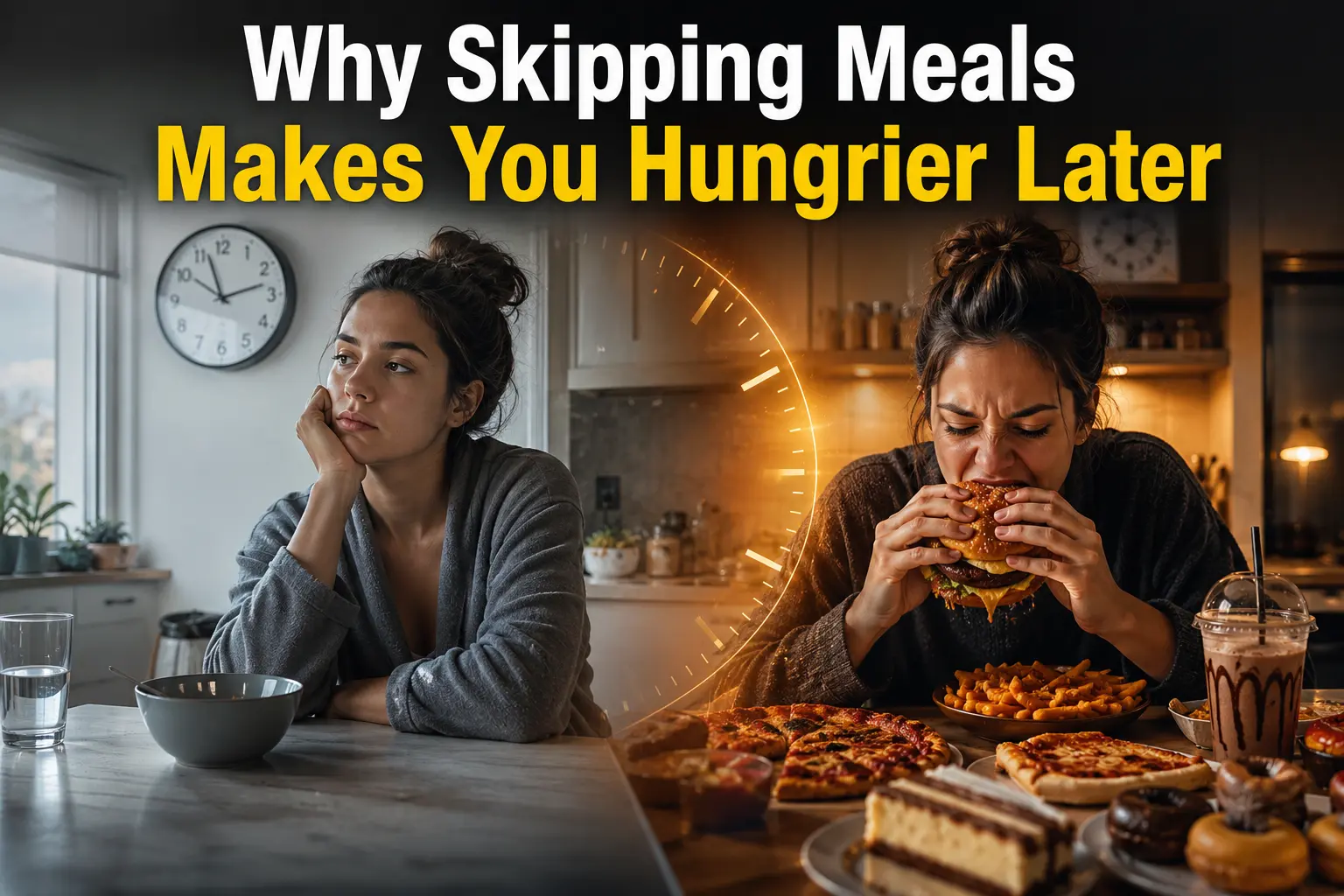
You skip a meal thinking it will help.
Maybe you’re busy.
Maybe you’re trying to “control calories.”
Skipping meals can delay hunger — not eliminate it.
At first, it feels like discipline.
But later in the day, something changes.
You don’t feel slightly hungry.
You suddenly feel intensely hungry.
And food becomes harder to ignore than before.
So what is actually happening?
It’s not a lack of control.
It’s a built-in biological response your body uses to protect energy balance.
The Hidden Truth
What Really Happens Inside Your Body When You Skip Meals
When you miss a meal, your body reacts in layers:
- Energy levels begin to drop
- Hunger hormones gradually increase
- Food thoughts become more frequent
- The brain prioritizes quick energy foods.
It is not a failure.
It’s biology trying to restore balance.
Why Hunger Comes Back Stronger Later
Skipping meals creates a “build-up effect”:
Hormonal pressure increases
Hunger signals (like ghrelin) rise over time.Energy imbalance grows
Your body pushes harder for fuel later.Craving response intensifies
You become more sensitive to high-calorie foods.
The “Rebound Hunger” Moment
It is where most people get confused.
They think:
This rebound often leads to:
- Overeating at night
- sugar cravings
- impulsive snacking
- loss of portion control
This rebound effect is closely related to the fact that emotional and physical hunger can feel very similar but are actually different systems in the body. Learn more:
True Hunger vs Emotional Hunger: The Hidden Difference That Quietly Controls How You Eat
Skipping Meals vs Regular Eating
| Eating Pattern | Short-Term Effect | Later Effect |
|---|---|---|
| Regular Meals | Stable energy | Predictable hunger |
| Skipping Meals | Temporary suppression | Strong rebound hunger |
The Key Insight Most People Miss
Skipping meals doesn’t reduce total hunger.
It reshapes when hunger appears—and how intense it feels.
How This Connects to Eating Behavior
It is closely related to deeper eating patterns:
How Often Should You Eat for Better Metabolism? (Simple Guide)
explains why meal frequency alone does not meaningfully control metabolism or long-term fat loss.
Why Eating Habits Matter More Than Diets for Health and Weight Control
shows how long-term results are driven more by behavior than strict diet rules.
Together, they reveal a consistent truth:
Structured Fasting vs Random Skipping
There’s an important distinction:
- Structured fasting → planned eating windows, predictable
- Random skipping → irregular, reactive, hunger spikes
One is a strategy.
The other is chaos.
Frequently Asked Questions (FAQs)
Why do I feel extremely hungry after skipping meals?
Because hunger hormones and energy demand increase over time.
Does skipping meals help with weight loss?
Not reliably—it can lead to stronger hunger and overeating later.
Is skipping meals the same as intermittent fasting?
No. Fasting is structured; skipping meals is usually inconsistent.
Why do I crave sugar after skipping meals?
Low energy levels can push your brain to crave quick fuel sources like sugar and processed carbohydrates.
Does skipping breakfast make you hungrier later?
Yes. For some people, skipping breakfast can increase cravings and overeating later in the day.
Is it unhealthy to skip meals occasionally?
Occasionally skipping meals is usually not harmful for healthy individuals, but frequent unstructured skipping may disrupt appetite control.
What is the difference between hunger and cravings?
Hunger is your body’s signal that it needs energy. Cravings are often caused by emotions, habits, stress, or seeing certain foods.
Final Insight
Skipping meals doesn’t silence hunger.
It only postpones it—until it returns louder than before.